Showing posts with label mental health. Show all posts

Thursday, April 19, 2018

Wrestling With Depression: Gentleman Jervis Speaks On Mental Health

As most longtime readers of The Code know, I'm a huge fan of pro wrestling, especially independent pro wrestling. One of the appeals of smaller scale pro wrestling is that fans get the opportunity to be closer to the action. The indie wrestlers themselves are often much more accessible to fans than those in the big leagues of WWE. One of my favorite pro wrestlers is a grappler by the name of Gentleman Jervis, and meeting him 5 years ago was one of my highlights as a fan. Don't believe me? Here's a picture:

One of the qualities that sets Jervis apart from other pro wrestlers is his relentless gentleness and kindness. In the squared circle, Jervis is more likely to use grappling techniques that will make his opponent unable to move instead of fisticuffs. He employs a sleeper hold... in which he rocks the opponent to sleep instead of chocking them out. And he persona of "The World's Sweetest Man" extends to his presence online from Reddit to social media. In an interview last year with EPSN, Jervis said:
"I want to be a beacon of light on the internet, and I feel in order to do that, I must also navigate the dark crevices and bring out the light in the situation. I try to be nice with everything I do and say, and I think that's translated to my physical life, my real life. My digital life and my digital personas are very sweet and kind, and now my physical persona has assumed that form as well. You have to put out the niceness and create the light that you wish to see reflected upon you."
Which is why it might have been surprising to some when he recently announced he had grappled with depression, self-harm, and suicidal ideation. He recently wrote a blog post about it, entitled "On Sweetness And Suicide". An excerpt:
My mistake was believing that... I could face depression on my own with exercise, healthy eating and positivity. These things are extremely beneficial to one’s health, but sometimes these habits are just not enough. Some depression sufferers like me need medicated assistance as well and that’s okay! ... My outward appearance is a projection of sweetness, friendliness, and understanding. Sometimes, I am not so nice. Sometimes I am downright mean. My self-hate and anger boil over and I become a monster to those around me. A Rottenbelly. Though I am not proud of these moments, I am also not ashamed. Just like anyone else, I can be weak at times. But I can also be strong. Part of being strong is accepting your actions, forgiving yourself for them, apologizing to any parties who may be hurt or offended and correcting your behavior for the future.  
The entire entry is an honest account of the struggles he faced, the thoughts he had, his history with mental health, and the support he received and is an engaging read. Give it a look, won't you?


Monday, August 7, 2017

Being An Indie Game Developer While Keeping Your Sanity

Debates about the legality and how necessary "crunch time"--  extreme periods of work in order to meet milestones or game launch deadlines where 80 hour work-weeks are the norm-- have been a hotly-contested topic for close to half a decade. I talked about how AAA studios like Blizzard exploit workers' passion and camaraderie to cover up the effects of crunch time 3 years ago. As the perennial debate over crunch time and overwork in video games has heated up once again, I wanted to turn to an area that is often overlooked: the pressure and strain of single-person indie game development.

Writing for gamesindustry.biz earlier this year, Oliver Milne penned "The dangers of passion projects: Staying sane in indie development". He spoke with Josh Parnell, the single person behind the long-anticipated space sim Limit Theory that was successfully crowdfunded in 2012. Parnell worked on nothing but the ambitious space-sim for 3 years straight, handling programming and debugging and reworking all the code himself. In 2015, his regular public updates stopped cold. Parnell seemed to have dropped off the face of the earth. Six months later, he resurfaced, citing overwhelming stress and the need to retreat for half a year for his mental health.

Crowdfunded or not, you might think that control over your own schedule, milestones and owning what you make might make long hours and the pressure of crunch very unlikely. As Milne and Parnell point out, it's more likely than you'd think:
Being in control of their own hours and intellectual property might, on the face of it, seem like it would reduce those problems for indie developers, but Parnell says the indie lifestyle comes with its own risks: "On the one hand, what makes you so great as an indie dev is your passion. It's that you're doing what you love. On the other hand, that's exactly the danger of it, because the minute it becomes work, or the minute you let your life get consumed by it, everything changes. It's hard to see that coming when all you're thinking about is 'Oh, I'm just going to be doing what I love, it's going to be great!'

The entire article does a great deep dive on Parnell's case in particular and what all game devs could learn from what happened, so I'd recommend reading the whole thing.

Wednesday, May 24, 2017

Animated Brain: Artists' Mental Health Resource Needs Our Help

Description: Cover for the book "The Animated
Brain: An Anthology of Mental Health Experiences
In The Animation & Comics Industries"
Kiernan Sjursen-Lien, also known as Zanko, is a writer on BOOM!'s Over the Garden Wall comics and a prolific artist in both the comic and animation industry. They recently announced a new project aimed at helping professionals in comics and animation: The Animated Brain, which aims to be an anthology of mental health experiences and advice for both career artists and those new to the creative field.

Regarding the content of the anthology, Sjursen-Lien said, "It contains comics about mental illnesses from anxiety to bipolar disorder to dissociative identity disorder to some recipes to make when you’re having a bad day. We tried to cover our bases!".

To help make this anthology a reality, they've started a modest Kickstarter campaign.

THey're getting close to the initial funding goal, so they've announced that all additional proceeds aside from the printing of the actual book will go to the National Alliance on Mental Illness, or NAMI, Autistic Advocacy, The Selective Mutism Center, and 4 Paws for Ability, who help kids get service dogs to assist with their mental or physical disabilities.

Monday, November 21, 2016

Social Anxiety Guide To Calling Gov't Representatives

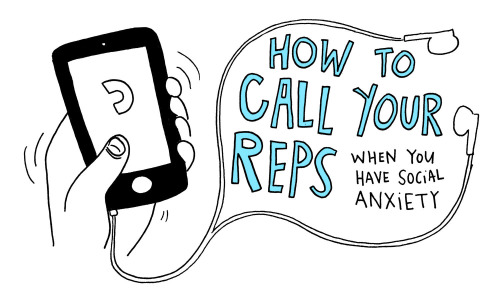
In the wake of the recent United States elections, calling your state and local representatives as a means of taking direct action and affecting change have become even more vital than ever. For those that struggle with chronic mental illness or anxiety, taking this sort of action can be even more difficult than it would be for a neurotypical person.  The artist Cordellia of echothroughthefog recently made a comic about how they pushed against anxiety, made those calls, and how you can do that, too! A transcript of the comic and more resources follow.


“How to call your reps when you have social anxiety”

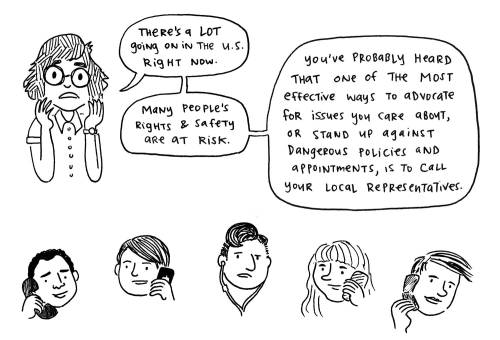
There’s a LOT going on in the U.S. right now. Many people’s rights and safety are at risk. You’ve probably heard that one of the most effective ways to advocate for issues you care about, or stand up against dangerous policies and appointments, is to call your local representatives.
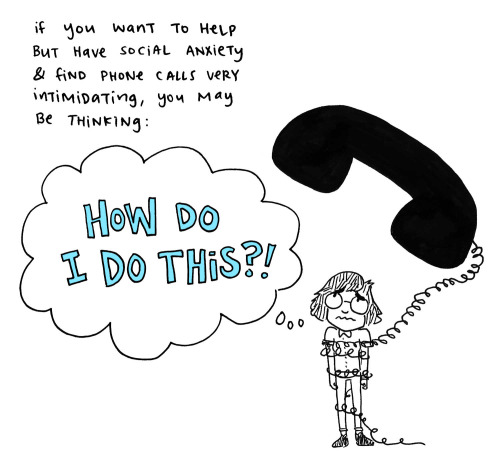
If you want to help but have social anxiety and find phone calls very intimidating, you may be thinking, “How do I do this?!” (An oversized telephone handset hovers ominously over the narrator with its cord spiraling around her body. She looks up at it with great concern.)
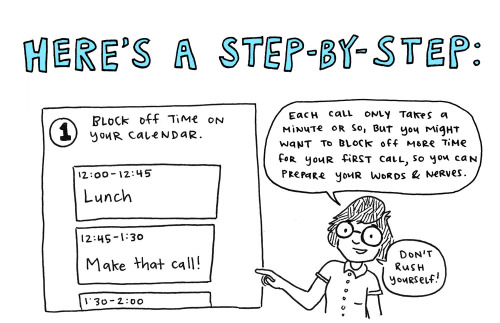
Here’s a step-by-step:
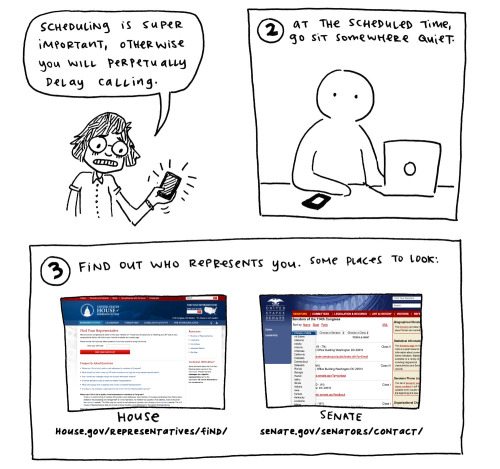
  1. Block off time on your calendar. Each call only takes a minute or so, but you might want to block off more time for your first call, so you can prepare your words & nerves. Don’t rush yourself! Scheduling is super important, otherwise you will perpetually delay calling.
  2. At the scheduled time, go sit somewhere quiet.
  3. Find out who represents you. Some places to look: House (http://www.house.gov/representatives/find/) and Senate (http://www.senate.gov/senators/contact/).
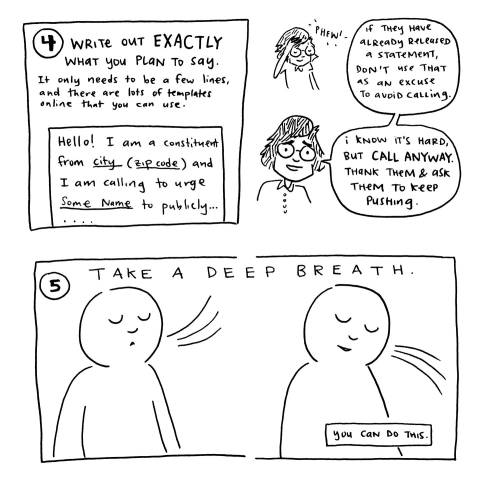
  4. Write out exactly what you plan to say. It only needs to be a few lines, and there are lots of templates online that you can use. e.g. “Hello! I am constituent from city (zip code) and I am calling to urge Some Name to publicly…” If they have already released a statement, don’t use that as an excuse to avoid calling. I know it’s hard, but call anyway. Thank them and ask them to keep pushing.
  5. Take a deep breath. You can do this.
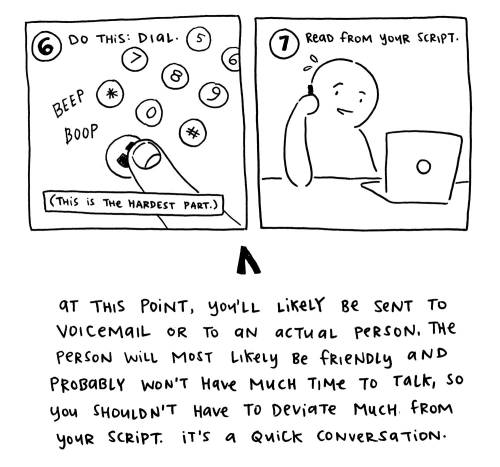
  6. Do this: dial. (This is the hardest part.)
  7. Read from your script. At this point, you’ll likely be sent to voicemail or to an actual person. The person will most likely be friendly and probably won’t have much time to talk, so you shouldn’t have to deviate much from your script. It’s a quick conversation.
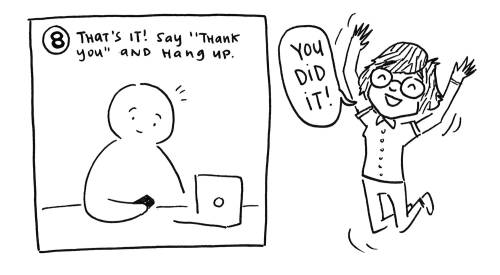
  8. That’s it! Say “Thank you” and hang up.
You did it! If you’re thinking “Hey, that wasn’t so bad…”, call more people! And follow up with them next week, or even tomorrow, to make sure they keep these issues top of mind.
It is okay if your voice shakes. It is okay if you feel awkward.They get a lot of calls, so they don’t have time to judge you by how well you delivered your message.
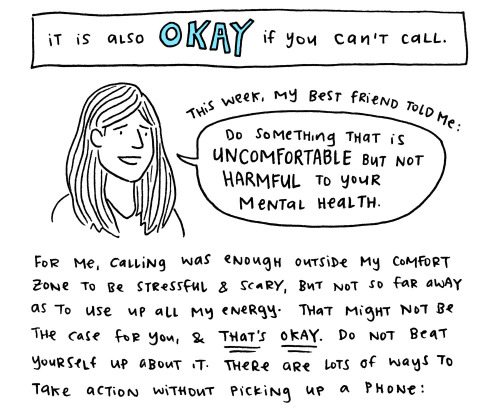
Is is also okay if you can’t call.
This week, my best friend told me, “Do something that is uncomfortable but not harmful to your mental health.” For me, calling was enough outside my comfort zone to be stressful & scary, but not so far away as to use up all my energy. That might not be the case for you, and that’s okay. Do not beat yourself up about it. There are lots of ways to take action without picking up a phone:

  • Write to government officials
  • Create art that challenges and art that inspires
  • Donate, if you’re financially able, to organizations that fight injustice
  • Listen to immigrants, people of color, women, trans and non-binary people, people of all faiths and orientations, and people with disabilities. Support their work. Amplify their voices.
  • Keep it up.
And here are some resources:
  • Emily Ellsworth explains why calling is the most effective way to reach your congressperson.
  • Sharon Wong posted a great series of tweets that helped me manage my phone anxiety and make some calls.
  • Kelsey is tweeting pretty much daily with advice and reminders about calling representatives. I found this tweet an especially great reminder that calls aren’t nearly as big a deal as anxiety makes them out to be.
Informational resources:
There are a lot of these, as well! These three are good places to start:

    Wednesday, September 14, 2011

    5 Shocking But Real Medical Conditions Linked To Video Games (Retro Repost)

    Note: This article was originally published as part of my time as an Associated Content Featured Contributor to the Video Games Section. Associated Content was later bought by Yahoo! and renamed Yahoo! Voices. Yahoo Voices shut down in July of 2014. This article is being republished here on The Code, backdated to its original date of publication to remain as a record of my writing.

    From your parents scolding you not to play video games so close to the television, to opinion and editorial pieces in newspapers across the country calling video games the next harbinger of a violent society, video games are blamed for a host of maladies, both social and physical. Video game players might be forgiven as dismissing old wives' tales, or ignoring talking-head pundits blustering about video games. When medical experts begin to weigh in with conditions they have seen in patients, it might do well for even the most hardcore gamer to sit up and take notice. Here are 5 shocking but true medical conditions that have been linked to playing video games.

    5. Acute Wiiitis 

    Dr. Julio Bonis, a practitioner of family medicine in Madrid, diagnosed and named a muscle injury he called "Acute wiiitis" in June 2007. He first noticed the condition, pronounced "wee-eye-tiss", when he awoke after a playing a few rounds of the Wii Tennis game the night before. While the injury was similar to the strain tennis players are at risk of, appropriately named "Tennis Elbow", his injury was in the wrist and forearm area. He noted that his colleagues had made similar observations or complaints of injury and muscle fatigue after playing Wii Sports. Luckily, the treatment, as outlined in the New England Journal of Medicine was fairly simple: take ibuprofen for one week, and abstain completely from playing any Wii video games.

    Of course, this wasn't the first time playing games for a Nintendo console had sparked diagnosis of an injury. If one looks back a few generations to the heyday of the Nintendo Entertainment System, one will find doctors talking about a malaise affecting hardcore gamers of the 1980s called...

    4. Nintendinitis

    First discussed by Dr. Brazington in the May 17th 1990 issue of the New England Journal of Medicine, Nintendinitis (also called “Nintendo Thumb”) is a repetitive strain injury caused by overuse of the directional pad on the NES controller. The main symptoms of Nintendinitis are blistering, swelling and acute numbness of the digits. The extremity most commonly afflicted with Nintendinitis was the thumb, but any finger used to operate an NES controller was diagnosed as at risk for the affliction. Nintendinitis can also be a precursor to other repetitive strain injuries like carpal tunnel syndrome. The recommended treatment for Nintendinitis was usually a short regimen of anti-inflammatory medication, an over the counter pain reliever and strict time limits on the length of video game play sessions.

    Nintendo isn’t the only video game console manufacturer to have its own ailment. The Sony Playstation alarmed some dentists with one malady dubbed…

    3. Playstation Lip

    First noted in the June 10th, 2000 issue of the British Dental Journal, “Playstation Lip” had two dentists, R. L. M. Inglis and R. R. Welbury quite concerned. They noted two separate patients that came to their office with severe lower lip trauma. When further questioned, the patients admitted to intensely chewing and sucking on their lower lips while concentrating on playing Playstation games. Other symptoms included jaw muscle fatigue and bleeding of the inside of the lower lip.

    While the usual treatment recommended for Playstation Lip is a matter of relaxation techniques and learning to modify one’s beahavoir when concentrating, in these patients’ case the lowerlip trauma was so severe that they required to use of soft splints and mouthguard-like shields for the gums. Of course, while the conditions outlined so far are injurious but not life threatening, there can be more severe consequences.

    2. Video Game Induced Epileptiform Seizures

    The first case of an epileptiform seizure that was linked to playing video games was reported in 1981. Over the past 30 decades, hundreds of cases of eliptiform seizures triggered by video games were reported. Further study has shown that the risk of seizures are not for younger children with photosensitive epilepsy (where seizures are triggered by light), but also in children and adolescents with epilepsy that are not photosensitive at all. This increased risk is why most video game published place warnings about an epilepsy risk in video game manuals, and sometimes in the video games or console startup sequences themselves.

    There currently is no known cure for photosensitive epileptic seizures, so most of the treament methods treat symptoms, along with a healthy dose of risk prevention. The most important steps for prevention of these seizures when playing video games: take a 15 minute break every hour, play in a well-lighted area, and to make sure you’re at least 6 to ten feet away from the television when playing video games.

    One curious case went even further than the possibility of triggering seizures, when a teenager came down with a case of…

    1. Traumatic Mental Detachment

    In late 2008, 13 year old Lorenzo Amato was found by his father, curled up in a state of shock, and appearing as if in a stupor. Lorenzo did not talk, respond to questions, or even seem to know where he was. When he was rushed to the emergency room, doctors thought Lorenzo might have suffered a stroke or aneurysm. Later, they determined that this had happened after a marathon session in front of the Playstation. Antonio Buccoliero, a local politician, told reports that “…once [the doctors] understood that this was a strange kind of mental detachment connected to his PlayStation,” they were able to successfully treat Lorenzo. Lorenzo later told reporters that he asked his father to throw out his Playstation, saying “If I even think about it I want to throw up.”

    While these conditions are strange but true, the key to continuing to enjoy playing video games without tying your muscles up in knots, harming your lips, or placing yourself at risk for light-induced seizures and eyestrain is moderation. According to the Mayo Clinic, taking breaks after every half hour, stopping when you get tired or feel fatigued, and resting your eyes if you feel sore, dizzy or nauseous will go a long way towards making sure you enjoy your favorite video games without taxing your body.

    Sources:

    http://www.reuters.com/article/idUSN0616721120070606

    http://www.sportsscientists.com/2008/01/computer-games-continued.html

    http://www.wired.com/culture/lifestyle/news/1998/12/16579

    http://www.ncbi.nlm.nih.gov/pubmed/2330022

    http://www.mja.com.au/public/issues/173_11_041200/koh/koh.html

    http://www.ncbi.nlm.nih.gov/pubmed/14706041

    http://iospress.metapress.com/content/nlw6et6ub0r13tmj/

    http://www.qj.net/qjnet/playstation-3/playstation-addict-diagnosed-with-mental-detachment.html

    http://www.mayoclinic.org/medical-edge-newspaper-2009/mar-13c.html

    Share This Post