Showing posts with label activism. Show all posts

Thursday, July 27, 2017

Update: How to Call Congress When You Have Anxiety

I posted a version of this post about 8 months ago. As the current administration marches on, calling your state and local representatives as a means of taking direct action and affecting change have become even more vital than ever. For those that struggle with chronic mental illness or anxiety, taking this sort of action can be even more difficult than it would be for a neurotypical person.  The artist Cordellia of echothroughthefog recently made a comic about how they pushed against anxiety, made those calls, and how you can do that, too! A transcript of the comic and more resources follow.


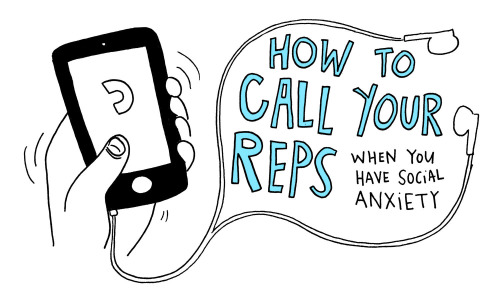
“How to call your reps when you have social anxiety”

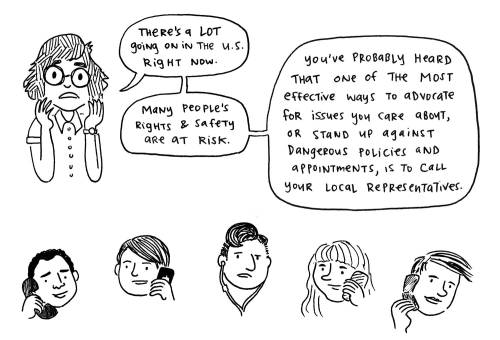
There’s a LOT going on in the U.S. right now. The civil rights and safety of many groups are at risk at the moment. You’ve probably heard that one of the most effective ways to advocate for issues you care about, or stand up against dangerous policies and appointments, is to call your local representatives.

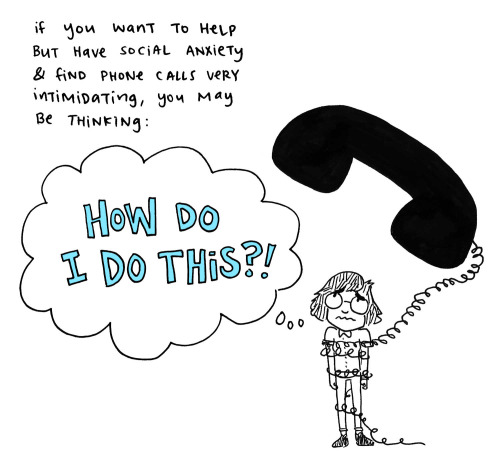
If you want to help but have social anxiety and find phone calls very intimidating, you may be thinking, “How do I do this?!” (An over-sized telephone handset hovers ominously over the narrator with its cord spiraling around her body. She looks up at it with great concern.)

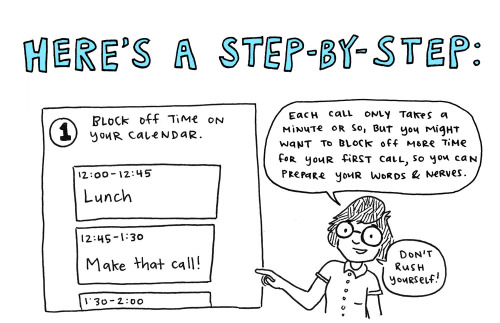
Here’s a step-by-step:
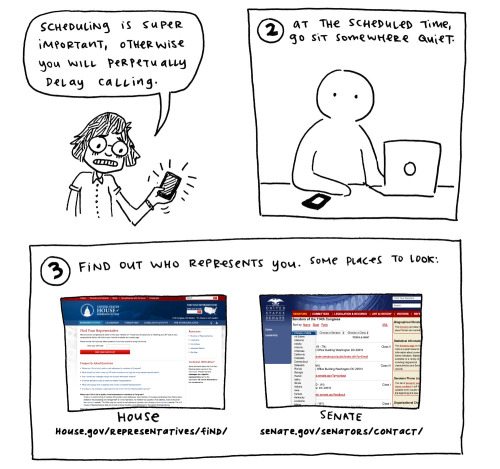
  • Block off time on your calendar. Each call only takes a minute or so, but you might want to block off more time for your first call, so you can prepare your words & nerves. Don’t rush yourself! Scheduling is super important, otherwise you will perpetually delay calling.
  • At the scheduled time, go sit somewhere quiet.
  • Find out who represents you. Some places to look: House (http://www.house.gov/representatives/find/) and Senate (http://www.senate.gov/senators/contact/).
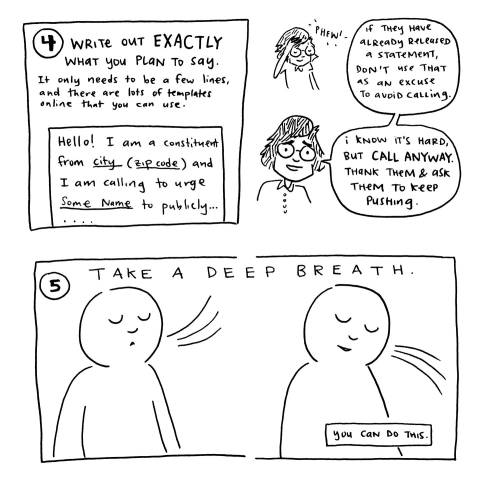
  • Write out exactly what you plan to say. It only needs to be a few lines, and there are lots of templates online that you can use. e.g. “Hello! I am constituent from city (zip code) and I am calling to urge Some Name to publicly…” If they have already released a statement, don’t use that as an excuse to avoid calling. I know it’s hard, but call anyway. Thank them and ask them to keep pushing.
  • Take a deep breath. You can do this.
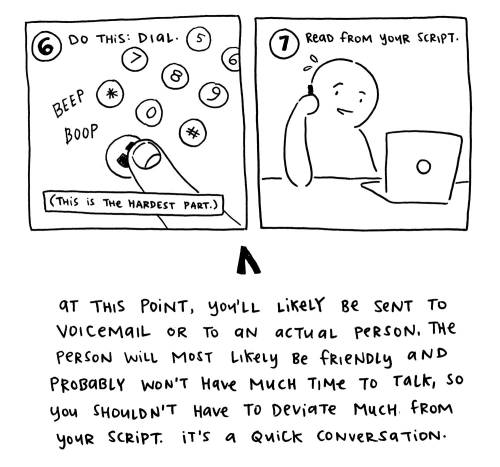
  • Do this: dial. (This is the hardest part.)
  • Read from your script. At this point, you’ll likely be sent to voicemail or to an actual person. The person will most likely be friendly and probably won’t have much time to talk, so you shouldn’t have to deviate much from your script. It’s a quick conversation.
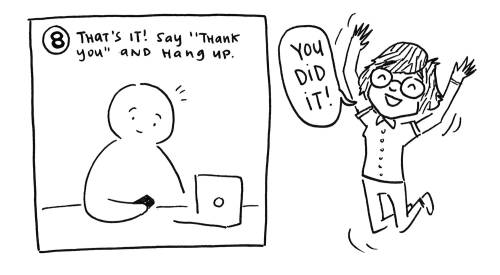
  • That’s it! Say “Thank you” and hang up.

You did it! If you’re thinking “Hey, that wasn’t so bad…”, call more people! And follow up with them next week, or even tomorrow, to make sure they keep these issues top of mind.

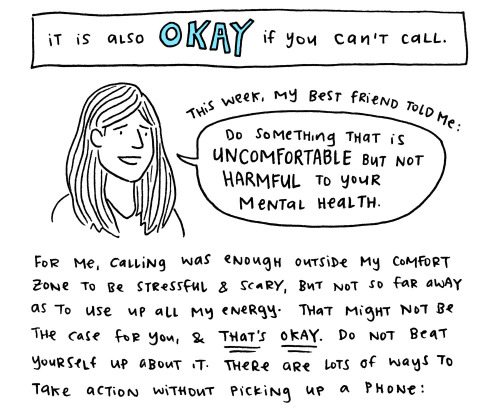
It is okay if your voice shakes. It is okay if you feel awkward.They get a lot of calls, so they don’t have time to judge you by how well you delivered your message. It is also okay if you can’t call.

This week, my best friend told me, “Do something that is uncomfortable but not harmful to your mental health.” For me, calling was enough outside my comfort zone to be stressful and scary, but not so far away as to use up all my energy. That might not be the case for you, and that’s okay. Do not beat yourself up about it.

There are lots of ways to take action without picking up a phone:
  • Write to government officials, One great tool is Resistbot-- a free service that turns your texts into a formal letter, and then faxes it to your elected officials. You'll get a copy of the letter, and a notification when the fax goes through. Although it takes its name from the idea of “resisting” the current administration, it’s a straightforward tool that you can use to voice your opinions, no matter what they are.
  • Create art that challenges and art that inspires
  • Donate, if you’re financially able, to organizations that fight injustice
  • Listen to immigrants, people of color, women, trans and non-binary people, people of all faiths and orientations, and people with disabilities. Support their work. Amplify their voices.
  • Keep it up.


And here are some resources:

  • Phone calls are still the most direct way to get a staffer’s ear, but this text-to-fax service has a few advantages on your end: you can speak up any time, the bot will keep trying if the lines are busy, and you don’t have to work up the nerve to talk to a stranger. Some members of Congress still have actual fax machines, while others will receive your message as a sort of glorified email. Either way, if your contact information is on the letter, it will be counted along with other messages from constituents.
  • Emily Ellsworth explains why calling is the most effective way to reach your congressperson.
  • Sharon Wong posted a great series of tweets that helped me manage my phone anxiety and make some calls.
  • Kelsey is tweeting pretty much daily with advice and reminders about calling representatives. I found this tweet an especially great reminder that calls aren’t nearly as big a deal as anxiety makes them out to be.
Informational resources:
There are a lot of these, as well! These three are good places to start:
Find your representative at house.gov
Find your senators at senate.gov
Use the “We’re His Problem Now” scripts when calling

Tuesday, July 18, 2017

#SurvivedAndPunished: Free Toolkit For Marginalized & Criminalized Survivors


A collaboration between Love and Protect and Survived and Punished has resulted in a new, free downloadable toolkit aimed at survivors of violence, sexual assault and abuse. Titled "#SurvivedAndPunished: Survivor Defense As Abolitionist Praxis", the toolkit is the work of over two dozen creatives, activists and writers. It was created because for many women who are survivors of violence and assualt, once the ordeal is survived they find themselves at the mercy of a criminal justice system that ends of punishing them even further. The aim of the toolkit per the project's statement is to offer an accessible, practical, and visible:
...collection of tools, tips, lessons and resources developed through our own experiences. It is also an effort to document and reflect on our own movement work. It is important for us to document especially because our organizing work has been led by Black women, women of color, immigrants and queer/trans people, who are so often erased from history. We hope to preserve some of these histories, build solidarity, and share hope as we continue our collective struggle.
You can read the toolkit online, or download your own copy, for free at the Survived And Punished website here.

Wednesday, July 12, 2017

Looking For Group: Gamers of Color Sticking Together

Image description: A tweet from twitter user sourcedumal that reads "when
there are 47 long flowing hair options in character creator but 3 natural hair
options: afros, cornrows, dreads. And they all look terrible."
Writing for Endgadget, Jessica Condit gave us "Gaming While Black: From Casual Racism to Cautious Optimism", and detailed how many gamers of color have either banded together or not engaged in voice chat just to be able to keep enjoying a hobby and form of entertainment important to them because social pressures and racial harassment follow them everywhere:
“The stories Allen could tell probably wouldn't surprise Dr. Kishonna Gray. Dr. Gray is an Assistant Professor at Eastern Kentucky University's School of Justice Studies, and the founder and director of EKU's Critical Gaming Lab, a hub for researching the immersive online environments within console gaming. She studies gaming and harassment from the player's point of view. "Most gamers of color have isolated themselves into private parties, private chats, or just don't engage verbally at all," Dr. Gray said. "And that's sad because they can't take full advantage of the gaming experience that they paid for. So what's happening is a virtual ghettoization of minority gamers. [...] Because a person's identity is automatically revealed when a person speaks, they are targeted. I call it linguistic profiling. As soon as someone hears how you sound, they engage in this practice. They hear how you sound and react based on that. So a lot of black gamers are called derogatory terms because of how they sound. They don't have to do anything but sound black."”
While thre are still some that would cling to the dismissive response of video games and online game not being a part of the real world, Dr. Gray disagrees:
"Gaming culture is a direct reflection of our society," she said. "The only reason racism and sexism run rampant in gaming is because racism and sexism run rampant in society. But in physical spaces, mostly, it's not overt. It's subtle. It's covert. So, yes, these issues manifest in a similar manner in gaming, but I contend that they present themselves worse. It's not subtle. It's in-your-face racism. A black person may not be called a [n word] to their face, but they can almost guarantee it will happen in virtuality."
Although the article was written in 2015, not much has changed. The entire article is a fascinating read, so go read the whole thing.

Thursday, May 18, 2017

Why Are There No Black Family Emojis?

First created by Shigetaka Kurita in 1999, emojis have come a long way. From little unicode-based pictures and ideograms used by a savvy few to what looks to be a thoroughly forgettable animated movie and novelty pillows shaped like cartoon poop, emoji are used millions of times a day. Once broad-based support was added for emojis in 2015, the use of emojis have almost become a language in and of themselves.

Since there are a lot people emojis, there has been a lot of controversy over representation and what is seen as the default. For example, "Family" emojis at first didn't depict same-sex couples, and after outcry and discussion, these options were added to the Unicode standard. It makes sense, after all. If there's a way to show a person, you'd like that person to look like you, right?

So why aren't there options to make black family emojis? Jeremy Burge, writing for emojipedia says:
[O]ther emojis all have a choice of skin tones. Why not the families? The answer is that black family emojis are already possibleUnicode supports the sequences required to make emoji families with any combination of people or skin tones.
In 2016, Microsoft used these ZWJ sequences to create white families, black families, and all kinds of variations in between in an update to Windows 10.
When Unicode 8.0 was rolled out in 2015, in addition to adding in stuff like a taco emoji🌮 , the standards group also added in a way to give the human emojis human skin tones in the following ranges: 🏻 🏼 🏽 🏾 🏿.

However, there is currently no way to apply these to the family emoji-- either as a whole or for individual family members. Instead, the family emojis are displayed according to one standard- that the skin tones be rendered in pure yellow. Superficially it might make sense-- after all the smiley face is the same yellow. However, that sort of falls apart after even some cursory consideration, because whiteness is usually taken as the default, even with the "cartoonish" yellow. Look no further than the Simpsons! And as emojipedia pointed out on twitter:
Over 35 percent of Americans identify as a race other than white and while they can text a single emoji that closely resembles their skin color, they can't use it for couple or family.I don't know about you but "it's so hard" isn't an acceptable answer for not including black families, and it seems more like an excuse that reeks of 💩.

Wednesday, May 17, 2017

GamerGate's Lasting Effects & How To Fight Back

As the widespread use of the Internet took off in the late '90s and early 2000s, gamers started to form communities. With those communities were norms and rules both written and unwritten than began to coalesce with what those communities did and did not find acceptable. These were mostly-male dominated spaces, with the norms and rules functioning as gate-keeping tactics-- first to keep out those that might have reminded the gate-keepers of bullies, but expanded to be anyone that could be treated as an outsider or an other. This was especially true for women and other minorities. Trash talking was sen as "part of the game", even when it led to rape jokes and threats, for example.

Harassment of women and the marginalized in gaming communities in specific and online in general didn't beging with GamerGate. GamerGate just gave a collective name to what had been lurking under the surface of gaming culture for a long time. It just was now too big to willfully ignore. As I wrote last year, the more virulent influence of GamerGaters seemed prime to make hardcore gamers the new conservative reactionaries-- and this was before Trump was elected on a wave of dank 4chan memes, racism, and twitter rants.

Writing for Bitch Media, Sam Riedel reflects on the 3rd anniversary of the beginning of the GamerGate movement. She also talks about the effect it's had on her as a gamer, and the frustration that many companies that pride themselves on building gaming communities still stand by and don't seem to do much in her essay "No Girls Allowed: The Lasting Rules of GamerGate and Toxic Misogyny":
[Many of the PAX East] show’s panels that touched on harassment and abuse did so in a way that was only marginally helpful.. The Diverse Gaming Coalition held a panel on stopping online bullying, and concluded that “fixing” people who want to cause harm “is our goal” but is “not realistic,” ending 20 minutes early after focusing primarily on hawking T-shirts and signing up new partners. 
The It Gets Better Project’s panel immediately followed and was even more frustrating... When asked what should be done to fight this abuse, panelist Leslie Pirritano recommended that victims reach out to the Online SOS Network—but when it came to reducing instances of harassment, the It Gets Better panel could only spout platitudes; Huertas referenced Game of Thrones’ Tyrian Lannister, saying victims should “wear [their abuse] like armor.” 
Most disappointingly, it doesn’t seem like community managers... seem that concerned with ending the problem. At a panel entitled “Community Management 101”... Devin Connors of game studio Psyonix said CMs can try to “remold their behavior” but should try not to engage. That sort of corporate non-answer, which prioritizes companies over lives, is especially distressing when you consider that Connors is in charge of maintaining the Rocket League community as Corsair Media’s Global Social Media and Community Manager.
As Riedel points out, women play games just as much as men, but cis men hold the majority of jobs in gaming.
Take a look at the numbers: Even though Pew Research Center finds that women play games just as much as men, and "There are no differences by race or ethnicity in who plays video games," the International Game Developers Association reports that over 75% of those working in the games industry are straight, white cisgender men... gaming culture as a whole is still nightmarishly toxic for people who aren't cisgender men, and even for some who are.
This circles back to my earlier posts on diversity in the tech sector. Those in positions of power need to prioritize marginalized voices, and that means hiring more women and people of color and LGBT+ people-- not just as token hires but with real responsibility, As for those not in hiring positions, but positions of societal power, we need to prioritize amplify marginalized voices instead of talking over them, and when they talk, we NEED to listen.


Monday, April 17, 2017

Dramatic Failure: Serial Harasser Zak S. Joins White Wolf

Photo of Zak Smith courtesy of White Wolf.
It recently came to light that Zak Smith, the serial harasser who clings to the ass of the role playing game industry like a boil you can't lance, managed to find continued employment.

This time, Zak's managed to attach their lamprey-like mouth to the mobile division of White Wolf (WW) as the co-author of Vampire The Masquerade: We Eat Blood, as announced here. Notably, this announcement blog post from WW also includes the following concluding paragraph:
Regarding the recent accusations made against our freelancers: White Wolf was aware of and investigated the previous accusations against Zak before contracting him to write and illustrate the game script. Fortunately, these accusations all pertained to alleged online behavior: each accusation is connected to an online discussion, and the digital records of these discussions can be located and reviewed. White Wolf’s investigation concluded that the accusations are false, and that Zak did not engage in the alleged behavior. We have full faith in Zak and Sarah and are excited to see their great work with the World of Darkness spread!
It's notable because this paragraph confirms that White Wolf has not just gone creatively bankrupt but morally bankrupt, too. Aside from the fact that WW decided to hire a sentient trash pile that assumed the shape of a person, WW's decision is puzzling because Zak Smith has used his fanbase  to harass people important to WW's past, like David Hill (Chronicles of Darkness, Changeling) and Avery Adler (Monsterhearts). David Hill writes of the harassment he received:
The phone call that I received came from a cheap prepaid phone purchased in the city he lives, but millions do. The phone call directly referenced him, and things he's specifically obsessed with. Around that time, I received an email rerouted through the United Arab Emirates which featured a photo of my child's school and a number of very specific threats... it referenced things he's said about me which were not true, and at the time, he lived some 20~ minutes from me.  
I know every time he brings me up, because I tend to wake up to a stream of threats and very disturbing anonymous messages.  
For the past seven or so years, he's screen-shotted and saved everything I say online, even things I've said in private groups, in spite of thorough blocks. I've had to aggressively block people suspected of being his sock puppets. At one time, a friend of mine being harassed by him actually had an associate who is a plagiarism expert identify a few of his sock puppet accounts who write exactly like him... He's been impersonating [an] RPG net mod for over a year... When called on it, he said it wasn't him and it didn't happen. When logs were shown, his story changed and now he's saying it isn't him, but someone that shares a computer with him, who has been impersonating this community figure for over a year to defend him and talk him up. And who writes with an almost laughably similar style to him.  
My issue is that he stalks me. He saves everything I say online. His fans threaten me and my family. I have tried for the better part of a decade to get him to leave me the fuck alone, but he absolutely under no circumstances will not. This isn't some thing where I can sit down with a cup of tea and meet him half way... This is not some rational disagreement. He's a stalker. He's an abuser. I'm not going to kindly ask him to pretty please stop abusing me and everyone else he's abusing. Because I have before. It didn't work. It won't work.
In 2015, I covered Zak Smith's use of a website he ran to snipe, misgender, insult and harass anyone Zak didn't like. But the documentation of Zak Smith's harassment doesn't end there. Here's a first-hand account from another one of his targets of one incident, and then a master post of what Zak did over the course of three and a half years. Here's a 3 part post from another woman in tabletop gaming Zak Smith has harassed detailed what she was put through: Part One, Part Two and Part three.

Zak Smith also has a secret group he uses to co-ordinate his followers into his private harassment army.

And just when you thought that GamerGate's fever dream given flesh couldn't sink any lower, here's how Zak Smith used a charity to force his harassment victims to have to interact with him.

At this point, it's a pretty good idea to view seeing Zak Smith's name attached to anything in the same way you'd view watching a cockroach skitter out of a diner's restaurant kitchen: a warning sign for you to take your business elsewhere, lest you consume something disgusting.

Monday, January 25, 2016

Make The Web Better In Under 5 Minutes

Description: Close of of a computer keyboard. Just above the
"alt" key is a blue rectangular key with rounded corners labeled
"Accessibility", with the International Symbol For Access next to it.
Folks, I'm gonna put on my web develop hat for a moment here. One of the biggest barriers to making the web accessible for everyone are lack of accessibility features. People with disabilities deserve to access the web as much as anyone else. Features that can make websites accessible for people with disabilities are often simple and involve minimal labor or cost. These features typically have either no impact on the web experience of non-disabled people at all, or else improve the experience for everyone using the web. Right now, the law requires businesses to make their websites accessible. But most businesses ignore this obligation, in part because the U.S. Department of Justice has delayed the release of regulations that spell out exactly what accessibility features websites must have.


"But Shawn, I don't have a disability, why should I care?" some might ask. Well, if empathy won't convince you, how about self interest? In the disability activism community some people use the term "temporarily able-bodied" (TAB for short) to refer to people that don't have a disability. Why? Well, odds are that as you age, you will experience declines in vision, movement, motor function or cognitive functions. You may be able-bodies NOW, but you won't always be. So consider web accessibility as a way to "future-proof" the web and its vast resources, if nothing else.

Friday, August 22, 2014

If You Call This Justice, I Don't Want Your Support

Image courtesy of shutterstock.com
After my post on the unacceptable torrent of abuse that has been heaped upon Zoe Quinn by misogynist nerd man-babies so desperate to deny that the little clubhouse of video games is changing that they are perfectly happy to take a vituperative screed from her ex-boyfriend and run with it to harass, hack, speculate, insult and demean her by claiming that the private sexual life matters because she's a women making a game they don't like, , someone anonymous left a comment saying that I should link to "unbiased sources". The sources the comment linked was one tumblr post labeling her everything from a "shit-tier developer" to literally calling her a whore that faked every single bit of her abuse, harassment and public hacking at the center of an industry-wide conspiracy (that comment's gone, now, btw).

Prominent youtube "personality" joined the pile-on, with Youtuber JonTron linking approvingly to a pornographic slander comic, and then later approvingly linking to a fan comparing the outcry against his actions to black people being lynched.

Other games industry writers from Stephen Totilio and Patrick Klepek to Leigh Alexander and Jenn Frank took to her defense. One of her most prominent game developer defenders of Zoe Quinn was Phil Fish (who had recently returned publicly to twitter to comment on the human rights abuses in Ferguson). This week, both his twitter account and business website Polytron were hacked, and personal details were released-- everything from back accounts to home address history, along with a data dump of 1.5 GB of developer only assets and financial records for FEZ and his business. After he regained control of his accounts, he announced he was selling off the FEZ IP, the Polytron assets and leaving video game development for good.

Liz Ryerson has a cutting analysis of these angry, scared self-appointed gatekeepers:
Zoe has become the scapegoat for every bit of internalized misogyny and misdirected rage these people felt. she appears to them an amorphous assemblage of everything that is viewed as wrong with women - manipulativeness, sluttiness, being an 'attention-whore'. the idea of trusting the word of a frighteningly narcissistic ex who's out to ruin her reputation is fine with them, because it meshes with their worldview... 

...often it's a conservative, reactionary anger that comes out of disillusionment and fear, and gets constantly externalized onto marginalized people, especially women and queer people. they struggle to understand and adjust to a rapidly shifting cultural landscape, in and out of games, that's moving away from traditionally catering to them and their empathy-deficient values into something more culturally sensitive and aware. and so they find simple explanations for these complex phenomena that fit within their bigoted worldview - boogeymans of evil, manipulative and misleading women like Zoe Quinn or Anita Sarskeesian. they view themselves as anti-authority and anti-power, even as their actions are tremendously conservative and tremendously serving of the interests of power.

The outrage over alleged private infidelity that never even resulted in an actual review lays bare the lie that this is about hand-wringing over worries of "journalistic ethics" and shows instead that those joining in on the pile-on really just see women as a threat to the world of video games and other geeky hobbies, and are ready to rage and holler and attempt to intimidate any woman they decide is somehow a threat at the flimsiest provocation. If you really cared about favorable review currying for games, you'd maybe throw some of this vitriol at the industry practice of only releasing game information to friendly outlets, perhaps.

It shouldn't be up to women to fight these battles alone. As I mentioned in my post about what men need to do about the harassment of women online, we need to make it absolutely clear that this behavior is unacceptable and that anyone that feels otherwise is unwelcome.

So let me make this crystal clear: If you support the harassment of Zoe Quinn or her supporters, if you think you are doing the right thing by shaming her about her private relationships or sexual history, if you think that anyone harassed in the way she has been "had it coming" or that by doing any sort of gate-keeping to women in your hobby you are fighting the good fight-- I don't EVER want your support.

Don't visit my blog. Don't support my patreon. Don't donate to me. Don't read my work or play my games. Don't listen to my podcast. You are not welcome here on The Code, and I don't want you as a fan.

I call on major gaming sites to issue clear condemnations of this behavior in general and defense of Zoe Quinn in particular. When fans or site visitors heap abuse on women that criticize actions or inaction of those in the industry, it because these harassers and misogynists view this as okay thing to do. And if your site policy doesn't explicitly forbid these attitudes and actions from your audience, the toxic elements of your audience view this sort of pile on as implicitly okay. Look at the harassment of Courtney Stanton and Maddy Meyers by webcomic fans, the harassment of Samanta Allen by Giant Bomb fans, the pile-ons from 4chan and reddit and totalbiscuit and jontron fans and elsewhere of Zoe Quinn.

It is unacceptable and unforgivable. You are not noble truth seekers. You're just flinging shit.

Monday, August 4, 2014

Mattie Brice on Identity, Representation and Game Design

passing
Image via mattiebrice.com

Mattie Brice (who first came ot my attention when writing about the excellent "Depression Quest" by Zoe Quinn) has a great personal essay up about what she's been studying and considering about game design and identity entitled "Passing Through: Another Take On Identity In Activism & Design". An excerpt:
This past year, I've sat down with a lot of creators about representation in games. One of the first questions out of their mouth is “How do you depict minorities well in games?” Maybe it’s because this is usually over dinner, knife and fork in hand, that I want to reply with “Human?” Thinking of my grandmother who doesn't have a clearly identifiable race by American standards trying to explain herself to an official. ‘Human’ is loaded though; dominant identities are conflated with universal traits of humanity while minoritized people must be loud about their diverging qualities. Usually, I would fall back on trying to tap what is really human, and in turn, interrogate and separate what we assume is default about humanity and is really dominant culture... 
I've started to think of my grandmother’s story a little differently lately. I feel like there’s a more active, personal dynamic with identity than what we currently conceive. Contemporary activism has a strong slant towards self-identification, particularly within established minoritized groups. This makes sense; a person is who they say they are, and that needs to be respected. What does that say about my grandmother, who didn't have an answer for her race until she lived in America? Would she be outside today’s activism if she didn't explicitly label herself?
It's a thoughtful and engaging read, and I wholeheartedly encourage you to read the entire essay.


Share This Post