The World Cyber Games (WCG) today announced Chengdu, China as the WCG 2009 Grand Final host city for the world's largest and most prestigious video game tournament and festival. The formal announcement will be made in China on April 23rd when Chengdu city officials and World Cyber Games organizers join together for the official signing ceremony in Chengdu, China.
The World Cyber Games Committee considers numerous factors when selecting each year's host city, including geography, facilities, infrastructure and marketing plans. For 2009, Chengdu received the overall highest score due to the extensive support offered by local government, accessibility of the Grand Final venue, and high network potential of broadcasters.
"As a state-level digital entertainment industry base, Chengdu aims to become the eSports training and tournament center in China," said Ge Honglin, Mayor of Chengdu. "By hosting the World Cyber Games Grand Final, the biggest and most celebrated eSports and gaming festival in the world, we believe we are now well on our way to achieving this goal."
Chengdu, capital of Sichuan Province in China, is a city rich in history, dating back more than 2,300 years. Chengdu is a cultural center for science and technology, commerce and finance, as well as a hub for transportation and communication in southwest China. The city has already hosted a number of major eSport competitions and is the first place in China to establish ratings for players, referees and coaches. Chengdu is also the first Chinese city to train cyber gaming referees and mandate gaming venue standards.
"Chengdu already has an incredible reputation for being one of the world's elite cities when it comes to hosting video game competitions," said Mr.Hyoung-Seok Kim, CEO of International Cyber Marketing, organizers of the World Cyber Games. "We have no doubt that they will be a wonderful and exciting host city that provides World Cyber Games players and fans with a unique and amazing setting for the premiere event and competition."
Founded in 2000, the pioneering WCG continues today under the slogan "Beyond the Game." Over the years, it has steadily grown to become the world's largest and most prestigious video game festival and tournament, with an aim to be a total digital entertainment festival for gamers and the general public.
The 2007 World Cyber Games experienced record numbers of gamers and participating countries, with more than 700 players and 70 countries competing. At last year's WCG Grand Final in Seattle, USA, TEAM USA captured the overall championship for only the second time in the history of the tournament. National Championship registration is well underway in the USA (www.worldcybergames.com/usa) and many other countries for the WCG 2008 global tournament, which culminates with the World Cyber Games 2008 Grand Final, Nov. 5 - 9, in Cologne, Germany.
Samsung Electronics is the worldwide premier partner for the World Cyber Games. Other global partners include Microsoft Xbox 360 and Games For Windows, Samsung Monitor(SyncMaster), Philips amBX, Procurve Networking by HP, Dust-Off and several others.
Tuesday, April 8, 2008


Monday, April 7, 2008
Crayon Physics Comes To A Browser Near You!

It looks simple:
A child's crayon scribblings on a piece of graph paper.
The goal sounds simple:
You play the game by moving the red ball so that it collects the floating stars. You can cause the red ball to move by drawing physical objects, like ramps, or shapes, like squares. You draw with the left mouse button and erase with the right mouse button.
Even the game engine sounds simple:
It was created with C , and SDL.
But Crayon Physics has taken the gaming world by storm.
Now, you don't even have to download the game to enjoy it.
Online Crayon Physics is Flash version of this sleeper indie game hit, and still totally addictive. For us homebrew-running-capable DS owners there's also Pocket Physics. Still in beta and a little buggy though.
Gamespot Steals Content, Gets PWNED
 Danny "Sardius" Cowan compiles a weekly feature for gaming industry news site Gamasutra called "Release This!" which compiles worldwide video game releases. As you can imagine, this feature takes him quite a bit of time and effort.
So when GamePro began syndicating this feature across all of the IDG family of sites without permission of Gamasutra, and without crediting Danny, he could have gotten mad.
Instead, he got even.
Not once, but twice.
"In brightest day/
in darkest night,/
Crtl+C, Ctrl+V is how GamePro writes."
Heart of A Lion? Check. WIngs of a Bat? Double check.
Strong Bad's favorite glam metal band, Limozeen, played a club in Atlanta for reals over the weekend.
Here's a taste of "Because It's Midnite":
You can see the rest of the show up on YouTube.
Here's a taste of "Because It's Midnite":
You can see the rest of the show up on YouTube.
So You Wanna Be A Video Game Writer?

"One question I'm asked all the time is: What do I have to do to become a game writer? Well, at last I'm going to tell you. Are you ready for it? You're sure? Okay!
To become a game writer you must be good at writing for games.
I'm glad that's settled.
Oh ... were you looking for a little more than that? I guess you're persistent and curious -- that's a start. I'll tell you what I know."
Writer James Portnow explains how the art of writing for video games is different from writing for any other medium - and how making that distinction is the all-important first step towards being a GOOD writer for video games.
Be warned, there are some BioShock spoilers in the article proper.
(via gamesetwatch)
EA: You'll Pay Us More MOney For Less Ice Cream

Libr'ul commie puppy eating cartoonist and weblogger August Pollak is pretty hot under the collar about EA's recent plan to charge gamers for upgraded weaponry in what is supposed to be a complete game at purchase:
The short version: You have to buy a video game. Then you have to pay to play it against other people over the internet. You have to pay to download extra levels or maps for the game. And now, in this particular case, you have to pay again to buy additional weapons for your character. I am pretty sure only a few years ago this would mean someone was selling you an incomplete game. Now you're paying for "add-ons."While gamers are up in arms about this rather skewed spin on "pay as you go" gaming, August points out it's essentially an older problem in a newer wrapping:
Basically, it's a much older concept at work here, which you can call the "less ice cream theory." It's when a company decides that the consumer will be happier with paying the same price for less of a product rather than paying more for the same product at a higher price. In other words, why ice cream now comes in "1.75 quart" containers instead of "one-half gallon" containers. The only way this isn't allowed to happen is when the consumer wildly revolts- case in point, Coca-Cola tried a few years back to reduce 2-liter bottles of soda to 1.5 liters, under the guise of a "new, easier-to-handle bottle." No, seriously. I don't know the exact details of the consumer distaste for that, but needless to say that marketing idea lasted less than a year.
My point being, video games cost about as much now as they did ten years ago. The industry is terrified of, and stubborn to, raise the price, so they take away part of the game and sell it to you later. You're paying the same amount for less ice cream.
Now who would win in a fist fight: Sam Kennedy or Master Chief?
 A recent issues of Popular Mechanics tackled an interesting video game question: Just how "realistic" is the weaponry in so-caled "realistic" military first-person shooters like America's Army and Rainbow Six?
"[M]ilitary shooters have a tradition of so-called realism. Most of the in-game weapons are available now—or at least loosely based on designs that could eventually reach the likes of Iraq and Afghanistan. In other words, as optimistic as game developers might be about a high-tech replacement for the M-16 assault rifle, there are no plasma rifles or rail guns in your arsenal. Firefights look and sound like something out of Blackhawk Down, with that unnerving, staccato crackle of modern-day warfare. And the damage inflicted feels more accurate, too: In games like Call of Duty 4 or Ghost Recon: Advanced Warfighter, most enemies are vulnerable to a single burst, and a few incoming rounds can kill you easily. So as this successful genre continues to deliver best-selling titles, will increasingly powerful PCs and game consoles allow military shooters to become more realistic than ever? "
According to the article, the technology certainly is there. Says one developer:
With 200 unique variables for each weapon, including the damage it inflicts at various ranges, how fast it reloads and when bullets tend to start dropping off, a gun in RSV2 could perform precisely like the real thing. “These consoles are so powerful, when you fire a bullet we could factor all of it in: windfall, range, everything about the history of that specific weapon, friction values for the barrel, how many times it’s been fired since it was last cleaned,” says Theiren. “We could make it as anally realistic as possible. But we’re not trying to make a live simulator.”
Read on for more gaming and gunnery geekery.
In-Gamw Ways To Turn Abusive Gamers Into Bugs Instead of Features
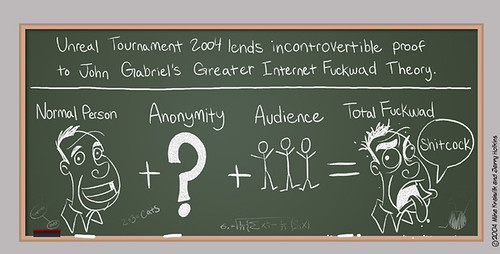 Bill Fulton, a former Microsoft developer writes about the need for instituting features into games that discourage players from acting like jerks.
"[W]hy do I care? Because the online behavior of our customers is dramatically reducing our sales, and continues to stunt the growth of our industry. Non-gamers simply don’t love games enough to put up with the crap they get online. The reason they would consider playing online is to have fun with other people -- and right now, playing games online with strangers rarely delivers that for anyone outside the hardcore demographic.Essentially, he proposes finding a way to engineer social expectations into games rather than just glumly accepting that people who play online are going to be complete tools.Are these problems even solvable?
Short answer: yes. Social environments and culture can be designed. Just like good game design creates fun gameplay, good social design creates fun social experiences. Unfortunately, online games seem to have allocated very few resources to designing the social environment."
The comment section is almost as interesting as the article itself.
Is It Too Loud, or Are You Too Old? Video Games In The Eyes of Non-Gamers
 "Inevitably, after I finish speaking, the strong opinions come. It happens the same way every time: People listen and then they say what they've been feeling. 'Videogames are not good for you'. 'Videogames are a waste of time. They isolate children. Kids never go outside to play. They just sit there and stare at the TV all day'."
This choice is from an enlightening, and at times, sobering look at what prominent game designer Brenda Brathwaite has written for The Escapist.
After a dinner table discussion of what she did for a living lead to an exchange like th one quoted above, she was inspired to ask 40 people over the age of 30 (who were not gamers) what they thought about video games as a whole.
The answers wre surprising: most of them were completely negative, and seemed grounded in second or third hand media reports, or buried resentments.
From later in the article:
More and more, Edison sees a split between two extremes. "I see popular thought divided starkly between those who play, enjoy or appreciate interactive media and those whose feelings fall somewhere along the lines of 'I hate videogames,' 'Videogames are for kids' and 'There is no redeeming value to be found in gaming.' If you take the latter group, you hear two contradictory beliefs: that videogames are a child's medium, and that videogames are too violent and explicit for children. Just those two conflicting biases alone would be enough, I think, for a person unfamiliar with videogames to throw up their hands and be done with the subject until someone more invested works it all out."
The article's entitled "The Myth of the Media Myth", and is worth a read.
How about you, dear readers? What do your parents, friends or other relatives who are non-gamers? What do they think? Any readers over 30 who'd care to chime in?
Tuesday, March 25, 2008
Hilarious bootleg NES game review: Titanic
The ever-irascible CinnamonPirate brings us another import bootleg review, this time of an NES game based on the popular flick Titanic.
Yes, THAT Titanic.
From the review:
I have a hard time imagining what possessed anyone to make this game. The board meeting probably went something like this:
President: OK guys, we have this terrible RPG engine for the Famicom. How can we squeeze more money out of it?
Developer: Well, Titanic has been popular with students studying English. What if we make a game based on the movie?
President: But how will it work? I mean, the only character you could play as would be Jack, and he dies.
Developer: Don’t you see! An RPG where the player’s character dies! It will be revolutionary!
President: Make it so.
Well, they made it so.
The result was the most unbelievably fucking awful game in history.
Read the whole thing so his suffering won't be in vain.
Monday, March 17, 2008
Pontiac Ad References Spy Hunter Arcade Game
Pontiac cashes in on arcade classic Spy Hunter nostalgia with this awesome new ad:
XBLA Remake of Bionic Commando Dev: 2D Gaming Will Live or Die With Fan Support
A few months ago, I linked to this totally frickin' sweet preview video of the remake of the NES classic Bionic Commando for X-box Live Arcade titled Bionic Commando: Re-Armed. Capcom held a poll to determine the price it should sell for, and the gaming masses have spoken; the overwhelming choice to price the game at was $10.
Capcom's Ben Judd posted the official reasoning behind the pricing and faith in its fans thusly:
Capcom's Ben Judd posted the official reasoning behind the pricing and faith in its fans thusly:
We first asked the question to our community about how much they would pay for Bionic Commando Rearmed here on the Bionic Commando community site.
Some people said it was stupid. Human nature dictates that people will choose the cheaper of two prices. Some people said we hated money. Well, while the results may suggest that $10 is the sweet spot for most people (in the US the final tally was 83% in favor of the $10 price point and 17% in favor of the $15 price point), there is another side of the story which wasn’t represented by the poll results – and that is the huge number of user comments that we received, where a majority were suggesting they would pay $15 or even $20 for the game.
When I first posed the question it wasn’t about whether people wanted something to be cheaper or more expensive. That answer is obvious. It was about whether people would be willing to pay more to support high-quality 2D gaming. 2D games are a bigger risk (no, they are not necessarily cheap to make. BCR has plenty of 3D models and uses much of the same tech and physics as the 3D version) because they are a harder sell. However, when we started the community site it was all about hearing from Bionic Commando fans and connecting with our community. The poll says $10 so that’s what it will be. Since the title will have to do quite well at that price point to break even (no, I’m not going to give you a specific number), I guess we have to roll the dice and see where they land.
Oh well, I’m tired of meta-emulated crap. These old 2D titles are where games were born. With some solid adjustments, new modes, and updated graphics they can still provide a hell of a lot of fun. Just updating the graphics isn’t paying them enough respect.
Besides, I’d rather fail having created the best game I could, even if the end result doesn’t justify 2D games like this in the future. So $10 it is for the XBLA and PSN versions (we haven’t decided on the PC version because it may have some additional content that can be downloaded later).
Let’s ride this train to the end of the line. Thanks for your feedback and your support.
Ben
(Hat tip to xblarcade.com for the source)
Official 2008 World Cybergames Lineup Announced.
The game lineup has been announced, along with the match=up type, and iut certainly looks interesting. From the ESA's press release the games this year will be:
Counter-Strike 1.6 (5v5) - (PC)
StarCraft: Brood War (1v1) - (PC)
Warcraft III: The Frozen Throne (1v1) - (PC)
FIFA 08 (1v1) - (PC)
Need for Speed: ProStreet (1v1) - (PC)
Command & Conquer 3: Kane's Wrath (1v1) - (PC)
Age of Empires III: The Asian Dynasties (1v1) - (PC)
Red Stone (4v4) - (PC)
Carom3D (1v1) - (PC)
Asphalt 3 (1v1) - (Mobile)
Project Gotham Racing 4 (1v1) - (Xbox 360)
Guitar Hero 3 (1v1) - (Xbox 360)
Halo 3 (4v4) - (Xbox 360)
Virtua Fighter 5 (1v1) - (Xbox 360)
Beta Build of Sleeper Hit Rythmn Game "Rez" for Dreamcast Released
K-Project, the beta version of Rez for the Dreamcast. The file is a self-booting image that will fit on a standard 80-Minute CD-R.
Here are the details from the .NFO file:
K-Project, the beta version of Rez for the Dreamcast. The file is a self-booting image that will fit on a standard 80-Minute CD-R.
Here are the details from the .NFO file
==== K-Project ====
(Rez beta version)
Date: March 3, 2008
# of RARs: 7 x 20MB
Filename: kprjbeta
Some notable differences from the retail version:
- Debug menus appear in the beginning of the game; this can
sometimes disappear if this isn't your first time playing the disc.
- A mouse cursor appears during the beginning; a mouse can probably
be used to mess with the debug menus.
- Loading screen shows 'Project Eden'; the title screen says 'VIBES.'
- The menus are different from the retail release.
- Some of the sound effects have changed from the retail release.
- The music is mostly different from the retail release.
- The bosses act differently than in the retail release.
- The timing of the attack waves is less precise than the retail
version, and sometimes groups of enemies will appear and disappear
during transitional sections.
- The VMU displays a different animation than the retail version.
- The options on the main menu are different:
PLAY - Same as retail
EXTRA - Play all areas one after the other, like BEYOND mode
in retail, sans options
REPLAY - Shows a replay of your last played game
DEMO - Similar to HOW TO PLAY in retail, but can select
tutorial or short demos from stages 1 to 4
- Sometimes a small debug window flashes at the top right of the screen.
- Some of the graphics in-game are different from the retail version.
- The end-of-level score screen looks different.
- You can continue right where you died, unlike in the retail version.
- There is a unique intro to each Boss in the Boss Rush area which is
not in the retail version. You shoot groups of enemies that
form the name of the boss to earn bonus points.
- There is no music during the Boss Rush.
- The third boss in the Boss Rush is different.
- The final boss is similar to the retail version, but you start in the
center and gradually pan out at each evolutionary stage. The
video footage between each stage is also different.
- There is no ending, but the Boss Rush is labelled as Area 6 and you
are scored separately from Area 5.
- There's a sinister 3D picture on the options scrren.
- VMU saving, just like the retail version, works fine and takes 9 blocks.
== Nothing was ripped from the GD-R to create a burnable MIL-CD. ==
== This MIL-CD image was kept as true as possible to the GD-R in ==
== all possible ways, including the track and files structure. ==
Wow, this sounds like a hell of a find. Here's the original link:
http://underground-gamer.com/details.php?id=27140
Here's the megaupload version:
http://www.megaupload.com/?d=J5HR8VNM
A hat tip to the Lost Levels forums, where you can also get a guide to the Dreamcast Keyboard commands for the debug menu for the Rez Beta.
Reminder For Those Robotech Fans NOT In The USA or Canada
From Kevin S himself, on the Palladium Message boards:
Please Note: We’ve forgotten to remind people in our last few Press Releases that, currently, Palladium can only sell the RPG in the USA and Canada. I know that must disappoint a great many of our friends and fans overseas. Each additional country costs an additional licensing fee (and a substantial one at that), so it just wasn’t cost effective for us to add even places like England, France, Germany and Australia. That may change in the future, depending on how many books our distributors in those countries think they can sell, but for now, only the USA and Canada can get the books. I hope you understand.
So, take any Amazon release info with a grain of salt. Aside from having someone you know in the US or Canada that could buy a copy and ship it to you, any other international orders seem to be out of reach for now.
Life Meter: Amazing Art & Creative Comics, All About Video Games

Hey, you!
You read The Code, so you obviously like video games.
You probably like art. You've maybe even read a comic or two in your lifetime, I'd wager.
Then you will love the happy mutants over at LifeMeter.
Edited by Zack Giallongo, Dave Roman, and Stephanie Yue, Life Meter is a collection of comics and cartoon art inspired by the artists' collective appreciation and love of video games. The site manages to show off a diverse range of art styles, while maintaining respect for the characters and their game worlds.
And contributors to Life Meter have racked up some pretty impressive recognition. Life Meter contributor Matt Loux's videogame inspired graphic novel, Sidescrollers,
was listed by The American Library Association as one of the Great Graphic Novels for Teens in 2008.
You can check out the art gallery or read up on the collection of comics.
(The art piece used in this post is entitled Castelvania by Bill Mudron and is one of many outstand fan works presented in the Life Meter art gallery.)
Subscribe to:
Posts (Atom)