Showing posts with label art. Show all posts

Wednesday, August 9, 2017

Shining Some Light On Solarpunk's Politics

Artwork courtesy of T.X. Watson
If you're a regular reader of this blog, you've probably heard of steampunk. I've also covered steamfunk and silkpunk. There's a cyberpunk off-shoot that started via artist tumblrs and has grown from aesthetic to a speculative near-future with some interesting political underpinnings: solarpunk.
It's been the prompt for at least one game jam, and has an oversize influence in visual domains: There's a seemingly endless scroll of solarpunk pinterest boards, and the concept has worked its way into webcomics and concept art for Black Panther.

Writing for Medium, Andrew Dana Hudson has an in-depth look at the vision behind this speculative future, and the politics behind the genre. An excerpt:
Let me say from the outset: the world of solarpunk is this world. The here, the now and the very soon. Burdened with all that that’s been slung across our backs. While you might set your solarpunk stories in far off futures or fantasy universes (I won’t stop you), great speculative fiction always reflects the fears and aspirations of the time and place it was written. This is what I’m interested in: what solarpunk can tell us about the civilization we have right now, where it’s going and what we’ll be living through.
I’ll also offer up my own ideas about what exactly we should be doing with this strange bloom we’ve found. Solarpunk feels like a cathartic uncorking of a pent up imagination, and that energy can be channeled in different directions. A genre explores ideas through motifs, variations on a theme. A movement provokes change through iterations of strategy and deed. I love the former, but we need the latter.
The entire article is fascinating reading, so I implore you to read the whole thing. Then, once you've done that, have a look at the impressive body of work from the late, great Solarpunk Press, where you can find art, podcasts and fiction that explore the genre.

Tuesday, August 8, 2017

Listen Up: The Art Scene Podcast

Hosted by Louis Vargas, The Art Scene  focuses of on-depth conversations with up and coming artists, gallery owners, museum professionals and anybody else with an art background that have gone on to take non-traditional paths in life after an art degree. The Art Scene doesn't just cover an artist's work but also an artist's life. He also gives a lot of insight into the California art scene.

You can follow along via The (art)Scene website, on iTunes via iOS or on soundcloud.

Listen Up is an ongoing series devoted to shining a spotlight on podcasts by diverse creators. You can check out all the podcasts previously featured here. If you have a podcast you'd like to recommend, post it in the comments or email me at shawnstruck at gmail dot com.

Friday, August 4, 2017

Kids, Squids, Art Memes & DIY Hacks

The Splatoon series is well-known for two things: inventive multiplayer non-violent FPS action and the Miiverse player art accompanying player profiles that often showed some surprisingly intricate artwork. In fact, even though the Miiverse function won't be included in the Nintendo Switch, Splatoon 2 includes a profile function that works essentially the same way... so artists have kept on arting.

Some of the profile art looks jaw-droppingly detailed. Two examples:


How were these done? The two images were made using two different approaches: one involved a lot of patience, and the other involved hacking a game controller to run an external program.

The first image was created by reddit/twitter user Tobi, who explained his process this way:
“I just used a capacitive stylus for rough shapes, a zoomed in copy of the guy's face in 2-colour mode which I constructed in Photoshop, and a looooooooooot of patience to recreate the face. You don't have to be pixel perfect, because the entire thing hinges on visual noise to begin with, but it's nice if the face had some semblance of coherence to it. The clothes and hair are mostly random dots, whose only purpose were to create the illusion of texture and depth.

The second image, however, was not made by hand. Splatoon player and programmer ShinyQuagsire23 figured out how to trick an external USB input capture device to repurpose a fighting game controller to create the input needed to recreate an image pixel-by-pixel . The entire image creation process takes about an hour.

ShinyQuagsire23 uploaded the entire project to GitHub so that the rest of the world can share detailed Splatoon profile art too.

Or use it to make the dankest of memes.

Wednesday, July 19, 2017

Vidders: History, Heroes Of Media Fandom & How To Be One Too


In what's one of the more novel uses of github I've seen in a while, lim, a fan artist whose work was recently shown at the Vancouver Art Gallery has released one of the definitive histories of early media fandom: Videlicet.. Like much of early media fandom in sci-fi and fantasy, its early pioneers were women. Not only does the zine look back at the past with profiles of prominent vidders, it also helps forward the future by presenting a DIY guide for your own fanvids.

Let's back up a bit. What is vidding? Vidding began in the mid-70s, after the original Star trek series went off the ait. Trekker Kandy Fong synced Star Trek stills sold to collectors, projected them on a slide projector, and synced the stills with music from a cassette player. This was the earliest version of fan-made music videos, called "vids", and vidding was often done live. For years, vids were only shown at fan conventions. While the VCR's widespread use made vidding more accessible, it still required extensive technical skill, often requiring daisy chaining VCRs together, splicing in footage and audio from many different source on-the-fly and as you needed it. Even with the rise of broadband connections and media sharing sites like YouTube, vidding still remains grounded in smaller communities, curated experiences, and smaller, more intimate exhibitions.

Videlicet covers a LOT of ground, so while I encourage a deep dive, I want to share two of my favorite parts of this zine:
It’s the soundwork that emphasizes their physicality of the characters, reminding us of the opening lyric of flesh and bone; we are cued not to think of these superheroes as 2-D comic book cutouts but as real three-dimensional bodies. The sounds of human effort are layered into the music with perfect synchronicity, so that we hear grunting, the crunch of bone, the crack of gunshots – things that mark the collision of people and things in a way that makes the fighting feel real; we can feel it in our teeth.

Dissecting lyrical interpretation is making the brushstrokes visible. Picasso did not paint the world as he saw it. He painted it as he processed it in the same way that vidders do. Vidding is a lie that makes people see the truth. When working through a lyrical interpretation of a vidsong, aim to make choices that strengthens that truth you are trying to vid and let that drive the lyrical interpretations.
Readers, do you have any favorite fanvids? What was your favorite part of Videlicet? Have a fanvid you'd like to promote? Sound off in the comments!

Wednesday, July 12, 2017

Listen Up: The Young n Creative


The Young n Creative is a podcast dedicated giving people of color working as creatives across a wide variety of media a wider platform with which to share their passion. Every week the website focuses on a new "creative of the week" and the podcast covers up and coming and established artists of all kinds, from designers to disc jockeys give their perspective on what it means to be "young n creative".

You can follow along on The Young n Creative website, on iOS via iTunes or via stitcher .

Listen Up is an ongoing series devoted to shining a spotlight on podcasts by diverse creators. You can check out all the podcasts previously featured here. If you have a podcast you'd like to recommend, post it in the comments or email me at shawnstruck at gmail dot com.

Tuesday, July 4, 2017

Listen Up: Artistic State of Mind

Juliana and Stephen are brother and sister, but don't think the debates they get into are just another form of sibling rivalry. They are both passionate hosts that really give listeners a deeper dive into the world of theater, acting, music and film. In-between the regularly updated podcast, they're both quite involved in the UK music and stage scene and do lots of work on initiatives to celebrate and uplift diverse artists.

They just recently wrapped up Season 2, so now's the perfect time to catch up. You can follow along on the Artistic State of Mind website, on iTunes via iOS or check out the podcast's dedicated soundcloud.

Listen Up is an ongoing series devoted to shining a spotlight on podcasts by diverse creators. You can check out all the podcasts previously featured here. If you have a podcast you'd like to recommend, post it in the comments or email me at shawnstruck at gmail dot com.

Tuesday, June 27, 2017

Knowledge Check: D&D Unsung Heroes Were These Women

Writing for Kotaku, Cecillia D'Anastasio has a great longform article on how the early history of Dungeons & Dragons and some of the setting's most iconic features were all thanks to the major contributions from many women, and most of the time the women contributed despite the atmosphere surrounding them:
The countless histories documenting Dungeons & Dragons’ 40-year ascent to the cultural mainstream tend to gloss over the women who made the fantasy role-playing game what it is today. The early D&D heroes we hear about are always big-gutted men with gray beards, who in their basements and at conventions in their name, cultivated the younger men who would carve the game’s legacy in their image. But that’s the lore of D&D, not its story. From the earliest days of D&D, women were shaping its look, its narrative, its affect and its fandom.
This may come as a surprise since, in those nascent years, most women around D&D were tolerant wives and mothers. That’s not because D&D didn’t appeal to women; it had simply inherited the deeply masculine culture of its predecessor—wargaming.
It is a great read and talks with many key TSR employees from Dungeons and Dragons' past. Check it out!

Friday, May 19, 2017

Fan Art Friday #1: Harry Potter and the Chat of Snap

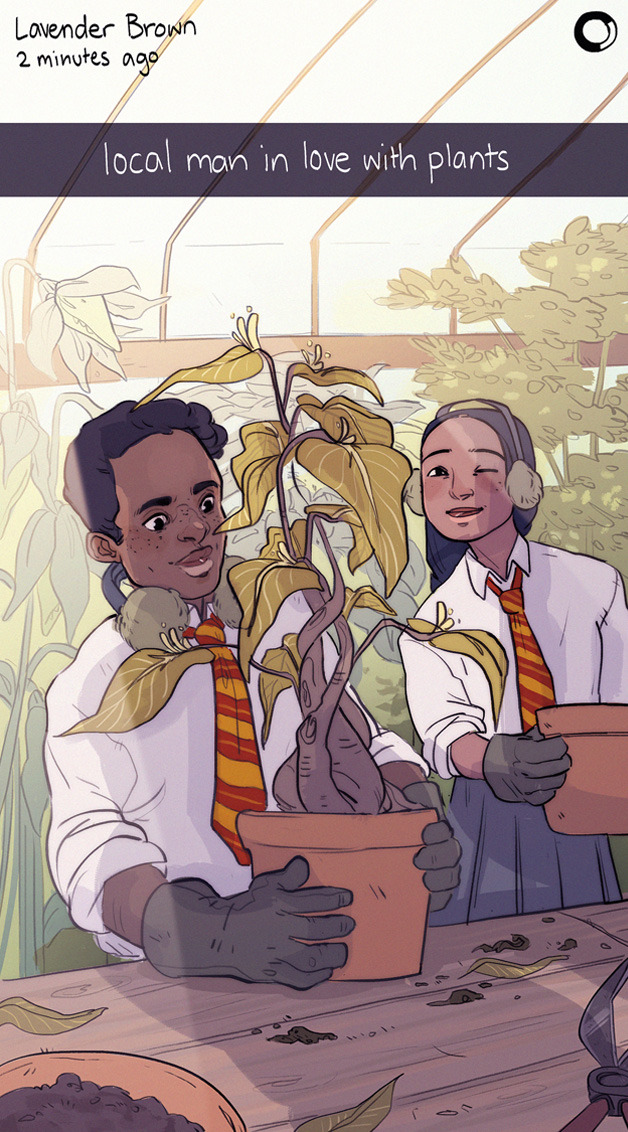
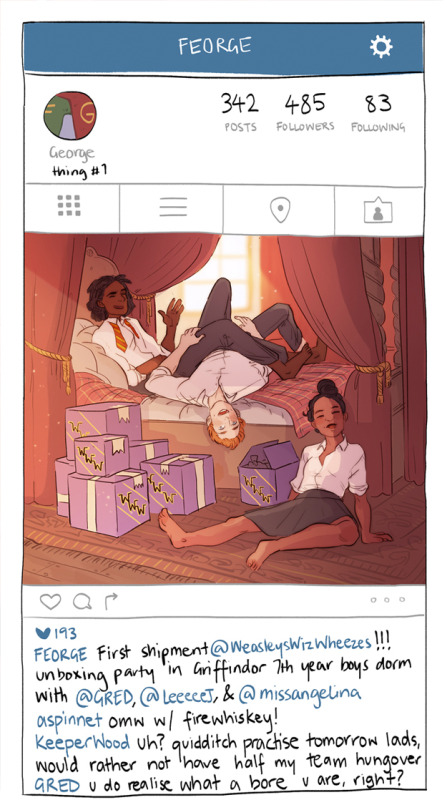
Melbourne, Australia-based illustrator Sas Milledge recently did some amazing fan art for the Sparknotes tumblr that imagined what the kids of the Harry Potter-verse would have been up to had Snapchat and Instagram been around then, and it's AMAZING. Check it out just two of many creative and skillfully composed drawings from the post:


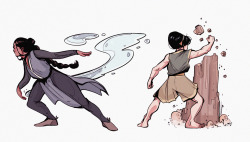
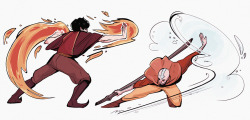
Milledge has also done some great Avatar: The Last Airbender fan art:


Check out the online folio for even more great art, still from animated shorts they done, and more!

Fanart Friday is a now-weekly tradition I'm setting up for the blog. I'm interested in spotting fanworks, of, for and by POC, LGBT artists and if you know of any work you think should begiven a boost, send me an email at shawnstruck@gmail.com or comment below!

Tuesday, April 25, 2017

Black Materia: Awesome Take On Final Fantasy VII's Cast

Image Description: Cloud Strife from Final
Fantasy VII drawn as a black male with
blond locs. Part of a fan art series by artist Nikolas
Draper-Ivey
Recently, comic artist and illustrator Nikolas Draper-Ivey had enough with random haters online. As he tells it:
...[S]ome people on my page had a problem with me drawing black people because I, a black man, was drawing far too many of them (and not as stereotypes or tropes) when I’m known for having diverse character designs in the first place. 
 I literally got asked, “Do you ever draw white people?” And “You only draw black guys. Why?” In the same morning and I’m like, “Oh so this is a PROBLEM now?” Anyone that has seen my work knows that I draw people from all over. 
...if me drawing people of color as characters and not stereotypes and over used tropes offends you, then get ready to hate my black ass then, because I’m not about to sit by and let us not be represented in a respectful, uplifting and positive light anymore...
Rather than letting the haters get him down, though, he used all that salt to work on some truly awesome fan art and give his take on the main cast of the Squaresoft RPG Final Fantasy VII. Why'd he chose that game? As Draper-Ivey put it, "I specifically chose FFVII because it’s already a diverse cast and to Square Enix’s credit, you could literally tell the same story with these designs."

Those designs are amazing. His work in the superhero genre was already pretty impressive, and seeing his take on a JRPG classic is awesome. He takes the source material and puts his own well-illustrated spin on it. You can see his art of Cloud Strife above, but I was also wowed by his fan art of FFVII's main villain, Sephiroth. Check it out:


Thursday, January 28, 2016

Are Hardcore Gamers The New Right Wing Conservatives?

Description: Stephen Colbert, dressed in a business suit &
seated at a desk, raising a pitchfork. the caption reads "Unleash
Nerd Fury!"
 In the mid-to-late 90s up to the the early 2000s, there was a lot of sound and fury and fear about censoring video games, worries about the resultant effect on free speech and the possibility of strangling video games as an art-form before it even left the cradle. There were Congressional hearings on video game violence, pundits bloviating in newspapers, magazines and online, and reactionary conservatives seemingly pinning blame for video games on everything from the Columbine massacre to the collapse of the nuclear family. But for all the sturm und drang, all the worries about legislators attempting to legislate morality... nothing really came of it. As the Houston Chronicle's Jeff Rouner outlines in "Have Gamers Become The New Religious Right?":
However, though there was a lot of talk about official censorship there was never really any serious chance it would happen in America. Video games were declared free speech by the Supreme Court in 2005 in a 7 – 2 decision, and Nintendo had given up their dream of completely family-friendly entertainment by 1994. Mature content became a badge of honor to the gamer community. It was proof that the medium couldn’t be stopped by moralistic thugs determined to protect us from ourselves.
So what happened?
Journalists like Leigh Alexander and Mattie Bryce as well as YouTubers like Anita Sarkeesian began looking at game content, both narrative and mechanical, and examining what that content said about us. It was not, as a lot of gamers like to claim, a call to censor or ban that content. It was just looking at it in a more thoughtful and nuanced way. With games now protected by all the power of the First Amendment, you would think that discussion over them could flourish more freely since they were in no danger of being taken away. 
That’s not what happened, though. Organized retaliation against the concept of conversation and dialogue in the form of 4chan ops and GamerGate happened instead. Sarkeesian’s videos were constantly flagged on YouTube in an attempt to take them down and online campaigns to have various journalists discredited or fired became a new way of life for anyone who dared deconstructing games from a social justice perspective... Criticism of the status quo, no matter how mild, is felt like an attack on a person’s morality. Religious people in the ‘80s who were comfortable with traditional gender roles took the idea of someone else rejecting those roles as a judgment. Likewise, players who are perfectly happy with a white, male-centric, violent, heteronormative status quo in gaming feel judged for that happiness when marginalized people and their allies speak up about how it affects them.
How bad has it gotten? A couple worked together for a year on a game called "That Dragon, Cancer" as a way to help process and explore their grief as well as the boundaries of games as an interactive medium. And hardcore gamers howled with outrage. Over a game a couple made born from their experiences of watching their infant son wrestle with cancer.
Unfortunately, Feminist Frequency gave the game a good review, and so of course the horde has descended on Steam to flood the forums with cries of “feels-marketing” and saying the Greens immoral for not donating profits to cancer research. Bear in mind, none of these people have actually played That Dragon, Cancer. They just hate it because a bunch of other people they normally pick on all got together and said it made them feel something.
So readers, I ask you: what are moderate gamers to do? Sound off in the comments below.

Tuesday, August 26, 2014

Open Letter To Aaron Diaz: Stop Hiding


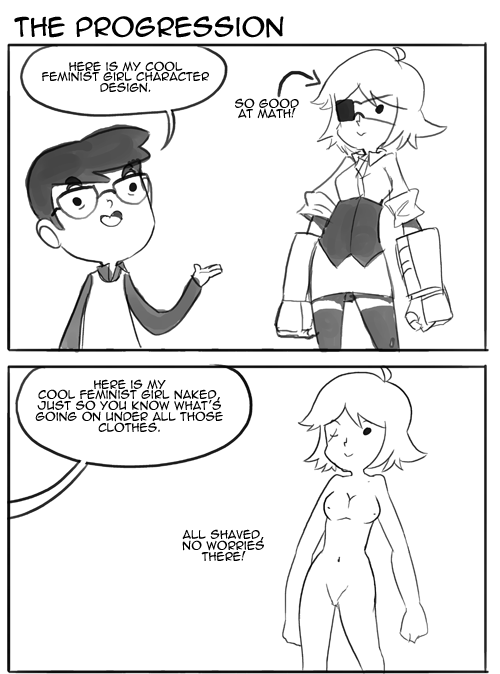
Web comic artist Mary Cagle, known on tumblr by the handle cube-watermelon,  recently posted the comic above, poking fun at the phenomenon of many male comic artists that self-identity as some form of progressive or feminist ally where they will draw cheesecake type pinups or costumes and scenarios that appeal to them specifically, but then try to dress them up (no pun intended) as not just pleasing to look at, but that the art is somehow "empowering" or transgression.

She concludes her post with the bon mot, "Sometimes I think it's okay to just admit you like looking at certain types of bodies naked, and that's okay."

While Cagle most likely wasn't surprised at getting some push-back from some people on tumblr, she was definitely surprised by one response: Aaron Diaz, the writer and artist of transhumanist science fiction web comic Desden Codak. He sent Cagle a note on tumblr:

Hey, how about not being a passive-aggressive shit next time, eh?
To which Cagle published the response:
I would think that you, who spend so much time pointing out the flaws and problematic areas in other people’s work, would be able to take one silly comic directed at your work and others like it. Normally I wouldn’t respond to this kind of thing publicly, but I’ll make an exception since you called me a shit.
Diaz has done many examples of comic and media criticism, notable among them being his redesigns of iconic DC Comics super heroes and concept art he made of Zelda as the lead character in a video game inspired, he said, by Anita Sarkeesian's Tropes Vs. Women in Video Games. And while Cagle parody comic wasn't specifically aimed at Diaz, it most certainly was inspired by a tumblr post (since deleted, see cached copy here) by him where he said "Inspired by some amputee photo shoots, I decided to try my hand at some cyborg-themed pinup sketches with Kim, a sort of celebration of the female form and taking agency over one’s body." Which is pretty ridiculous in the face of it, more so when you see the pin ups and his justification for drawing them (and that's leaving aide his kind of creepy "being disabled is totally an opportunity for the transhumanism movement). That fact that he deleted it shows that he recognizes that he messed up somewhere along the line, but instead of addressing it, he just vague-tweeted about it for a while.

In response to Diaz's actions, Magnolia Porter, a fellow web comic artist and friendly acquaintance of Diaz, published an open letter to Aaron Diaz:
There’s a place for everything, and an artist has the right to create whatever they want to create, for whatever ends they choose. What I have a problem with is that your comic is not presented as a science fiction comic with a dash of sexy thrills, but rather as a feminist narrative in support of powerful independent women. You've made it clear on many occasions that you don’t consider your work to be objectifying or sexist. I have a problem with cheesecake-style art being presented as something feminist, empowering, enlightened- something made “for women”, when it’s clearly made for men.You’re allowed to make art with male gaze. But please call a spade a spade... 
I don’t think I've seen a single page of Dresden Codak that doesn't feature a woman posed in a male-gazey way, with loving focus on her ass or cleavage, or wearing a sexual costume, or in some situation that puts her in a compromising position (like the most recent page in which Kimiko's clothing is burned off of her body, which has happened at least twice in the series’ run.) I have a very hard time believing that these details are accidental. 
...Aaron, you can do whatever you want with your own comic. However, if you really do care about female characters in media, or care to know why so many people seem to be angry with you about it, I would do one of two things. If you don’t want your comic to present its female characters in a borderline-erotic light, then stop doing that. If you don’t mind that, then by all means continue, but please just admit that you like drawing t&a and that it’s not particularly empowering, or feminist, or a celebration of personal agency. As a woman, I resent being told that men’s eye candy is actually meant to uplift me and that I should celebrate it.
Honestly, I don't have any sympathy for Aaron Diaz, nor do I have any sympathy for his position nor his reactions. He got called out for his messed up behavior and has fired back with sadly-all-too-typical defensiveness.

I've seen it happen so often, it's become distressingly familiar. A woman points out that a character or story or the way something is presented is sexist. Men insist that woman is seeing things that aren't there or otherwise reading too much into things because it doesn't come across as sexists to them. This is something I've done before, myself. As men, we are often taught that our perspectives are the default. We end up taking our perspectives and assuming that's how it is for everyone.

Commenter divined by radio at metafilter said it pretty well, I think:
So men who adamantly refuse to believe that their own gender privilege may have resulted in a variably-applied resistance to accepting a woman's objection or approach as valid -- to believe a woman when she speaks, to allow that what she is saying is true, even if they have not experienced precisely what she has experienced -- are displaying, at best, a touch of willful ignorance. They are privileging their own feelings and desires over women's truths, lives, stories, and experiences. And the end result doesn't tend to be very flattering.


Tuesday, August 19, 2014

The Pug Files: The Truth Is Out There

The Pug Files- fawn fur by macncheesecabra

The Pug Files- black fur by macncheesecabra
If you like pugs, whimsy, The X-Files, cute art or novelty clothes, then this post's got you covered. Redbubble artist macncheesecabra (previously featured on this blog as the world's only example of Double Dragon Neon's Fuzzface fan art) has released a new line of stickers, prints or shirts featuring two great things that go great together: aliens and pugs.

You can get the fawn colored variant here or the dark fur variant here.

Wednesday, July 30, 2014

Nintendo Game Boy: Now You're Playing With Flower


Images courtesy of  Riverwood-Elf
Painted the pokemon Haunter!
These incredibly well done custom Nintendo Game Boy cases are courtesy of tumblr user Riverwoof-Elf, who does custom covers for portable systems for her friend's shop. If you want one of your very own, contact her via her tumblr.

(Thanks to reader Velmagrrl for the tip)

Tuesday, July 29, 2014

Keep the Game Alive: Preserving Video Games For Art History

Image courtesy of Trevor Owens
Jeremy Parish has a new article up on 2-dimensions about preserving video games for the future, and it's a pretty interesting read.:
The fact that we even need to have a conversation about game preservation is just, like, the most pathetic thing ever. In a good world, it would be a no-brainer proposition. Of course the history of video games, and specifically the games involved, should be enshrined and preserved and presented in a clear and sensible fashion. Of course. And yet, here we are... the concept of video game preservation exists as an almost entirely grassroots movement, often skating at the edge of the law. That sounds so dramatic and important, which is silly; it’s just a matter of keeping old creations from vanishing into obscurity, which is really the furthest thing from going rogue. It shouldn’t have to be like that. And yet, here we are.

Video games and computer games are part of our shared cultural heritage and go back at least 50 years (and some would argue further back than that, depending on how you define "game"). The general public is very interested in early video games- as plenty of exhibitions on video game history, like the Smithsonian's show on the history of video games, and articles like Parish's show.

One problem faced by those looking to preserve classic console and arcade games is that the source code to video games is often proprietary. Other times, the original code has been lost to time, and the specific hardware used may be difficult to use later, as the team behind the Ms. Pac-Man & Galaga 20th Anniversary arcade cabinet found:

Galaga has three Z80 processors where Ms Pac-Man has one, Galaga has 64 sprites where Ms Pac-Man has six, Galaga's stamps are in front of the sprites while Ms Pac-Man's are behind, not to mention the additional complexity of switching between games in the attract mode and selecting which game to play... To make matters worse we would need to make some minor tweaks to the game code to enable the games to live together on the same hardware and Namco was unable to come up with the source code. So, we wound up disassembling and reverse-engineering pretty much all of both games.
As Parish notes, even documenting and compiling examples of game prototypes can be a daunting task :
...the effort, money, networking, and perseverance required to find code for a game that never made it past the unreleased sample stage is extraordinary. And that doesn’t even factor in the constant struggle to gain access to unreleased code that’s fallen into the hands of jealous collectors who are more concerned with being able to lord their possession of something truly unique over the rest of the collecting community than they are with making sure those one-of-a-kind rarities aren’t lost to time, magnetism, or bit rot… and so, here we are.
Hats off to those doing the hard work of curating video games, since as of yet they are not considered by mainstream sources to be an important part of our cultural history that should be carefully preserved like any other medium. However, if video games were ever to become considered culturally significant, or someday viewed in a different light, classic video games, (some of which are facing original & master copy data degradation, laser disc rot, bitrot etc) might meet the same fate as silent-era films that weren’t preserved because they were seen as cheap, disposable entertainment and have been lost to time forever.

Monday, March 17, 2008

Life Meter: Amazing Art & Creative Comics, All About Video Games


Hey, you!

You read The Code, so you obviously like video games.

You probably like art. You've maybe even read a comic or two in your lifetime, I'd wager.

Then you will love the happy mutants over at LifeMeter.

Edited by Zack Giallongo, Dave Roman, and Stephanie Yue, Life Meter is a collection of comics and cartoon art inspired by the artists' collective appreciation and love of video games. The site manages to show off a diverse range of art styles, while maintaining respect for the characters and their game worlds.

And contributors to Life Meter have racked up some pretty impressive recognition. Life Meter contributor Matt Loux's videogame inspired graphic novel, Sidescrollers,
was listed by The American Library Association as one of the Great Graphic Novels for Teens in 2008.

You can check out the art gallery or read up on the collection of comics.

(The art piece used in this post is entitled Castelvania by Bill Mudron and is one of many outstand fan works presented in the Life Meter art gallery.)

Tuesday, March 11, 2008

Pac-Man, Space Invaders, Tetris With A Twist: Retro Sabotage


Retro Sabotage, at first blush, seems to be a collection of mini-versions of classic arcade games like Space Invaders, Pong, Pac-Man or Tetris... but there is more than meets the eye.

Some of the games, like "pong 2.0" are pure parody. Others, like "Compromise", have some very interesting nuggets of gameplay.

They update every Thursday, and if you have a single pixel's worth of gaming nostalgia, or a sense of humor, you'll want to check it it.

Tuesday, February 19, 2008

Raph Koster: "I sit and I look at what we do and I think 'Goddamn we're irrelevent.' "

Raph Koster, the lead designer of Ultima Online and creative director of Star Wars Galaxies kicked off the Worlds in Motion summit with a keynote address. The address was nominally about "...why virtual worlds and online spaces are more than a fad-and why you absolutely should care."

It turned into something that has echoed across the game development blogosphere, touching off a firestorm of criticism, commentary and (one would hope) some self-reflection.

The quote that makes up this entry's title comes during the slideshow presentation where he says

"... the Neal Stephensons dreamt of the infinite promise, and you wonder how it addresses the things that we wrestle with in the real world... The collective venture capital at the summit has to be north of 50 million; enough to replace the FEMA trailers the people of New Orleans are living in. "I sit and I look at what we do and I think 'Goddamn we're irrelevent.' Have I brought you down enough yet?"

But all is not lost, he says. Gaming and virtual worlds do have importance because

"What we do in this room can have an impact... We see windows into virtual worlds when we download the [World of Warcraft]client. The metaverse is more windows -- breaking down the barriers between the worlds. We're heading for a world full of windows -- the question is what we'll be seeing through them. Will it be like a mirror or something new? We're not playing with toys but with people. We need to use what we already have and make a difference. Whether we empower each other makes a difference."
Definitely a lot of food for thought. It's not just video games, but our everyday lives are becoming more and more virtual every day: online banking, shopping, craiglist, ebay, online dating, message boards, blogs, you name it.

How can we harness this focus and energy to help others? It's not like there's zero reach. Ralph said "We have cybercafes in rural Senegal -- people without food and water still have Google. ".

Is this pie-in-the sky idealism, or will virtual world building lead to real social change for the good of others?

And even if it can, does that mean it should? OR should games be games, social movements be social movements and never the twain shall meet?

8-Bit NES Tribute and the WWE: Two Great Tastes That Taste Great Together!

I loves me some pro wrestling. I obviously loves me some old-school NES games.

John Cena, a pro wrestler for WWE has combined both in what is the only T-shirt related to pro wrestling I've ever wanted to a)buy and b) wear in public:
OH HELL YES.

At the risk of losing my "wrestling smart internet guy indie cred", I will say that John Cena is one of my favorite wrestlers, and him coming up with a shirt like this is just AWESOME.

And he's not frontin', either! In his very first DVD, he talks about his love of old-school NES games, is wearing a "NO! I don't need a strategy guide" T-Shirt from the webcomic Deisel Sweeties, and he did a freestyle rap for a webmaster who runs an NES video game site that namedrops everything from Excitebike to the Konami Code.

Gamers, we're EVERYWHERE.

Thanks to Nyterayn of PMO for clueing me in!

Wednesday, January 23, 2008

So You Want To Be A Video Game Journalist?

This series is a bit of an oldie, but a goodie.

I've written feature articles for 1UP.com and been published in PC Magazine, I have written for 411Mania Games, and I blog for RPGX.org. What insight can I offer to those wishing to become a Games Journalist?

Hell if I know.

Seriously, I'm not some big special person, I just had the right ideas at the right time, and was a little bit lucky. As passionate about the medium as I am, I do other things besides write about video games; it's nowhere near a full-time job. I don't really have any authority in the matter. I don't think I'd be up to writing a guide, personally.

CMP, the company behind Game Developer and Gamausutra recently published an article titled "So You Want to Be a Games Journalist" by Aaron McKenna. Criticism leveled at the article was that it was written in what seemed like an overly optimistic, condescending and starry-eyed tone that wasn't helpful in conveying what it REALLY was like to be a video games journalist.

This article got Kieron Gillen and Tim Edwards so hot under the collar that they arranged for as many games journalists as they could think of to publish articles titled "So You Want to Be a Games Journalist" of their own at the same time. Matthew Kumar of Insert Credit says:

There are currently 12 entries, and you can read my take at my workblog, but readers might particularly be interested in the Triforce's extended metaphor, John Walker's frontal attack on the original piece, and Kieron Gillen's completely straight (and certainly useful) guide. But there's also Tim Edwards, Tom Bramwell, Suki, Bill Harris, Jon Blyth, Richard Cobbett, Stuart Campbell and Jon Hicks.

You've never heard of any of them? Well, as my guide explains, that's practically the point.

The entire series in incredible reading; I particularly recommend the Triforce's piece, along with Tim Edwards' and Kieron Gillen's article, but they are all good, all useful, and they all ring true (even the contradictory parts).

Monday, January 14, 2008

This is the coolest DS Homebrew application ever. And I have proof!


See that cat? That was painted.. with a DS.

If that has you intrigued, check out this amazing gallery of images created using Colors! A Nintendo DS homebrew app that makes use of the machines little-known pressure sensitive capabilities.

Sure, you need a flash card to paint yourself, but as the gallery shows, it is SO totally worth it.

Share This Post