Laura Ellyn, who previously made a guest comic here about ghosts in video games, has just released a free interactive text based adventure on the twine platform. It's called "The Sparkly Child" and it's a game about a young woman who was born sparkly and shiny, and who has to learn to deal with the fact that sometimes her light exposes things people would prefer to stay in the dark.
It's really engaging, and you should give it a try.
Showing posts with label children. Show all posts
Showing posts with label children. Show all posts
Friday, August 21, 2015


Friday, August 8, 2014
Video: Adorable Kids Cosplaying At SDCC

Watch the video below for 4 minutes of incredibly awesome and incredibly cute kids waxing enthusiastic about costumes both home-made and those done with help from Mom or Dad.
Tuesday, August 5, 2014
The Doc Is In: Disney Toy Breaks Records
 |
| Credit: Jacob Slaton for The New York Times |
Jade Goss, age 2, looks as if she just stepped out of the wildly popular “Doc McStuffins” cartoon. “She has the Doc McStuffins sheets. She has the Doc McStuffins doll. She has the Doc McStuffins purse. She has Doc McStuffins clothes,” said Jade’s mother, Melissa Woods, of Lynwood, Calif. “I think what attracts her is, ‘Hey, I look like her, and she looks like me,’ ” Ms. Woods said of the character, an African-American child who acts as a doctor to her stuffed animals. With about $500 million in sales last year, Doc McStuffins merchandise seems to be setting a record as the best-selling toy line based on an African-American character, industry experts say...
“Children’s play is serious business,” Dr. Spencer said. “They are getting ideas about who they are from these objects. There are messages about one’s confidence, one’s sense of self in terms of what I look like and being powerful.”
Read the whole article here.
Thursday, July 31, 2014
Someone Like Me: What Children's Stories Can Teach Minority Kids
 |
| Image via spesiria |
On New Year’s Day, we are heading out to brunch, and Kavya’s sitting on the stairs, her head in her hands. Crying. I ask her what happened. In most cases, we verbally abuse the pain-inflicting object, followed immediately by a good stomping, and that sorts things out. But this time is different.
In-between muted, heaving sobs, she says something that I hadn’t expected for at least a few more years: “I want yellow hair. Like Rapunzel.” She points to the large, manga-eyed, blonde princess with tiny toothpick-wrists, smiling on her t-shirt.
It’s one of those parenting moments where time stands still. I fight the urge to say, “Rapunzel’s hair is stupid. She can go to hell.”
My wife, Sona, sits on the stairs with Kavya and tries to comfort her. Sona’s parents don’t really understand the heaviness of what Kavya is saying, and view it as just a random tantrum.
…Instead of berating Rapunzel for her physical appearance, I ask Kavya if she knows who my favourite princess is.
She looks up at me. “Who?”
“Princess Kavya.” I say, touching her nose.
She starts crying even louder. After a bit, she says, “Why do you like Princess Kavya?”
In fact, Sona wrote an essay herself on why she co-founded CAKE Literary, a literary development company that focuses on high concept fiction with a strong commitment to diversity.:
“Growing up as a little brown girl—one of the few, back then—in small-town, suburban central New Jersey, books were my escape. I caused a ruckus alongside little Anne in Avonlea; I mourned Beth along with her sisters in the harsh winter of Maine; I honed my grand ambitions like Kristy and her babysitters’ club; I even swooned alongside Elena over the brothers Salvatore when The Vampire Diaries was originally released. (Yes, I am that old.)
“Growing up as a little brown girl—one of the few, back then—in small-town, suburban central New Jersey, books were my escape. I caused a ruckus alongside little Anne in Avonlea; I mourned Beth along with her sisters in the harsh winter of Maine; I honed my grand ambitions like Kristy and her babysitters’ club; I even swooned alongside Elena over the brothers Salvatore when The Vampire Diaries was originally released. (Yes, I am that old.)
But if you’ll note: in all those books and the hundreds of others I devoured, I never really saw myself, or anyone remotely like me. The majority of characters in books for kids and teens in the ’80s and ’90s were white. And, according to Christopher Myers in his recent New York Times piece, “The Apartheid of Children’s Literature,” the majority still are today, by quite a landslide.
Why is this worth discussing? Because it hurts. A lot. It’s a hit to a kid’s self-esteem to be told—silently, but oh so clearly—that their story is not worth telling, that their voice is not important.”
 |
| Image courtesy of dakotaa.deviantart.com |
In the meantime, many artists on tumblr have contributed to This Could Have Been Frozen, featuring different takes on Disney's Frozen recasting the lead characters as people of color. While Frozen takes its cues from the fairy tale "The Snow Queen," they points out that not all Europeans are white, and the movie explicitly references Saami culture in the way many characters dress.
Some people may be wondering what the big deal is? Stories are stories, and books are books, right?
Wrong.
Stories help kids understand the world. When there are entire sections of society that are barely represented-- or worse, neglected-- then it becomes harder for kids to idetiny with, understand, or empathize with them. It's even worse when a minority kid doesn't see anyone like them in the stories they read or the media they experience, because they miss out on that sense of belong, of being a valued part of society, and of getting to identify with the heroes in books or on-screen.
Stories help kids understand the world. When there are entire sections of society that are barely represented-- or worse, neglected-- then it becomes harder for kids to idetiny with, understand, or empathize with them. It's even worse when a minority kid doesn't see anyone like them in the stories they read or the media they experience, because they miss out on that sense of belong, of being a valued part of society, and of getting to identify with the heroes in books or on-screen.
Author Deepa D. outlined this feeling in "I Didn't Dream of Dragons" in a personal essay that is still relevant almost five years later:
When I was around thirteen years old, I tried to write a fantasy novel. It was going to be an epic adventure with a cross-dressing princess on the run, a snarky hero, and dragons. I got stuck when I had to figure out what they would do after they left the city. Logically, there would be a tavern. But there were no taverns in India.
Write what you know is a rule that didn’t really need to be told to me; after having spent my entire life reading books in English about people named Peter and Sally, I wanted to write about the place I lived in, even if I didn’t have a whole bookcase of Indian fantasy world-building to steal from. And I couldn’t get past the lack of taverns. Even now, I have spent a number of years trying to figure out how cross-dressing disguise would work in a pre-Islamic India where the women went bare-breasted. When I considered including a dragon at the end of a story, I had to map out their route to the Himalayas, because dragons can be a part of a Tibetan Buddhist tradition—they do not figure in Hindu mythology.
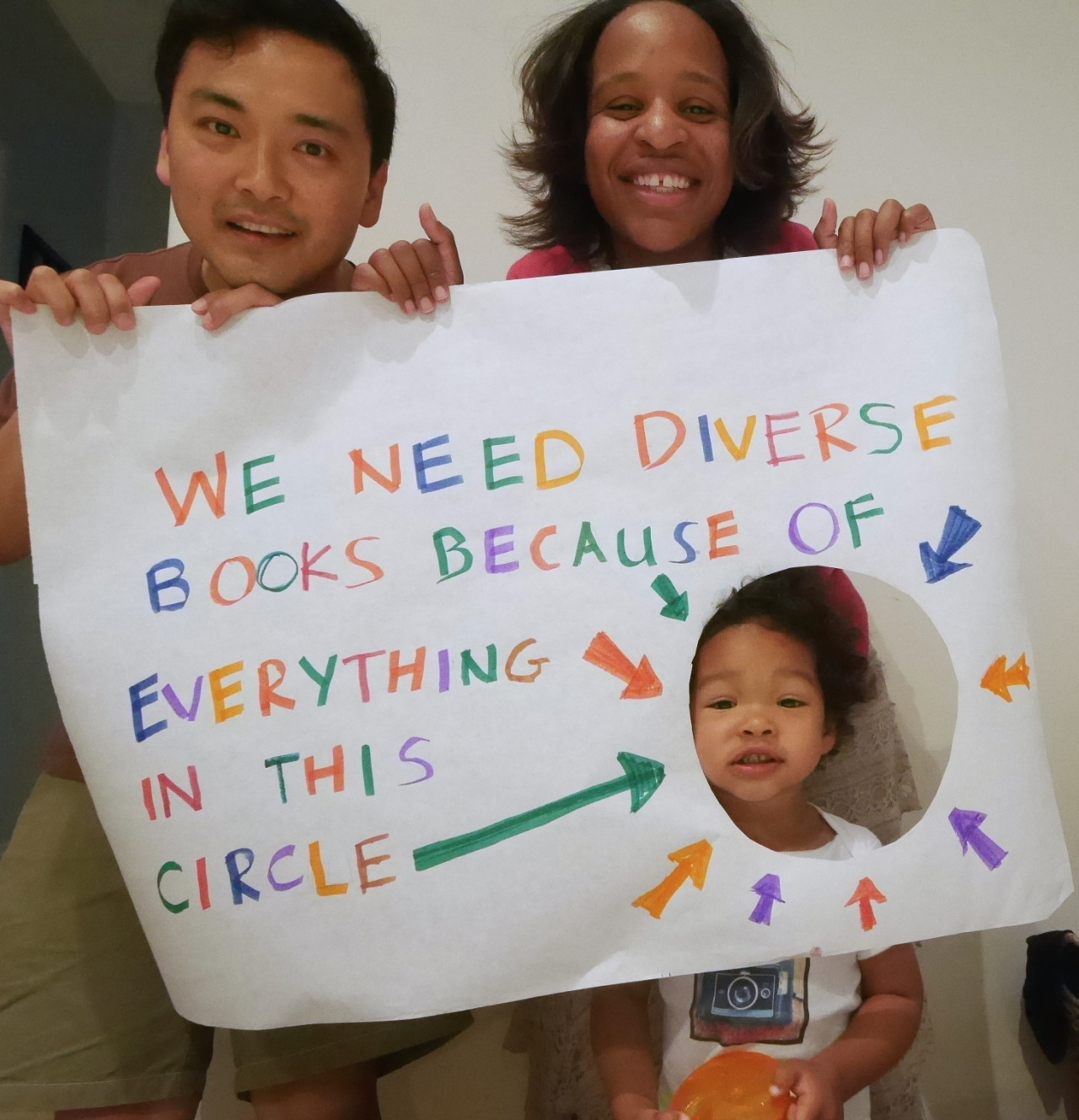 |
| Image courtesy of We Need Diverse Books. |
Subscribe to:
Posts (Atom)