 |
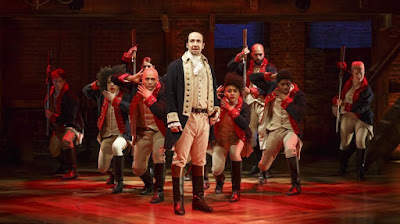
| Photo credit Joan Marcus |
Let me tell you what I wish I’d knownWhen I was young and dreamed of gloryYou have no control:Who livesWho diesWho tells your story?
--"Who Tells Your Story",
Hamilton
My interest in historical biographies, the meta-ideas behind historically-based fiction, and whose voices and contributions are remembered or ignored was sparked over the summer and fall by the hottest musical on Broadway: Hamilton. I fell in love with the soundtrack, and then had the mind-blowing opportunity to actual see it in person this past fall. So much of the musical as it is written and cast is relevetory: a story about the Founding Fathers in general and Hamilton in specific. It stars a cast that is predominantly people of color, drawing from African-American pioneered and influenced styles from Dixieland jazz to hip-hop. As Disha Jani writes in
“Who Tells Your Story?”: Historical Fiction as Resistance" for The Toast, there is an important difference in historical fiction. She believes it has the power to change not just historical narratives but cultural ones as well.
...historical fiction can be a form of resistance to a homogenizing view of our world and our past. There are certainly more immediate and material ways to resist oppression — legislating, organizing, protesting, boycotting, and mobilizing are very powerful ways — but sometimes, just existing and living your life, having your story told, can have an impact.
...People have always found ways to live and find meaning and challenge oppression, and part of our job is to seek them out and tell their stories. They existed, and it’s our job to find some way to understand…
When these same narrative and imaginative tools are used by historians, it can help deliver a blow to the insidious assertion made in nearly every grade-school classroom – that we’re supposed to relate exclusively to dead rich white men because they created everything of value. Sometimes we do relate to them, because our experiences meet somewhere in the space between the living and the dead. At other times, we yearn for someone to relate to who is a little bit more like us, whatever that may mean. To find them, we may have to first find an interlocutor – an historian, or filmmaker, or composer – who has decided to reveal this someone to us. If the interlocutor cannot find the kinds of records that are left behind by the lettered, important few, they rely on other sources.
The entire article is brilliant.
Read the whole thing!


