 |
| Photo illustration courtesy of ArsTechnica |
On March 11, 2014, Urich was working early. "Someone is using the Mayor's likeness in a twitter account," he wrote to Peoria's Chief Information Officer Sam Rivera at 6:06am. "It's not him. @Peoriamayor. Can you work to get it shut down today?"
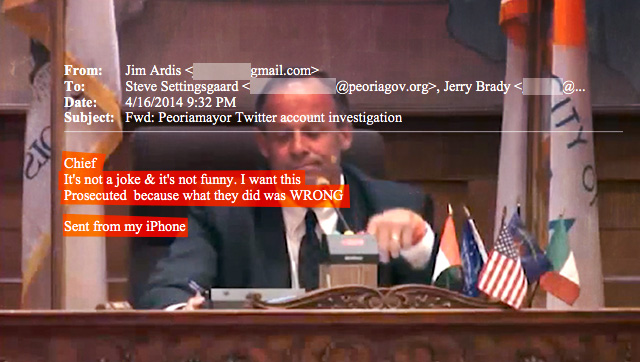
...Urgency was the watchword; Settingsgaard almost immediately assigned the matter to Detective James Feehan of the Computer Crimes Unit, and Feehan just as quickly got to work. By 11:00am that morning, he wrote back to his chief that nothing in the @peoriamayor account added up to a criminal act—though "there are tweets posted by the individual which amount to defamation," he said. Should Ardis want to pursue that angle, he could do so through a civil lawsuit, but the police would have no involvement. At 11:21am, Settingsgaard passed the bad news back to Ardis. No crime had been committed, and indeed, even the possible defamation angle raised by Feehan might be problematic. "I'm not an expert in the civil arena but my recollection is that public officials have very limited protection from defamation," he concluded. Case, apparently, closed.
Except it wasn't. The mayor, Jim Ardis, leaned on his staffers to see if there was any way to turn the parody twitter account from a civil case into a criminal one. They found a possible loophole in a newly-enacted misdemeanor statute, which was enough justification for the mayor to involve the police by pressing charges. Police subpoenaed Twitter, and used the information from that to subpoena Comcast. From there, they were able to isolate the physical address the the parody account (which had since been suspended by twitter) posted from, and from there... there was a police raid!
What had begun as a few tweets to a handful of people had now escalated to the point that the Peoria police were ready to send men with guns over to a local home with orders to search every drawer and dresser for clues to the owner of a Twitter account that had already been suspended... It was also a hunt for drugs. One of the images tweeted out by @peoriamayor had included an image showing "a hand holding a razor blade which was separating a white powdery substance." This was enough for the police to believe that "cocaine, heroin, [or] drug paraphernalia" might be found at the home.
At 12:34pm on April 15, a judge signed the warrant. Five hours later, a Peoria detective and three additional officers were at the University Street house, knocking on the door. In a thorough search, the police turned up three desktop computers, one laptop, four iPhones, an iPad, two SD cards, an iPod, and two Xboxes belonging to several different people who lived at the house. They also found a "broken black ashtray with green seedy substance," "two multicolored glass pipes," a "large gold gift bag with five sandwich bags containing a green leafy substance," and "two glass pipes [and] two metal pipes with small blue Bic lighter."
... Jacob Elliott, the 36-year-old whose name was on the home's Comcast account, hadn't created @peoriamayor, but got his home turned inside out by the police anyway. He ultimately copped to ownership of the "green leafy substance," which was of course marijuana. “I couldn’t believe this much force was being used for a fake Twitter account—it blew my mind,” he told the Journal Star after the raid. “It was extremely frightening. I don’t think I’ve ever been so scared in my life... As soon as I opened the door, a female officer shoved her hand into my pocket and screamed, ‘What’s in your pocket?’" A second officer then handed him a copy of the warrant. No one was charged with "false personation" related to the Twitter account. Elliott was charged with felony marijuana possession and spent two days in jail before getting the chance to make bail; when he got out, he was suspended from his job.
The whole sordid episode was hard to believe but had absolutely happened, leading to questions first from a local crime reporter, then from the Associated Press raising questions of abuse of power, criminalization of free speech, and wasting taxpayer's money as well as police's time. The mayor was raked over the coals by both council members and citizens at a town meeting.
Then came another bombshell: There might not even have been a misdemeanor committed in the first place.
The Ars Technica article is a great example of using a FOIA request in the service of some really good investigative journalism, and I urge you to read the rest of the article to find out the rest of the story.
The Ars Technica article is a great example of using a FOIA request in the service of some really good investigative journalism, and I urge you to read the rest of the article to find out the rest of the story.


