Showing posts with label star trek. Show all posts

Wednesday, July 19, 2017

Vidders: History, Heroes Of Media Fandom & How To Be One Too


In what's one of the more novel uses of github I've seen in a while, lim, a fan artist whose work was recently shown at the Vancouver Art Gallery has released one of the definitive histories of early media fandom: Videlicet.. Like much of early media fandom in sci-fi and fantasy, its early pioneers were women. Not only does the zine look back at the past with profiles of prominent vidders, it also helps forward the future by presenting a DIY guide for your own fanvids.

Let's back up a bit. What is vidding? Vidding began in the mid-70s, after the original Star trek series went off the ait. Trekker Kandy Fong synced Star Trek stills sold to collectors, projected them on a slide projector, and synced the stills with music from a cassette player. This was the earliest version of fan-made music videos, called "vids", and vidding was often done live. For years, vids were only shown at fan conventions. While the VCR's widespread use made vidding more accessible, it still required extensive technical skill, often requiring daisy chaining VCRs together, splicing in footage and audio from many different source on-the-fly and as you needed it. Even with the rise of broadband connections and media sharing sites like YouTube, vidding still remains grounded in smaller communities, curated experiences, and smaller, more intimate exhibitions.

Videlicet covers a LOT of ground, so while I encourage a deep dive, I want to share two of my favorite parts of this zine:
It’s the soundwork that emphasizes their physicality of the characters, reminding us of the opening lyric of flesh and bone; we are cued not to think of these superheroes as 2-D comic book cutouts but as real three-dimensional bodies. The sounds of human effort are layered into the music with perfect synchronicity, so that we hear grunting, the crunch of bone, the crack of gunshots – things that mark the collision of people and things in a way that makes the fighting feel real; we can feel it in our teeth.

Dissecting lyrical interpretation is making the brushstrokes visible. Picasso did not paint the world as he saw it. He painted it as he processed it in the same way that vidders do. Vidding is a lie that makes people see the truth. When working through a lyrical interpretation of a vidsong, aim to make choices that strengthens that truth you are trying to vid and let that drive the lyrical interpretations.
Readers, do you have any favorite fanvids? What was your favorite part of Videlicet? Have a fanvid you'd like to promote? Sound off in the comments!

Wednesday, April 26, 2017

Captain Kirk: How Pop Culture & Toxic Masculinity Got It Wrong

Kirk:"Leave any bigotry in your quarters. There's
no room for it on the bridge."
The popular collective image of Captain Kirk from the original Star Trek series is that of a brash, impulsive captain who charges in first and asks questions later. Pop culture would have it that Capt. Kirk was also a serial womanizer, bedding alien women across the galaxy.

Popular culture has it completely wrong.

Writing for Strange Horizions, Erin Horakova penned an essay entitled "Freshly Remember'd: Kirk Drift" that looks at just why it's important that these notions be debunked and the conclusions people can draw from them be deconstructed. For example, there's a lot of toxic ideas about what it means to be "macho" if you buy into the "Kirk was a womanizer" narrative:
If your vision of masculinity cannot distinguish between choosing to have sex and situations of dubious consent incurred in the line of duty, it is deeply toxic. You are insisting that men are hyper-sexual, unemotional, and can never be taken advantage of (lest they cease to be strong, compelling men due to their ever having displayed vulnerability)... These misreadings are supported by a subterranean network of ideas about masculinity, pop culture, and the past that consistently reinforce them, hitting refresh on these dank memes. I don’t think all the connections have been made here, and all the implications unfolded.

Horakova outlines many instances of what she calls "Kirk Drift"-- the difference between what people think Capt Kirk did and Star Trek portrayed, and what actually aired. How these misconceptions not only inform the average person's idea of what Star Trek was, but what the reboot thinks Star Trek should be, How the ideas trickle down, changing and erasing everything from science fiction's attitudes to concepts of what it means to be a man to expressions of Jewish masculinity. Why should we care? hhhh makes the case thusly:
All texts run the danger, even if they’ve worked hard to be progressive, or if they yield easily to positive interpretations, of being “rewritten” in the world and even in our minds. In relation to her own work, novelist Dr. Nnedi Okorafor says that “what I really want to discuss is the whitewashing battle in many readers' minds. The one that turns characters white upon reading them so the reader is more comfortable.” Her work, like all work that comes from a place of or offers any potential for alterity, is at risk of being “colonised” by conservative narrative reclamations operating via the mechanism of mismemory. It is not enough for a text to be progressive; its memory must also be defended against this decay.

The entire essay is well-written, thoroughly sourced and a fascinating read. Grab the whole article here.

Tuesday, April 11, 2017

WIlliam Shatner vs Experts, #ActuallyAutistic Fans, Facts

Photo of William Shatner courtesy of Splash News
William Shatner is internationally known celebrity whose decades of work as an actor and as a charitable donor and spokesperson have given him tremendous influence both online and off. He has over 2.5 million followers on Twitter, and it was on Twitter that Shatner's behavior has played out in an all-too familiar way-- a celebrity has "good intentions" leading to someplace worse than hell-- stubborn, deep-seated defensiveness when confronted with the consequences of spreading misinformation online.

Four days ago, William Shatner tweeted his support for the group Autism Speaks. Autism Speaks purports to be an organization that represents autistic people, but is near-universally derided and loathed by actual autistic people.

Why? For starters:

Allies and autistic twitter users alike reached out to Shatner after his initial tweet, joining the in progress #actuallyautistic hashtag to outline why Autism Speaks was not a good organization. Shatner told those reaching out to him they should "go start [your] own charity" and blocking them. Others then tweeted that autistic people actually already had-- the Autistic Self-Advocacy Network. Shatner repeatedly accused ASAN's founder of misrepresenting his words and that ASAN was only interested in attacking Autism Speaks. He then block ASAN's founder on twitter along with the co-authors of Neurotribes, when they tried reaching out to him. Shatner instead talked about being attacked, harrassed for voicing his opinion, that tweeting support for Autism Speaks meant he was contributing to freedom of choice... but it got even worse.

Shatner dug himself even deeper into spreading misinformation. When Dr Neil Gorski reached out to Shatner, outlining Autism Speaks' history as an anti-vaxx organization,  what happened next made everything worse. As outlined in Slate:
With that, millions of followers were treated to a hit piece about Gorski hosted by TruthWiki. It’s hard to overstate the unreliability of TruthWiki, a haphazard collection of conspiracy theories and pseudoscientific nonsense riddled with typos and bizarre assertions. The exercise section, for instance, includes only two entries: “Natural Help for Diabetes” and “Deepak Chopra’s Eye Exercises.” When Science-Based Medicine objected to Shatner’s tweet, he posted another set of links discrediting Gorski, this time to the websites Newstarget (motto: “Obliterating Your Safe Spaces With Truth Bombs”) and NaturalNews, which is run by Mike Adams, aka “the Health Ranger”—who also founded TruthWiki.
“All on Google,” he added after them, as if that certified their authenticity.
If William Shatner has no compunctions about using his influence as a celebrity and Twitter user with 2.5 million followers to promote causes, then he should also recognize that he bears the responsibility for what can happen when he spreads misinformation and refuses to listen to people that are actually affected the cause he claims to advance. 

Tuesday, August 25, 2015

Star Trek, Philosophy & the Kobayashi Maru

Description: Technical detail readout of  the Star Trek series'
starship & titular scenario, the Kobayashi Maru. 
In the Star Trek series, the Kobayashi Maru is both the name of a starship and a training simulation for Starfleet cadets. The scenario goes like this: trainees encounter a civilian ship calling for help, but to help the ship, you would have to choose to venture into a demilitarized zone and violate a wartime treaty. If the trainees choose to honor the treaty, the ship is at the mercy of the warlike Klingons. If you try to meet it halfway, your ship is attacked and boarded. In the movie Star Trek II: The Wrath of Khan, the legendary James T. Kirk was the only cadet in Starfleet history to ever beat the Kobayashi Maru scenario... and he did so by reprogramming the simulation so that is was possible to win. Forbes-- yes, the vaunted business magazine & website-- looks at how this scenario informs and reflects the philosophy of both the science fiction series as a how, and popular philosophy in general.
Is the Kobayashi Maru a good test of leadership, and of the ethical decision-making that’s a part of it? And what should we make of the fact that Kirk seems to have “beat” the test by cheating? It’s good to question whether features of a situation that we take for granted really are fixed, rather than changeable. When faced with two bad choices, it’s good to try to find a third, or fourth, or fifth possible choice that is less obvious but that might be better all around. 
I think the optimism embodied in Kirk’s rejection of no-win scenarios is the sort of thing that can motivate creative thinking about how to do a better job sharing a universe (which, really, is what ethics is about). But I don’t think that’s what the Kobayashi Maru was intended to test.

You can read the rest of the article here. What do you think, readers? Are the larger ideas about grace under pressure, no-win scenarios and the like a useful intellectual exercise, or is it a few torpedoes shy of a spread?

Wednesday, May 27, 2015

That's No Starship. That's An Office Building!


Chances are, if you read this blog, that you're either a Star Trek fan, or you know someone who is. The collectibles connected to the series are legion: action figures, costumes, model starships... if you're a die hard fan, you might even have an authentic movie prop.

If you're the Chairman of Netdragon Websoft, you are such a Trekker that you make your company headquarters look like a replica of the USS Enterprise... with CBS/Paramount's official blessing. It was an undertaking that took a little over six years and cost over $160 million dollars. It was finished last year.

And yes, it has automatic doors that slide open with a little "whoosh" when you approach.

The video below gives an even better look at the building overall:

Wednesday, August 13, 2014

Star Trek Author: "We Must Strive for Diversity in SF/F"

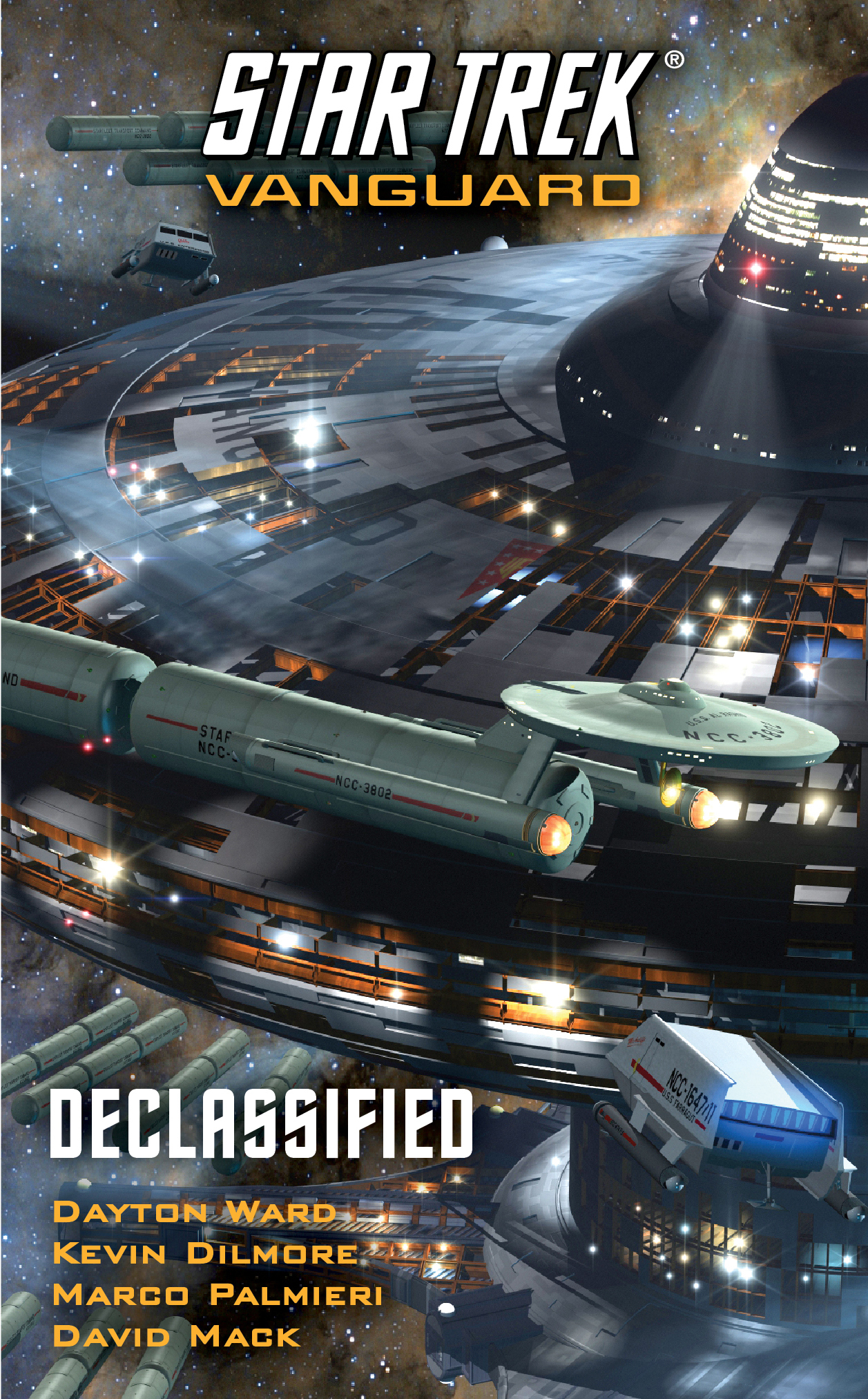
Cover image courtesy of Pocket Books
As my pal Drew can attest, I recently discovered the Star Trek: Vanguard series of novels and have gone ga-ga for them. They take place during the original Star Trek series run, right around the time of the episode "The Tholian Web" on a far-flung starbase 47 called Vanguard.

In addition to having a well-written cast of characters both main and incidental, the diverse spectrum of characters is well-represented. There are plenty of black people, people of color, gay characters, characters of faith as well as skeptics, and plenty of call-backs and calls forwards to other moments in the series. And none of these characters suffer from "tokenism". They are are relevant to the plot, which manages to weave cosmic shattering forces and threats to the Federation among other themes like struggling with depression, addiction, the role of a free press in society, classified warfare, and morality.

I'm on the 8th and final book, and I'm going to be a little sad to see the series end, myself, because I've grown invested in both the setting and the characters-- something I certainly wasn't expecting when I first picked up the books for a little light reading during my commute!

Though the Vanguard series ended a few years ago, author David Mack still gets email about it from readers every week. One reader wrote him to let him know that after Mack included a Vulcan woman who is (gasp!) a lesbian, that reader would never buy a book from him again! Mack responded on his own blog, and the response is awesome. An excerpt:

If he thinks the fear of alienating a few closed-minded readers is going to stop me from writing stories that feature and promote characters of diverse backgrounds—including LGBTQ characters, persons of color, and people who belong to ideological or philosophical minorities—he must be out of his mind...  
...[W]e’ve tried to make our literary dramatis personae more closely resemble the people of Earth. We’ve tried to include more people of African, Asian, and Southeast Asian ancestry than were seen in the televised and feature-film stories. We’ve tried to incorporate characters who hail from many cultures and viewpoints. We’ve tried to imagine a future in which people of all faiths have learned to live in harmony with people of other creeds as well as those who prefer to lead purely secular lives.  
We’ve tried to depict a future in which people’s gender identities are no longer limited to some arbitrary binary social construct, but rather reflect a more fluid sense of personal identity. 
I will never be made to feel shame for doing this. 

You can read the entire post here.

Monday, August 4, 2014

"Transporter Chief: Empathize!": Dev Engages Community & Preserves Artist Vision

Learning about community and inclusiveness with  Redshirt
Image courtesy of  Mitu Khandaker
Leigh Alexander has another great article on Gamasutra, this time on Mitu  Khandaker's game "Redshirt", a career/life sim game that takes the Utopian ideals of being a Starfleet-esque space cadet and turns it on its head. In "Redshirts" you advance by amassing social capital, popularity, and engaging in some good ol' fashioned career ruthlessness in climbing the organizational ladder.

But the pie-in-the-sky view of career advancement isn't the only thing that "Redshirt" skewers-- and when some aspects of the game end up hurting a player, the developer responds with understanding. As the article outlines:
Khandaker wanted to show the harmful side of the “sexy green alien" trope so common in science fiction — the trope is a character often sketched as more advanced and intellectual than humans, but also profoundly "othered" and objectified. In Redshirt, players can be a member of the green-skinned Asrion species for a chance to explore what the experience of the “green-skinned space babe” might be like within a believable infrastructure — playing as an Asrion can bring more unsolicited, demeaning romantic attention than playing as other species on the ship. The behavior of characters in the Redshirt world depends on sliders that players can edit if they choose, including a “bigotry” slider. Male characters with high bigotry are likely to persistently harass Asrion women, sometimes with sexual undertones, even if the player selected to play a character who is only interested in other women. 
Late last year, this element upset a player who wrote that she felt triggered by the unwelcome attention of characters in the Redshirt universe, and especially by the fact she’d lose points for refusing to interact with them, and had no option to “block” them as she could on real Facebook. The player posted about her negative experience, and Khandaker quickly replied. She apologized for the player’s troubling experience, and explained her design decisions — not in self-defense, but to explain how the player and others in her circumstance could switch off the “bigotry” sliders in order to ensure the game characters wouldn’t perform the harassing behavior... 
"I definitely thought some of the reaction to my addressing that concern and changing the game was strange," she [Khandaker] reflects. "After all, it was simply someone pointing out something to me which I hadn't previously considered. Someone who has been subject to that kind of unwanted attention and harassment and, crucially, wasn't prepared for encountering it in a game, would find the experience distressing," she says. "For some reason, even though I agreed wholeheartedly with the concerns that were addressed by the player who had been triggered, some people saw the whole situation as my having capitulated to some kind of unreasonable demand -- which is completely ridiculous," Khandaker continues. "Yes, the existence of that particular dynamic in the game was intended to make a statement about sexism (and racial fetishization), but art should never be at the expense of those it is defending."
I think this is a pretty good way to balance the concerns of players along with sticking to what you feel are important things a game has to say, myself. She listened to feedback, empathized with the player, explained why she made the choices she did, and showed how certain problematic parts could be adjusted-- a far cry from capitulation in my book. Also Khandaker hit upon something very important that artists would do well to keep in mind- even if your motives are good, and your intentions benign, your art should not come at the expense of those you're using your art to defend.

Thursday, July 24, 2014

Galaxy Quest: By Grabthar's Hammer, What A History!

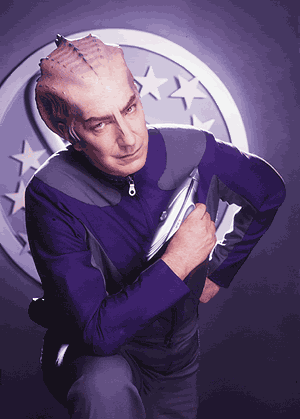
Alan Rickman as Alexander Dane, as Dr. Lazarus
Image courtesy of Dreamworks SKG
In news that is undoubtedly going to make many of my readers feel very old, the sleeper hit cult classic sci-fi comedy film Galaxy Quest turns fifteen years old this week. To celebrate, MTV.com interviewed the cast and crew to create Galaxy Quest: An Oral History. The entire article is filled with insights, like who was considered for the lead before Tim Allen, and how Steven Speilberg randomly showing up on set led to some extensive changes to the movie, like Missi Pyle's character Laliari getting more screen time:
Pyle: I heard that Spielberg was there. He came and then he saw my character and makeup and decided she should be a bigger part. I was only supposed to be in two scenes and then they realized they didn’t have another female except Sigourney Weaver. And I just think, “Am I in a dream, because this is ridiculous?” So they added the relationship with Tony Shalhoub’s character.
Since it was a deft spoof of science fiction media fandom in general as well as Star Trek in particular, did any veteran Star Trek actors happen to see Galaxy Quest? As it turns out, a number of actors in the Star Trek franchise did get to see it, and one fan site compiled some of their reactions. For example, here's Patrick Stewart's reaction:
I had originally not wanted to see [Galaxy Quest] because I heard that it was making fun of Star Trek and then Jonathan Frakes rang me up and said ‘You must not miss this movie! See it on a Saturday night in a full theatre.’ And I did and of course I found it was brilliant. Brilliant. No one laughed louder or longer in the cinema than I did, but the idea that the ship was saved and all of our heroes in that movie were saved simply by the fact that there were fans who did understand the scientific principles on which the ship worked was absolutely wonderful. And it was both funny and also touching in that it paid tribute to the dedication of these fans.
While the general consensus is that the marketing for the movie was what ended up tanking the film's chances for success at the box office despite the strong world of mouth, but thanks to the Wayback Machine, you can see one way the online marketing team got it on the money: the website promoting Galazy Quest was done up as an enthusiastic Geocities-style fan site, complete with visitor counters.

On the flipside of that, there is also a really cool meta-fanfic for Galaxy Quest that is not only a first person account that takes Galaxy Quest into today's media fandom landscape, but also comes with its own spin-off free downloadable fanzine: There Are Things We Don't Talk About In This Fandom.

For an official look at some pars of Glaxy Quest that could have been but never where, check out 9 minutes of deleted scenes... including a very young Rainn Wilson!


While both fans of the movie and most of the princpal cast have clamored for a sequel, with each year going by it seems more and more unlikely. It looks like the closest you're going to get is a comic that was published in 2008 called "Galaxy Quest: Global Warning". It was written by Scott Lobdell and featured the cast of Galaxy Quest leaving a launch party for Galaxy Quest: The Journey Continues only to end up having to save the world from a "Judgement Ship" causing natural disasters all over the globe.

And if all of this Galaxy Quest talk has you itching to see it again, it's available for free viewing online in HD if you are an Amazon Prime or Amazon Student Prime member!

Share This Post