Writing and musings from Shawn Struck on "geek culture" like video games, technology, web design, tabletop games and more.
Showing posts with label inclusiveness. Show all posts
Wednesday, June 21, 2017
Listen Up: Not Your Mama's Gamer
Not Your Mama's Gamer has always been a bold, insightful and fun take on video gaming from a diverse, inclusive and feminist perspective. The companion podcast is no exception. Samantha Blackmon and the rest of the NYMG staff hold court each week on the latest industry news, perspectives on favorite games, what they're playing or reading... and drinking.
You can listen along via the Not Your Mamas Gamer website, via iOS on iTunes, or via stitcher .
Listen Up is an ongoing series devoted to shining a spotlight on podcasts by diverse creators. You can check out all the podcasts previously featured here. If you have a podcast you'd like to recommend, post it in the comments or email me at shawnstruck at gmail dot com.
Tuesday, May 23, 2017
Making the Web Accessible For The Visually Impaired
![]() |
| Description of how a screen reader works with webpages. Courtesy of the National Federation of the Blind, the Amer- ican Foundation of the Blind, and the Associated Press. |
[A]ttempting to navigate the site will be really obnoxious. There are shortcuts to help navigate screens with the screen reader, and these are used pretty frequently. JAWS, for example, will use H to move from header to header, T from table to table, and so on. If that order isn’t intuitive, an end user can get in an unexpected place - and since there’s no visual context, it can be hard to get back on track.
Mostly, it’s about being aware that the structure of your code has further reaching impact than just the visual aspects of the screen.
If you're a business, it also ends up costing you sales and loyal customers. By coding a website that is screen-reader accessible with features like properly marked-up semantic structure and labeled links and images, your website will be more easier to be indexed search engines. Web crawlers (also called "web spiders") such as the one Google uses get their information from websites the same way a user employing assistive technology would. By having an accessible site Google can more easily index your site and make it easier to find in search results. And according to WebAim, if a visually impaired customer finds a commercial website is easy to use with assistive technology, they are twice as likely to be a repeat customer.
A site's marketing copy is tailored to bring customers to your website, so it's just good business sense to make sure it’s accessible once they arrive. The American Foundation for the Blind and WebAIM have several tip sheets and tutorials that help make your website welcoming for people with low or no vision.
Ultimately, while making the web more accessible for the blind does immediately benefit visually impaired users right now, it also helps your bottom line AND your future use of the web. As I wrote last year:
"But Shawn, I don't have a disability, why should I care?" some might ask. Well, if empathy won't convince you, how about self interest? In the disability activism community some people use the term "temporarily able-bodied" (TAB for short) to refer to people that don't have a disability. Why? Well, odds are that as you age, you will experience declines in vision, movement, motor function or cognitive functions. You may be able-bodies NOW, but you won't always be.
Tuesday, January 26, 2016
Video: Diversity Makes Cooler Games For Everyone
Youtuber MrBtoungue took a break from his usual fare to expound upon the biggest complaint had had about gaming in 2015: it wasn't diverse enough. How did that affect him, a dude who described himself as "a comfortable cis white male with a lump of coal where my heart should be"?
Part of the reason is that two of his favorite games of the year, the Witcher 3 and Bloodbourne, could only have happened as unique products of their respective developer's times and culture. As he puts it, diversity is an asset:
I see something like an undiscovered country's worth of talent. Right here, within our own borders, a country full of people who want to make and play games-- and would be making and playing games in greater numbers if we didn't keep throwing obstacles in their path. I always wonder over the years how many From-Soft's-worth of talent we've driven off by us constantly asking to see their tits. How many projects' worth of creativity have we driven off with behavior that's racist or homophobic and transphobic or just generally abusive?
The cost of unequal representation and games is not only unfairness but wastedpotential.
You can watch the entire video below:
Monday, January 25, 2016
Make The Web Better In Under 5 Minutes
![]() |
| Description: Close of of a computer keyboard. Just above the "alt" key is a blue rectangular key with rounded corners labeled "Accessibility", with the International Symbol For Access next to it. |
Folks, I'm gonna put on my web develop hat for a moment here. One of the biggest barriers to making the web accessible for everyone are lack of accessibility features. People with disabilities deserve to access the web as much as anyone else. Features that can make websites accessible for people with disabilities are often simple and involve minimal labor or cost. These features typically have either no impact on the web experience of non-disabled people at all, or else improve the experience for everyone using the web. Right now, the law requires businesses to make their websites accessible. But most businesses ignore this obligation, in part because the U.S. Department of Justice has delayed the release of regulations that spell out exactly what accessibility features websites must have.
Please take a moment to read and sign this petition. Please sign the petition at the link asking the White House to direct the U.S. Department of Justice to release its regulations for web access without further delay. Anyone age 13 or older can sign any of the petitions at the White House petition site.
"But Shawn, I don't have a disability, why should I care?" some might ask. Well, if empathy won't convince you, how about self interest? In the disability activism community some people use the term "temporarily able-bodied" (TAB for short) to refer to people that don't have a disability. Why? Well, odds are that as you age, you will experience declines in vision, movement, motor function or cognitive functions. You may be able-bodies NOW, but you won't always be. So consider web accessibility as a way to "future-proof" the web and its vast resources, if nothing else.
Tuesday, June 16, 2015
Guest Post: Puppies Crying Bitter Tears
Bibliotropic, had a lot to say about the spate of what the Puppies rhetoric has meant for them personally as well as the field of writing in general recently. The Code is proud to present the following guest post from Ria. I also stand by everything they say here. Warning: contans swears.
"I dislike the both Puppy litter ideologies. I talked a bit about why last year, long before this current Puppy debacle began, with a post about Correia's comments on diversity in SFF. For those who don't want to read a long post about it, in a nutshell, someone who is now very strongly identified with the Puppies said, a while back, that including nonbinary characters and other forms of diversity in SFF would make for bad fiction, because doing so would come across solely as message fiction and remove any entertainment value. I objected to that, since what that amounts to in a practical sense is to erase people like me from having representation in fiction. The insinuation is that people such as myself aren't of any real value to have our stories, nor does anyone want to actually read about us or have us around. It's insulting, and it's dehumanizing.
So when this round of Puppy problems started, I admit I was already pretty inclined to dislike them, given that my experience of one of their figureheads was that he thinks people like me shouldn't play a central role in his beloved genre. And the more I read about what they stood for, the more my hackles rose. Accusations that women, people of colour, QUILTBAG folk were only getting nominations for awards due to affirmative action are galling, since what they essentially say is that these people getting nominations aren't actually as good as that straight white male over there and are only getting nominated because of quotas that need filling. If it wasn't for those quotas, that nomination would rightfully go to a dude. Comments that because certain of their books or series were popular with a certain crowd and sold well, they should totally be eligible for more award nominations. (Because quantity equals quality, I guess.)
There may be no AWARD for such well-selling books, but there is a REWARD. It's called a paycheque. A paycheque you get for doing a thing you love, which is something many people don't get to experience in their lives. That isn't to say that people with well-selling books don't deserve more than a simple paycheque. It's awesome to have fans, fan experiences, interaction, the knowledge that you're doing something people enjoy. Maybe there ought to be an award for the SFF book that sells the most copies in a year, I dunno. (Then, I suspect, there'd be a cry-out about how books released toward the end of a year just didn't have a chance, and look how many they sold the next year, so they should totally have won that award after all. Nobody gets everything.)
The problem I see with most of the Puppy stuff is that their message seems very unclear. First it appeared to be, "The Hugos are a stupid award full of politics I disagree with and all given to books I don't want to write or read. ...So how come I never win one?" Then it started to be about affirmative action accusations, about women and non-white and non-straight people swooping in and stealing awards that should go to more deserving folk. Then the hypocrisies really started coming to light, where Puppies would insult authors they disagreed with, very personally, but as soon as there was any retaliation against even their politics they'd cry defamation and abuse. At the end of it all, what I can see is that the Puppies stand for only the Puppies, and to hell with anything else. And by "to hell with," I mean largely that they'll insult and threaten people who don't toe the Puppy party line. it's fine and dandy for someone to come in and defend the Puppies and say, "Look, all they're saying is that they think their works should be judged as being just as valid as anyone else's, and that people are free to do as they please so long as he can do the same."
Sounds good on paper. And utterly out of context.
Because major Puppy authors are being allowed to write and publish the books they do. They're not being blocked from selling them. They may not qualify for awards, but hell, so do the vast majority of books published in a year. Big damn deal. The idea that everyone should have an award is a very liberal thing, and given that the Puppies seem to have a beef with politically liberal things, you'd think they'd be a bit more on board with a meritocracy. Nobody is imposing their ideals on the Puppies. The world can, amazingly, have multiple things in it, some of which by default disagree with other things. But the accusations made by them are harmful. Painful. Dismissive. And are largely focused on gender issues, sexuality, race, and a whole load of other things that make people say yes, there's some godsdamn bigotry happening here.
People love to say that so-and-so can't possibly be racist because they have black friends. Okay, so, by that logic, no heterosexual man can be sexist if they're married to a woman. Oh, wait, LOGIC DOES NOT COMPUTE! Someone can have black friends and still be racist. And since what a person writes and what a person believes aren't always walking along hand-in-hand, a person can also write about a black woman being just as kick-ass as a white man, but when they throw out n-word jokes at parties, sorry, that's still being racist.
I think some of the major Puppy supporters miss what a lot of people miss about prejudice. They hear the word sexism and assume that sexism comes in only one form: overt. You're only really sexist if you state that women are inferior to men and they shouldn't be allowed to do man things and should stay at home and quietly raise the kids. If you don't believe that, then you're totes not sexist. Except that sexism can also come in the form of believing that a woman only got an award nomination because she's a woman, which has the unspoken opinion that she didn't get it because she did something worthwhile. And since gender is brought into it, what's also unspoken is that she didn't do something as well as a man. Which means the award should rightfully go to men.
Sometimes bigotry is about what you don't say. It's about what you don't even think consciously. Sometimes this shit is so ingrained in you, thanks to a hundred and one different factors, that you don't even realise you're denigrating someone. Likewise, with racism and thinking you're only a racist if you want to bring back lynchings and banning black people from being around white people. There's no other way to be racist. Except that there is, and many of the Puppy opinions about race are very damn racist.
Surely there's going to be someone who wants to jump in and say, "Oh, fine, so you think all straight white men are worthless and wrong all the time, then." And no, I don't. And it's just a little bit ridiculous to say so. It's a bizarre extrapolation from my arguments. The fact that some straight white men have done some shitty-ass things doesn't make them wrong about everything. Just in the same way that I'm transgender doesn't make me right about everything. Including things involving gender politics.
Changing the subject a little, another thing that weirds me out about Puppy stuff? The way they seem to think that the Hugos have this liberal bias toward books that only talk about what liberals want talked about, and how nobody's actually reading these books. And how the voters at Worldcon are some elite subgroup of liberals who earned their voting privileges by, I dunno, helping an elderly Asian woman across the street to get to her ACA-funded doctor's appointment or something. That stuff straight-up ignores facts that are easily corrected. 30 seconds on Google will net you dozens of reviews for these books, showing that yes, people are reading them. Got the money to go to Worldcon? Great, here are your rights to vote on the Hugos and make your voice heard. It's not like you have to pass a liberal test or something in order to get these things. You pay money. And you read books. So the idea that books are winning a prestigious award when nobody's reading them because they suck so bad is just a touch ridiculous.
People have pointed this out before. I'm not the first. But this info seems to slide off people on the Puppy side of the fence because it doesn't mesh with what they see. It's not a flawless system. No system is. But some accusations are very easily refutable, and I'm not even sure where they came from beyond, "I'm not winning this award, so it must be a conspiracy against my politics." At the end of all this, I want the whole damn thing to be over. I want people to stop insulting each other for daring to like a different subset of SFF than they do. There's room for a lot of opinions here. A lot.
And that includes both conservative "men doing manly things" fiction AND fiction involving nonbinary people in stories that look like they can right out of a liberal buzzword dictionary. Doesn't make either of them good or bad by default. That's the trick for the author to manage. You can make a terrible idea into a good story, and a great idea into a terrible story. So yeah, I dislike the Puppies on both a personal and political level, because they're largely insulting, ignorant, and seem like they'd be a lot happier if people like me shut our mouths and let them get on with doing what they do unopposed, but damn, am I ever eager for this bullshit to stop!"
Ria is an agender ex-pat Brit currently living on the east coast of Canada, along with 5 cats and a glorified budgie named Albert. When not reading and reviewing books on bibliotropic.net, Ria can often be found obsessively playing video games, being an amateur photographer, or experimenting with various fibre arts.
"I dislike the both Puppy litter ideologies. I talked a bit about why last year, long before this current Puppy debacle began, with a post about Correia's comments on diversity in SFF. For those who don't want to read a long post about it, in a nutshell, someone who is now very strongly identified with the Puppies said, a while back, that including nonbinary characters and other forms of diversity in SFF would make for bad fiction, because doing so would come across solely as message fiction and remove any entertainment value. I objected to that, since what that amounts to in a practical sense is to erase people like me from having representation in fiction. The insinuation is that people such as myself aren't of any real value to have our stories, nor does anyone want to actually read about us or have us around. It's insulting, and it's dehumanizing.
So when this round of Puppy problems started, I admit I was already pretty inclined to dislike them, given that my experience of one of their figureheads was that he thinks people like me shouldn't play a central role in his beloved genre. And the more I read about what they stood for, the more my hackles rose. Accusations that women, people of colour, QUILTBAG folk were only getting nominations for awards due to affirmative action are galling, since what they essentially say is that these people getting nominations aren't actually as good as that straight white male over there and are only getting nominated because of quotas that need filling. If it wasn't for those quotas, that nomination would rightfully go to a dude. Comments that because certain of their books or series were popular with a certain crowd and sold well, they should totally be eligible for more award nominations. (Because quantity equals quality, I guess.)
There may be no AWARD for such well-selling books, but there is a REWARD. It's called a paycheque. A paycheque you get for doing a thing you love, which is something many people don't get to experience in their lives. That isn't to say that people with well-selling books don't deserve more than a simple paycheque. It's awesome to have fans, fan experiences, interaction, the knowledge that you're doing something people enjoy. Maybe there ought to be an award for the SFF book that sells the most copies in a year, I dunno. (Then, I suspect, there'd be a cry-out about how books released toward the end of a year just didn't have a chance, and look how many they sold the next year, so they should totally have won that award after all. Nobody gets everything.)
The problem I see with most of the Puppy stuff is that their message seems very unclear. First it appeared to be, "The Hugos are a stupid award full of politics I disagree with and all given to books I don't want to write or read. ...So how come I never win one?" Then it started to be about affirmative action accusations, about women and non-white and non-straight people swooping in and stealing awards that should go to more deserving folk. Then the hypocrisies really started coming to light, where Puppies would insult authors they disagreed with, very personally, but as soon as there was any retaliation against even their politics they'd cry defamation and abuse. At the end of it all, what I can see is that the Puppies stand for only the Puppies, and to hell with anything else. And by "to hell with," I mean largely that they'll insult and threaten people who don't toe the Puppy party line. it's fine and dandy for someone to come in and defend the Puppies and say, "Look, all they're saying is that they think their works should be judged as being just as valid as anyone else's, and that people are free to do as they please so long as he can do the same."
Sounds good on paper. And utterly out of context.
Because major Puppy authors are being allowed to write and publish the books they do. They're not being blocked from selling them. They may not qualify for awards, but hell, so do the vast majority of books published in a year. Big damn deal. The idea that everyone should have an award is a very liberal thing, and given that the Puppies seem to have a beef with politically liberal things, you'd think they'd be a bit more on board with a meritocracy. Nobody is imposing their ideals on the Puppies. The world can, amazingly, have multiple things in it, some of which by default disagree with other things. But the accusations made by them are harmful. Painful. Dismissive. And are largely focused on gender issues, sexuality, race, and a whole load of other things that make people say yes, there's some godsdamn bigotry happening here.
People love to say that so-and-so can't possibly be racist because they have black friends. Okay, so, by that logic, no heterosexual man can be sexist if they're married to a woman. Oh, wait, LOGIC DOES NOT COMPUTE! Someone can have black friends and still be racist. And since what a person writes and what a person believes aren't always walking along hand-in-hand, a person can also write about a black woman being just as kick-ass as a white man, but when they throw out n-word jokes at parties, sorry, that's still being racist.
I think some of the major Puppy supporters miss what a lot of people miss about prejudice. They hear the word sexism and assume that sexism comes in only one form: overt. You're only really sexist if you state that women are inferior to men and they shouldn't be allowed to do man things and should stay at home and quietly raise the kids. If you don't believe that, then you're totes not sexist. Except that sexism can also come in the form of believing that a woman only got an award nomination because she's a woman, which has the unspoken opinion that she didn't get it because she did something worthwhile. And since gender is brought into it, what's also unspoken is that she didn't do something as well as a man. Which means the award should rightfully go to men.
Sometimes bigotry is about what you don't say. It's about what you don't even think consciously. Sometimes this shit is so ingrained in you, thanks to a hundred and one different factors, that you don't even realise you're denigrating someone. Likewise, with racism and thinking you're only a racist if you want to bring back lynchings and banning black people from being around white people. There's no other way to be racist. Except that there is, and many of the Puppy opinions about race are very damn racist.
Surely there's going to be someone who wants to jump in and say, "Oh, fine, so you think all straight white men are worthless and wrong all the time, then." And no, I don't. And it's just a little bit ridiculous to say so. It's a bizarre extrapolation from my arguments. The fact that some straight white men have done some shitty-ass things doesn't make them wrong about everything. Just in the same way that I'm transgender doesn't make me right about everything. Including things involving gender politics.
Changing the subject a little, another thing that weirds me out about Puppy stuff? The way they seem to think that the Hugos have this liberal bias toward books that only talk about what liberals want talked about, and how nobody's actually reading these books. And how the voters at Worldcon are some elite subgroup of liberals who earned their voting privileges by, I dunno, helping an elderly Asian woman across the street to get to her ACA-funded doctor's appointment or something. That stuff straight-up ignores facts that are easily corrected. 30 seconds on Google will net you dozens of reviews for these books, showing that yes, people are reading them. Got the money to go to Worldcon? Great, here are your rights to vote on the Hugos and make your voice heard. It's not like you have to pass a liberal test or something in order to get these things. You pay money. And you read books. So the idea that books are winning a prestigious award when nobody's reading them because they suck so bad is just a touch ridiculous.
People have pointed this out before. I'm not the first. But this info seems to slide off people on the Puppy side of the fence because it doesn't mesh with what they see. It's not a flawless system. No system is. But some accusations are very easily refutable, and I'm not even sure where they came from beyond, "I'm not winning this award, so it must be a conspiracy against my politics." At the end of all this, I want the whole damn thing to be over. I want people to stop insulting each other for daring to like a different subset of SFF than they do. There's room for a lot of opinions here. A lot.
And that includes both conservative "men doing manly things" fiction AND fiction involving nonbinary people in stories that look like they can right out of a liberal buzzword dictionary. Doesn't make either of them good or bad by default. That's the trick for the author to manage. You can make a terrible idea into a good story, and a great idea into a terrible story. So yeah, I dislike the Puppies on both a personal and political level, because they're largely insulting, ignorant, and seem like they'd be a lot happier if people like me shut our mouths and let them get on with doing what they do unopposed, but damn, am I ever eager for this bullshit to stop!"
Ria is an agender ex-pat Brit currently living on the east coast of Canada, along with 5 cats and a glorified budgie named Albert. When not reading and reviewing books on bibliotropic.net, Ria can often be found obsessively playing video games, being an amateur photographer, or experimenting with various fibre arts.
Thursday, June 4, 2015
WisCon: Your Microaggresions Aren't Welcome Here
![]() |
| photo via BuzzFeed |
Author, tech writer and blogger K. Tempest Bradford, (who's also been the organizer for the safer space for people of color at the convention and is also a committee member) recently posted about how microagressions are everywhere (inappropriate comments, touching of hair, questioning of disabilities, accommodation, etc) and how she wasn't sure what she could do:
Thee most obvious one for me is to be that person that calls folks out when I witness such situations and encourage others to do so as well. That’s only workable so long as there are people willing and around. You can’t be everywhere. And while that could eventually grow and grow into awareness for everyone, that could take time. And while that’s happening some people still won’t feel welcome at the con.
What didn’t occur to me is that WisCon the organization could do something to address this behavior. As of this year, we are. The Safety chairs made it clear that con goers should, if they felt comfortable doing so, report such behavior (labeled microaggressions) to Safety, and that the on duty staff as well as appropriate department or con chairs would take steps to address the problem with the involved parties. That could mean having a discussion with someone about their inappropriate words/behavior and giving them guidelines around further contact with the person who filed the complaint (such as: do not approach them again), as happened this year.
That’s not the only recourse. The idea is to make WisCon a safer space for everyone, not just some certain kinds of people. To make WisCon the type of con where you are not required to let things roll off your back and ignore or laugh off microaggressions and othering so you don’t disrupt everyone else’s good timeThe outline of what WisCon is doing in particular ends with a powerful exhortation to fandom to make this something that becomes part of fandom and community at large:
As a community, can we make it clear that othering is not okay? That microagressions are not appropriate? Can we make it our problem to address as a community and not only a burden individuals have to deal with? Can we agree that allowing this crap to drive people away (and it does) is untenable?
Labels:
diversity,
feminism,
geek culture,
inclusiveness,
microagressions,
racism,
sci-fi,
science fiction,
wiscon
Thursday, August 14, 2014
GenCon & Gaming's Race Problem
![]() |
| Image courtesy GenCon LLC |
However, for all of its long and storied history, there is little doubt that its demographic makeup hasn't changed as drastically as it could have. As A.A. George writes, in "Gaming’s Race Problem: GenCon and Beyond" for Tor.com:
As a lifelong gamer, I am excited to go to GenCon.
As an ethnic minority, I am apprehensive about going to GenCon.
For all that GenCon offers, it lacks in minority gamers. Last year was my first GenCon, and as I explored the convention, I saw almost no one who looked like me. By far, the most visible minorities at GenCon were the hired convention hall facilities staff who were setting up, serving, and cleaning up garbage for the predominantly white convention-goers...
... GenCon is emblematic of this problem. Of the twenty-seven Guests of Honor (in various categories), only two are people of color. The judges of the prestigious ENnie Awards for role-playing, hosted at GenCon, have been almost exclusively white since its inception. The same is true for the nominees and winners of the Diana Jones Awards. There may be more efforts to include people of color in gaming artwork, but where are the real life people of color on the grand stage of gaming?
Furthermore, GenCon is disturbingly tolerant of deeply offensive material. Shoshana Kessock wrote about her experiences with Nazi cosplay and paraphernalia at Gencon shortly after returning from GenCon 2013, and I had similar encounters... GenCon has weakly worded policies to prevent these horrific violations, but it has failed to enforce its own rules.
There are lots of well-meaning gamers that say that race isn't a factor in what they choose to play or who they choose to play with. I've even heard a number of gamers insights that they don't even see color, just a gamer. A.A. George responds:
I’ve been told time and again by gamers, “I don’t see race” as if they were doing me a kindness. This is not enlightenment or progressiveness. It is ignorance. If you do not see race, you do not see me. You do not see my identity, my ethnicity, my history, my people. What you are telling me, when you say “I do not see race,” is that you see everything as the normal default of society: white. In the absence of race and ethnicity, it is only the majority that remains. I am erased.
He does have suggestions, however, on what allies, advocates and those that want to make gaming an open, inclusive and more accepting and diverse:
- Listen. The Gaming as Other series is a great place to start. There are a handful of panels at Cons on the topic and I’ll be sitting on two of them at GenCon: “Why is Inclusivity Such a Scary Word?” and “Gaming As Other.”
- Keep engaging, listening and supporting. We notice your support and it gives us the strength to keep going.
- Hire more people of color and give them agency, visibility, power, responsibility, and credit in a wide variety of meaningful and important areas in your organization. Do not simply hire a token minority. Do not use people of color as a form of marketing.
- Reach out to minority groups and invite them personally to conventions. Your neighbors, your co-workers, the people at your church, all of them.
- Offer and play games that are actively and intentionally more inclusive.
These are all excellent starting points. I'd also encourage you to read the entire post of George's, because he addresses how fantasy gaming both helped and hindered acceptance his own identity.
Tuesday, August 5, 2014
NPR Tackles Diversity In Comics
![]() |
| Miles Morales, the current Marvel Ultimates' Spider-Man. Image courtesy of Marvel Comics Group. |
There’s a really interesting conversation happening about comic books and diversity. And it’s largely happening online. Producer Daisy Rosario takes us to Special Edition NYC, a comic book convention, to talk to fans and creators and bring you an overview of just how the conversation is shaping up. People who already follow comics are likely very aware, but for the people who maybe see the movies and don’t know much else, this is a chance to hear it right out of the mouths of the people who are living this. As is true in other art forms, such as film and music, there are a lot of diverse creators making their work independently and with smaller companies. But we are focusing on well-known superhero comics, the type that have a greater reach, for the purposes of this story. First we meet some fans. Then we talk to David Marquez, the artist who draws Miles Morales aka Ultimate Spider-Man. Later we meet Rachel Edidin, former comic book editor for Dark Horse Comics. She is also a writer, podcaster and pop culture journalist who has covered comics, as well as other topics for Wired magazine and more.
Hell of a lineup, and a great listen besides. The first part of the podcast series is available here, and also features some bonus segments with David Brothers of Image Comics.
Monday, August 4, 2014
Mattie Brice on Identity, Representation and Game Design

Image via mattiebrice.com
Mattie Brice (who first came ot my attention when writing about the excellent "Depression Quest" by Zoe Quinn) has a great personal essay up about what she's been studying and considering about game design and identity entitled "Passing Through: Another Take On Identity In Activism & Design". An excerpt:
This past year, I've sat down with a lot of creators about representation in games. One of the first questions out of their mouth is “How do you depict minorities well in games?” Maybe it’s because this is usually over dinner, knife and fork in hand, that I want to reply with “Human?” Thinking of my grandmother who doesn't have a clearly identifiable race by American standards trying to explain herself to an official. ‘Human’ is loaded though; dominant identities are conflated with universal traits of humanity while minoritized people must be loud about their diverging qualities. Usually, I would fall back on trying to tap what is really human, and in turn, interrogate and separate what we assume is default about humanity and is really dominant culture...
I've started to think of my grandmother’s story a little differently lately. I feel like there’s a more active, personal dynamic with identity than what we currently conceive. Contemporary activism has a strong slant towards self-identification, particularly within established minoritized groups. This makes sense; a person is who they say they are, and that needs to be respected. What does that say about my grandmother, who didn't have an answer for her race until she lived in America? Would she be outside today’s activism if she didn't explicitly label herself?It's a thoughtful and engaging read, and I wholeheartedly encourage you to read the entire essay.
"Transporter Chief: Empathize!": Dev Engages Community & Preserves Artist Vision
![]() |
| Image courtesy of Mitu Khandaker |
Leigh Alexander has another great article on Gamasutra, this time on Mitu Khandaker's game "Redshirt", a career/life sim game that takes the Utopian ideals of being a Starfleet-esque space cadet and turns it on its head. In "Redshirts" you advance by amassing social capital, popularity, and engaging in some good ol' fashioned career ruthlessness in climbing the organizational ladder.
But the pie-in-the-sky view of career advancement isn't the only thing that "Redshirt" skewers-- and when some aspects of the game end up hurting a player, the developer responds with understanding. As the article outlines:
Khandaker wanted to show the harmful side of the “sexy green alien" trope so common in science fiction — the trope is a character often sketched as more advanced and intellectual than humans, but also profoundly "othered" and objectified. In Redshirt, players can be a member of the green-skinned Asrion species for a chance to explore what the experience of the “green-skinned space babe” might be like within a believable infrastructure — playing as an Asrion can bring more unsolicited, demeaning romantic attention than playing as other species on the ship. The behavior of characters in the Redshirt world depends on sliders that players can edit if they choose, including a “bigotry” slider. Male characters with high bigotry are likely to persistently harass Asrion women, sometimes with sexual undertones, even if the player selected to play a character who is only interested in other women.
Late last year, this element upset a player who wrote that she felt triggered by the unwelcome attention of characters in the Redshirt universe, and especially by the fact she’d lose points for refusing to interact with them, and had no option to “block” them as she could on real Facebook. The player posted about her negative experience, and Khandaker quickly replied. She apologized for the player’s troubling experience, and explained her design decisions — not in self-defense, but to explain how the player and others in her circumstance could switch off the “bigotry” sliders in order to ensure the game characters wouldn’t perform the harassing behavior...
"I definitely thought some of the reaction to my addressing that concern and changing the game was strange," she [Khandaker] reflects. "After all, it was simply someone pointing out something to me which I hadn't previously considered. Someone who has been subject to that kind of unwanted attention and harassment and, crucially, wasn't prepared for encountering it in a game, would find the experience distressing," she says. "For some reason, even though I agreed wholeheartedly with the concerns that were addressed by the player who had been triggered, some people saw the whole situation as my having capitulated to some kind of unreasonable demand -- which is completely ridiculous," Khandaker continues. "Yes, the existence of that particular dynamic in the game was intended to make a statement about sexism (and racial fetishization), but art should never be at the expense of those it is defending."
I think this is a pretty good way to balance the concerns of players along with sticking to what you feel are important things a game has to say, myself. She listened to feedback, empathized with the player, explained why she made the choices she did, and showed how certain problematic parts could be adjusted-- a far cry from capitulation in my book. Also Khandaker hit upon something very important that artists would do well to keep in mind- even if your motives are good, and your intentions benign, your art should not come at the expense of those you're using your art to defend.
Friday, August 1, 2014
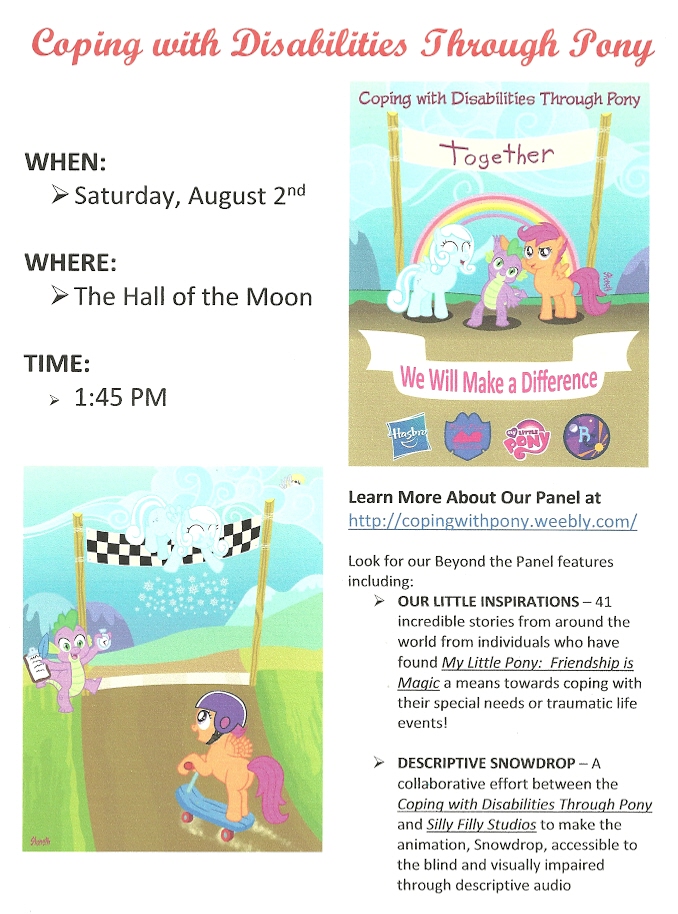
Reminder: "Coping With Disabilities Through Pony" Panel Tomorrow
Matthew Palumbo, a dad with a degenerative visual disability, is spending the last Bronycon he expects to have usable vision left taking his seven year old son to meet all the voice actors his heart desires... and also help raise awareness and reformation in the MLP:FiM fandom by hosting the panel "Coping With Disabilities Through Pony" tomorrow. The panel will be tomorrow in Moon Hall, starting promptly at 1:45 PM. The panel will be headed by Matthew Palumbo and his 7 year old son Ethan, fan animator Meredith Sims of Silly Filly Studios, illustrator, fan artist and programmer of Braillemon Rachael Meredith, and writer & aspiring educator Benjamin Platt.They will also detail two new "Beyond the Panel" initiatives: The collection of "Our Little Inspirations"-- 41 stories from fans around the world in e-document, free pdf and at -cost physical book form as well as a free downloadable audiobook-- and "Descriptive Snowdrop"-- an re-release of award-winning fan film Snowndrop that makes the story of a blind pony fully accessible to the blind and visually impaired with descriptive audio.
Don't miss it!
Labels:
bronies,
brony,
bronycon,
disability,
disability advocacy,
discussion,
inclusiveness,
mlp,
mlp:fim,
my little pony,
panel
Thursday, July 31, 2014
Critical Failure: WotC Employed Toxic Harassers As Consultants On New D&D

I take it all back.

The blog Fail Forward details how beneath the positive press for its inclusive language, the latest edition of D&D also counts among it consultants two men that have a long history of engaging in harassment, homophobic and transphobic behavior: RPGPundit and Zak S.
Seeing their names there in black and white was just too much, and people began to speak out. Most did so in private, others posted publicly but without naming names. This, I became aware, was because anyone who criticized the pair found themselves subjected to harassment, abuse and real world stalking... This is where Zak excels. He has in the past posted lists of people who he feels have displeased him in some way, complete with their real names. Those people then lists find themselves subjected to sustained campaigns of harassment.
...
While this behavior is alarming, it the choice of victim that is the most telling. These attacks nearly always target women and LGTBQ individuals, mostly freelancers and independent designers. Zak and Pundit have taken pains to defend themselves against accusations of transphobia, but I know several trans people who their fans have attacked and harassed. Zak described one of them as ‘mentally ill’, both he and Pundit told others they would be better off committing suicide. Recently, in a post defending Zak and accusing his detractors of misogyny, his girlfriend attempted to out a trans designer.
The anonymous tumblr Problematic Tabletop started cataloging some of their more public behavior. Fresh waves of hate mail forced designers to delete and hide social media accounts to escape. At the same time Zak put his setting book on sale, using promotional quotes consisting of people calling out his behaviour. This was not unusual, Zak’s business model revolves around publicly being a jerk. He is, quite literally, a career bully.Eventually, Mike Mearls, the lead designer of the newest edition of D&D, asked for people to come to him privately with any stories of harassment on the part of Zak S. and the RPGPundit had engaged in. Days later, Mike Mearls said that he considered of the claims didn't matter, because he couldn't find any evidence of either man using explicit slurs, so the matter was closed as far as he was concerned.
Meanwhile, Zak was publicly speaking on Mearls’ behalf, saying that WOTC had found the claims against him to be baseless. Those who sent Mearls information began to panic, had he just shared their complaints with their harasser? Mearls responded that he had told Zak the claims were baseless, but hadn’t shared any names or details with him. Nevertheless they were not pleased, nor did they feel safe. Why had Mearls consulted with Zak before replying to them? Why was it more important to re-assure Zak he was in the clear than respond to allegations of harassment? Mearls again replied, saying that he was not taking the accusations seriously because some of the people stating them were members of the Something Awful forums... Meanwhile, The RPG Site, operated by someone Mearls hired as a consultant, currently contains such topics as: “Bruce Baugh can go fuck himself with a rusty spoon”, “Why I dislike feminism” and a thread defending the use of the word ‘Jap’ in WW2 settings...
In investigating this story I heard the same tales over and over again. The RPG community is small enough that almost every woman, person of colour or LGTBQ individual seems to have had a run in with Zak or Pundit. The only reason I hadn’t heard about this before is because they are too afraid to speak out. Discussions happen in private, or with the names left out, because both Zak and Pundit are infamous for googling their own names and attacking their critics. Zak even now tries to portray these allegations as prudish conservatives out to smear him due to his involvement in pornography. Yet for that to be true almost every marginalised voice in the RPG community would need to be part of a secret right wing conspiracy. At a certain point you have to accept that that is implausible.WotC has not made a public statement on the matter. All communication has been through private emails and a now-deleted G+ discussion. It's been nearly a month since this brought to light. WotC has been content to soak up praise and admiration for using inclusive language, but wants to dodge responsibility for using two poisonous people as consultants for that same new edition of D&D.
You don't get to have it both ways. Inclusive language has to accompany inclusive behavior-- otherwise, you're doing nothing but paying lip service with empty words.
Shape up, WotC.
Labels:
criticism,
D and D,
DnD,
dungeons and dragons,
fandom,
feminism,
harassment,
homophobia,
inclusiveness,
lgbt,
lgbt issues,
outrage,
rpgpundit,
trans issues,
transphobia,
WotC,
zak s
Wednesday, July 16, 2014
Minecraft As Safe Space (Excepting Skeletons)

(Screenshot of the Proteancraft parkour course)
This landed in my inbox the other day, and for all the Minecraft players who follow me, I figured I'd share this with you all:
What you’re looking at right now are a few stills of our brand-new minecraft server, Proteancraft. Proteancraft offers something most other [Minecraft] servers don’t: a safe, welcoming environment for players from all walks of life.
The difference is our staff and community. We’re a tumblr-based survival minecraft server dedicated to keeping our community as free as possible from the likes of transphobic, homophobic and otherwise offensive/tasteless characters. The server is handled by a handful of (relatively) mature folks who actually give a hoot about how are players feel. If you’re ever feeling uncomfortable on the server, let us know and we’ll attempt to resolve the issue however possible.
Proteancraft is online nearly 24/7, so you can connect and play at any time. With 3.5gb of RAM and over 30 unique plugins, you’re bound to have a fun time here! So, come join us!The server IP for Proteancraft is 192.99.18.143:25794 and if you're interested on keeping up with developments, you can follow the Proteancraft blog here.
Labels:
community,
inclusiveness,
minecraft,
proteancraft,
safe space
Subscribe to:
Posts (Atom)