Showing posts with label industry. Show all posts

Wednesday, June 6, 2018

Telltale Tell-All: How Toxic Work Culture Drives Away Best Devs

Description: "Telltale Games Will Remember That"

Writing for The Verge, Megan Farokhmanesh, does a deep dive into the arduous working condition in the video game industry in general, and one award winning studio in particular. As she explains:
These conditions almost always hit one group the hardest: developers, or the people who actually make the games. Layoffs are a pervasive fact of life, even at successful studios where developers are often hired en masse to help hit tight deadlines and then fired to cut costs after the game ships or is canceled. With the next deadline, the cycle begins anew. Overwork, job insecurity, and profound burnout are omnipresent concerns; more than three-quarters of developers report working under “crunch” conditions, which can mean working up to 20 hours a day and more than 100 hours a week. These practices can have a significant and debilitating cost to employees, one that often feels baked into video game development culture.
And how does Telltale Games, the studio that done everything from The Walking Dead and Game of Thrones to Batman and Sam and Max episodic games factor into this? Farokhmanesh elaborates:
The story of Telltale — its rise, decline, and potential reformation — is not just the story of the missteps of one studio. It’s a shocking window into the $36 billion video game industry (which is now so large and lucrative that it rivals the film industry), and how its worst practices can grind down and burn out even the most devoted and valuable employees.
The entire article is important for anyone interested in the human cost of the video games they enjoy, and what is currently being done, and can be done about working conditions in the future.Read the whole thing.

Friday, January 22, 2016

Jonathan Blow (Maybe) Peed In A Jug To Make A Point?


(or: Jon Blow, You Know Nothing)

(or: Jonathan Blow? MORE LIKE JONATHAN PEE AM I RIGHT GUYS)

So, noted indie game developer Jonathan Blow (whom you may know from the game Braid, from the movie about indie games ) took to twitter today and posted a picture that thanks to Blogger's Terms of Serivces I can't re-post but I can describe. With the tweet "Here is another thing I helped make, to help finish The Witness" he attached a picture of a clear jug with a tube attached at the top that was either his actual pee, or something faked to look like he'd peed in a jug. Twitter collectively reeled in shock.

Why would he do this? Was it making a point about how dedicated he was to finishing The Witness (even though he's just a consultant)? No, apparently it was to make a point that we are all shocked when a grown professional adult posts a picture of maybe-a-jug-of-his-own-urine instead of being shocked at the plight of indie game studios.

No, really.


Description: screenshot of a series of tweets. The first two, from Jonathan Blow, read: "Wow this tweet seemed to upset people. I meant it as a joke, but...it is also kinda true, you know? If y'all were as interested in new indie games as yo seem to in that picture I just posted, more indie developers would survive!" The 3rd post, re-tweeted by Blow from the user bombsfall reads "But once you recognize the secret reason for the pee bottle, you will be ashamed for your words and deeds".
Now bombsfall was referencing another tweet by a famous developer responding to criticism: Hideo Kojima responding to criticism of sniper the Quiet's male-gazey design. All kidding aside, does Mssr. Blow maybe have a point?

No, not really.

Friend of the blog Daphny (full disclosure: she's also linked on my sidebar, contributes to my patreon, sent me homemade muffins and is my friend) addressed this in a great blog entry titled
"IF JON BLOW WAS INTERESTED IN HELPING PEOPLE SURVIVE WE WOULDNT HAVE TO JOKE ABOUT HIS PISS" and while I'm tempted to let that mic drop and call it a day, you should really read the whole thing. Some choice excerpts:
[Jonathan Blow has] said on twitter if you dont have 100 dollars to spend on greenlight your game isnt worth being on greenlight, and in an interview with kotaku australia said that its *~*~HARD FOR HIM TO THINK*~*~* ABOUT SOMEONE HAVING A HARD TIME COMING UP WITH 100 DOLLARS which displays his lack of awareness of what its like to not have 100 dollars to INVEST because all of your money is going to IMMEDIATE survival needs (food, shelter, bills)...
his indie fund is such an insular money making scheme, indie fund pours TONS OF MONEY into huge boring investments instead of paying smaller projects for actual ambitious and unique creative work. of course this isnt ALWAYS TRUE but they gauge what they fund on GUARANTEED SUCCESS not ARTISTIC POTENTIAL. its not a fund for people who are breaking out, its a fund for those who want to GET RICH. thats a fine goal to have, but the lack of transparency with indie fund should really set off any outsiders red flags
AAA indie indeed. but GOTTA SUPPORT THE ‘COMMUNITY
Seriously, go read the entire thing. It's short, devastating, hilarious, and has two Vines.

Thursday, January 8, 2015

Intel Apologizes for #Gamergate, Funding 300M Diversity Initiative

Photo courtesy theverge.com
Intel recently announced at the Consumer Electronics Show that it invest $300,000,000 in a "Diversity in Technology" initiative.  The initiative will see Intel investing in and partnering with the National Center for Women in Technology, Feminist Frequency, Rainbow PUSH, Girls Who Code, the Cybersmile Foundation, the IDGA and more.

Intel CEO Brian Krzanich said in his keynote address that "It's not good enough to say we value diversity, and then have our industry not fully represent..." women and other minorities, and that the aim goes beyond the company's bottom line. "This isn't just good business," said Krzanich, "this is the right thing to do... We're calling on our industry to again make the seemingly impossible possible by making a commitment to real change and clarity in our goals. Without a workforce that more closely mirrors the population, we are missing opportunities, including not understanding and designing for our own customers." To show the effort is more than just talk, he said will make sure its hiring practices reflect this going forward and will tie its leaders' pay to the progress toward this goal, which will be closely tracked and monitored.

Last year, after the #gamergate-led groups directed an email astrotufing campaign to Intel attacking a blog post Leigh Alexander made about the hate group on Gamasutra, a video-game industry-focused site, and succeeded in convincing the company to temporarily withdraw its advertising contract. Intel later reinstated its advertising and released a statement saying "Intel does not support any organization or movement that discriminates against women. We apologize and we are deeply sorry if we offended anyone."

Thursday, August 28, 2014

Tainted Love: How Game Companies Exploit Employees' Passion

It's a familiar homily to those looking at a satisfying career: "Do what you love, and work won't seem like work." It sounds all well and good, doesn't it? Imagine, a job that not only give you a paycheck to fill your wallet, but satisfaction to fill your soul. Creative industries abound where workers are not just happy to be there, they are passionate about the work they do, or want to find a place where they feel like they belong.

Blizzard Entertainment, the company behind the 300-pound gorilla of MMOs, World of Warcraft, looks to tap into that very feeling, that yearning for a sense of belonging. And in the company's latest recruitment video, they leap right past the Army's "It not just a job, it's an adventure" type of pitch and goes straight into "We a family of people, just like you". Take a look:


In just six minutes, the video has tons of variation on passion, family, fulfillment and even love.he message is hammered home that this is not a job, it’s a new family. One part in particular that caught my ear was a  few employees emphasizing that all of the departments in Blizzard, even the purely creative ones, are considered part of the company's success. There is one part of the video that also confused me. One talking head says that the first thing you see when you start a Blizzard game is "... 'Designed by Blizzard'. And it's very true."

Um... I sure hope so. I mean, it seems obvious that a Blizzard game made in-house by Blizzard is designed by Blizzard. This statement seems like it was written by one of the Krang from Teenage Mutant Ninja Turtles. As Ian Williams and Austin Walker outline in their anaylasis "Working For the Love of the Game: The Problem With Blizzard's Recruitment Video", peel back a layer and you see it reflects nearly everything wrong with video game companies as employers:

It is telling of the ideological and material conditions of the games industry that the simple act of giving a full group of workers credit on their production seems like an accomplishment. The irony, of course, is that those employees, beaming with pride, aren't themselves named or credited in the recruitment video.

But the video makes no mention of the concrete benefits that working at Blizzard provides. There’s no mention of benefits or wages; nothing about crunch time, that specter haunting the industry; nothing about the sort of material, tangible things that make a difference in how one is employed, rather than how one feels during employment. There are perfectly acceptable, subtle ways to talk about these things without veering into the gauche. Employees could talk about their own financial security, or about being able to plan for the future while simultaneously being fulfilled with their work today... But your recruitment will be based in love, not on wages. The mentions come rapid fire, culminating in the grand pronouncement from one employee: Blizzard employees are “just a bunch of geeks,” just like you. 

This is a window into how the industry as a whole views employment... this is [also] an industry with a layoff rate twice the national rate across all industries and a culture of crunch where 68% of respondents work more than 50 hours a week for months at a time in order to get a product out the door. It’s a bad tradeoff: In exchange for being quiet about wages, hours, benefits and the like, you’ll get to hang out with like-minded people you’ll love to be with. The Blizzard video is the distillation of this pitch in a very blunt form....Blizzard’s video is just one more artifact of a culture that preempts demands for fair remuneration with a prodding reminder that, after all, if you love what you do, then the pay shouldn’t matter. This is the same story told by Twitch executives who say that its streamers “aren’t interested” in being paid. It’s the same story that crops up any time someone wonders if modder labor is exploitative. It’s the same story that is so often leveraged to blur the line between fandom and promotional labor. It’s a story told so well and so often that it doubles in on itself: Exploited fans become exploited modders. Exploited modders become exploited developers. 

You might wonder, though, in a pitch that aims to capture a creative's sense of fulfillment, or a fan's love of playing games, what's wrong with focusing so much on passion?

All this talk of passion sets a very real paradigm, limiting the acceptable actions of those in poor labor conditions. Why is the industry so insistent that game development is “more than just a job?” Because if it’s just a job, just a 9 to 5 workday in a cubicle pounding out code or testing content, then the crunch time is something you can object to. In fact, you would (or should) be expected to object to a 60 hour week. If, instead, protesting crunch time means letting down a grand artistic vision (one which Blizzard reminds the viewer all employees contribute to) or, even worse, letting down your new family, that’s a very different proposition. None of us wants to let down our family and friends, but we can probably get away with letting down management. That social pressure is what keeps crunch time and other bad practices in place as a normal part of the industry. 

The mythology of crunch and a culture of layoffs have naturalized them, erasing their histories. Instead of being able to identify key shifts in industry labor practices, we’re told that we’ve always been at war with the 60 hour work week. There’s a sheepish air when people at leading companies bring up issues such as crunch, as if it’s unavoidable, like a downpour or an unbidden burp. This is nonsense. Crunch is certainly a disaster, but it is not an act of God. There is nothing that says that crunch and layoffs are unavoidable. The laws we write about how we work are products of men and women, not natural forces imposed upon us by an unseen hand.

And that's the heart of the issue, isn't it? The video seems directed at super fans but it really just hides the reality of  grueling work conditions and preys upon people's need to belong and sense of pride. Honestly, for all of the rah-rah about being a part of Blizzard, it all sort of comes off a little defensive.

Luckily, Paste Magazine bucks the comments section trend by both being not awful and having relevant and insightful commentary. Here what one former video game worker of 20 years had to say:

After over 20 years in the industry I finally had to pull back. They'd squeezed every last drop of passion out of me. Games haven't really been "design driven" for a long time anyway, and with F2P gaming gaining dominance the impact of the bottom line is only growing stronger Yes, they're beautiful, but all the innovation is happening in the back end. As for all the extracurricular stuff, that won't mean much when they hand you your walking papers, and you suddenly realize that for all the hours of your life they took may help you get your next job, but is meaningless for the job after that. Meals, games, entertainment are all about one thing... keeping you on campus for as many hours as possible.

So just because things have been this way, and are this way now doesn't mean they have to stay this way. But what will it take for that to happen?

Tuesday, August 19, 2014

Studio Says Steam & Bundles Killed Indie Gaming

Image courtesy of puppygames
UK indie games studio puppygames, most famous for its tower defense games, its retro-inspired arcade games and declaring that the games demo was dead, has fallen on some hard times recently, as they posted on their official blog last week:
We tried for several solid months to rescue our direct sales but it seems nothing but nothing that we can do will change the fact that at any given moment, Steam comprises 97% of our income. And that’s just when there isn't a crazy Steam sale on. So we wasted months on that and achieved precisely nothing. This is especially depressing when we consider that those months could have gone into furthering the progress of Battledroid... we only had about four months’ cash left in the bank (as of the start of May), and by my best estimates, we needed to spend about another 12 months on Battledroid before it could actually take in any money (which itself is a dauntingly difficult prospect for a game we were planning to release for free).
While the frustration and disappointment are understandable, puppygames unleashed a salvo yesterday entitled "BECAUSE YOU’RE WORTHLESS: THE DARK SIDE OF INDIE PR" where they place the blame for sinking profit on Steam & bundled sales:
...the value of an independent game plummeted from about $20 to approximately $1, with very few exceptions. Steam is great! You can sell loads of games! But only if they’re less than $10. Technically Valve don’t actually dictate the prices we charge... market expectation of games now that means you can only sell them for a dollar. That’s how much we sell our games for. One dollar. They’re meant to be $10, but nobody buys them at $10. They buy them when a 90% discount coupon lands in their Steam inventory. We survive only by the grace of 90% coupon drops, which are of course entirely under Valve’s control. It doesn't matter how much marketing we do now, because Valve control our drip feed.

So where does that leave customers in this value equation? Not worth very much to them, according to the entry:
Now you’re worth $1 to us. If you buy every one of our games, you’re worth $5. After Valve and the tax man and the bank take their cuts, you’re not even worth half a cup of coffee. So, while we’re obsequiously polite and helpful when you do contact us for support, even if it’s just the same old “please install some actual video drivers” response, you really should be aware that you are a dead loss. Even if you buy everything we ever make again. Even if all your friends buy everything we ever make again. You just cost us money. Not just fictitious, huge-piles-of-filthy-lucre indie-game-developer who made-it-big money. All our money. 
We barely scratch a living, like most indie game developers. You quite literally cost us lunch because the shop sold you a computer with broken software on it. So you’ll understand now why customers aren't worth anything much any more. You’ll realise why we’re actually happy to see you go if you feel like insulting us. You might add two and two together and realise that for four, we’re not going to cry ourselves to sleep over the loss...
I don't know if I really agree with much of what they have to say, though. Some games don't sell well because they're not fun to play or put together well. For example, the tower defense genre has hundreds of games, many of them completely free to play. So when you take a game like puppygames' Revenge of the Titans, it's already up against a lot of competition. For example, I thought the character design was really well done, but the actual game wasn't fun. The progression from level to level was really stop and start, and the skill progression tree was hard to use and harder to understand for me. 

The post also has some really odd classism ("When he [Phil Fish] walks into the restaurant where you pitifully scrub the floor like a servile wretch in order to pay for DLC in DOTA 2, you'll call him sir.") and a lot of sour grapes, like Homer Simpson complaining that "They won't let me into their crappy club for jerks!" What do you think, readers? Are they right on the money, or have they missed the mark?

Monday, August 18, 2014

Problem Attic: Cure for the Common Code

The Title Screen
Title screen image courtesy of Liz Ryerson
(Note: This article was supposed to appear last Friday, but due to technical difficulties with the Blogger backend, did not. It appears today. Thanks for your understanding.)

Brendan Vance, a game developer most famous for his stated mission to advance video games as an artistic medium through analyzing its theoretical underpinnings recently posted about the parts of a game design contributing to the whole, Marshall McLuhan, dissatisfaction with AA gaming, then video games in general... and the game that brought him back: Problem Attic by Liz Ryerson, in an essay titled "Form and Its Usurpers":
I develop video games for a living, but I spent last year really hating video games. I questioned how it was I could consume 60 hours of ‘content’ for Assassin’s Creed 3 yet feel utterly unsatisfied by my act of consumption. I questioned what it was I had consumed, other than my own time. I questioned what it was I sought from the game in the first place. I questioned the nature of the ‘content’ it claimed to offer me; privately I began to suspect it might not even exist. The games I was making and playing seemed more and more to me like empty forms: Puzzle boxes within puzzle boxes, each layer promising ‘content’ underneath it yet in the end yielding an empty centre. I became too tired and bored to care about games anymore. I could no longer see the point in it. I felt as if some enormous detritus had gathered upon my career and favourite hobby; that I could no longer reach through this detritus to claim the enjoyment I had once found underneath. 
I awoke from my yearlong stupor the night I encountered a game called Problem Attic by a person named Liz Ryerson. It was like nothing I’d seen before. Rather than a puzzle box, it was more of a sculpture.
The game Problem Attic itself is a bizarre 2-D platformer about that takes place in a prison, and addresses the idea of both prisons as a physical space and a psychological block. It has a deliberately lo-fi presentation done in a purpose glitch style, and as jarring as it can be visually, I think it feeds into the atmosphere of the game really well. One of the problems with the presentation though, is that it seems to get hung up on the "hellscape" atmosphere and tricking the player and confuses being overtly hostile in the story with being overtly hostile to the player (there is a part of the game where it quite literally tells you to go fuck yourself).

At any rate, Vance's essay covers a multitude of thoughts on being and identity and loss. It's also fairly long. You might want to pack a lunch or something.


Wednesday, August 6, 2014

Pixar Exec At Heart Of Industry-Wide Pay Scandal

Photo illustration via Cartoon Brew
Cartoon Brew explains:
Pixar and Disney Animation president Ed Catmull has always had a reputation as a decent person, but newly revealed court documents show that he’s been working against the interests of Pixar’s employees for years, as well as trying to hurt other animation studios who didn’t play by his rules... Catmull’s deposition and emails from the lawsuit confirm that he was instrumental in operating a secret wage-theft cartel that violated the Sherman Antitrust Act. But it’s even worse than you think. The cartel orchestrated in large part by Catmull robbed potential wages and job opportunities from thousands of animation industry workers at other studios, including DreamWorks, Lucasfilm, Robert Zemeckis’ ImageMovers, the now-defunct Orphanage, and Walt Disney Animation Studios... 

...As Catmull and other Pixar honchos and Disney got richer and richer during the CG feature animation boom, the employees’ salaries at Pixar and beyond were being artificially controlled through illegal means. With these documents, we now know that DreamWorks and Disney also undermined free market principles by colluding to restrict their employees’ wages and job opportunities. These revelations extend beyond the scope of the class-action suit, which is in the process of being settled with a paltry $9 million slap on the wrist for Pixar and Lucasfilm.
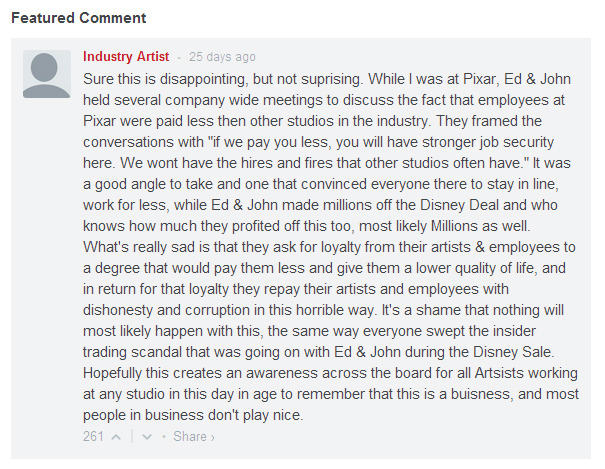
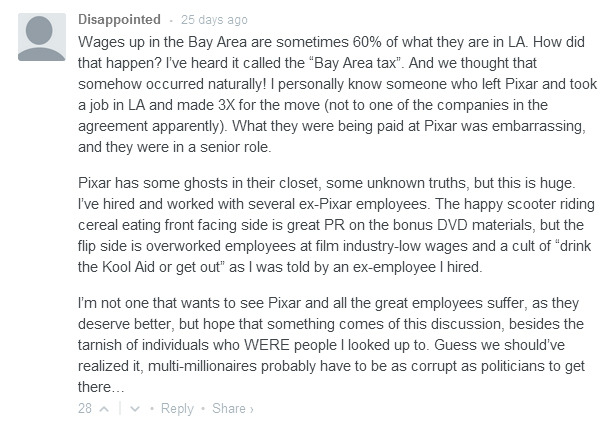
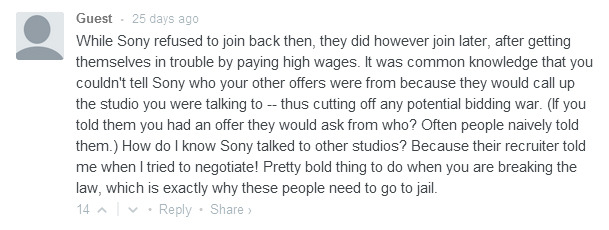
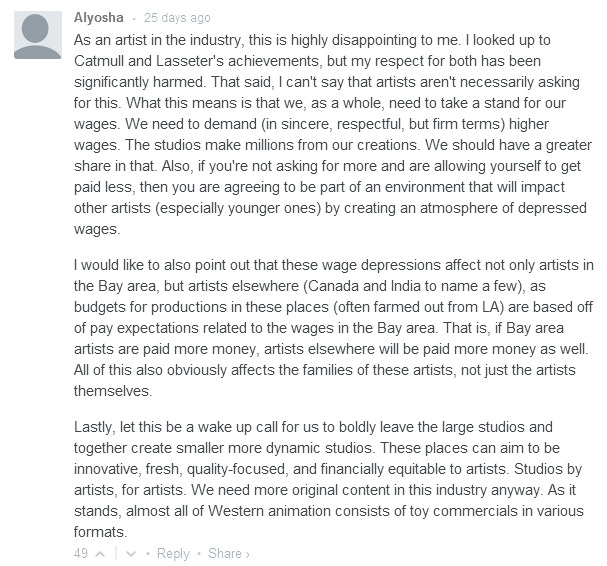
Interestingly enough, the comments section of the article has exploded with anonymous industry members coming forward and contributing a number of horror stories. They've been screen-capped, just in case they later "disappear mysteriously":


Tuesday, July 22, 2014

Mythbusting Ideas About Women In The Game Industry


Brianna Wu has an excellent article on polygon today on women in the gaming industry and harassment. She outlines the stories of a number of women in the gaming industry and the harassment they have received.

Not only that, but each particular case study takes a myth surrounding online harassment of women in the games industry and shows how it's false, using that woman's direct, lived experience.

An excerpt from the introduction:
My name is Brianna Wu. I lead a development studio that makes games. Sometimes, I write about issues in the games industry that relate to the equality of women. My reward is that I regularly have men threatening to rape and commit acts of violence against me. 
If you are a woman working in the games industry, especially in a public way, you’re going to experience harassment. I imagine telling my 12-year-old self that fulfilling my dream of making games would lead to constant threats. Would she still do it? Would any woman? The problem with sharing these stories in broad terms is that people think men and women receive the same harassment online. They do not. I’m not writing this piece to evoke your sympathy. I’m writing to share with you what prominent, successful women in the industry experience, in their own words.
The entire article is a must-read.

She also created a companion video:

The harassment of women in the games industry is an epidemic, and it's also a reflection of the crap that women have to go through in society in general. It's easy to lay the blame at the feet of anonymous internet cesspools like 4chan and misogynistic pockets of Reddit but those are really just enablers. The internet doesn't exist in a vacuum. It’s part of the culture that we, as a society, have allowed to mushroom because we haven’t done much as a society to stop it.

I talked about a few things men can do to help stop this both online and in general in my blog post "The Status Is Not Quo: Being A Geeky Woman Online & What Men Need To Do".

Friday, September 10, 2010

Retro Repost: THQ IS Wrong - How Used Game Sales Help The Industry

Note: This article was originally published as part of my time as an Associated Content Featured Contributor to the Video Games Section. Associated Content was later bought by Yahoo! and renamed Yahoo! Voices. Yahoo Voices shut down in July of 2014. This article is being republished here on The Code, backdated to its original date of publication to remain as a record of my writing.

The tension between video game publishers and the used games market boiled over last week. THQ creative director Cory Ledesma said in a CVG interview that "...when the game's bought used we get cheated," and further declared that THQ didn't "...really care whether used game buyers are upset because new game buyers get everything. So if used game buyers are upset... I don't really have much sympathy for them." Jerry Holkins, one half of the popular web comic Penny Arcade that has spawned a charity, two gaming conventions, merchandise and even a series of video games, went even further. Commenting on the controversy, he said "I honestly can't figure out how buying a used game was any better than piracy. From the perspective of a developer, they are almost certainly synonymous." With video games commanding billions of entertainment dollars, and the US recession still showing no signs of reversing, purchasing used games versus buying them new seems to be an increasingly polarizing issue. However, there is a strong case to be made that buying used video games is not only a morally sound practice but also a boost to the video games market.
Buying Used Games Is A Legal And Moral Right
Once you have purchased a video game, you own the game you bought. The rights of the creators of a copyrighted work, such as a video game, stop once the work has been sold (with the exception of making unauthorized copies). You have the right to the give away or sell property that you own to someone else if you want. It's called the "Right Of First Sale", and it's been a part of property law in the US for 102 years. In the more recent case of Vernor v. Autodesk, Inc. the court held that a retail purchase of a computer or console game has all the physical and commercial aspects of a sale, not a license. If if looks like a sale, walks like a sale, and quacks like a sale, then your have the same rights of first sale doctrine. That means that you can even resell it if you want; you're not infringing on any other rights.
A Customer Who Buys A Used Game Is Still A Customer
When a customer walks into a store and pays money to purchase a used game, they are already doing two out of three things a game company wants them to do. A sale is still being made, a game is still being purchased, monetary value is still being assigned. All a game company has to worry about in that case is providing enough of a value to the customer that the customer will decide to buy a new game instead of a used one next time.
Someone pirating a video game is not engaging in a sale, or assigning a monetary value to a game. A video game or software pirate is downloading an unauthorized copy for free. There is little a video game company could do from its end to change a pirate's behavior.
Sales of Used Games Fuel The Purchase of New Games
GameStop CEO Dan DeMatteo spoke to industry publication Gamasutra in 2008, saying that he expected the retail chain to give out approximately 800 million dollars in used video game credits, pointing out that these "... trade-in credits will go toward the purchase of new video games... [T]he consumer oftentimes.. needs that residual value from those games as a trade-in to be able to afford a new video game". Steve Perlman, speaking at the Design Innovate Communicate Entertain Summit in Las Vegas recently, established that the average price for a new video game is $60. With a recession that is showing no signs of reversing anytime soon, consumers are looking to stretch entertainment dollars even further. And sixty dollars is three times the average new release DVD or CD.
Industry analyst Micheal Pachter of Wedbush Morgan Securities says that the relationship between used video game sales and new game sales isn't parasitic, but mutually dependent, asserting that when customers get credit for used games, consumers buy more games, "Sometimes they buy new games. If, instead, they buy used games, so what?" he said in article for the Holywood Reporter. He continued, "In creating more demand for used games, it keeps the price of used games up, which means there is less cannibalization of new game sales."
Selling A Used Game Is Inherent In The Value Of The Game Itself
This value extends past the legal right of first sale. There is actual monetary value inherent in physical media that you own and can later give away or sell if you wish. When a company strips away the ability to re-sell, rent, or even lend out a game, that company is now delivering less of a value to its consumers.
For a salient example, one need look no further than conducting a Google search for "PSP Go" and "expensive". The PSP Go is similar to Sony's previous hand-held gaming console, the PSP, except it does not use physical media at all. All games are sold through a digital download system. These digital downloads are non transferable. These digital downloads are also priced at the same cost as traditional physical media. This, in essence, makes the consumer pay more for video games with less value. It's not hard to see why sales have been lackluster and consumers feel the PSP Go is an expensive proposition. It turned out that lots of people noticed they were paying physical media prices for digital media that can't be loaned, re-sold or lent out. There's always a market for the the latest and and coolest design, and PSP Go is a smaller and sleeker design than the original PSP. But the video games for the PSP Go weren't just the same price as comparable hand-held console games and other media. The games cost more while offering less value because they are not transferable.
Used Game Sales Help Video Game Retailers Large And Small Stay In Business
Wilm Stocks, the Executive Vice President at Atari acknowledged in a Hollywood Reporter interview that video game stores are balancing on very thin profit margins. saying "[I]f you talk to anybody in the used [video game sales] business, they'll tell you that they don't make enough margin on sales of new releases and that, in the large, expensive environments in which these guys operate -- in the mall-based stores -- that a three- or six-month delay becomes a problem for them." Customers playing a game and trading it it towards the purchase of a new game generate additional revenue for the store and video game publishers. As Patcher said, even customers who just buy used games end up reducing and internalizing market churn.
Used Game Sales Help Minimize Consumer Risk While Creating Potential Fans
While intense competition for entertainment dollars, being able to re-sell a game offers a built-in incentive to try a video game they might be unwilling to buy new. If a consumer is unsatisfied with the purchase, the customer can partially recoup their losses by selling or trading the game in. If the buyer of a used game likes the game, they may be more likely to purchase the next video game in the franchise, or other video games from the publisher.
The Video Game Industry Is Doing Just Fine
According to market research firm The NPD Group, Infinity Ward's Modern Warfare 2 sold 550 million dollars worth of video games in just five days. After 2 months of being released Modern Warfare 2 achieved sales of a billion dollars. Rockstar's Grand Theft Auto 4 sold over 3 million copies the first week it was out, and as of Spring 2010, it had sold a total of 17 million copies.
In conclusion, while video game companies may have issues with retails that sell used video games, there is nothing wring with a consumer choosing to purchase a used video game. It is a legal right, and in a period of increasing costs and shrinking disposable income, a legitimate choice.
Source:

Share This Post