Showing posts with label tropes vs women. Show all posts

Thursday, January 28, 2016

Are Hardcore Gamers The New Right Wing Conservatives?

Description: Stephen Colbert, dressed in a business suit &
seated at a desk, raising a pitchfork. the caption reads "Unleash
Nerd Fury!"
 In the mid-to-late 90s up to the the early 2000s, there was a lot of sound and fury and fear about censoring video games, worries about the resultant effect on free speech and the possibility of strangling video games as an art-form before it even left the cradle. There were Congressional hearings on video game violence, pundits bloviating in newspapers, magazines and online, and reactionary conservatives seemingly pinning blame for video games on everything from the Columbine massacre to the collapse of the nuclear family. But for all the sturm und drang, all the worries about legislators attempting to legislate morality... nothing really came of it. As the Houston Chronicle's Jeff Rouner outlines in "Have Gamers Become The New Religious Right?":
However, though there was a lot of talk about official censorship there was never really any serious chance it would happen in America. Video games were declared free speech by the Supreme Court in 2005 in a 7 – 2 decision, and Nintendo had given up their dream of completely family-friendly entertainment by 1994. Mature content became a badge of honor to the gamer community. It was proof that the medium couldn’t be stopped by moralistic thugs determined to protect us from ourselves.
So what happened?
Journalists like Leigh Alexander and Mattie Bryce as well as YouTubers like Anita Sarkeesian began looking at game content, both narrative and mechanical, and examining what that content said about us. It was not, as a lot of gamers like to claim, a call to censor or ban that content. It was just looking at it in a more thoughtful and nuanced way. With games now protected by all the power of the First Amendment, you would think that discussion over them could flourish more freely since they were in no danger of being taken away. 
That’s not what happened, though. Organized retaliation against the concept of conversation and dialogue in the form of 4chan ops and GamerGate happened instead. Sarkeesian’s videos were constantly flagged on YouTube in an attempt to take them down and online campaigns to have various journalists discredited or fired became a new way of life for anyone who dared deconstructing games from a social justice perspective... Criticism of the status quo, no matter how mild, is felt like an attack on a person’s morality. Religious people in the ‘80s who were comfortable with traditional gender roles took the idea of someone else rejecting those roles as a judgment. Likewise, players who are perfectly happy with a white, male-centric, violent, heteronormative status quo in gaming feel judged for that happiness when marginalized people and their allies speak up about how it affects them.
How bad has it gotten? A couple worked together for a year on a game called "That Dragon, Cancer" as a way to help process and explore their grief as well as the boundaries of games as an interactive medium. And hardcore gamers howled with outrage. Over a game a couple made born from their experiences of watching their infant son wrestle with cancer.
Unfortunately, Feminist Frequency gave the game a good review, and so of course the horde has descended on Steam to flood the forums with cries of “feels-marketing” and saying the Greens immoral for not donating profits to cancer research. Bear in mind, none of these people have actually played That Dragon, Cancer. They just hate it because a bunch of other people they normally pick on all got together and said it made them feel something.
So readers, I ask you: what are moderate gamers to do? Sound off in the comments below.

Friday, August 21, 2015

Video Games Still Have Growing Up To Do

Description: Cartoonish doodles of video game box art for fictional titles
"Night Vision Mode 4", "Lord of Armor","Tank Driver" & "Sword Thong"
Jeremy Parish recently wrote in US Gamer about how he was initially excited to get a promotional email about an upcoming import game. It hit all his interest buttons: It was

  • a rougelike dungeon-crawler RPG
  • for the Playstation Vita
  • by a developer that's released a number of well-made and critically well-received games for portable systems before
...but as he read on, he became a lot less enthused. Why, well as he read on, he saw that this new game was also labeled as...
"a breast-expanding RPG." Maybe that doesn't mean what I think it means, I thought to myself as I read through the email. But no: It means exactly what it sounds like. Omega Labyrinth features a team of female warriors who go venturing into random dungeons in search of treasure, and as they grow in skill and power, their breasts increase in size, eventually straining against and even tearing through their costumes. In proper roguelike style, the heroines lose their gear when defeated; I can only assume they lose their enhanced cup sizes as well. 
Omega Labyrinth also includes an unspeakably demeaning item appraisal system. As in most roguelikes, the heroines will encounter all sorts of unknown equipment in the course of their adventures, which must be identified before you can safely use them. Other roguelikes offer various mechanisms for accomplishing this: Paying a shopkeeper, using a special scroll or spell, or the classic desperation move of use-identification. Omega Labyrinth, however, allows you to identify items by... rubbing them between your heroines' breasts. So we have Matrix, a talented studio, creating a legitimate roguelike for Vita: All good things. Then, they've drenched it with a thoroughly repellant coating. What a waste. 
Parish doesn't have a problem with the existence of games like this per se-- free market and all that. But he points out Omega Labrynth and games of its ilk are emblematic of a wider problem with the medium:
They're all a symptom of a creative medium trapped in a state of stunted maturity. The fact that video gaming's most visible treatment of sexuality boils down to cartoon games revolving primarily around strategically torn clothing and overly enthusiastic jiggle physics speaks volumes about just how arrested gaming's development has become. If games would mature — if they were allowed to mature — games like Omega Labyrinth would undoubtedly still exist, but they'd be a single facet of how the medium treats sexuality rather than being very nearly the entirety of it. 

Tuesday, August 18, 2015

YA Books & The John Green Problem

Fiction for young adults is seemingly booming. YA lit sections in chain bookstores seem to keep increasing in size, the number of eager readers grow yearly, and YA writer John Green's novel The Fault In Our Stars was adapted into a box-office success in a movie adaption of the same name. As the Daily Dot pointed out earlier this year though, he's endemic of a larger genre-wide problem:
On Twitter, Green has 2 million followers. Compared to the rest of the leaders in Young Adult fiction, that number is staggering. To approach even half the Twitter influence of John Green all by himself, you need an entire army of YA women. AndersonBlume,DessenVeronica Roth, Cassandra ClareRichelle MeadMargaret StohlKami Garcia,Rainbow RowellMaureen JohnsonMalinda LoHolly BlackLJ SmithEllen Hopkins,Shannon HaleLauren MyracleLibba BrayMelissa Marr, and Leigh Bardugo: As a group these women only have about 1.2 million followers on Twitter. That’s the voice of one man outweighing several decades of women who have had major successes, critical acclaim, and cultural influence. 
The problem of the cultural influence his books have created is not Green’s fault, but it’s created a frustrating situation for female writers and readers. Book blogger Rhiannon K. Thomas issued a sweeping takedown of the way the NYT bestseller list is stacked against female authors, many of whom write series, which are automatically moved to the “Children’s Series” list, out of the YA category altogether. She also pointed out that when men like Green aren’t writing YA, the media perception of it suddenly changes. Instead of being high literature, it suddenly becomes a shallow, frivolous genre that only silly teenagers and unfulfilled housewives participate in—just like the romance genre sans Sparks.
While John green himself has also done loads of things that are actually harmful to the audience he's writing for-- like reducing the death of Anne Frank to a mere prop, or taking a teenage girl's post discussing how the author's online presence makes her feel uncomfortable to mean he was accused of being a pedophile-- I think it's part of a larger systematic inequality. 

Whether you look at books, comic books, film or television, women are under-represented and outmatched. This is especially troubling because it leads to the FALSE idea that not only are there no women writers, creators or taste-makers, but that half the planet can just be ignored or dismissed and wouldn't want to see themselves represented anyhow.

Tuesday, June 16, 2015

Guest Post: Puppies Crying Bitter Tears

Description: Screenshot of tweets with hashtag "New Hugo
Categories" from Foz &Arthur Chu: "Best UNcritical Use of
1950s Gender Roles In Story Set 2000 Years In Future", "Best
Non-White Protagonist Portrayed By White Model On Cover" &
"The Dan Simmons Award For Best Time Traveller From
Future Telling You All Your Political Opinions Are Right".
Friend of the blog Ria, of Bibliotropic, had a lot to say about the spate of what the Puppies rhetoric has meant for them  personally as well as the field of writing in general recently. The Code is proud to present the following guest post from Ria. I also stand by everything they say here. Warning: contans swears.

"I dislike the both Puppy litter ideologies. I talked a bit about why last year, long before this current Puppy debacle began, with a post about Correia's comments on diversity in SFF. For those who don't want to read a long post about it, in a nutshell, someone who is now very strongly identified with the Puppies said, a while back, that including nonbinary characters and other forms of diversity in SFF would make for bad fiction, because doing so would come across solely as message fiction and remove any entertainment value. I objected to that, since what that amounts to in a practical sense is to erase people like me from having representation in fiction. The insinuation is that people such as myself aren't of any real value to have our stories, nor does anyone want to actually read about us or have us around. It's insulting, and it's dehumanizing.

So when this round of Puppy problems started, I admit I was already pretty inclined to dislike them, given that my experience of one of their figureheads was that he thinks people like me shouldn't play a central role in his beloved genre. And the more I read about what they stood for, the more my hackles rose. Accusations that women, people of colour, QUILTBAG folk were only getting nominations for awards due to affirmative action are galling, since what they essentially say is that these people getting nominations aren't actually as good as that straight white male over there and are only getting nominated because of quotas that need filling. If it wasn't for those quotas, that nomination would rightfully go to a dude. Comments that because certain of their books or series were popular with a certain crowd and sold well, they should totally be eligible for more award nominations. (Because quantity equals quality, I guess.)

There may be no AWARD for such well-selling books, but there is a REWARD. It's called a paycheque. A paycheque you get for doing a thing you love, which is something many people don't get to experience in their lives. That isn't to say that people with well-selling books don't deserve more than a simple paycheque. It's awesome to have fans, fan experiences, interaction, the knowledge that you're doing something people enjoy. Maybe there ought to be an award for the SFF book that sells the most copies in a year, I dunno. (Then, I suspect, there'd be a cry-out about how books released toward the end of a year just didn't have a chance, and look how many they sold the next year, so they should totally have won that award after all. Nobody gets everything.)

The problem I see with most of the Puppy stuff is that their message seems very unclear. First it appeared to be, "The Hugos are a stupid award full of politics I disagree with and all given to books I don't want to write or read. ...So how come I never win one?" Then it started to be about affirmative action accusations, about women and non-white and non-straight people swooping in and stealing awards that should go to more deserving folk. Then the hypocrisies really started coming to light, where Puppies would insult authors they disagreed with, very personally, but as soon as there was any retaliation against even their politics they'd cry defamation and abuse. At the end of it all, what I can see is that the Puppies stand for only the Puppies, and to hell with anything else. And by "to hell with," I mean largely that they'll insult and threaten people who don't toe the Puppy party line. it's fine and dandy for someone to come in and defend the Puppies and say, "Look, all they're saying is that they think their works should be judged as being just as valid as anyone else's, and that people are free to do as they please so long as he can do the same."

Sounds good on paper. And utterly out of context.

Because major Puppy authors are being allowed to write and publish the books they do. They're not being blocked from selling them. They may not qualify for awards, but hell, so do the vast majority of books published in a year. Big damn deal. The idea that everyone should have an award is a very liberal thing, and given that the Puppies seem to have a beef with politically liberal things, you'd think they'd be a bit more on board with a meritocracy. Nobody is imposing their ideals on the Puppies. The world can, amazingly, have multiple things in it, some of which by default disagree with other things. But the accusations made by them are harmful. Painful. Dismissive. And are largely focused on gender issues, sexuality, race, and a whole load of other things that make people say yes, there's some godsdamn bigotry happening here.

People love to say that so-and-so can't possibly be racist because they have black friends. Okay, so, by that logic, no heterosexual man can be sexist if they're married to a woman. Oh, wait, LOGIC DOES NOT COMPUTE! Someone can have black friends and still be racist. And since what a person writes and what a person believes aren't always walking along hand-in-hand, a person can also write about a black woman being just as kick-ass as a white man, but when they throw out n-word jokes at parties, sorry, that's still being racist.

I think some of the major Puppy supporters miss what a lot of people miss about prejudice. They hear the word sexism and assume that sexism comes in only one form: overt. You're only really sexist if you state that women are inferior to men and they shouldn't be allowed to do man things and should stay at home and quietly raise the kids. If you don't believe that, then you're totes not sexist. Except that sexism can also come in the form of believing that a woman only got an award nomination because she's a woman, which has the unspoken opinion that she didn't get it because she did something worthwhile. And since gender is brought into it, what's also unspoken is that she didn't do something as well as a man. Which means the award should rightfully go to men.

Sometimes bigotry is about what you don't say. It's about what you don't even think consciously. Sometimes this shit is so ingrained in you, thanks to a hundred and one different factors, that you don't even realise you're denigrating someone. Likewise, with racism and thinking you're only a racist if you want to bring back lynchings and banning black people from being around white people. There's no other way to be racist. Except that there is, and many of the Puppy opinions about race are very damn racist.

Surely there's going to be someone who wants to jump in and say, "Oh, fine, so you think all straight white men are worthless and wrong all the time, then." And no, I don't. And it's just a little bit ridiculous to say so. It's a bizarre extrapolation from my arguments. The fact that some straight white men have done some shitty-ass things doesn't make them wrong about everything. Just in the same way that I'm transgender doesn't make me right about everything. Including things involving gender politics.

Changing the subject a little, another thing that weirds me out about Puppy stuff? The way they seem to think that the Hugos have this liberal bias toward books that only talk about what liberals want talked about, and how nobody's actually reading these books. And how the voters at Worldcon are some elite subgroup of liberals who earned their voting privileges by, I dunno, helping an elderly Asian woman across the street to get to her ACA-funded doctor's appointment or something. That stuff straight-up ignores facts that are easily corrected. 30 seconds on Google will net you dozens of reviews for these books, showing that yes, people are reading them. Got the money to go to Worldcon? Great, here are your rights to vote on the Hugos and make your voice heard. It's not like you have to pass a liberal test or something in order to get these things. You pay money. And you read books. So the idea that books are winning a prestigious award when nobody's reading them because they suck so bad is just a touch ridiculous.

People have pointed this out before. I'm not the first. But this info seems to slide off people on the Puppy side of the fence because it doesn't mesh with what they see. It's not a flawless system. No system is. But some accusations are very easily refutable, and I'm not even sure where they came from beyond, "I'm not winning this award, so it must be a conspiracy against my politics." At the end of all this, I want the whole damn thing to be over. I want people to stop insulting each other for daring to like a different subset of SFF than they do. There's room for a lot of opinions here. A lot.

And that includes both conservative "men doing manly things" fiction AND fiction involving nonbinary people in stories that look like they can right out of a liberal buzzword dictionary. Doesn't make either of them good or bad by default. That's the trick for the author to manage. You can make a terrible idea into a good story, and a great idea into a terrible story. So yeah, I dislike the Puppies on both a personal and political level, because they're largely insulting, ignorant, and seem like they'd be a lot happier if people like me shut our mouths and let them get on with doing what they do unopposed, but damn, am I ever eager for this bullshit to stop!"

Ria is an agender ex-pat Brit currently living on the east coast of Canada, along with 5 cats and a glorified budgie named Albert. When not reading and reviewing books on bibliotropic.net, Ria can often be found obsessively playing video games, being an amateur photographer, or experimenting with various fibre arts.

Wednesday, June 10, 2015

Sherlock, Watson & Chainmail Bikinis

Description: A red-haired woman warrior locked in combat
with a lizard monster taller than she is. She holds a shield
to defend against attacks, sword ready to strike.  The armor
she is wearing is a chain mail bikini, leaving much of her body
exposed to attack.
There are two terms in literary criticism that have been used in the wider world of media fandom and fiction critiques: Watsonian and Doylian. Watsonian means looking at something from an in-universe perspective. For example: "Sherlock Holmes died in that story because he fell off a cliff," would be a Watsonian explanation. "Sherlock Holmes died because the author was sick of writing stories about the detective and wanted to start something new," would be a Doylian perspective, named after the author of the Sherlock Holmes, Arthur Conan Doyle. It was first used on a Bujold-Master fan discussion list and spread from there. It's basically making a difference between talking about something a character says or does and how it fits with the character's fictional world, and why or how the writer's choices fit into our real life life culture, society and circumstances.

There can be a bit of a problem in discussions of fiction when a Watsonian (in-universe) perspective is used to dismiss a Doylian (real world) criticism, and nowhere is that more apparent in both tabletop and gaming circles than the trope of the Warrior Woman Who Fights In A Chainmail Bikini.

The chainmail bikini has been a staple of pulp fantasy art since the 1930s, and has appeared in one form or another in the art and character designs of fantasy novels,tabletop games and video games ever since. Take the cover art for Runequest up there. An in-universe explanation for why the character chooses to wear a chainmail bikini because she feels powerful, almost invincible in battle, and doesn't think she really needs to wear practical armor, so what's the big deal? That would be a Watsonian view.

Description: Video game renders of characters in
armor.On the left,a woman wears armor that covers
armor covering her hands, feet, legs& shoulders while
barely covering her crotch and breasts & exposed
midriff. At right, a male character in armor leaving
nothing exposed but his head.
But the artist or character designer choosing to draw her or portray her that way isn't a value-neutral choice when you look at it in a Doylist (real world) sense. Sure, in the fictional world the story takes place she's Druscilla the Invincible and her bikini symbolizes her fearlessness. But the character also exists as part of a whole trope of chainmail bikini women in fantasy battlefields that have the men warriors decked out in armor from head to toe. And THAT exists among a tradition and media landscape showing women dressed like that merely acting as decoration for men who look like the traditional badass power fantasy. In-universe, the chainmail bikini could represent the character's choice to show fearlessness. In the real world, it is the artist who is choosing to create this look for a character, and those depictions mean something else entirely.

So yes, you can totally appreciate and acknowledge just how awesome Druscilla is in her story
setting. You can't, however, make the context for her portrayal and her appearance vanish or ignore it just because you happen to like her story or her character. So if someone points out how that portrayal in the wider world is sexist, and you counter with "This armor has a practical advantage and it's the character herself choosing to wear it!" you are trying to counter a Doylian crtique with a Watsonian explanation, and that doesn't quite work. Someone pointing out the inherent sexism in chainmail bikini art and representation is also about everything else in fiction in specific and society in general that that bikini can represent. If you're bombarded with those images and these portrayals amongst the constant sea of objectification of women, and you're a woman, you can't just not exists in the world you're living in and you can't just un-see it.


When someone points out issues with sexism in a game, it doesn't make the people who play it bad people. It doesn't make the artists or writers bad people either (though it might show them to be making lazy decisions). Critiquing elements of a game isn't an attack on the game or an attack on people playing it. Criticism of something you like isn't an attack on you. And this isn't just limited to video games.As recently as 2013, the The Science Fiction and Fantasy Writers of America's (SFWA) magazine The Bulletin generated controversy with its cheesecake cover of a woman in a chainmail bikini...on the heels of editorials and columns written talking about "lady editors" and rating women solely on attractiveness and how Barbie should be a role model to women in sci-fi and fantasy because she was "dignified".

Most people protesting what they see as gratuitous elements don't want to see things banned and certainly aren't trying to censor anybody (besides, censorship is something only a government body can do)-- they'd just like it to not be the default. It would be cool to have the default be something other that just skimpy or revealing attire. It'd be nice to get a break from the constant objectification. And these critiques can open up the door to considering other things we take for granted. Why not a lithe man calling himself Dru the Invincible wading into battle in naught but a thong? Does that seem silly to you, but not so much if it were Drucilla in her chainmail bikini? Why not?

Friday, August 8, 2014

Where Are The Women Video Characters?


Over 90 percent of kids play video games regularly, according to the most recent study from the NPD group. And according to the ESRB, over 65 percent of US households own at least one video game console.

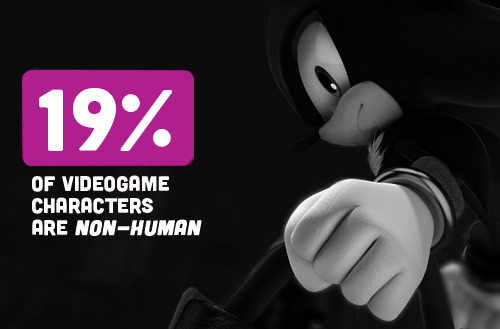
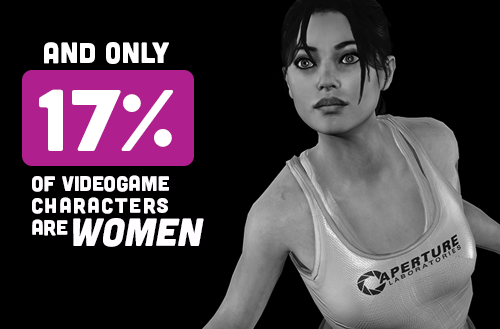
A study by Children Now and Dr. David Leonard of Washington State University this year that the images above reference showed that 17 percent of video games characters were female, 19 percent of characters were women and 64 percent of characters in video games were male. Even more distressing, the study found that found what little black women characters there were had a distressingly narrowed role: 90 percent of black female characters were either props, bystanders or victims. So with there being more non-human characters in video games than women characters in video games... how does that affect boys' views of women and what they can do? How does that affect girls' view of themselves? How many of the women characters are just motivation for the hero to start a quest, or a damsel in distress, or otherwise a periphery in a game?

As I've said often, representation matters. Two years ago, a study conducted by Commuunication Research showed that watching TV shows increased the self esteem of  white boys, but noticeably undercut the confidence and self esteem of girls no matter what the race.

One outlet that will be dedicated to tackling this issues is an upcoming podcast called The Smash Survey. The about page describes The Smash Survey as "... an upcoming podcast project that will critically explore the representation of race, gender, and queer identity in media and pop culture in a fun and engaging format. Through interviews, games, critiques, and panels TTS will try and answer the three primary questions of representation and media portrayals: Why are they the way they are, why are they wrong and what can we do to fix them?" You can follow the tumblr of the same name here.

What say you, readers?

Tuesday, July 22, 2014

Mythbusting Ideas About Women In The Game Industry


Brianna Wu has an excellent article on polygon today on women in the gaming industry and harassment. She outlines the stories of a number of women in the gaming industry and the harassment they have received.

Not only that, but each particular case study takes a myth surrounding online harassment of women in the games industry and shows how it's false, using that woman's direct, lived experience.

An excerpt from the introduction:
My name is Brianna Wu. I lead a development studio that makes games. Sometimes, I write about issues in the games industry that relate to the equality of women. My reward is that I regularly have men threatening to rape and commit acts of violence against me. 
If you are a woman working in the games industry, especially in a public way, you’re going to experience harassment. I imagine telling my 12-year-old self that fulfilling my dream of making games would lead to constant threats. Would she still do it? Would any woman? The problem with sharing these stories in broad terms is that people think men and women receive the same harassment online. They do not. I’m not writing this piece to evoke your sympathy. I’m writing to share with you what prominent, successful women in the industry experience, in their own words.
The entire article is a must-read.

She also created a companion video:

The harassment of women in the games industry is an epidemic, and it's also a reflection of the crap that women have to go through in society in general. It's easy to lay the blame at the feet of anonymous internet cesspools like 4chan and misogynistic pockets of Reddit but those are really just enablers. The internet doesn't exist in a vacuum. It’s part of the culture that we, as a society, have allowed to mushroom because we haven’t done much as a society to stop it.

I talked about a few things men can do to help stop this both online and in general in my blog post "The Status Is Not Quo: Being A Geeky Woman Online & What Men Need To Do".

Friday, July 18, 2014

The Status Is Not Quo: Being A Geeky Woman Online & What Men Need To Do


It's a bitter irony that for the many self-identified male geeks, nerds, gamers (both of the video and tabletop kind), comic books fans, sci-fi enthusiasts &etc that talk about growing up feeling unwelcome or ostracized in wider society, many women wanting to contribute to, or participate in, those same communities end up feeling that same isolation, hostility and othering just for being a woman online. Whether it's having their "credentials" challenged as being nothing more than a "fake geek girl" or being made to question their own legitimacy at an even just because they are attending an event with their significant other.

Online platforms like Twitter and Youtube have enabled women to work to curate and create spaces on their own terms. Women have flocked to these services to create their own networks of support, activism, and discussion as well as reclaim online space to talk about shared interests, media fandom, geek culture, video games and more from a feminist perspective. However, as Samantha Allen points out, for all the resources and community the Internet has offered, it has made it...

"...much easier for men to manipulate, harass, abuse, stalk, and, yes, physically harm women.This past weekend, I was on a panel with some members of Nostalgia Chick, a set of veteran media critics who often include feminist perspectives in their videos. They told me that the Internet, in many ways, has become a less hospitable place for them to do their work over the years. 

And I believe it. Between 4Chan, Men’s Rights Activist groups, theReddit Red Pill community, pick-up artist (PUA) groups, and anti-PUA groups like the one that Elliot Rodger clung to so dearly, the Internet has allowed men to band together more efficiently than ever before to threaten and antagonize women. Every woman with an online presence has a story to share about unwanted contact, sexual harassment, and predatory behavior."

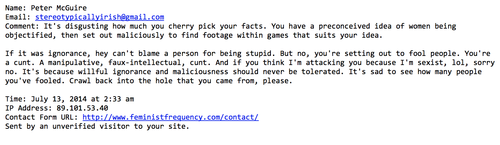
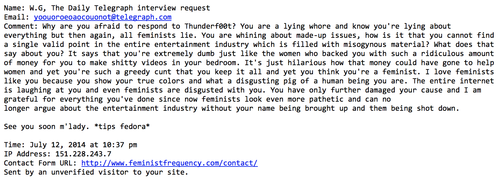
Anita Sarkeesian, the writer and producer of the Feminist Frequency web video series, started the "Tropes vs. Women In Video Games" series that looks at video game tropes and culture through a feminist lens, has been the target of years of harassment, and recently shared a small sampling of the harassing emails she gets on a regular basis:
I get so many emails like this I could publish a coffee table book full of them.
image
It’s especially amusing that this misogyny laced email is unironically signed “See you soon m’lady. *tips fedora*”
image
Sadly, this is a widespread problem for women creators on YouTube, and was addressed at this year's VidCon, the world's largest conference for online video content creators. As Rae Votta outlines in "What It's Really Like For Women On Youtube":

In March, abuses of power by men in the YouTube space over their younger, female fans came to light after several women spoke out on Tumblr and other platforms about their experiences, causing community-wide outrage and task forces like YouCoalition, which was formed to “combat sexual abuse, emotional manipulation and other forms of violence in the YouTube community,” according to the website. Saturday’s Women on YouTube panel broached this still-raw topic, emphasizing the opinion that, while the start of the conversation about abuse had a lot of flaws, the important thing is that the community doesn't treat the situation like it’s finished, and still gives the issue the attention that it deserves.

Rojas, who was one of the women who spoke out against inappropriate behavior, chimed in, “We've shown a lot of people that they won’t get away with it.”
“We are not a community that welcomes abusers,” emphasized Lex Croucher. “The most important thing is to encourage people affected by this to come forward and [to be] supportive of those who do come forward.”
Lots of people try to frame harassment and abuse online as "just the Internet", but the emotional toll and physical danger is important, and a very real threat, and carry very real consequences. Recently, Samanta Allen was harassed off Twitter after she was buried under an avalanche of harassing tweets when she talked about how she liked the staff of Giant Bomb but was disappointed that for all the site's talk of valuing diversity, the site's first public hires in years were another two white men. Women's hurt and fear for safety and the emotional toll for being harassed online have real, chilling impact on discourse.

This is unacceptable. And the burden of speaking out shouldn't continually fall to the women being harassed. So what can we do? Guys, we have to loudly speak out against this behavior. We have to support women in our creative and media spaces. We need to let other men know that this behavior is not okay, and we need to make it socially unacceptable. We need to listen to women's experiences-- really listen, and not just wait for our chance to say "not all men". We need to realize that online harassment isn't something that just happens-- it's a choice that is made, it is a crime that is done.

As Andy Kouri says in "Fake Geek Guys: A Message to Men About Sexual Harassment":
It is wholly and rightfully and crucially up to men in this society and especially in this subculture to speak out and watch out. To end the cycle of bullying, harassment and violence. To recognize the grotesque irony of degrading women over matters of heroic fictions whose lessons about fairness and decency we’ve supposedly been studying since we were just little boys, and to start putting those ideas into practice as grown-ass men. 

Readers, what say you? Sound off in the comments below.

Share This Post