Showing posts with label new media. Show all posts

Tuesday, July 18, 2017

Listen Up: Black Media Minute

The Black Media Minute is a podcast that dives into the ins and outs of the media business with Black creatives and industry professionals. The show features interviews and analysis of books, movies and television. It's hosted by Kimberly Foster, who was named one of Forbes' "30 Under 30" last year. Every episode is packed full of probing interviews and insightful conversations with  people who shape the media landscape.

You can follow along at the Black Media Minute with Kimberly Foster website or via itunes.

Listen Up is an ongoing series devoted to shining a spotlight on podcasts by diverse creators. You can check out all the podcasts previously featured here. If you have a podcast you'd like to recommend, post it in the comments or email me at shawnstruck at gmail dot com.

Thursday, January 21, 2016

Libraries Have Reference Books, So Where's The D&D?

In theory, Dungeons & Dragons and local libraries are a perfect fit. Both libraries and D&D attract people who love reading, imagining new vistas, poring through books, reading and creating stories, and looking up lore. In fact, the earliest D&D game books directed readers to libraries for research and recommended reading. Many libraries even have extensive graphic novel sections, comic book clubs, or provide meeting space for tabletop gaming groups. In practice, finding D&D rulebooks-- or any sort of tabletop gaming resource is well-nigh impossible, even though Dungeons and Dragons have influenced an entire generation of today's writers. Why is that?

Edward Schneider is a professor who studies how media and information is used and how it's organized. Brian Hutchison is not only a lifelong Dungeons & Dragons player, but also an librarian and information specialist. They were fascinated by the disconnect between the potential fit between D&D in libraries and how thin on the ground the availability was, and decided to conduct a study tracking role playing gamebooks in libraries around the country. The study, entitled "Referencing the Imaginary: An Analysis of Library Collection of Role-Playing Game Materials" was recently published in the journal The Reference Librarian and Schneider explained a little bit about the study in an article for Gizmodo:
The most commonly held book was the 2008 edition of the Dungeons & Dragons Player’s Handbook, with 327 copies worldwide — almost 50 fewer copies than the sequel to Snooki’s opus! If you like irony, there are 70 copies of the world’s most depressing cookbook,Microwave Cooking for One, on library shelves, and 21 copies of Heroes of Horror.Heroes of Horror is the Dungeons & Dragons book that allows you to play as an Archivist — a magical librarian. 
...There is no sign that popular interest in fantasy and science fiction is subsiding. Game of Thrones, Lord of the Rings, HP Lovecraft, and Star Wars all have direct links to the role playing game genre. An increasing number of universities offer video game design and development programs, and Dungeons & Dragons has been extremely influential in the history of video games, especially in Japanese RPG’s. D&D games are natural tools for libraries to use in community building in public libraries, but they also belong in academic libraries; the academic study of games has steadily increased.

We heard many different reasons why libraries might not stock these materials widely, but none of them made much sense.
The materials were not more prone to theft, not more or less checked out or circulated then comparable volumes, and had plenty of positive reviews from a variety of sources. So why the scarcity? The author theorized anti-D&D hysteria from the 80s and 90s, as a possible idea that has taken hold. What does this mean for the future of these resources and local libraries, though? Schneider is hopeful, concluding that there was
...a huge opportunity for librarians to connect with a different part of their community. Librarians seek to serve their patron communities, and it is time they considered adding more from the RPG genre to collections... I encourage genre fans to talk to their local librarians. A few vocal patrons can make a big difference, give your local library an excuse to collect and display these materials. Give them some friendly guidance, and make sure to speak up for your favorite publishers!

Thursday, June 11, 2015

Austin Walker On Video Game Critics & Influence

Description: The word JUDGE looms over a stick figure drawing
of a person frowning at a computer monitor, hands steepled.
Austin Walker has been a hot new hire for video game website Giant Bomb,and with his latest essay for the site, it's not hard to see why. In his latest editorial in the "Why We Write Series", he tackles the importance of critique, the reasons behind it and the influence of games criticism and games as entertainment.

First of all, he wants to dispel the notion of critics trying to "force changes" on unwary developers:
So, what if instead of thinking about all of this in terms of a binary relationship (either a critic forces someone to do something or they don’t), we thought about this on a spectrum. On one end of the spectrum is absolute disconnect from influence: A writer pens long form essays about how developers should always do whatever they want. On the other end of the spectrum is critical work demanding that devs actually be “forced” to do things. But most critique exists in between those two extremes. 
He also puts the boots to two other ideas behind pulling punches when it comes to criticism of games-- targeting and timing:

When we note that a game is filled with slurs and offensive caricatures, we’re told that we should be less offended because, hey, it's just satire. When we point out how a game leverages a history of racialized, coded imagery to elicit fear, people link us to wiki articles and explain the deep lore as justification. When a game made me spend a half hour of my real time every day just to keep my skin color on point, I was told that, no no, of course games have a problem with race, but why did I have to go after Animal Crossing...
Yes, writing about diversity and The Witcher 3 is especially complicated because of the perspectives involved. Polish history is filled with outsider groups minimizing, controlling, ignoring, and erasing the nation's unique ethnic and cultural character. At the same time, people of color in white-dominant spaces have struggled to develop the vocabularies of critical race studies and post-colonialism only to then be told to mind their tone. These things mix here in an especially volatile way. But this doesn't mean that we should shy away from addressing it, afraid of stepping on toes, afraid of what we don't know. It means we step forward in good faith, with sympathy for the other perspective, and with a willingness to incorporate the complexities of someone else's view.

He also covers ideas of American standards, media influencers, and the emotional core that drives him to write. A great read.

Thursday, August 7, 2014

Twitch.tv Is Digging Its Own Grave

base image courtesy of the Oregon Trail Tombstone Generator
Twitch.tv was spun off from its parent site, justin.tv when the company noticed that live streams of video games and e-sports were one of the fastest growing video categories in both content and viewers. Eventually twitch.tv became so popular, according to the Wall Street Journal  streaming of twitch.tv video accounted for 2 percent of all internet traffic used in the US and was the fourth most popular source of internet traffic during peak usage hours. Twitch.tv outlasted not just its only real direct competion (the site own3d.tv, which went out of business last year), but even outlasted its parent site-- justin.tv shut down operations this month.

In the same month that the Wall Street Journal published the article pointing out twitch.tv's success, the interactive experiment "Twitch Plays Pokemon" became a runaway hit, amassing millions of views and praise from Twitch's vice president of marketing, Matthew DiPietro. DiPietro told Gamespot that the original stream was an example of “how video games have become a platform for entertainment and creativity that extends WAY beyond the original intent of the game creator.” It was also announced this year that twitch.tv would be the official streaming video provider for E3.

But just a short time after it was reported that Google purchased twitch.tv for 1 billion dollars, it seems that new content restrictions and fundamental changes to how the site works are alienating long-time users and angering developers. In official blog posts from the twitch dev team, it was announced that previously saved and archived broadcasts were slated for deletion. Certain highlight videos would be saved, but only up to a maximum of two hours. Many twitch channels have archived broadcasts going back years, which are now going to vanish soon.

In another unwelcome change, if your broadcasts use anything twitch decided was copyrighted audio (including in-game music), and you saved it for later, the ENTIRE half hour segment would have its audio muted. Thais has resulted in broadcasts that have no other audio but the in-game music as someone plays being muted entirely, and even developers showing their own game off via twitch have had the audio muted!
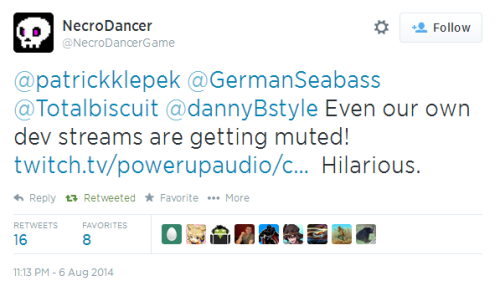


Was the audio muted thanks to the game's composer, maybe? Nope.
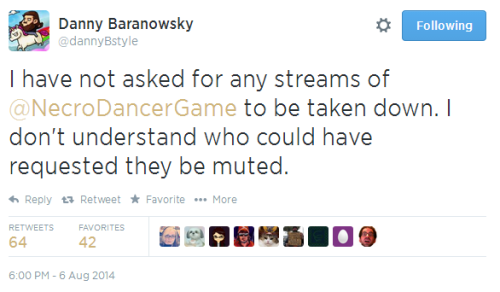


Alright, then maybe audio tracks are flagged for being muted because the creator might have registered them with some sort of content service?


That's odd. Well, there has to be some way the developers can clear music track beforehand, right?
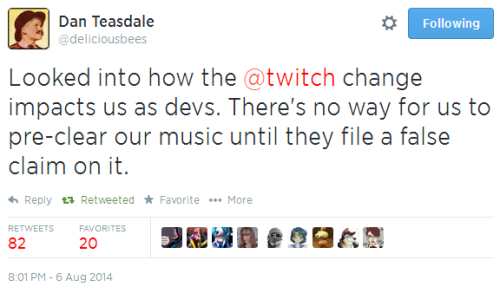

Oh. That's really not good. As tumblr user khoroshocrossing put it:
Think of your favorite youtuber. Imagine if all their old videos were suddenly deleted, and you could only view their uploads in meaty chunks that split up their full recording. Now, imagine if these meaty chunks are censored because of copyright restraints on audio usage and short audio clips. So huge portions of their library are restricted and permanently erased because they used a copyrighted clip. It would be an enormous pain in the ass and it would strongly stifle what content creators can upload to their channel, right? Well, just apply all of the above to video game streaming, and now you've got a massive problem. 
There's already been a lot of push-back from both twitch users and game developers, but twitch doesn't seem to want to budge. Can a company founded on the backs of its community engagement last for long when it takes steps to alienate the same userbase that made it ripe for Google's billions in the first place?

(Thanks to tumblr user flatluigi for the twitter screencaps.)

Update: Wow, this article has blown up! If you like what I do here, please consider chipping in via patreon-- you get something back from me for as little as a dollar-- or hitting the donate button on the right sidebar. Thanks for reading!

Share This Post