Showing posts with label critique. Show all posts

Tuesday, July 4, 2017

Listen Up: Artistic State of Mind

Juliana and Stephen are brother and sister, but don't think the debates they get into are just another form of sibling rivalry. They are both passionate hosts that really give listeners a deeper dive into the world of theater, acting, music and film. In-between the regularly updated podcast, they're both quite involved in the UK music and stage scene and do lots of work on initiatives to celebrate and uplift diverse artists.

They just recently wrapped up Season 2, so now's the perfect time to catch up. You can follow along on the Artistic State of Mind website, on iTunes via iOS or check out the podcast's dedicated soundcloud.

Listen Up is an ongoing series devoted to shining a spotlight on podcasts by diverse creators. You can check out all the podcasts previously featured here. If you have a podcast you'd like to recommend, post it in the comments or email me at shawnstruck at gmail dot com.

Tuesday, June 13, 2017

Glitch In The Narrative: ROM 2064 Missteps With Disability

I loved almost everything about MidBoss' cyberpunk adventure game, Read Only Memories: 2064. The soundtrack was evocative and well put together, the look of the game nailed the classic cyberpunk aesthetic, the writing was by turns affecting and humorous, and nearly all the characters from the protagonist and side NPCs were vibrantly well written. ROM: 2064 is also a game that takes unflinching looks at issues of morality, disability, gender, and mental illness in society, which is why one character's end game story turns out to be so disappointing. I've set up a jump cut to ward off accidental spoilers, so be warned: the rest of this post features spoilers for the endgame of ROM: 2064.

Tuesday, November 29, 2016

Anime Fandom Needs A Wake-Up Call

Anime fandom in the US has come a long way since the early 1980s when you'd be hard-pressed to find much available commercially outside of episode of Voltron or re-runs of Speed Racer and Astro Boy. From the anime boom of the 1990s to the mainstream success of the anime genre leading to over 2 billion dollars in US sales over the past decade, anime has sparked a cornucopia of fan activity along with it. Fan art, fan fiction, fan conventions.

 Many anime fans have been keen to point the rich tapestry of expression and artistry that goes into anime they like, which makes it really peculiar that anime fandom as a whole is so resistant to critique. Other forms of artistic media and media fandom have long had strenuous elements of critque, but when writers and critics attempt to look at anime with the same tool-set that has been successfully applied to books, music, and film for decades, the nerd rage is palpable. Anime Feminist which bills itself as a hub for "reviews, interviews and discussion on anime and manga through a feminist lens, run by a team of writers from academia, the industry and grassroots fandom" was online for five days before it received its first death threat.

It's not like the articles on that site rehash tired old debates like "subs vs dubs" either. The writing published is quality work from fans that know their stuff-- both media and academic-wise. For example, the site has a great interview with manga artist Minami Sakai as well as an essay by Peter Fobian that examines the difference in treatment of Black Lagoon's Revy and Gurren Lagann's Yoko:
Where Revy’s presentation sells a complex and volatile character, the choice of camera angles, exaggerated postures, and repeated compromising scenarios makes Yoko come off as a source of inappropriate humor at best or a pure source of visual titillation directed at the male audience at worst. Revy’s background and her relationship with Rock are able to be respectfully explored because she is presented as a serious character. Conversely, Yoko’s later development is undermined by her presentation as something less than a character, an ornament not to be taken seriously.
Anime Feminist's co-founder, Amanda Cook, gave an interview on Kotaku that touched on why she feels this matters, and how a stubborn refusal to examine anime can lead to shrinking of an art form AND its audience:
There are many, many women, queer people, non-binary people, people of color who can tell you quite clearly why it matters to them personally, and I think everyone should listen to their stories. If empathy isn’t enough to convince you, more objective reasons why sexualized or infantilized representation of women is a problem include the fact that it’s poor storytelling... [it's] common in anime and we accept it as the price of admission. Not everyone will care about storytelling quality in anime, or any media they consume, but high profile critics do, and most won’t waste their time reviewing—in other words, promoting—anything that they don’t expect to meet their basic standards for quality... I have a lot of friends who used to watch anime but don’t anymore, partly because, like me, it became too hard to seek out anime that treated women well. There are also lots of people who are enthusiastic about other geek properties but won’t touch anime because of its reputation of infantilizing women and sexualizing children. It makes it hard to recommend anime to people who aren’t already fans
This pervasive background radiation of out of place fan service and explosion of jacked-up sexualization has some collateral damage, too: other anime fans, especially cosplayers. In the article "How ‘Locker Room Talk’ And Casual Misogyny Are Making Conventions Intolerable For Cosplayers" Alyssa Fiske details how these attitudes can make conventions into an uncomfortable and sometimes even dangerous experience. 
Done well, cosplay can be one of the most joyous expressions of fandom, and a huge part of fandom is feeling like something special belongs to you, that a specific part of pop culture spoke to you so deeply that you wanted to wrap yourself up in it, mentally and physically. It’s a harmless bit of escapism, one that can inspire creative, emotional, and physical expression that many can take part in and enjoy. But it’s not without that dark side that Krose experienced at Dragon-Con, one that prompts those in the vicinity of cosplayers to gain a boldness that can make those in costume uncomfortable or unsafe. Oftentimes people forget that there is a human being beneath the costume, leading to inappropriate situations that add an unfortunate, even frightening, element to the convention experience.
In 2014, Bitch Media did a study on the percentages of people in the industry who had experienced verbal and physical harassment, and the numbers were staggering: 59% said they felt sexual harassment was a problem in comics, and 25% said they had been sexually harassed in the industry. As far as convention attendees themselves, 13% reported verbal harassment, while 8% had been physically assaulted, groped, or raped. In a society that still blames women for their own assaults or denies that they even happen, there is no guarantee that your distress will even be acknowledged. While it is great that the community takes care of its own, there are still steps that could be taken to ensure harassment numbers go down.
The US industry of anime and manga does some amazing things; it's possible to get official same-day release of subtitled episodes, digital releases of manga alongside print counterparts, more use of the visual novel style of games. But anime fandom's general insistence that its direction or demands or troubling attitudes and culture are sacrosanct-- especially when so much of it can be troubling and anti-women makes me sad. It also makes it super difficult for anime to reach a wider audience, because uncritical attitudes mean that anyone who just wants to dip their toe into the anime pool doesn't have good enough guidance to help them wade through a river of crap.

Thursday, June 11, 2015

Austin Walker On Video Game Critics & Influence

Description: The word JUDGE looms over a stick figure drawing
of a person frowning at a computer monitor, hands steepled.
Austin Walker has been a hot new hire for video game website Giant Bomb,and with his latest essay for the site, it's not hard to see why. In his latest editorial in the "Why We Write Series", he tackles the importance of critique, the reasons behind it and the influence of games criticism and games as entertainment.

First of all, he wants to dispel the notion of critics trying to "force changes" on unwary developers:
So, what if instead of thinking about all of this in terms of a binary relationship (either a critic forces someone to do something or they don’t), we thought about this on a spectrum. On one end of the spectrum is absolute disconnect from influence: A writer pens long form essays about how developers should always do whatever they want. On the other end of the spectrum is critical work demanding that devs actually be “forced” to do things. But most critique exists in between those two extremes. 
He also puts the boots to two other ideas behind pulling punches when it comes to criticism of games-- targeting and timing:

When we note that a game is filled with slurs and offensive caricatures, we’re told that we should be less offended because, hey, it's just satire. When we point out how a game leverages a history of racialized, coded imagery to elicit fear, people link us to wiki articles and explain the deep lore as justification. When a game made me spend a half hour of my real time every day just to keep my skin color on point, I was told that, no no, of course games have a problem with race, but why did I have to go after Animal Crossing...
Yes, writing about diversity and The Witcher 3 is especially complicated because of the perspectives involved. Polish history is filled with outsider groups minimizing, controlling, ignoring, and erasing the nation's unique ethnic and cultural character. At the same time, people of color in white-dominant spaces have struggled to develop the vocabularies of critical race studies and post-colonialism only to then be told to mind their tone. These things mix here in an especially volatile way. But this doesn't mean that we should shy away from addressing it, afraid of stepping on toes, afraid of what we don't know. It means we step forward in good faith, with sympathy for the other perspective, and with a willingness to incorporate the complexities of someone else's view.

He also covers ideas of American standards, media influencers, and the emotional core that drives him to write. A great read.

Wednesday, June 10, 2015

Sherlock, Watson & Chainmail Bikinis

Description: A red-haired woman warrior locked in combat
with a lizard monster taller than she is. She holds a shield
to defend against attacks, sword ready to strike.  The armor
she is wearing is a chain mail bikini, leaving much of her body
exposed to attack.
There are two terms in literary criticism that have been used in the wider world of media fandom and fiction critiques: Watsonian and Doylian. Watsonian means looking at something from an in-universe perspective. For example: "Sherlock Holmes died in that story because he fell off a cliff," would be a Watsonian explanation. "Sherlock Holmes died because the author was sick of writing stories about the detective and wanted to start something new," would be a Doylian perspective, named after the author of the Sherlock Holmes, Arthur Conan Doyle. It was first used on a Bujold-Master fan discussion list and spread from there. It's basically making a difference between talking about something a character says or does and how it fits with the character's fictional world, and why or how the writer's choices fit into our real life life culture, society and circumstances.

There can be a bit of a problem in discussions of fiction when a Watsonian (in-universe) perspective is used to dismiss a Doylian (real world) criticism, and nowhere is that more apparent in both tabletop and gaming circles than the trope of the Warrior Woman Who Fights In A Chainmail Bikini.

The chainmail bikini has been a staple of pulp fantasy art since the 1930s, and has appeared in one form or another in the art and character designs of fantasy novels,tabletop games and video games ever since. Take the cover art for Runequest up there. An in-universe explanation for why the character chooses to wear a chainmail bikini because she feels powerful, almost invincible in battle, and doesn't think she really needs to wear practical armor, so what's the big deal? That would be a Watsonian view.

Description: Video game renders of characters in
armor.On the left,a woman wears armor that covers
armor covering her hands, feet, legs& shoulders while
barely covering her crotch and breasts & exposed
midriff. At right, a male character in armor leaving
nothing exposed but his head.
But the artist or character designer choosing to draw her or portray her that way isn't a value-neutral choice when you look at it in a Doylist (real world) sense. Sure, in the fictional world the story takes place she's Druscilla the Invincible and her bikini symbolizes her fearlessness. But the character also exists as part of a whole trope of chainmail bikini women in fantasy battlefields that have the men warriors decked out in armor from head to toe. And THAT exists among a tradition and media landscape showing women dressed like that merely acting as decoration for men who look like the traditional badass power fantasy. In-universe, the chainmail bikini could represent the character's choice to show fearlessness. In the real world, it is the artist who is choosing to create this look for a character, and those depictions mean something else entirely.

So yes, you can totally appreciate and acknowledge just how awesome Druscilla is in her story
setting. You can't, however, make the context for her portrayal and her appearance vanish or ignore it just because you happen to like her story or her character. So if someone points out how that portrayal in the wider world is sexist, and you counter with "This armor has a practical advantage and it's the character herself choosing to wear it!" you are trying to counter a Doylian crtique with a Watsonian explanation, and that doesn't quite work. Someone pointing out the inherent sexism in chainmail bikini art and representation is also about everything else in fiction in specific and society in general that that bikini can represent. If you're bombarded with those images and these portrayals amongst the constant sea of objectification of women, and you're a woman, you can't just not exists in the world you're living in and you can't just un-see it.


When someone points out issues with sexism in a game, it doesn't make the people who play it bad people. It doesn't make the artists or writers bad people either (though it might show them to be making lazy decisions). Critiquing elements of a game isn't an attack on the game or an attack on people playing it. Criticism of something you like isn't an attack on you. And this isn't just limited to video games.As recently as 2013, the The Science Fiction and Fantasy Writers of America's (SFWA) magazine The Bulletin generated controversy with its cheesecake cover of a woman in a chainmail bikini...on the heels of editorials and columns written talking about "lady editors" and rating women solely on attractiveness and how Barbie should be a role model to women in sci-fi and fantasy because she was "dignified".

Most people protesting what they see as gratuitous elements don't want to see things banned and certainly aren't trying to censor anybody (besides, censorship is something only a government body can do)-- they'd just like it to not be the default. It would be cool to have the default be something other that just skimpy or revealing attire. It'd be nice to get a break from the constant objectification. And these critiques can open up the door to considering other things we take for granted. Why not a lithe man calling himself Dru the Invincible wading into battle in naught but a thong? Does that seem silly to you, but not so much if it were Drucilla in her chainmail bikini? Why not?

Thursday, August 28, 2014

Writer Reveals The Truth About Zoe Quinn & Women In Tech


It's been a hell of a week for a few prominent women in video games. Just two days ago, Anita Sarkeesian got explicit, credible threats to her family, address and loved ones that she actually had to call police and move herself and her family out of their home for a night.

I've written pretty extensively about the campaign of harassment that's surrounded Zoe Quinn in two posts: "Not Okay: Hateful Man-Babies Target Zoe Quinn. Again." and "If You Call This Justice, I Don't Want Your Support". Since publishing those two posts, I've gotten comments, tweets and emails (the majority of which are unsigned) saying I was spreading a campaign of lies, that it was incumbent upon me to tell "the truth" about Quinn.

Yesterday, Elizabeth Sampat wrote a post called "The Truth About Zoe Quinn". Here's what she had to say:
The truth about Zoe Quinn is that no one in the world deserves the shit that she has gotten. The truth is that these witch hunts over journalistic ethics and transparency and whatever bullshit dog whistle that 4chan and its ilk are using for their issues with a woman’s sexual agency are driving women out of the industry.
...The truth is sometimes I have survivor’s guilt, and sometimes I have panic attacks about being the only one left fighting, and sometimes despite all of my tough words and the fact I literally cannot imagine doing anything else with my life, the truth is that I can’t stop thinking about maybe leaving the industry. I don’t want to; the thought is like an involuntary tic, tugging at my consciousness. Maybe it’s a survival instinct. I keep using the word “survive” but I can’t help but wonder: is this surviving? What parts of me are surviving? Can any woman escape this whole? 
...The truth is, a lot of the women who are being driven away have never met or interacted with Anita or Zoe. A lot of the women in our industry exist in a constant state of fear.  
Women who make games and would never dream of connecting their face or real name with a Twitter account, just in case.  
Women who would never go indie. Women who are terrified of starting a crowdfunding campaign but who can’t get their dreams funded any other way, and so their dreams just die.  
Are you okay with this?  
Is this the industry that you want?
It certainly isn't one I want. However, a lot of men don't realize they're complicit in creating this atmosphere, either by inaction of playing devils advocate. In the comments section almost every games news site I've seen there will be comments that start out with the obvious “What happened was horrible! I can't believe people would stoop so low" and then follow up with a huge "BUUUUUUUT look, her videos are so controversial and maybe if she hadn't been nicer or less emotional or were virtuos or didn't game people a reason to mad it would happen blippety bloo it's just my opinion blorpety blah not all men and not all gamers blah blah devilsadvocatecakes." It's maddening.


Wednesday, August 27, 2014

Responsible Fans & Thinking Critically

Image from Battle ROyale courtesy of J-Flim Pow-wow

In light of the recent discussions on entertainment's approach to the militarization of the police in the wake of Ferguson, Anita Sarkeesian getting a death threat today that involved law enforcement and having to leave her house, I wanted to revisit (friend of the blog's) Jenn Frank and her essay entitled "On Consuming Media Responsibly". In it, she delves deep into how one can still enjoy both an entire genre and specific works that also have problematic parts:
In the right context I’m not even slightly offended by gross-out stuff, tits-and-ass, or sexualized violence. I tend to accept these things as classic horror staples, staples that—especially in the case of the best North American slasher ever made, Black Christmas (1974)—can be used to chilling, humorous, and otherwise surprising effect... it’s less important what a movie says and more important that you, the viewer, understand why you’re enjoying it. I believe in judicious self-awareness; a director like Nicolas Winding Refn knows exactly why he makes the directorial choices he makes, and he works those kinks right out onscreen. Or, if you aren’t enjoying a piece of work—if ultraviolence isn’t your thing, or if you’re suffering a visceral reaction—it’s every bit as important that you identify what about the piece is making you uncomfortable.

This also applies to video games as well, as she points out:

But for better or worse, video games and their themes consistently alienate broad swathes of game players—and often for the very reasons other demographics of player enjoy them. As critics, players, and creators, it becomes important to identify and acknowledge both what is happening and why...
Feminist Frequency videos aren’t fearful or phobic; instead, they extend hope that video games and other media live up to their promise. But that hasn’t stopped some video game fans and men’s rights advocacy collectives from repeatedly decrying (and possibly even sabotaging) Sarkeesian’s work. Tellingly, Sarkeesian’s game videos themselves go into little depth at all. Their arguments are radically nonconfrontational, and also limited by time constraints. They’re basically “supercuts” themselves, demonstrating a medium’s laziest trait—this is the humor and value in any good supercut, really—so there is barely anything about Sarkeesian’s takeaway message to cause real affront to anybody. The disproportionately angry reaction to the Feminist Frequency videos, however, is due cause for alarm. If people, especially female people, can literally say nothing in criticism of lazy game narratives, what hope do we have? Nobody should become absolute arbiter of what we consume; that’s a private responsibility for adults or parents. We ourselves are our own gatekeepers.
Seriously, just liking something with problems in it doesn't make you a bad person. Similarly, someone pointing out why something is harmful or problematic isn't an attack on you. If we are to be responsible fans, let alone responsible people, it's important to think about what we like and why. We don't all have to agree, but there's a galaxy-wide gulf between disagreeing with someone's interpretation and declaring that they want to destroy something you love-- and by extension, you.

Tuesday, August 26, 2014

Open Letter To Aaron Diaz: Stop Hiding


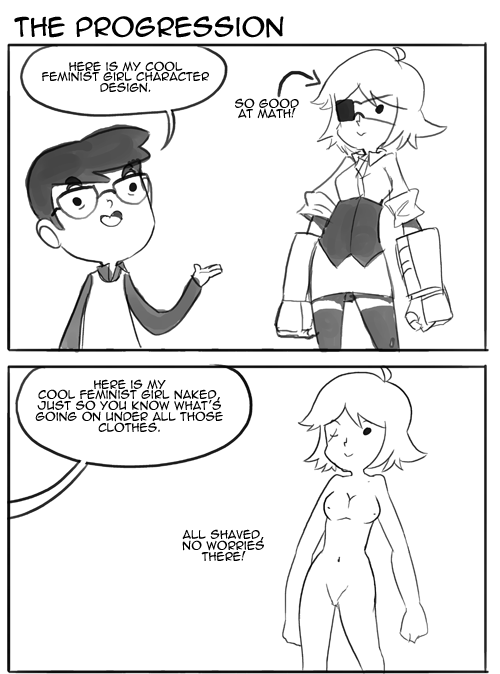
Web comic artist Mary Cagle, known on tumblr by the handle cube-watermelon,  recently posted the comic above, poking fun at the phenomenon of many male comic artists that self-identity as some form of progressive or feminist ally where they will draw cheesecake type pinups or costumes and scenarios that appeal to them specifically, but then try to dress them up (no pun intended) as not just pleasing to look at, but that the art is somehow "empowering" or transgression.

She concludes her post with the bon mot, "Sometimes I think it's okay to just admit you like looking at certain types of bodies naked, and that's okay."

While Cagle most likely wasn't surprised at getting some push-back from some people on tumblr, she was definitely surprised by one response: Aaron Diaz, the writer and artist of transhumanist science fiction web comic Desden Codak. He sent Cagle a note on tumblr:

Hey, how about not being a passive-aggressive shit next time, eh?
To which Cagle published the response:
I would think that you, who spend so much time pointing out the flaws and problematic areas in other people’s work, would be able to take one silly comic directed at your work and others like it. Normally I wouldn’t respond to this kind of thing publicly, but I’ll make an exception since you called me a shit.
Diaz has done many examples of comic and media criticism, notable among them being his redesigns of iconic DC Comics super heroes and concept art he made of Zelda as the lead character in a video game inspired, he said, by Anita Sarkeesian's Tropes Vs. Women in Video Games. And while Cagle parody comic wasn't specifically aimed at Diaz, it most certainly was inspired by a tumblr post (since deleted, see cached copy here) by him where he said "Inspired by some amputee photo shoots, I decided to try my hand at some cyborg-themed pinup sketches with Kim, a sort of celebration of the female form and taking agency over one’s body." Which is pretty ridiculous in the face of it, more so when you see the pin ups and his justification for drawing them (and that's leaving aide his kind of creepy "being disabled is totally an opportunity for the transhumanism movement). That fact that he deleted it shows that he recognizes that he messed up somewhere along the line, but instead of addressing it, he just vague-tweeted about it for a while.

In response to Diaz's actions, Magnolia Porter, a fellow web comic artist and friendly acquaintance of Diaz, published an open letter to Aaron Diaz:
There’s a place for everything, and an artist has the right to create whatever they want to create, for whatever ends they choose. What I have a problem with is that your comic is not presented as a science fiction comic with a dash of sexy thrills, but rather as a feminist narrative in support of powerful independent women. You've made it clear on many occasions that you don’t consider your work to be objectifying or sexist. I have a problem with cheesecake-style art being presented as something feminist, empowering, enlightened- something made “for women”, when it’s clearly made for men.You’re allowed to make art with male gaze. But please call a spade a spade... 
I don’t think I've seen a single page of Dresden Codak that doesn't feature a woman posed in a male-gazey way, with loving focus on her ass or cleavage, or wearing a sexual costume, or in some situation that puts her in a compromising position (like the most recent page in which Kimiko's clothing is burned off of her body, which has happened at least twice in the series’ run.) I have a very hard time believing that these details are accidental. 
...Aaron, you can do whatever you want with your own comic. However, if you really do care about female characters in media, or care to know why so many people seem to be angry with you about it, I would do one of two things. If you don’t want your comic to present its female characters in a borderline-erotic light, then stop doing that. If you don’t mind that, then by all means continue, but please just admit that you like drawing t&a and that it’s not particularly empowering, or feminist, or a celebration of personal agency. As a woman, I resent being told that men’s eye candy is actually meant to uplift me and that I should celebrate it.
Honestly, I don't have any sympathy for Aaron Diaz, nor do I have any sympathy for his position nor his reactions. He got called out for his messed up behavior and has fired back with sadly-all-too-typical defensiveness.

I've seen it happen so often, it's become distressingly familiar. A woman points out that a character or story or the way something is presented is sexist. Men insist that woman is seeing things that aren't there or otherwise reading too much into things because it doesn't come across as sexists to them. This is something I've done before, myself. As men, we are often taught that our perspectives are the default. We end up taking our perspectives and assuming that's how it is for everyone.

Commenter divined by radio at metafilter said it pretty well, I think:
So men who adamantly refuse to believe that their own gender privilege may have resulted in a variably-applied resistance to accepting a woman's objection or approach as valid -- to believe a woman when she speaks, to allow that what she is saying is true, even if they have not experienced precisely what she has experienced -- are displaying, at best, a touch of willful ignorance. They are privileging their own feelings and desires over women's truths, lives, stories, and experiences. And the end result doesn't tend to be very flattering.


Wednesday, July 23, 2014

Game Developers, Armchair Designers and Game Critiques

Image courtesy The Muppet Holding Company
If you haven't added the insightful blog "Ask A Game Developer" to you bookmarks, feed list or blogroll, you really should. The blog is run by an unnamed game developer who both answers reader questions about game development, and occasionally write essays on different aspects of being a game dev. One of the more interesting discussion threads that emerged was the role that game reviews and YouTube reviews played in game development. As it turns out? Not very much.
"As a whole, however, the developers don’t really pay attention to that sort of thing. We’re too busy working on the game itself to really pay too much attention to the gaming media outside of cursory attention just to keep abreast of current events in the industry. A handful of people might enjoy watching the youtubers or other video makers (I think Zero Punctuation is fairly popular at my office) who post let’s-plays or reviews or opinions on games, but that’s more of the exception than the norm."
Well then, according to this game developer, who does care? The marketing team.
"...they absolutely care about the gaming media, youtubers, and anyone else who creates content related to the (possible) promotion of games. In these situations, however, what they care about is the metrics. How many of the readers/viewers are in the target demographic? What is the general attitude toward the developer and publisher by the audience? And, most importantly, if we spend part of our marketing budget to hire this person/group/etc. to promote our product, what sort of returns will we get? "
The blog author delves further into this when they discuss what they call "armchair designers" in the post "Getting Up From The Armchair":
"So here’s the thing about armchair designers. They tend to lack the context to make choices like how much time, effort, and/or money it will cost to get something done. After all, they’ve never had to deal with a budget or a production schedule or requirements before, so they aren’t necessarily aware they exist or how they work. They don’t know how long a cinematic scene will take to create, because they never had to wait for the motion capture and audio recording, or set up the positioning and timing, or make sure they stayed within the word budget, or had to create it without using any additional resources because the animation department was tasked up the wazoo already. Because the armchair designer lacks this crucial context, he lacks the necessary skills to determine whether something is easy or hard to do."
What do you think? I'm torn. I do believe that baseless, uninformed critique doesn't help anyone-- it's just posturing and pontificating on the critic's part and useless noise. However, just because someone doesn't have a background in game development doesn't mean that critiques that come from someone without a game development background are useless. Games, after all, are meant to be played. And some game studios have tried to deflect legitimate criticism with bogus technical explanations (google "assassin's creed" and "women are too hard to animate" for example), and making a game dev background a requirement for decent critique is a bit of unnecessary gate-keeping to excludes those that have already been marginalized in gaming spaces. In fact, setting it up as a dichotomy is a false choice, in my view. People can create AND critique, and many would argue that criticism is an important part of the artistic process in and of itself. While I think there's an effective way and an ineffective way to critique, I also think that creation doesn't exist in a vacuum and artists and creators will never learn, develop, or improve from an echo chamber.

What say you, readers?

Share This Post