Thursday, January 8, 2015

Intel Apologizes for #Gamergate, Funding 300M Diversity Initiative

Photo courtesy theverge.com
Intel recently announced at the Consumer Electronics Show that it invest $300,000,000 in a "Diversity in Technology" initiative.  The initiative will see Intel investing in and partnering with the National Center for Women in Technology, Feminist Frequency, Rainbow PUSH, Girls Who Code, the Cybersmile Foundation, the IDGA and more.

Intel CEO Brian Krzanich said in his keynote address that "It's not good enough to say we value diversity, and then have our industry not fully represent..." women and other minorities, and that the aim goes beyond the company's bottom line. "This isn't just good business," said Krzanich, "this is the right thing to do... We're calling on our industry to again make the seemingly impossible possible by making a commitment to real change and clarity in our goals. Without a workforce that more closely mirrors the population, we are missing opportunities, including not understanding and designing for our own customers." To show the effort is more than just talk, he said will make sure its hiring practices reflect this going forward and will tie its leaders' pay to the progress toward this goal, which will be closely tracked and monitored.

Last year, after the #gamergate-led groups directed an email astrotufing campaign to Intel attacking a blog post Leigh Alexander made about the hate group on Gamasutra, a video-game industry-focused site, and succeeded in convincing the company to temporarily withdraw its advertising contract. Intel later reinstated its advertising and released a statement saying "Intel does not support any organization or movement that discriminates against women. We apologize and we are deeply sorry if we offended anyone."

How Nerds Dreamt of Rebel Alliance But Became The Empire

 Laurie Penny, author of Unspeakable Things: Sex, Lies & Revolution, is also a prolific columnist and blogger and has written on everything from capitalism and feminism to pop culture and science fiction. She recently read Scott Aaronson's comment on a blog post about sexism and the roles of men and women on the STEM fields, where Aaronson writes of the pain, confusion and isolation he experienced for years and how while he felt he agreed with most of the ideas behind feminism, when it came to discussions of privilege, he stopped dead in his tracks, saying the be was sure that "...being a nerdy male might not make me 'privileged' — that it might even have put me into one of society’s least privileged classes" and that he spent years growing up "... feeling not 'entitled', not 'privileged', but terrified."

Penny, in her personal essay "On Nerd Entitlement" responds with understanding and empathy:

"As a child and a teenager, I was shy, and nerdy, and had crippling anxiety... desperate for a boyfriend or, failing that, a fuck... I hated myself and had suicidal thoughts. I was extremely lonely, and felt ugly and unloveable. Eventually I developed severe anorexia and nearly died... Having been a lonely, anxious, horny young person who hated herself and was bullied I can categorically say that it is an awful place to be. I have seen responses to nerd anti-feminism along the lines of  being bullied at school doesn't make you oppressed. Maybe it's not a vector of oppression in the same way, but it’s not nothing. It burns. It takes a long time to heal... [S]hy, nerdy boys. Your suffering was and is real. I really fucking hope that it got better, or at least is getting better, At the same time, I want you to understand that that very real suffering does not cancel out male privilege, or make it somehow alright. Privilege doesn't mean you don't suffer, which, I know, totally blows."
She points out though, that unlike Anderson, she also had additional barriers in her way. "I was also female, so when I tried to pull myself out of that hell into a life of the mind, I found sexism standing in my way. I am still punished every day by men who believe that I do not deserve my work as a writer and scholar." In fact, men outnumber women in STEM fields, and a recent Yale study showed that when faced with equally qualified men and women applicants in a STEM field, professors were more likely to offer the man a job than the woman. If the woman was hired, her starting salary was, on the average, $4,000 LESS.

Penny further explains:
"...imagine what it's like to have all the problems you had and then putting up with structural misogyny on top of that [or] also faces sexism and racism. This is why Silicon Valley is fucked up. Because it's built and run by some of the most privileged people in the world who are convinced that they are among the least. People whose received trauma makes them disinclined to listen to pleas from people whose trauma was compounded by structural oppression. People who don't want to hear that there is anyone more oppressed than them, who definitely don't want to hear that maybe women and people of color had to go through the hell of nerd puberty as well..."

The entire essay is a nuanced, empathetic response, and I encourage you to read the whole thing.


Wednesday, January 7, 2015

Now You're Playing With (Word) Power


Screenshot via Dejobaan Games
Text-based games have been a part of interactive entertainment since the first home computers. Ask most people what sort of game comes to mind when they hear "text based gaming" and most people will probably answer "interactive fiction" (which has undergone a bit of a renaissance in the bast few years thanks to the development and popularity of Twine). But developer of critical hits The Wonderful End of the World and AaaaaAAaaaAAAaaAAAAaAAAAA!!! has a new entry into the field. Dejobaan Games' latest release, Elegy For A Dead World, makes writing an integral part of its game-play.

Elegy For A Dead World was successfully funded via Kickstarter in October, and its premise is pretty interesting. It is a text-driven adventure game about sifting through the remains of long-dead civilizations and chronicling what you find. You do this by wandering past sumptuously hand-drawn scenes and then giving your reaction via prompts-- sort of like filling in the blanks. The game then takes your writing and stitches it into a narrative which you can then share with others via Steam Workshop.

In "A Videogame That Teaches You to Write Poetry, Even if It Intimidates You" by Bryan Lufkin in Wired, the specific scenarios and how you complete them are intriguing:

Elegy lets players write prose and poetry as they explore distant planets and dead civilizations. The player faces 27 challenges in three worlds, each riffing on a specific British Romance-era poem: “Ozymandias” by Percy Bysshe Shelley, “When I Have Fears That I May Cease to Be” by John Keats, and “Darkness” by Lord Byron. The different challenges find the player in various roles: an emperor rallying his troops before a doomed battle, for example, or a schoolgirl evacuating a city being bombed. Players travel through beautifully designed backgrounds, while on-screen text narrates the story. But much of the text is left blank—that’s when players tap their inner Wordsworths, finishing the tale with their own imaginations.

Is it any good? I've enjoyed my time with it, and PC Magazine named Elegy For A Dead World as one of its 2014 Games of the Year. It's out now, and you can pick it up from the Steam Store here for PC, Mac and Linux.

Steam Users to Valve: #GamerGate Group's Gotta Go

A few months ago, Steam introduced what was called the "Discovery Update" to the service. One of its biggest additions was introducing something called "Steam Curators". Curators can be any individual or organization who has opinions about games and wants to share them, and Steam offers a home page where the group list its recommendations.

Unfortunately, Steam helpfully will recommend groups to you whether you want to or not, which is how users have reported being shown the Gamergate Recommends curator recommendations:


And when a group is recognized as a Curator, there's more than just a homepage with game recommendations. These recommendations also appear in the official Steam stores, right near the "add to cart" button. User [FoH]Fansy screencapped what appeared on the official Steam store for Shantae: Risky's Revenge The Director's Cut:


I wrote about the harassment , the misogynistic, and hate-group roots of the the gamegate movement, and it's sadly chugged along, making increasingly desperate stabs at relevancy. While Steam added the ability to hide recommendations it's both poorly documented and a band-aid solution. You can read the discussion [FoH]Fansy started in the official Steam Suggestions forum here.

Monday, January 5, 2015

Zak S, Roll For Harassment


Screencap from the fFacebookpage for "The Dongion"
UPDATE: Zak Smith is now working for White Wolf. You can read all about it here.

(Trigger warning for death, transphobia)
Here's how Zak Smith hid behind "parody" to anonymously snipe at and harass professional writers, bloggers and anyone he didn't like.

I previously wrote about how Wizards of the Coast employed as consultants two people notorious for harassing the marginalized in the latest edition of Dungeons & Dragons. As if the odious things Zak Smith has done with his name publicly attached weren't bad enough, there's the period of time when he ran "The Dongion".
The Dongion was like The Onion for tabletop rpgs, if you didn't want to be funny and had absolutely no grasp of nuance or satire. Whether it was talking about how people talking about how gross the implications of the Drow were should die in a fire to misgendering trans women developers and bloggers, and calling them "grotesque" and "frauds" (see screen cap above).

"But Ironhead Shawn," that site is run by 'E Gary Zweibel' not Zak Smith, whick are completely different names!" Blogger Ettin details a number of ways that this pseudonymous blogger writes articles that talk about how great Zak Smith is or how the people that Zak Smith doesn't like are also people the site makes fun of and how both The Dongion used exact Zak Smith slang like "Monocole Droppers" and how after there were public request for specific complaints in the wake of the controversy of him being a paid D&D consultant, The Dongion posted articles calling accusations of Zak S being an awful person were all trolls, including naming a specific pro writer. Once that pro writer went to WotC about it, the Dongion suddenly announced it would stop updating before deleting the site altogether-- and yet, the site's still listed on Zak S' blogroll! Why does this matter? How does this help Zak Smith? As Ettin points out:
Zak’s usual tactic is to harass in ways that give him plausible deniability... It’s how Wizards of the Coast credited him as a consultant in the Basic version of a game they’re trying to make more inclusive, how a guy who left the Escapist over their handling of Gamergate can still blow it off as “an impressive ability to rub the tabletop community the wrong way”, and how bigger names like Kenneth Hite and Monte Cook can be comfortable writing ad copy for his books. The Dongion cut out the middleman, letting Zak harass people himself without hurting the persona he presents to others.

If we're going to make gaming-- whether it be the dice-chucking, card-flopping, or button-pressing kind-- more inclusive, we have to make it know that behavior like this is unacceptable.

Have A Nice Resolution: Mick Foley Shows How

The original "Cheap Pop" design
Mickey Foley is has been a professional wrestler, a best-selling author, a children's book writer, a noted Christmas enthusiast, a documentary producer, a travelling stand-up comedian and storyteller, an advocate for RAINN... and when dealing with one t-shirt designer, was also a bit of an unethical dick. As the reddit thread by a designer who did work for him outlined:

So we designed the Mick Foley's Cheap Pop shirt. He loved it. He wanted to sell them on his comedy tour, specifically a couple of big shows he was doing overseas at the time...We also planned to sell them on our website and broached the idea that Mick would plug the shirt for us on Twitter and we would donate a portion of the profits to RAINN...

He was cool with that initially and agreed.Then he changed his mind and asked if we would be okay with letting him sell them exclusively for awhile before we started selling them on our site... we agreed to hold off for 2 months while he sold them on his tour.In the meantime, he sold the shirts. He wore it in a photoshoot and even Nolle was rocking one.The 2 months passed and he wanted to extend the exclusivity. Eh, sure. Then he wanted to extend it a third time... We wanted to sell it. So we told him we we really wanted to start selling. He seemed cool with that and promised to plug us on Twitter and mention us in an online radio show interview he was doing. 

He never did either.

We sold a limited run of the shirts online... We knew we were shutting down and Mick still seemed interested in selling the shirts, so I emailed him and asked him if he was interested in buying the artwork from us. That way, he'd own it and could manufacture as many as he wanted without having to use us as the middleman.He was interested so we started negotiating price. We offered him a VERY reasonable price and he said it was too high. Against better judgement... we went even lower. Again, he balked and said it just wasn't affordable. We couldn't go any lower.That was the last email I ever got from him, despite sending a follow-up email a few weeks later to see if he was still interested or if there was anything else could do. So at that point, we figured, ah well, lost cause. It was fun while it lasted.

However a while later, the designer was at a Ring of Honor show when he saw an attendee wearing a autographed "Cheap Pop" design shirt that was clearly inspired by his design...

... and as it turned out, Foley was selling the above design at his stand-up shows!

I'm a graphic designer-- I've even done design & shirt work for a professional wrestler, and it is always saddening to see a fellow creative worker get ripped off. Especially because designs and pro wrestler face a lot of the same creative and financial struggles. Pro wrestler Jervis Cottonbelly has spoken before on how important it is for wrestlers to adequate compensate and respect those who are designing there merchandise so the attitude isn't unknown to pro wrestlers at large.

After the designer went public with his story, and one small twitter firestorm later... Mick Foley had this to say:

"I have realized over the course of several civil DM's with you that making a legally acceptable move, and a morally correct move are not always the same thing. In recognition of this distinction, I apologize for not informing you of my decision to pursue an alternate version of your concept and I will donate the remaining #CheapPop shirts in my possession to people in need on Long Island. Maybe we can re-issue the shirt later this year as a fund-raiser for RAINN. It is my sincere hope that you will not be the recipient of any unpleasant social-media interactions because of this issue."

Mick Foley also posted a slightly longer version on his facebook page, conceding that he could understand just "...why the creator of the original #CheapPop t-shirt may have dared use the "D word" in reference to my decision to change artists and artwork on a similar project, without letting him know about it first... I could have handled the situation with more respect to the original artist..."

See? It's not hard to make amends. When you mess up, you own your mistake, you accept responsibility for it, you acknowldge why what you did was wrong, and you sincerely apologize to the wronged party. Both designer and designee have worked out an amicable solution, and hopefully a lesson was learned.

We're Back (finally)!

So right after I made the previous post, I had to deal with a hackers locking me out of the Google account connected to this blog, going back and forth with tech support for several weeks, my laptop dying on me, a personal medical issue, and intense college art program.

I have my blog back, my time back and am good to go, so a return of activity starts today.

Monday, September 1, 2014

Admin Note: Slowing Down

Hey all. Since july, I've stuck to more or less to an update schedule of 5 days a week, and at least 2 posts a day. I'm going to have to scale that back a bit for the forseeable future. The Code is a one-man operation, and I'll be starting a semester as a new student at Rutgers-Newark to working on getting my Bachelor's-- with all the workload that entails.

In addition, I just secured a job as a part-time administrative assistant for a touring musican which is also going to take a lot of time. Something's gotta give, and so academic and paid work have to come first.

Fear not, I'll still be updating... just not as often.

I hope you'll stick around to see what I have to share and say.

Thanks!

Thursday, August 28, 2014

Writer Reveals The Truth About Zoe Quinn & Women In Tech


It's been a hell of a week for a few prominent women in video games. Just two days ago, Anita Sarkeesian got explicit, credible threats to her family, address and loved ones that she actually had to call police and move herself and her family out of their home for a night.

I've written pretty extensively about the campaign of harassment that's surrounded Zoe Quinn in two posts: "Not Okay: Hateful Man-Babies Target Zoe Quinn. Again." and "If You Call This Justice, I Don't Want Your Support". Since publishing those two posts, I've gotten comments, tweets and emails (the majority of which are unsigned) saying I was spreading a campaign of lies, that it was incumbent upon me to tell "the truth" about Quinn.

Yesterday, Elizabeth Sampat wrote a post called "The Truth About Zoe Quinn". Here's what she had to say:
The truth about Zoe Quinn is that no one in the world deserves the shit that she has gotten. The truth is that these witch hunts over journalistic ethics and transparency and whatever bullshit dog whistle that 4chan and its ilk are using for their issues with a woman’s sexual agency are driving women out of the industry.
...The truth is sometimes I have survivor’s guilt, and sometimes I have panic attacks about being the only one left fighting, and sometimes despite all of my tough words and the fact I literally cannot imagine doing anything else with my life, the truth is that I can’t stop thinking about maybe leaving the industry. I don’t want to; the thought is like an involuntary tic, tugging at my consciousness. Maybe it’s a survival instinct. I keep using the word “survive” but I can’t help but wonder: is this surviving? What parts of me are surviving? Can any woman escape this whole? 
...The truth is, a lot of the women who are being driven away have never met or interacted with Anita or Zoe. A lot of the women in our industry exist in a constant state of fear.  
Women who make games and would never dream of connecting their face or real name with a Twitter account, just in case.  
Women who would never go indie. Women who are terrified of starting a crowdfunding campaign but who can’t get their dreams funded any other way, and so their dreams just die.  
Are you okay with this?  
Is this the industry that you want?
It certainly isn't one I want. However, a lot of men don't realize they're complicit in creating this atmosphere, either by inaction of playing devils advocate. In the comments section almost every games news site I've seen there will be comments that start out with the obvious “What happened was horrible! I can't believe people would stoop so low" and then follow up with a huge "BUUUUUUUT look, her videos are so controversial and maybe if she hadn't been nicer or less emotional or were virtuos or didn't game people a reason to mad it would happen blippety bloo it's just my opinion blorpety blah not all men and not all gamers blah blah devilsadvocatecakes." It's maddening.


Tainted Love: How Game Companies Exploit Employees' Passion

It's a familiar homily to those looking at a satisfying career: "Do what you love, and work won't seem like work." It sounds all well and good, doesn't it? Imagine, a job that not only give you a paycheck to fill your wallet, but satisfaction to fill your soul. Creative industries abound where workers are not just happy to be there, they are passionate about the work they do, or want to find a place where they feel like they belong.

Blizzard Entertainment, the company behind the 300-pound gorilla of MMOs, World of Warcraft, looks to tap into that very feeling, that yearning for a sense of belonging. And in the company's latest recruitment video, they leap right past the Army's "It not just a job, it's an adventure" type of pitch and goes straight into "We a family of people, just like you". Take a look:


In just six minutes, the video has tons of variation on passion, family, fulfillment and even love.he message is hammered home that this is not a job, it’s a new family. One part in particular that caught my ear was a  few employees emphasizing that all of the departments in Blizzard, even the purely creative ones, are considered part of the company's success. There is one part of the video that also confused me. One talking head says that the first thing you see when you start a Blizzard game is "... 'Designed by Blizzard'. And it's very true."

Um... I sure hope so. I mean, it seems obvious that a Blizzard game made in-house by Blizzard is designed by Blizzard. This statement seems like it was written by one of the Krang from Teenage Mutant Ninja Turtles. As Ian Williams and Austin Walker outline in their anaylasis "Working For the Love of the Game: The Problem With Blizzard's Recruitment Video", peel back a layer and you see it reflects nearly everything wrong with video game companies as employers:

It is telling of the ideological and material conditions of the games industry that the simple act of giving a full group of workers credit on their production seems like an accomplishment. The irony, of course, is that those employees, beaming with pride, aren't themselves named or credited in the recruitment video.

But the video makes no mention of the concrete benefits that working at Blizzard provides. There’s no mention of benefits or wages; nothing about crunch time, that specter haunting the industry; nothing about the sort of material, tangible things that make a difference in how one is employed, rather than how one feels during employment. There are perfectly acceptable, subtle ways to talk about these things without veering into the gauche. Employees could talk about their own financial security, or about being able to plan for the future while simultaneously being fulfilled with their work today... But your recruitment will be based in love, not on wages. The mentions come rapid fire, culminating in the grand pronouncement from one employee: Blizzard employees are “just a bunch of geeks,” just like you. 

This is a window into how the industry as a whole views employment... this is [also] an industry with a layoff rate twice the national rate across all industries and a culture of crunch where 68% of respondents work more than 50 hours a week for months at a time in order to get a product out the door. It’s a bad tradeoff: In exchange for being quiet about wages, hours, benefits and the like, you’ll get to hang out with like-minded people you’ll love to be with. The Blizzard video is the distillation of this pitch in a very blunt form....Blizzard’s video is just one more artifact of a culture that preempts demands for fair remuneration with a prodding reminder that, after all, if you love what you do, then the pay shouldn’t matter. This is the same story told by Twitch executives who say that its streamers “aren’t interested” in being paid. It’s the same story that crops up any time someone wonders if modder labor is exploitative. It’s the same story that is so often leveraged to blur the line between fandom and promotional labor. It’s a story told so well and so often that it doubles in on itself: Exploited fans become exploited modders. Exploited modders become exploited developers. 

You might wonder, though, in a pitch that aims to capture a creative's sense of fulfillment, or a fan's love of playing games, what's wrong with focusing so much on passion?

All this talk of passion sets a very real paradigm, limiting the acceptable actions of those in poor labor conditions. Why is the industry so insistent that game development is “more than just a job?” Because if it’s just a job, just a 9 to 5 workday in a cubicle pounding out code or testing content, then the crunch time is something you can object to. In fact, you would (or should) be expected to object to a 60 hour week. If, instead, protesting crunch time means letting down a grand artistic vision (one which Blizzard reminds the viewer all employees contribute to) or, even worse, letting down your new family, that’s a very different proposition. None of us wants to let down our family and friends, but we can probably get away with letting down management. That social pressure is what keeps crunch time and other bad practices in place as a normal part of the industry. 

The mythology of crunch and a culture of layoffs have naturalized them, erasing their histories. Instead of being able to identify key shifts in industry labor practices, we’re told that we’ve always been at war with the 60 hour work week. There’s a sheepish air when people at leading companies bring up issues such as crunch, as if it’s unavoidable, like a downpour or an unbidden burp. This is nonsense. Crunch is certainly a disaster, but it is not an act of God. There is nothing that says that crunch and layoffs are unavoidable. The laws we write about how we work are products of men and women, not natural forces imposed upon us by an unseen hand.

And that's the heart of the issue, isn't it? The video seems directed at super fans but it really just hides the reality of  grueling work conditions and preys upon people's need to belong and sense of pride. Honestly, for all of the rah-rah about being a part of Blizzard, it all sort of comes off a little defensive.

Luckily, Paste Magazine bucks the comments section trend by both being not awful and having relevant and insightful commentary. Here what one former video game worker of 20 years had to say:

After over 20 years in the industry I finally had to pull back. They'd squeezed every last drop of passion out of me. Games haven't really been "design driven" for a long time anyway, and with F2P gaming gaining dominance the impact of the bottom line is only growing stronger Yes, they're beautiful, but all the innovation is happening in the back end. As for all the extracurricular stuff, that won't mean much when they hand you your walking papers, and you suddenly realize that for all the hours of your life they took may help you get your next job, but is meaningless for the job after that. Meals, games, entertainment are all about one thing... keeping you on campus for as many hours as possible.

So just because things have been this way, and are this way now doesn't mean they have to stay this way. But what will it take for that to happen?

Wednesday, August 27, 2014

Responsible Fans & Thinking Critically

Image from Battle ROyale courtesy of J-Flim Pow-wow

In light of the recent discussions on entertainment's approach to the militarization of the police in the wake of Ferguson, Anita Sarkeesian getting a death threat today that involved law enforcement and having to leave her house, I wanted to revisit (friend of the blog's) Jenn Frank and her essay entitled "On Consuming Media Responsibly". In it, she delves deep into how one can still enjoy both an entire genre and specific works that also have problematic parts:
In the right context I’m not even slightly offended by gross-out stuff, tits-and-ass, or sexualized violence. I tend to accept these things as classic horror staples, staples that—especially in the case of the best North American slasher ever made, Black Christmas (1974)—can be used to chilling, humorous, and otherwise surprising effect... it’s less important what a movie says and more important that you, the viewer, understand why you’re enjoying it. I believe in judicious self-awareness; a director like Nicolas Winding Refn knows exactly why he makes the directorial choices he makes, and he works those kinks right out onscreen. Or, if you aren’t enjoying a piece of work—if ultraviolence isn’t your thing, or if you’re suffering a visceral reaction—it’s every bit as important that you identify what about the piece is making you uncomfortable.

This also applies to video games as well, as she points out:

But for better or worse, video games and their themes consistently alienate broad swathes of game players—and often for the very reasons other demographics of player enjoy them. As critics, players, and creators, it becomes important to identify and acknowledge both what is happening and why...
Feminist Frequency videos aren’t fearful or phobic; instead, they extend hope that video games and other media live up to their promise. But that hasn’t stopped some video game fans and men’s rights advocacy collectives from repeatedly decrying (and possibly even sabotaging) Sarkeesian’s work. Tellingly, Sarkeesian’s game videos themselves go into little depth at all. Their arguments are radically nonconfrontational, and also limited by time constraints. They’re basically “supercuts” themselves, demonstrating a medium’s laziest trait—this is the humor and value in any good supercut, really—so there is barely anything about Sarkeesian’s takeaway message to cause real affront to anybody. The disproportionately angry reaction to the Feminist Frequency videos, however, is due cause for alarm. If people, especially female people, can literally say nothing in criticism of lazy game narratives, what hope do we have? Nobody should become absolute arbiter of what we consume; that’s a private responsibility for adults or parents. We ourselves are our own gatekeepers.
Seriously, just liking something with problems in it doesn't make you a bad person. Similarly, someone pointing out why something is harmful or problematic isn't an attack on you. If we are to be responsible fans, let alone responsible people, it's important to think about what we like and why. We don't all have to agree, but there's a galaxy-wide gulf between disagreeing with someone's interpretation and declaring that they want to destroy something you love-- and by extension, you.

Read This 25th Anniversary Retrospective on TGFX-16

image courtesy of boomhammer.com
In another video game milestone that is sure to make some of my readers feel very old indeed, 2014 marks the 25th anniversary of NEC's video game console, the TurboGrafx-16. While the name may be a little chuckle-worthy, the history of the console and the impact it had on video games are both fascinating and important. Leigh Aexander has a great retrospective entitled "TurboGrafx-16: A Quarter Century of Gaming Excellence". She blends a look back at the console with personal reflections, including one element that really hits home for me, too-- playing video games with Dad. An excerpt:
The thing was absolute magic to me: Black as a beetle, sleek as an animal, elegantly compact. Even when I knew about other consoles, I preferred this one: It was the Hu-Cards, you see. TG-16 games came on small, flat rectangular cards just a little bit thicker than a credit card. Usually they were a bright, solid color with the game’s logo on it. They dwelled in slick, lucid plastic sleeves. Their business end was black licked in gold connectors. You slipped one into your machine like you were at a chip-and-pin machine.
...It was the only phase of my life during which my Dad and I played videogames together. At the end of the very first jungle level, the boss music would begin with a dissonant, almost locomotive hooting, insistently, and two prehistoric bears would shamble ominously onto a screen from which there was suddenly no retreating. Dad called up the hint line about the bears. Although I learned to get good at Legendary Axe eventually over the years—and I persisted at it for years, even after the TG-16 had attained total obsolescence—I could not quite get as far as Dad got, to some temple-land of pit traps where monkeys would leap onto your back, chipping away at your life.
The whole essay is a great read, and there's some great reminiscing in the comments section too.


Check Out This Awesome Supercut of Video Games In Film

An oldie but I good I found while trawling youtube the other day, Slacktory has compiled a slick, entertaining 20 minute super-cut of memroable depictions of video games in movies:


Here's a list of the movies that appear: WarGames, Nightmares ("The Bishop Of Battle"), Shaun Of The Dead, The Beach, Tron, Joysticks, Night Of The Comet, Hollywood Hot Tub, The Avengers, Rancho Deluxe, The King Of Kong, Boyz N The Hood, Grosse Pointe Blank, Parenthood, Brainscan ,Terminator 2: Judgement Day, Fast Times At Ridgemont High, Freddy's Dead: The Final Nightmare, The Wizard, Wreck-It Ralph, The Last Starfighter, The Thing, The Hurt Locker, Adventureland, Cloak & Dagger, Airplane!, Snakes On A Plane, Toy Story, The Wrestler, Bloodsport, Jackie Chan's Street Fighter (City Hunter), Surf Ninjas, Ferris Bueller's Day Off, High School U.S.A., Midnight Madness, Back To The Future 2, Ghostbusters 2, 40 Year Old Virgin, Mallrats, Paul Blart: Mall Cop, Scott Pilgrim Vs. The World, Lost In Translation, The Karate Kid (2010), The FP, Superbad, Reign Over Me, The Wackness ,Swingers, Robocop 2, Wasabi, Juice, Inside Man, Crank 2, Dawn Of The Dead (1978), Superman III, D.A.R.Y.L., Encino Man, Jaws, Monster House, The Princess Bride, Rookie Of The Year, Teenage Mutant Ninja Turtles, Stay Alive, Soylent Green, Eddie Macon's Run, Jekyll & Hyde... Together Again, and Scanners 2.

Tuesday, August 26, 2014

Open Letter To Aaron Diaz: Stop Hiding


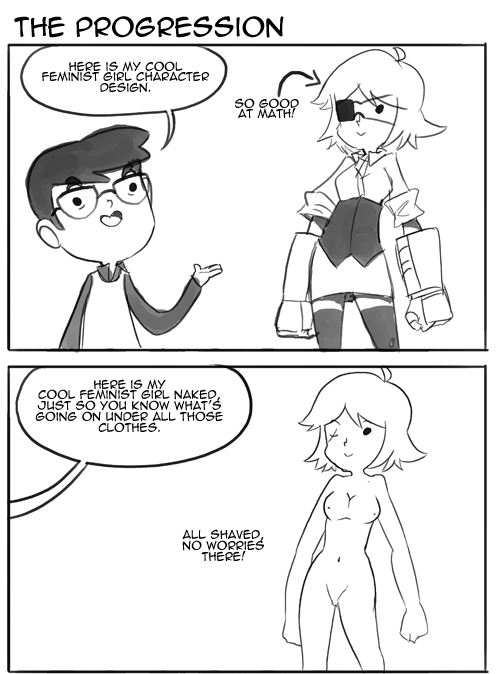
Web comic artist Mary Cagle, known on tumblr by the handle cube-watermelon,  recently posted the comic above, poking fun at the phenomenon of many male comic artists that self-identity as some form of progressive or feminist ally where they will draw cheesecake type pinups or costumes and scenarios that appeal to them specifically, but then try to dress them up (no pun intended) as not just pleasing to look at, but that the art is somehow "empowering" or transgression.

She concludes her post with the bon mot, "Sometimes I think it's okay to just admit you like looking at certain types of bodies naked, and that's okay."

While Cagle most likely wasn't surprised at getting some push-back from some people on tumblr, she was definitely surprised by one response: Aaron Diaz, the writer and artist of transhumanist science fiction web comic Desden Codak. He sent Cagle a note on tumblr:

Hey, how about not being a passive-aggressive shit next time, eh?
To which Cagle published the response:
I would think that you, who spend so much time pointing out the flaws and problematic areas in other people’s work, would be able to take one silly comic directed at your work and others like it. Normally I wouldn’t respond to this kind of thing publicly, but I’ll make an exception since you called me a shit.
Diaz has done many examples of comic and media criticism, notable among them being his redesigns of iconic DC Comics super heroes and concept art he made of Zelda as the lead character in a video game inspired, he said, by Anita Sarkeesian's Tropes Vs. Women in Video Games. And while Cagle parody comic wasn't specifically aimed at Diaz, it most certainly was inspired by a tumblr post (since deleted, see cached copy here) by him where he said "Inspired by some amputee photo shoots, I decided to try my hand at some cyborg-themed pinup sketches with Kim, a sort of celebration of the female form and taking agency over one’s body." Which is pretty ridiculous in the face of it, more so when you see the pin ups and his justification for drawing them (and that's leaving aide his kind of creepy "being disabled is totally an opportunity for the transhumanism movement). That fact that he deleted it shows that he recognizes that he messed up somewhere along the line, but instead of addressing it, he just vague-tweeted about it for a while.

In response to Diaz's actions, Magnolia Porter, a fellow web comic artist and friendly acquaintance of Diaz, published an open letter to Aaron Diaz:
There’s a place for everything, and an artist has the right to create whatever they want to create, for whatever ends they choose. What I have a problem with is that your comic is not presented as a science fiction comic with a dash of sexy thrills, but rather as a feminist narrative in support of powerful independent women. You've made it clear on many occasions that you don’t consider your work to be objectifying or sexist. I have a problem with cheesecake-style art being presented as something feminist, empowering, enlightened- something made “for women”, when it’s clearly made for men.You’re allowed to make art with male gaze. But please call a spade a spade... 
I don’t think I've seen a single page of Dresden Codak that doesn't feature a woman posed in a male-gazey way, with loving focus on her ass or cleavage, or wearing a sexual costume, or in some situation that puts her in a compromising position (like the most recent page in which Kimiko's clothing is burned off of her body, which has happened at least twice in the series’ run.) I have a very hard time believing that these details are accidental. 
...Aaron, you can do whatever you want with your own comic. However, if you really do care about female characters in media, or care to know why so many people seem to be angry with you about it, I would do one of two things. If you don’t want your comic to present its female characters in a borderline-erotic light, then stop doing that. If you don’t mind that, then by all means continue, but please just admit that you like drawing t&a and that it’s not particularly empowering, or feminist, or a celebration of personal agency. As a woman, I resent being told that men’s eye candy is actually meant to uplift me and that I should celebrate it.
Honestly, I don't have any sympathy for Aaron Diaz, nor do I have any sympathy for his position nor his reactions. He got called out for his messed up behavior and has fired back with sadly-all-too-typical defensiveness.

I've seen it happen so often, it's become distressingly familiar. A woman points out that a character or story or the way something is presented is sexist. Men insist that woman is seeing things that aren't there or otherwise reading too much into things because it doesn't come across as sexists to them. This is something I've done before, myself. As men, we are often taught that our perspectives are the default. We end up taking our perspectives and assuming that's how it is for everyone.

Commenter divined by radio at metafilter said it pretty well, I think:
So men who adamantly refuse to believe that their own gender privilege may have resulted in a variably-applied resistance to accepting a woman's objection or approach as valid -- to believe a woman when she speaks, to allow that what she is saying is true, even if they have not experienced precisely what she has experienced -- are displaying, at best, a touch of willful ignorance. They are privileging their own feelings and desires over women's truths, lives, stories, and experiences. And the end result doesn't tend to be very flattering.


Admin Note: We're Back

Sorry for the radio silence over the past few days. The technical issues that prevented any posts from going up have been fixed. I'll try and post an extra post or so a day to catch up. Thanks for your understanding!

Friday, August 22, 2014

If You Call This Justice, I Don't Want Your Support

Image courtesy of shutterstock.com
After my post on the unacceptable torrent of abuse that has been heaped upon Zoe Quinn by misogynist nerd man-babies so desperate to deny that the little clubhouse of video games is changing that they are perfectly happy to take a vituperative screed from her ex-boyfriend and run with it to harass, hack, speculate, insult and demean her by claiming that the private sexual life matters because she's a women making a game they don't like, , someone anonymous left a comment saying that I should link to "unbiased sources". The sources the comment linked was one tumblr post labeling her everything from a "shit-tier developer" to literally calling her a whore that faked every single bit of her abuse, harassment and public hacking at the center of an industry-wide conspiracy (that comment's gone, now, btw).

Prominent youtube "personality" joined the pile-on, with Youtuber JonTron linking approvingly to a pornographic slander comic, and then later approvingly linking to a fan comparing the outcry against his actions to black people being lynched.

Other games industry writers from Stephen Totilio and Patrick Klepek to Leigh Alexander and Jenn Frank took to her defense. One of her most prominent game developer defenders of Zoe Quinn was Phil Fish (who had recently returned publicly to twitter to comment on the human rights abuses in Ferguson). This week, both his twitter account and business website Polytron were hacked, and personal details were released-- everything from back accounts to home address history, along with a data dump of 1.5 GB of developer only assets and financial records for FEZ and his business. After he regained control of his accounts, he announced he was selling off the FEZ IP, the Polytron assets and leaving video game development for good.

Liz Ryerson has a cutting analysis of these angry, scared self-appointed gatekeepers:
Zoe has become the scapegoat for every bit of internalized misogyny and misdirected rage these people felt. she appears to them an amorphous assemblage of everything that is viewed as wrong with women - manipulativeness, sluttiness, being an 'attention-whore'. the idea of trusting the word of a frighteningly narcissistic ex who's out to ruin her reputation is fine with them, because it meshes with their worldview... 

...often it's a conservative, reactionary anger that comes out of disillusionment and fear, and gets constantly externalized onto marginalized people, especially women and queer people. they struggle to understand and adjust to a rapidly shifting cultural landscape, in and out of games, that's moving away from traditionally catering to them and their empathy-deficient values into something more culturally sensitive and aware. and so they find simple explanations for these complex phenomena that fit within their bigoted worldview - boogeymans of evil, manipulative and misleading women like Zoe Quinn or Anita Sarskeesian. they view themselves as anti-authority and anti-power, even as their actions are tremendously conservative and tremendously serving of the interests of power.

The outrage over alleged private infidelity that never even resulted in an actual review lays bare the lie that this is about hand-wringing over worries of "journalistic ethics" and shows instead that those joining in on the pile-on really just see women as a threat to the world of video games and other geeky hobbies, and are ready to rage and holler and attempt to intimidate any woman they decide is somehow a threat at the flimsiest provocation. If you really cared about favorable review currying for games, you'd maybe throw some of this vitriol at the industry practice of only releasing game information to friendly outlets, perhaps.

It shouldn't be up to women to fight these battles alone. As I mentioned in my post about what men need to do about the harassment of women online, we need to make it absolutely clear that this behavior is unacceptable and that anyone that feels otherwise is unwelcome.

So let me make this crystal clear: If you support the harassment of Zoe Quinn or her supporters, if you think you are doing the right thing by shaming her about her private relationships or sexual history, if you think that anyone harassed in the way she has been "had it coming" or that by doing any sort of gate-keeping to women in your hobby you are fighting the good fight-- I don't EVER want your support.

Don't visit my blog. Don't support my patreon. Don't donate to me. Don't read my work or play my games. Don't listen to my podcast. You are not welcome here on The Code, and I don't want you as a fan.

I call on major gaming sites to issue clear condemnations of this behavior in general and defense of Zoe Quinn in particular. When fans or site visitors heap abuse on women that criticize actions or inaction of those in the industry, it because these harassers and misogynists view this as okay thing to do. And if your site policy doesn't explicitly forbid these attitudes and actions from your audience, the toxic elements of your audience view this sort of pile on as implicitly okay. Look at the harassment of Courtney Stanton and Maddy Meyers by webcomic fans, the harassment of Samanta Allen by Giant Bomb fans, the pile-ons from 4chan and reddit and totalbiscuit and jontron fans and elsewhere of Zoe Quinn.

It is unacceptable and unforgivable. You are not noble truth seekers. You're just flinging shit.

Share This Post