Showing posts with label literature. Show all posts

Monday, July 17, 2017

Listen Up: Better Than The Movie


Better Than the Movie is a monthly podcast for people who are passionate about books. Each episode covers book news and issues related to literature and popular culture. The goal of each episode is th "encourage listeners and readers to look beyond the Best Sellers lists and discover new voices and stories", and they have had a number of interesting interviews with many authors of color.

You can listen along o the Better Than The Movie website, via iTunes or via Stitcher.

Listen Up is an ongoing series devoted to shining a spotlight on podcasts by diverse creators. You can check out all the podcasts previously featured here. If you have a podcast you'd like to recommend, post it in the comments or email me at shawnstruck at gmail dot com.

Wednesday, October 5, 2016

VOYA: Youth Advocates, Unless The Young Woman Is Bi

Description: The character Beetlejuice wagging his index finger derisively at the
camera, with the caption "Ah! Oo, oo, oo, ah, ah, ahh! Nobody says the 'B' word" beneath.

Librarians across the country rely on Voices of Youth Advocates Magazine (VOYA) as a professional journal for young adult librarians. It's rutinely cited as a valuable publication in advancing advocacy of young adults, and the promotion of young adult literature and reading. Its reviews have a lot of influence in what Young Adult (YA) section librarians stock on library shelves and the magazine champions itself as "...one of the earliest and... strongest advocates for intellectual freedom and equal access to information for teens". Which is why a recent review of the YA novel "Run" by Kody Kepplinger is all the more troubling, and VOYA's response to the backlash against it very worrisome. Here's the review, (emphasis is my own doing):
"Agnes is legally blind, and leads such a sheltered life that she cannot even take the bus home from school or attend parties. Bo Dickinson has a drug addicted mother, an absent father, and is rumored to be the town slut. Although opposites, they become good friends through their kindness and acceptance of each other. Bo’s cousin Colt is almost a brother to her; they have grown up together and are part of the family “you steer clear of because nothing good can come of getting mixed up with that bunch.” Agnes has a different problem; her parents hover over her and limit her activities so it is impossible for her to be a normal teenager, until she begins sneaking out to go places with Bo. When Bo hatches a plan to leave town to find her father, Agnes decides to go along, thinking she and Bo will live together. They steal a car from Agnes’s family and begin their road trip, along the way visiting Colt, with whom Agnes has a sexual encounter. When Agnes discovers that Bo intends to live with her father, they separate and she gets in touch with her parents, leaving Bo to a disappointing meeting with her father, and an eventual return to the foster care system. The story contains many references to Bo being bisexual and an abundance of bad language, so it is recommended for mature junior and senior high readers.–Rachel Axelrod"

Yup. Not only is a character talking about her orientation eye-rolling mentioned in the same breath as cursing, it also means that it can't be recommended for anyone below junior or senior level in high school. Even though, like yours truly back in the long ago, there are bi youth that exist and know they're bi long before junior or senior year. As much as I'm angry at the biphobia in this review's attitude, I have it a little better than most. I'm a bi man. The form of biphobia that surrounds bi-women is even more pernicious and damaging.

When the reviewer uses the word mature, it's a commonly understood meaning in YA book context that means "sexual content". And there's a common element where bi women are hyper-sexualized just by exisiting, We live in a society that acts that women that are bi, use the word "bisexual" to label themselves and are out about it are on the same level as sex acts. This attitude also floats around in a social climate where bi women face intra-group discrimination and increased percentages of harassment, violence and partner abuse. Plus, you don't see a similar warning like "this book contains many refences to being straight, so it's only appropriate for juniors and seniors" because straightness is see as the "default" or "normal".

Well, maybe there's a sex scene with Bo, and that's what makes it mature, maybe? Nope. As the author herself pointed out on twitter:
The irony? (And this might be a spoiler so beware:) There IS a sex scene in the book Between the STRAIGHT characters. Not Bo, the bi M[ain] C[harcter]. But Bo's sexuality - Bo who doesn't have a sex scene while her straight co-narrator does - is the one considered "mature." 

The review doesn't think to warn about a sex scene, but does think to warn about a character talking about being bi! VOYA is super influential in the young adult literary field. Booksellers and librarians rely on these reviews because no one person can read all of the thousands of YA novels published every year. VOYA's own mission statement reads "Young adults have rights to free and equal access to information in print, nonprint, and electronic resources, without infringement of their intellectual freedom due to age or other restrictions." and this review's note runs counter to that. Author Tamina Wright points out that "These types of reviews, in addition to being insulting and harmful to actual queer teens, hurt queer books because they could be passed over. Queer books, by and large, don’t get the big advances or the huge marketing budgets so they depend on word-of-mouth, hand-selling, and libraries. Being in a library could quite literally make an author’s career."

The topping on the sundae of crap that is this VOYA review? It was released during NATIONAL BI VISIBILITY WEEK.

When Wright wrote an email to VOYA, pointing out that this attitude is harmful to bi youth in general, and herself in particular as both a bi woman and parent of a genderqueer child, a VOYA editor responded with the non-apology of "sorry if you were offended", claimed that nothing was inappropriate about the review, and then personally attacked Wright for "revealing your child's sexuality to me" (which the author didn't even do) and said that because it was Bi Visibility Week, all Wright wanted to do was "find and destroy your enemies in a public forum" (even though Wright sent a private email). FOR REAL. The screencaps of the emails are here.

There was an outcry from queer youth and authors and librarians. SO VOYA did the logical thing... and printed Wright's email and the editor's response as a special "Letter To The Editor Column" on its website that has since been removed. Bi author Hannah Moskowitz, whose YA work VOYA has reviewed favorably in the past, wrote a scathing response to VOA's actions, which she shared on here twitter here.

Literary agent Barry Goldblatt-- who is a big name YA lit agent-- publically announced he was pulling all agency ads from VOYA in response, and encouraging his contacts in the publishing industry to do the same.

Author Peggy North dug through old VOYA back issues and found that the magazine only seemed to warn about f/f romances. NO similar warning for straight ones, and these reviews were all written by different staffers. Meanwhile VOYA doubled down on social media:


cs_htfzuaaarjwh-jpg-large

It gets better. And by better, I mean worse.

VOYA finally apologizes. Sorta. In the most flouncy, pouty way possible. See, it's the "LGBTQ community" that has "taken offense" and "demanded" an apology! So, there's a ham-handed apology, but it's a start, right? Surely VOYA would start listening to authors and others and try to improve?

Nope. They then deleted all mention of the controversy from their official twitter and FB accounts, and began blocking anyone that spoke to them about it. Including famous writers. Successive attempts at apologies from VOYA have started out better but quickly careen into defensiveness.

Let me share a resource with you that shows YA stories with bi protagonists that don't have weird, unnecessary bi-phobic warnings.


Tuesday, August 18, 2015

YA Books & The John Green Problem

Fiction for young adults is seemingly booming. YA lit sections in chain bookstores seem to keep increasing in size, the number of eager readers grow yearly, and YA writer John Green's novel The Fault In Our Stars was adapted into a box-office success in a movie adaption of the same name. As the Daily Dot pointed out earlier this year though, he's endemic of a larger genre-wide problem:
On Twitter, Green has 2 million followers. Compared to the rest of the leaders in Young Adult fiction, that number is staggering. To approach even half the Twitter influence of John Green all by himself, you need an entire army of YA women. Anderson, Blume,Dessen, Veronica Roth, Cassandra Clare, Richelle Mead, Margaret Stohl, Kami Garcia,Rainbow Rowell, Maureen Johnson, Malinda Lo, Holly Black, LJ Smith, Ellen Hopkins,Shannon Hale, Lauren Myracle, Libba Bray, Melissa Marr, and Leigh Bardugo: As a group these women only have about 1.2 million followers on Twitter. That’s the voice of one man outweighing several decades of women who have had major successes, critical acclaim, and cultural influence. 
The problem of the cultural influence his books have created is not Green’s fault, but it’s created a frustrating situation for female writers and readers. Book blogger Rhiannon K. Thomas issued a sweeping takedown of the way the NYT bestseller list is stacked against female authors, many of whom write series, which are automatically moved to the “Children’s Series” list, out of the YA category altogether. She also pointed out that when men like Green aren’t writing YA, the media perception of it suddenly changes. Instead of being high literature, it suddenly becomes a shallow, frivolous genre that only silly teenagers and unfulfilled housewives participate in—just like the romance genre sans Sparks.
While John green himself has also done loads of things that are actually harmful to the audience he's writing for-- like reducing the death of Anne Frank to a mere prop, or taking a teenage girl's post discussing how the author's online presence makes her feel uncomfortable to mean he was accused of being a pedophile-- I think it's part of a larger systematic inequality. 

Whether you look at books, comic books, film or television, women are under-represented and outmatched. This is especially troubling because it leads to the FALSE idea that not only are there no women writers, creators or taste-makers, but that half the planet can just be ignored or dismissed and wouldn't want to see themselves represented anyhow.

Thursday, July 31, 2014

Someone Like Me: What Children's Stories Can Teach Minority Kids

Image via spesiria
Why do so many princesses looks the same? In a moving personal essay entitled "Challenging “Normal”: Why Non-Token Diversity in Kids’ Storytelling Is Important", Navdeep Singh Dhillon uses a recent heart-breaking incident with her young daughter to posit that in media for children, most characters that are not white only seem to be defined by their “otherness. An excerpt:

On New Year’s Day, we are heading out to brunch, and Kavya’s sitting on the stairs, her head in her hands. Crying. I ask her what happened. In most cases, we verbally abuse the pain-inflicting object, followed immediately by a good stomping, and that sorts things out. But this time is different. 

In-between muted, heaving sobs, she says something that I hadn’t expected for at least a few more years: “I want yellow hair. Like Rapunzel.” She points to the large, manga-eyed, blonde princess with tiny toothpick-wrists, smiling on her t-shirt. 

It’s one of those parenting moments where time stands still.  I fight the urge to say, “Rapunzel’s hair is stupid. She can go to hell.” 

My wife, Sona, sits on the stairs with Kavya and tries to comfort her. Sona’s parents don’t really understand the heaviness of what Kavya is saying, and view it as just a random tantrum. 

…Instead of berating Rapunzel for her physical appearance, I ask Kavya if she knows who my favourite princess is. 

She looks up at me. “Who?” 

“Princess Kavya.” I say, touching her nose. 

She starts crying even louder. After a bit, she says, “Why do you like Princess Kavya?”

In fact, Sona wrote an essay herself on why she co-founded CAKE Literary, a literary development company that focuses on high concept fiction with a strong commitment to diversity.:

“Growing up as a little brown girl—one of the few, back then—in small-town, suburban central New Jersey, books were my escape. I caused a ruckus alongside little Anne in Avonlea; I mourned Beth along with her sisters in the harsh winter of Maine; I honed my grand ambitions like Kristy and her babysitters’ club; I even swooned alongside Elena over the brothers Salvatore when The Vampire Diaries was originally released. (Yes, I am that old.) 

But if you’ll note: in all those books and the hundreds of others I devoured, I never really saw myself, or anyone remotely like me. The majority of characters in books for kids and teens in the ’80s and ’90s were white. And, according to Christopher Myers in his recent New York Times piece, “The Apartheid of Children’s Literature,” the majority still are today, by quite a landslide. 

Why is this worth discussing? Because it hurts. A lot. It’s a hit to a kid’s self-esteem to be told—silently, but oh so clearly—that their story is not worth telling, that their voice is not important.”

Image courtesy of dakotaa.deviantart.com

In the meantime, many artists on tumblr have contributed to This Could Have Been Frozen, featuring different takes on Disney's Frozen recasting the lead characters as people of color. While Frozen takes its cues from the fairy tale "The Snow Queen," they points out that not all Europeans are white, and the movie explicitly references Saami culture in the way many characters dress.

Some people may be wondering what the big deal is? Stories are stories, and books are books, right?

Wrong.

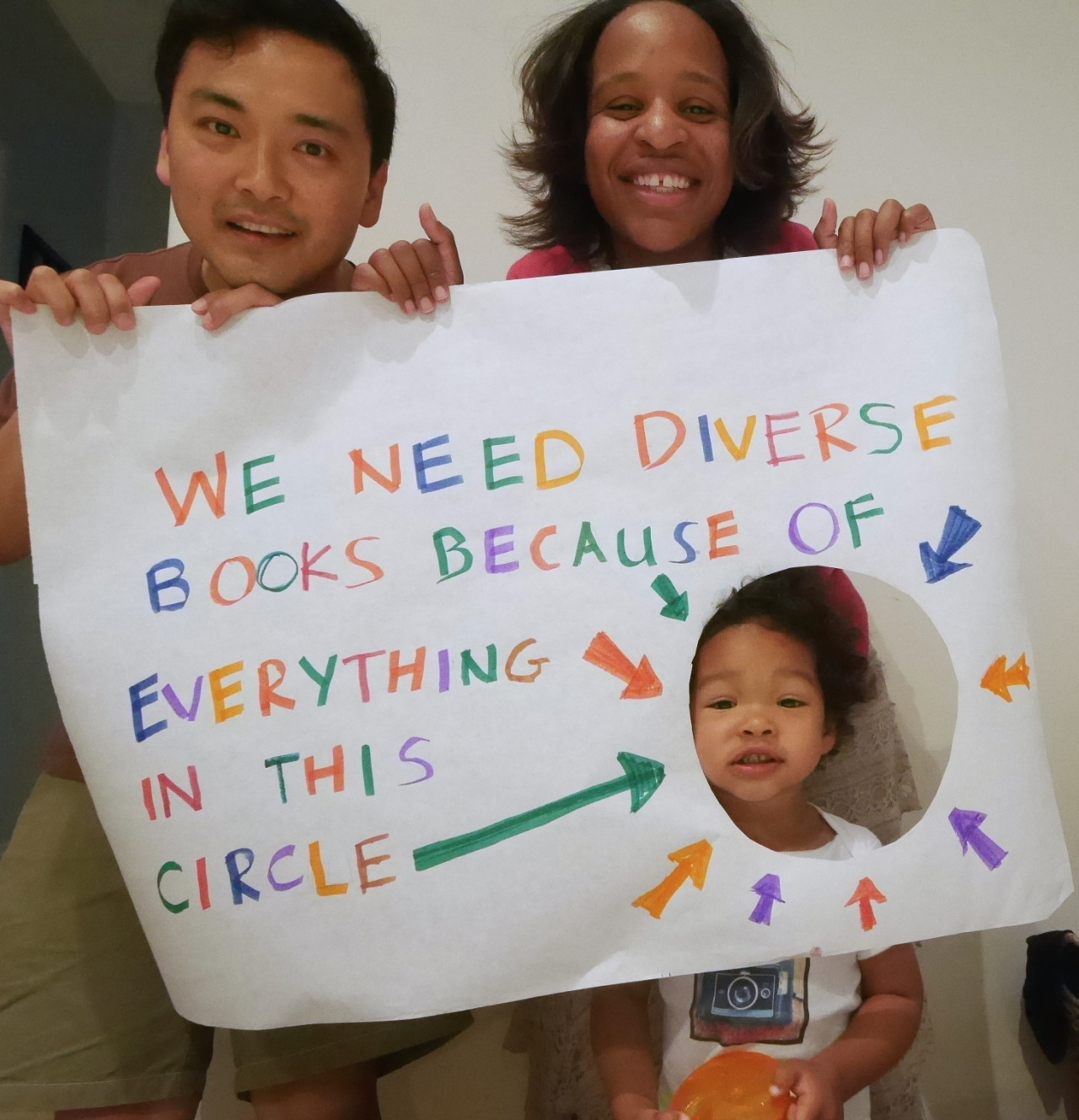
Stories help kids understand the world. When there are entire sections of society that are barely represented-- or worse, neglected-- then it becomes harder for kids to idetiny with, understand, or empathize with them. It's even worse when a minority kid  doesn't see anyone like them in the stories they read or the media they experience, because they miss out on that sense of belong, of being a valued part of society, and of getting to identify with the heroes in books or on-screen.

Author Deepa D. outlined this feeling in "I Didn't Dream of Dragons" in a personal essay that is still relevant almost five years later:

When I was around thirteen years old, I tried to write a fantasy novel. It was going to be an epic adventure with a cross-dressing princess on the run, a snarky hero, and dragons. I got stuck when I had to figure out what they would do after they left the city. Logically, there would be a tavern. But there were no taverns in India. 

Write what you know is a rule that didn’t really need to be told to me; after having spent my entire life reading books in English about people named Peter and Sally, I wanted to write about the place I lived in, even if I didn’t have a whole bookcase of Indian fantasy world-building to steal from. And I couldn’t get past the lack of taverns. Even now, I have spent a number of years trying to figure out how cross-dressing disguise would work in a pre-Islamic India where the women went bare-breasted. When I considered including a dragon at the end of a story, I had to map out their route to the Himalayas, because dragons can be a part of a Tibetan Buddhist tradition—they do not figure in Hindu mythology.

Image courtesy of We Need Diverse Books.

Share This Post