Showing posts with label social justice. Show all posts

Thursday, July 27, 2017

Update: How to Call Congress When You Have Anxiety

I posted a version of this post about 8 months ago. As the current administration marches on, calling your state and local representatives as a means of taking direct action and affecting change have become even more vital than ever. For those that struggle with chronic mental illness or anxiety, taking this sort of action can be even more difficult than it would be for a neurotypical person.  The artist Cordellia of echothroughthefog recently made a comic about how they pushed against anxiety, made those calls, and how you can do that, too! A transcript of the comic and more resources follow.


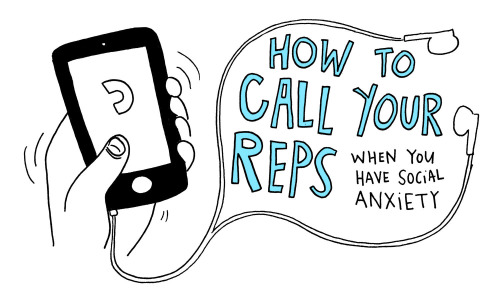
“How to call your reps when you have social anxiety”

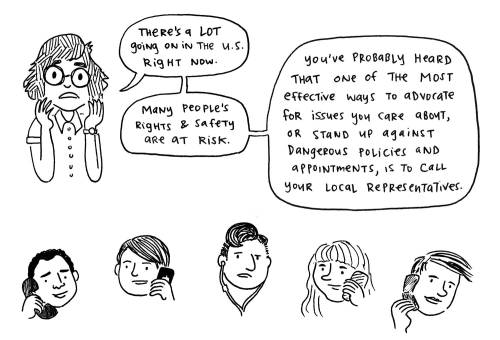
There’s a LOT going on in the U.S. right now. The civil rights and safety of many groups are at risk at the moment. You’ve probably heard that one of the most effective ways to advocate for issues you care about, or stand up against dangerous policies and appointments, is to call your local representatives.

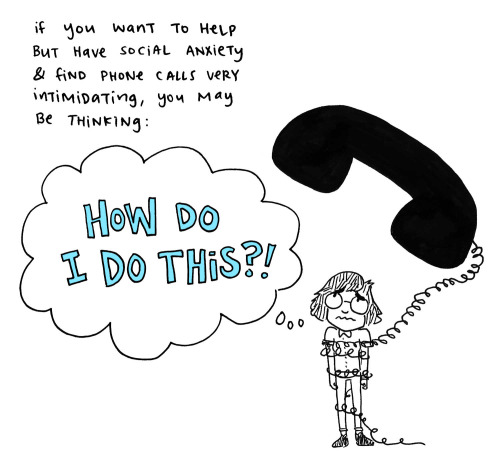
If you want to help but have social anxiety and find phone calls very intimidating, you may be thinking, “How do I do this?!” (An over-sized telephone handset hovers ominously over the narrator with its cord spiraling around her body. She looks up at it with great concern.)

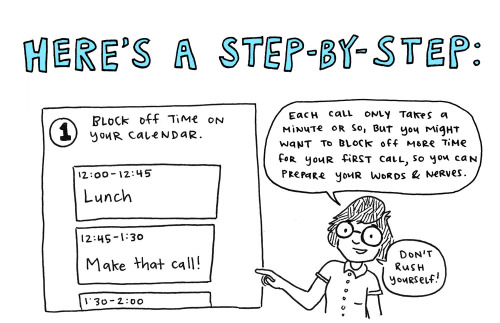
Here’s a step-by-step:
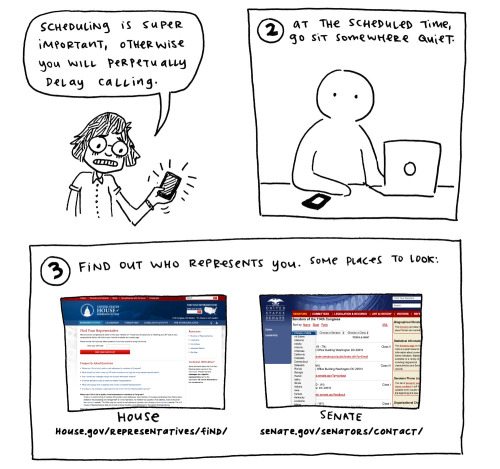
  • Block off time on your calendar. Each call only takes a minute or so, but you might want to block off more time for your first call, so you can prepare your words & nerves. Don’t rush yourself! Scheduling is super important, otherwise you will perpetually delay calling.
  • At the scheduled time, go sit somewhere quiet.
  • Find out who represents you. Some places to look: House (http://www.house.gov/representatives/find/) and Senate (http://www.senate.gov/senators/contact/).
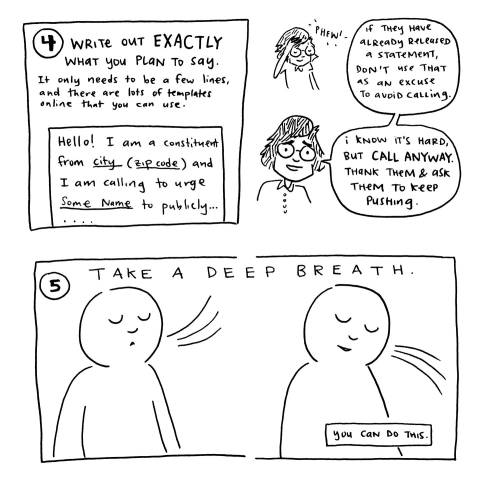
  • Write out exactly what you plan to say. It only needs to be a few lines, and there are lots of templates online that you can use. e.g. “Hello! I am constituent from city (zip code) and I am calling to urge Some Name to publicly…” If they have already released a statement, don’t use that as an excuse to avoid calling. I know it’s hard, but call anyway. Thank them and ask them to keep pushing.
  • Take a deep breath. You can do this.
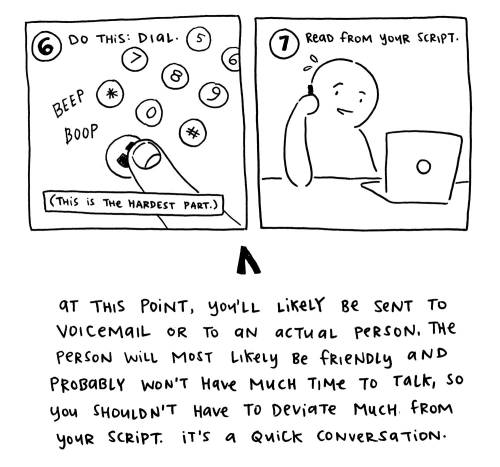
  • Do this: dial. (This is the hardest part.)
  • Read from your script. At this point, you’ll likely be sent to voicemail or to an actual person. The person will most likely be friendly and probably won’t have much time to talk, so you shouldn’t have to deviate much from your script. It’s a quick conversation.
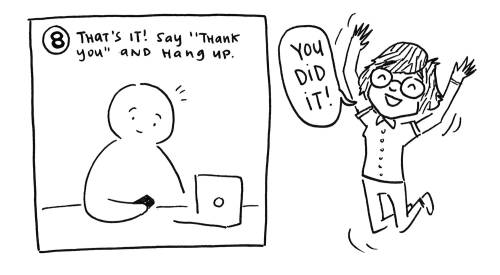
  • That’s it! Say “Thank you” and hang up.

You did it! If you’re thinking “Hey, that wasn’t so bad…”, call more people! And follow up with them next week, or even tomorrow, to make sure they keep these issues top of mind.

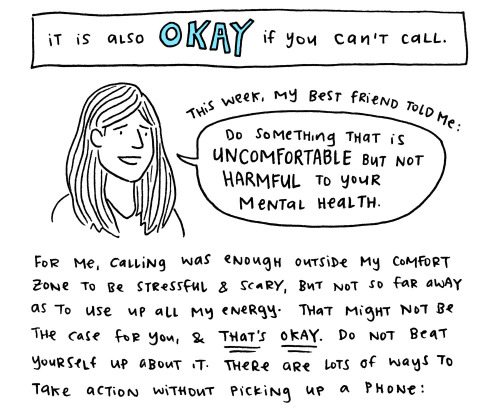
It is okay if your voice shakes. It is okay if you feel awkward.They get a lot of calls, so they don’t have time to judge you by how well you delivered your message. It is also okay if you can’t call.

This week, my best friend told me, “Do something that is uncomfortable but not harmful to your mental health.” For me, calling was enough outside my comfort zone to be stressful and scary, but not so far away as to use up all my energy. That might not be the case for you, and that’s okay. Do not beat yourself up about it.

There are lots of ways to take action without picking up a phone:
  • Write to government officials, One great tool is Resistbot-- a free service that turns your texts into a formal letter, and then faxes it to your elected officials. You'll get a copy of the letter, and a notification when the fax goes through. Although it takes its name from the idea of “resisting” the current administration, it’s a straightforward tool that you can use to voice your opinions, no matter what they are.
  • Create art that challenges and art that inspires
  • Donate, if you’re financially able, to organizations that fight injustice
  • Listen to immigrants, people of color, women, trans and non-binary people, people of all faiths and orientations, and people with disabilities. Support their work. Amplify their voices.
  • Keep it up.


And here are some resources:

  • Phone calls are still the most direct way to get a staffer’s ear, but this text-to-fax service has a few advantages on your end: you can speak up any time, the bot will keep trying if the lines are busy, and you don’t have to work up the nerve to talk to a stranger. Some members of Congress still have actual fax machines, while others will receive your message as a sort of glorified email. Either way, if your contact information is on the letter, it will be counted along with other messages from constituents.
  • Emily Ellsworth explains why calling is the most effective way to reach your congressperson.
  • Sharon Wong posted a great series of tweets that helped me manage my phone anxiety and make some calls.
  • Kelsey is tweeting pretty much daily with advice and reminders about calling representatives. I found this tweet an especially great reminder that calls aren’t nearly as big a deal as anxiety makes them out to be.
Informational resources:
There are a lot of these, as well! These three are good places to start:
Find your representative at house.gov
Find your senators at senate.gov
Use the “We’re His Problem Now” scripts when calling

Tuesday, July 18, 2017

#SurvivedAndPunished: Free Toolkit For Marginalized & Criminalized Survivors


A collaboration between Love and Protect and Survived and Punished has resulted in a new, free downloadable toolkit aimed at survivors of violence, sexual assault and abuse. Titled "#SurvivedAndPunished: Survivor Defense As Abolitionist Praxis", the toolkit is the work of over two dozen creatives, activists and writers. It was created because for many women who are survivors of violence and assualt, once the ordeal is survived they find themselves at the mercy of a criminal justice system that ends of punishing them even further. The aim of the toolkit per the project's statement is to offer an accessible, practical, and visible:
...collection of tools, tips, lessons and resources developed through our own experiences. It is also an effort to document and reflect on our own movement work. It is important for us to document especially because our organizing work has been led by Black women, women of color, immigrants and queer/trans people, who are so often erased from history. We hope to preserve some of these histories, build solidarity, and share hope as we continue our collective struggle.
You can read the toolkit online, or download your own copy, for free at the Survived And Punished website here.

Wednesday, June 28, 2017

Wrestling's Ultimate (Social Justice) Warriors

Honestly, I think the "not my president" t-shirt would have work-
ed even better as a "#notmypresident" shirt but that's nitpicking.
I've been a fan of pro wrestling ever since I was a little kid. And ever since I was a teen, the smaller and indie-er the pro wrestling, the better. While I've posted about pro-wrestling before, Kentucky-based Appalachian Mountain Wrestling seems to have created one of the best heel (that's a "bad guy" character for you non-wrestling fans) characters in ages: The Progressive Liberal.

Deadspin has a little bit about him, including a recap of some of his pre-match promo speech:
“You know what, I think Bernie Sanders would make a great Secretary of State,” Richards said before being jeered. Later on, he tried to persuade the crowd. “I want to exchange your bullets for bullet points. Bullet points of knowledge.”
In another article that goes deeper into the genesis of the character, Deadspin points out that while it's a gimmick that might have a limited shelf life, it is a perfectly-tailor-made hell gimmick that can work to make you want to boo him no matter what side of the aisle you're on politically:
The details really make the gimmick, and they’re not as obvious as the “Not My President” shirt. It’s the way the Progressive Liberal says “Appalachia,” pronouncing the third syllable with a hard A as in “ate,” instead of the flat A preferred by locals. The audience immediately understands that he’s not from here. Richards was originally billed out of Richmond, Virginia, his actual hometown. But he and James realized that when performing in Kentucky, which has a Richmond of its own, the crowd would become confused. So his origin became Washington, D.C. 
The [pro wrestling] industry has always been replete with guys working effete liberal gimmicks, but this is the perfect place and time, and Dan Richards has built a sustainable meal ticket, at least within the limited scope of the indie circuit. Test your mental constitution and imagine for a minute if Hillary had won; this character would still be popular and paying customers would still project their frustrations onto him, for a different reason. 

Commenter semangeloph1 points out that he hasn't even scratched the surface of what sort of heelish things the character could do:
This schtick could be milked for so much. He could challenge the women’s champion to a match because he doesn’t see gender. He could steal the belt and give it to some other heel loser to “redistribute” the wealth. Every time he loses a match, he could appeal it to some fake wrestling governing body and get the match turned over to him... When he wins, he could give the loser gift-certificates to Whole Foods and yoga sessions. He could refuse to fight championship matches unless assured that the ring is carbon neutral. I think if done right, this character could be one of the all-time great heels.
I haven't enjoyed stuff like this since Daniel Bryan cut a hell of a heel promo about how much he loved being vegan:
Of course, if that's not on-the-nose enough for you, there's also a wrestler literally billing himself as a Social Justice Warrior. Meet Leon Scott, the Social Justice Warrior, who wrestles in leagues in Central Florida. I've never wanted to have so much in common with a wrestler before: patches include Eat the Rich and Black Lives Matter, as well as anti-fascist and pro-trans messages. His Twitter account even re-tweets anti-fascist/anti-racist memes of the current administration. 

Wednesday, October 5, 2016

VOYA: Youth Advocates, Unless The Young Woman Is Bi

Description: The character Beetlejuice wagging his index finger derisively at the
camera, with the caption "Ah! Oo, oo, oo, ah, ah, ahh! Nobody says the 'B' word" beneath.

Librarians across the country rely on Voices of Youth Advocates Magazine (VOYA) as a professional journal for young adult librarians. It's rutinely cited as a valuable publication in advancing advocacy of young adults, and the promotion of young adult literature and reading. Its reviews have a lot of influence in what Young Adult (YA) section librarians stock on library shelves and the magazine champions itself as "...one of the earliest and... strongest advocates for intellectual freedom and equal access to information for teens". Which is why a recent review of the YA novel "Run" by Kody Kepplinger is all the more troubling, and VOYA's response to the backlash against it very worrisome. Here's the review, (emphasis is my own doing):
"Agnes is legally blind, and leads such a sheltered life that she cannot even take the bus home from school or attend parties. Bo Dickinson has a drug addicted mother, an absent father, and is rumored to be the town slut. Although opposites, they become good friends through their kindness and acceptance of each other. Bo’s cousin Colt is almost a brother to her; they have grown up together and are part of the family “you steer clear of because nothing good can come of getting mixed up with that bunch.” Agnes has a different problem; her parents hover over her and limit her activities so it is impossible for her to be a normal teenager, until she begins sneaking out to go places with Bo. When Bo hatches a plan to leave town to find her father, Agnes decides to go along, thinking she and Bo will live together. They steal a car from Agnes’s family and begin their road trip, along the way visiting Colt, with whom Agnes has a sexual encounter. When Agnes discovers that Bo intends to live with her father, they separate and she gets in touch with her parents, leaving Bo to a disappointing meeting with her father, and an eventual return to the foster care system. The story contains many references to Bo being bisexual and an abundance of bad language, so it is recommended for mature junior and senior high readers.–Rachel Axelrod"

Yup. Not only is a character talking about her orientation eye-rolling mentioned in the same breath as cursing, it also means that it can't be recommended for anyone below junior or senior level in high school. Even though, like yours truly back in the long ago, there are bi youth that exist and know they're bi long before junior or senior year. As much as I'm angry at the biphobia in this review's attitude, I have it a little better than most. I'm a bi man. The form of biphobia that surrounds bi-women is even more pernicious and damaging.

When the reviewer uses the word mature, it's a commonly understood meaning in YA book context that means "sexual content". And there's a common element where bi women are hyper-sexualized just by exisiting, We live in a society that acts that women that are bi, use the word "bisexual" to label themselves and are out about it are on the same level as sex acts. This attitude also floats around in a social climate where bi women face intra-group discrimination and increased percentages of harassment, violence and partner abuse. Plus, you don't see a similar warning like "this book contains many refences to being straight, so it's only appropriate for juniors and seniors" because straightness is see as the "default" or "normal".

Well, maybe there's a sex scene with Bo, and that's what makes it mature, maybe? Nope. As the author herself pointed out on twitter:
The irony? (And this might be a spoiler so beware:) There IS a sex scene in the book Between the STRAIGHT characters. Not Bo, the bi M[ain] C[harcter]. But Bo's sexuality - Bo who doesn't have a sex scene while her straight co-narrator does - is the one considered "mature." 

The review doesn't think to warn about a sex scene, but does think to warn about a character talking about being bi! VOYA is super influential in the young adult literary field. Booksellers and librarians rely on these reviews because no one person can read all of the thousands of YA novels published every year. VOYA's own mission statement reads "Young adults have rights to free and equal access to information in print, nonprint, and electronic resources, without infringement of their intellectual freedom due to age or other restrictions." and this review's note runs counter to that. Author Tamina Wright points out that "These types of reviews, in addition to being insulting and harmful to actual queer teens, hurt queer books because they could be passed over. Queer books, by and large, don’t get the big advances or the huge marketing budgets so they depend on word-of-mouth, hand-selling, and libraries. Being in a library could quite literally make an author’s career."

The topping on the sundae of crap that is this VOYA review? It was released during NATIONAL BI VISIBILITY WEEK.

When Wright wrote an email to VOYA, pointing out that this attitude is harmful to bi youth in general, and herself in particular as both a bi woman and parent of a genderqueer child, a VOYA editor responded with the non-apology of "sorry if you were offended", claimed that nothing was inappropriate about the review, and then personally attacked Wright for "revealing your child's sexuality to me" (which the author didn't even do) and said that because it was Bi Visibility Week, all Wright wanted to do was "find and destroy your enemies in a public forum" (even though Wright sent a private email). FOR REAL. The screencaps of the emails are here.

There was an outcry from queer youth and authors and librarians. SO VOYA did the logical thing... and printed Wright's email and the editor's response as a special "Letter To The Editor Column" on its website that has since been removed. Bi author Hannah Moskowitz, whose YA work VOYA has reviewed favorably in the past, wrote a scathing response to VOA's actions, which she shared on here twitter here.

Literary agent Barry Goldblatt-- who is a big name YA lit agent-- publically announced he was pulling all agency ads from VOYA in response, and encouraging his contacts in the publishing industry to do the same.

Author Peggy North dug through old VOYA back issues and found that the magazine only seemed to warn about f/f romances. NO similar warning for straight ones, and these reviews were all written by different staffers. Meanwhile VOYA doubled down on social media:


cs_htfzuaaarjwh-jpg-large

It gets better. And by better, I mean worse.

VOYA finally apologizes. Sorta. In the most flouncy, pouty way possible. See, it's the "LGBTQ community" that has "taken offense" and "demanded" an apology! So, there's a ham-handed apology, but it's a start, right? Surely VOYA would start listening to authors and others and try to improve?

Nope. They then deleted all mention of the controversy from their official twitter and FB accounts, and began blocking anyone that spoke to them about it. Including famous writers. Successive attempts at apologies from VOYA have started out better but quickly careen into defensiveness.

Let me share a resource with you that shows YA stories with bi protagonists that don't have weird, unnecessary bi-phobic warnings.


Thursday, August 20, 2015

SJW: Social Justice Witcher

Lawrence Richards, writing for gaming site The Leveller, recently took on a special challenge playing through The Witcher 3 (which we've previously discussed here):
I wanted to see if instead I could play a character whose interests were a bit less tedious than being some empty, unquestionable Nietzschean superman. I wanted to test the so-called freedom of what is clearly the most groundbreaking open world game of our generation, to see if I could reject the usual triple-A heroism and play a character who is sensitive, humble, committed to social justice rather than self-aggrandisement. 
I wanted to play a male character who could be an actual ally to the empowerment of his female co-stars, a-la the new Mad Max, rather than just the tough guy who saves them. I wanted to immerse myself in this world committed to freeing its inhabitants from their miserable feudal bondage, rather than just saving the day and making sure that the system can survive. I wanted to play a hero that Gamergate couldn’t wank over.
Giving some of the series' reputation for cringeworthy misogyny, The Witcher 3 may seem like an odd choice for Richards to try to play the character in this way. However, the developers have played up the nuanced choices available, and there are supposedly 32 different ending depending on how you play the game. Many reviews have called The Witcher 3 out as a good example of an expansive sandbox action game. With this in mind, he decided to play the game as an anarcho-feminist. Was he sucessful? Kind of.

There's also a neat little side-diversion on game economics and NPCS:

I tried to keep those ideas of money and exchange and autonomy in mind as I freed numerous entrepreneurs through the world. But ultimately it was all done in good faith, as well as a sense of resignation that there was no way for me to guarantee helping cottage industries was going to help the workers. There were very rarely apprentices, which made each smithy and merchant’s shop a kind of Ayn Rand utopia in which the only visible labour is that of the brilliant entrepreneur, the source of all value and creativity. This, though subtle, was for me one of the blandest features of the game, because it is an accidental trope rather than a philosophical decision.
What do you think? Sound off in the comments!

Tuesday, June 2, 2015

Social Justice Warriors In Lit: Not Really A Thing

Picture via twitter user @chiparoo
Author & poet Alexandra Erin, who's been skewering the self-proclaimed "Sad/Rabid Puppies" nominees-- a successful slate of this year's nominees made to the Hugo awards by a voting bloc convinced that nefarious political agendas are at work and wanted to counteract it by making sure authors with an agenda that matched their own were nominated-- expanded on a comment she made on the chief sci-fi writer behind the "puppies" movement, Brad R. Torgerson. She explains that while some people use the term "social justice warrior" (also shortened to "SJW") as some sort of pejorative, it's a label that is pretty much only ever made up by its detractors and actually isn't even really a serious thing:
That’s not a thing people called themselves. It’s a pejorative made up to dismiss people, a la calling someone “PC patrol” or “feminazi” or “thought police”. Some people have taken it as an ironic badge of honor or made geeky riffs on it (like “Social Justice Paladin” or “Social Justice Bard”), but by and large, you’re chiding people for not living up to the standards of a label that was foisted upon them in the first place. Which is actually part of the function of the label. Most of the people I have seen getting slapped with the “SJW” label not only don’t describe themselves as social justice warriors, they don’t describe themselves as activists. They’re just people, living their lives, dealing with their own problems, and acting their consciences.
In fact, as she points out, both the "SJW"s and their detractors would seem to agree on base ideas!
We all have different life experiences, which means different things will ring hollow to us... Now imagine a book full of things that are all just “off” by that same amount. Well, you probably don’t have to. You’ve probably read books that are like that, in their treatment of men, or Christians, or the military. And it didn’t just strike you as insulting, but also as bad writing. Right? Your ability to enjoy the story suffered, because while disagreeing with a writer’s politics is one thing, seeing yourself replaced by caricatures page after page is another.
So then, at its heart, when the Puppy-gaters are talking about "removing politics from writing" what they're really advocating for is to not be engaged, not to critically think about things, and to ignore something that affects you-- which sounds like the antithesis of what an engaged reader should do. Read the whole post here.

Friday, August 22, 2014

If You Call This Justice, I Don't Want Your Support

Image courtesy of shutterstock.com
After my post on the unacceptable torrent of abuse that has been heaped upon Zoe Quinn by misogynist nerd man-babies so desperate to deny that the little clubhouse of video games is changing that they are perfectly happy to take a vituperative screed from her ex-boyfriend and run with it to harass, hack, speculate, insult and demean her by claiming that the private sexual life matters because she's a women making a game they don't like, , someone anonymous left a comment saying that I should link to "unbiased sources". The sources the comment linked was one tumblr post labeling her everything from a "shit-tier developer" to literally calling her a whore that faked every single bit of her abuse, harassment and public hacking at the center of an industry-wide conspiracy (that comment's gone, now, btw).

Prominent youtube "personality" joined the pile-on, with Youtuber JonTron linking approvingly to a pornographic slander comic, and then later approvingly linking to a fan comparing the outcry against his actions to black people being lynched.

Other games industry writers from Stephen Totilio and Patrick Klepek to Leigh Alexander and Jenn Frank took to her defense. One of her most prominent game developer defenders of Zoe Quinn was Phil Fish (who had recently returned publicly to twitter to comment on the human rights abuses in Ferguson). This week, both his twitter account and business website Polytron were hacked, and personal details were released-- everything from back accounts to home address history, along with a data dump of 1.5 GB of developer only assets and financial records for FEZ and his business. After he regained control of his accounts, he announced he was selling off the FEZ IP, the Polytron assets and leaving video game development for good.

Liz Ryerson has a cutting analysis of these angry, scared self-appointed gatekeepers:
Zoe has become the scapegoat for every bit of internalized misogyny and misdirected rage these people felt. she appears to them an amorphous assemblage of everything that is viewed as wrong with women - manipulativeness, sluttiness, being an 'attention-whore'. the idea of trusting the word of a frighteningly narcissistic ex who's out to ruin her reputation is fine with them, because it meshes with their worldview... 

...often it's a conservative, reactionary anger that comes out of disillusionment and fear, and gets constantly externalized onto marginalized people, especially women and queer people. they struggle to understand and adjust to a rapidly shifting cultural landscape, in and out of games, that's moving away from traditionally catering to them and their empathy-deficient values into something more culturally sensitive and aware. and so they find simple explanations for these complex phenomena that fit within their bigoted worldview - boogeymans of evil, manipulative and misleading women like Zoe Quinn or Anita Sarskeesian. they view themselves as anti-authority and anti-power, even as their actions are tremendously conservative and tremendously serving of the interests of power.

The outrage over alleged private infidelity that never even resulted in an actual review lays bare the lie that this is about hand-wringing over worries of "journalistic ethics" and shows instead that those joining in on the pile-on really just see women as a threat to the world of video games and other geeky hobbies, and are ready to rage and holler and attempt to intimidate any woman they decide is somehow a threat at the flimsiest provocation. If you really cared about favorable review currying for games, you'd maybe throw some of this vitriol at the industry practice of only releasing game information to friendly outlets, perhaps.

It shouldn't be up to women to fight these battles alone. As I mentioned in my post about what men need to do about the harassment of women online, we need to make it absolutely clear that this behavior is unacceptable and that anyone that feels otherwise is unwelcome.

So let me make this crystal clear: If you support the harassment of Zoe Quinn or her supporters, if you think you are doing the right thing by shaming her about her private relationships or sexual history, if you think that anyone harassed in the way she has been "had it coming" or that by doing any sort of gate-keeping to women in your hobby you are fighting the good fight-- I don't EVER want your support.

Don't visit my blog. Don't support my patreon. Don't donate to me. Don't read my work or play my games. Don't listen to my podcast. You are not welcome here on The Code, and I don't want you as a fan.

I call on major gaming sites to issue clear condemnations of this behavior in general and defense of Zoe Quinn in particular. When fans or site visitors heap abuse on women that criticize actions or inaction of those in the industry, it because these harassers and misogynists view this as okay thing to do. And if your site policy doesn't explicitly forbid these attitudes and actions from your audience, the toxic elements of your audience view this sort of pile on as implicitly okay. Look at the harassment of Courtney Stanton and Maddy Meyers by webcomic fans, the harassment of Samanta Allen by Giant Bomb fans, the pile-ons from 4chan and reddit and totalbiscuit and jontron fans and elsewhere of Zoe Quinn.

It is unacceptable and unforgivable. You are not noble truth seekers. You're just flinging shit.

Share This Post