Showing posts with label feminism. Show all posts

Monday, July 17, 2017

Ballroom Glitz: Analysis of Feminine Game Design Via "Princess Debut"

Writing for Mammon Machine's ZEAL project, Alex Roberts looks at what she says is a prime example of "feminine game design" that she feels was overlooked: "Princess Debut" for the Nintendo DS:
Princess Debut is a rhythm game and dating sim released, to mild commercial success and critical disinterest, in 2008 for the Nintendo DS. It stars a teenage girl who, after trading places with her princess doppelganger in a parallel universe, learns ballroom dancing and wins the heart of at least one handsome prince with the help of her feisty talking animal companion. She finds magical accessories that transform into elaborate outfits. She spends perpetually sunny days in gardens and beaches with cute boys who are all interested in her. Princess Debut could only be girlier if her dance instructor was a horse instead of an anthropomorphic rabbit. (But that would mean striking a crucial Alice in Wonderland reference.) 
What makes Princess Debut feminine, though, is not its pink menus, delicate soundtrack, or shoujo manga-inspired character designs. Rather, those external aesthetics are genuinely representative of an internal structure that whose priorities and techniques are expressly feminine. Its cover art — a petite teenage girl, gasping with delight, eyes wide as dinner plates, hair in a perfect up-do — is wonderful in itself, but what makes Princess Debut worth writing about almost a decade later is the way it delivers on the promises that happy face is making.
Roberts does a deep dive into the aesthetics of "Princess Debut", comparing and contrasting it with another rhythm-action game, "Elite Beat Agents". She examines why one was a critical darling, one was met with critical indifference, and the difference between feminine game design and pinkwashing. It's a great read and has me so interested, I'm gonna be tracking down a copy of "Princess Debut" as soon as I can.

Wednesday, June 21, 2017

Listen Up: Not Your Mama's Gamer


Not Your Mama's Gamer has always been a bold, insightful and fun take on video gaming from a diverse, inclusive and feminist perspective. The companion podcast is no exception. Samantha Blackmon and the rest of the NYMG staff hold court each week on the latest industry news, perspectives on favorite games, what they're playing or reading... and drinking.

You can listen along via the Not Your Mamas Gamer website, via  iOS on iTunes, or via stitcher .

Listen Up is an ongoing series devoted to shining a spotlight on podcasts by diverse creators. You can check out all the podcasts previously featured here. If you have a podcast you'd like to recommend, post it in the comments or email me at shawnstruck at gmail dot com.

Tuesday, May 9, 2017

No More Excuses: 1,000 Women & Non Binary Folks Who Can Speak At Your Next Tech Conference

Last year, I wrote how despite the tech sector paying lip service to the idea of addressing diversity in its leadership or workforce, large companies and influential tech conferences are still big on talk and short on action.

For example, this exchange between tech writer Matt Andrews and EdgeConf's Andrew Betts on every single speaker being male:

When men in charge of tech conferences aren't being defensive, they're being straight up lazy, because finding women doing interesting work in tech is sssooooo hhhaaaarrrd, you guys!

No, seriously, someone said that.

Mike Kuniavsky the lead behind the "Sketching in Hardware" conference actually said in an interview that it's "…often much harder to identify the women who are doing interesting work than the men".

Melanie Ehrenkranz, a tech reporter with Mic.com, put out a call for anyone who was

  • willing to speak at a tech conference
  • doing interesting work in the tech sector, and 
  • was not a cis man
In just under a day, she had a list of 1,000 recommended names, which you can see for yourself here.


Okay, so now there's a list of speakers in tech. That's all we need now, right? Wrong. A list of women and nonbinary people that can speak on stage is just the first step. As Ehrenkranz said, the point is not for men in tech to have a list of people to tokenize;
"We also have to disrupt the idea that the only thing minorities are qualified to speak on is being a minority. The tech experts listed here are more than tokens — they're authorities in their fields. Individuals from underrepresented groups shouldn't have to tediously compile lists and shout into the Twittersphere that they are here, they are experts and they want to speak. Panel organizers need to make a more concerted effort to diversify their experts. Male panelists need to look at their fellow panelists and, if they notice it's exclusively white men, make space for more voices.  
We're not always going to do the work for you."

Note: Originally the title of this post inadvertently didn't mention non-binary people. I have since corrected it.

Wednesday, April 26, 2017

Captain Kirk: How Pop Culture & Toxic Masculinity Got It Wrong

Kirk:"Leave any bigotry in your quarters. There's
no room for it on the bridge."
The popular collective image of Captain Kirk from the original Star Trek series is that of a brash, impulsive captain who charges in first and asks questions later. Pop culture would have it that Capt. Kirk was also a serial womanizer, bedding alien women across the galaxy.

Popular culture has it completely wrong.

Writing for Strange Horizions, Erin Horakova penned an essay entitled "Freshly Remember'd: Kirk Drift" that looks at just why it's important that these notions be debunked and the conclusions people can draw from them be deconstructed. For example, there's a lot of toxic ideas about what it means to be "macho" if you buy into the "Kirk was a womanizer" narrative:
If your vision of masculinity cannot distinguish between choosing to have sex and situations of dubious consent incurred in the line of duty, it is deeply toxic. You are insisting that men are hyper-sexual, unemotional, and can never be taken advantage of (lest they cease to be strong, compelling men due to their ever having displayed vulnerability)... These misreadings are supported by a subterranean network of ideas about masculinity, pop culture, and the past that consistently reinforce them, hitting refresh on these dank memes. I don’t think all the connections have been made here, and all the implications unfolded.

Horakova outlines many instances of what she calls "Kirk Drift"-- the difference between what people think Capt Kirk did and Star Trek portrayed, and what actually aired. How these misconceptions not only inform the average person's idea of what Star Trek was, but what the reboot thinks Star Trek should be, How the ideas trickle down, changing and erasing everything from science fiction's attitudes to concepts of what it means to be a man to expressions of Jewish masculinity. Why should we care? hhhh makes the case thusly:
All texts run the danger, even if they’ve worked hard to be progressive, or if they yield easily to positive interpretations, of being “rewritten” in the world and even in our minds. In relation to her own work, novelist Dr. Nnedi Okorafor says that “what I really want to discuss is the whitewashing battle in many readers' minds. The one that turns characters white upon reading them so the reader is more comfortable.” Her work, like all work that comes from a place of or offers any potential for alterity, is at risk of being “colonised” by conservative narrative reclamations operating via the mechanism of mismemory. It is not enough for a text to be progressive; its memory must also be defended against this decay.

The entire essay is well-written, thoroughly sourced and a fascinating read. Grab the whole article here.

Monday, December 5, 2016

Empowering Roles With Dice Rolls: D&D, Women & Feminism

Rat Queens fan art. Illustration courtesy of nebezial at nebezial.deviantart.com
The notion of women finding empowerment through media and entertainment isn’t new, but the way a new generation of women are finding it through D&D has been.

As Canadian author and movie critic Tina Hassannia started playing Dungeons & Dragons and was surprised to find it an extremely empowering experience. She wrote in a National Post article that “Nerd culture, of which I count myself a member, has long been dominated by men, but playing D&D left me feeling empowered in a way that watching BeyoncĂ© videos never has. Instead of looking up to a role model, the game prompted me to discover the badass warrior within.”

Jen Luneau, writing for The Mary Sue, talks about how being in an all-women D&D group has been fun and empowering for her because she gets to decide what it means for her: "Because we’re surrounded by other women, we’re OK. Because we’re taking a traditionally male-dominated thing and making it whatever the hell we want it to be, we’re OK. And because the six of us have created a safe environment where we can be ourselves, I can’t wait until our next meeting."

One great ongoing look at women exploring D&D and other tabletop systems is She's A Geek. The latest episode goes over The Witch Is Dead and regularly covers campaigns, post-mortems and all sorts of great gaming discussion. Check it out!


Tuesday, November 29, 2016

Anime Fandom Needs A Wake-Up Call

Anime fandom in the US has come a long way since the early 1980s when you'd be hard-pressed to find much available commercially outside of episode of Voltron or re-runs of Speed Racer and Astro Boy. From the anime boom of the 1990s to the mainstream success of the anime genre leading to over 2 billion dollars in US sales over the past decade, anime has sparked a cornucopia of fan activity along with it. Fan art, fan fiction, fan conventions.

 Many anime fans have been keen to point the rich tapestry of expression and artistry that goes into anime they like, which makes it really peculiar that anime fandom as a whole is so resistant to critique. Other forms of artistic media and media fandom have long had strenuous elements of critque, but when writers and critics attempt to look at anime with the same tool-set that has been successfully applied to books, music, and film for decades, the nerd rage is palpable. Anime Feminist which bills itself as a hub for "reviews, interviews and discussion on anime and manga through a feminist lens, run by a team of writers from academia, the industry and grassroots fandom" was online for five days before it received its first death threat.

It's not like the articles on that site rehash tired old debates like "subs vs dubs" either. The writing published is quality work from fans that know their stuff-- both media and academic-wise. For example, the site has a great interview with manga artist Minami Sakai as well as an essay by Peter Fobian that examines the difference in treatment of Black Lagoon's Revy and Gurren Lagann's Yoko:
Where Revy’s presentation sells a complex and volatile character, the choice of camera angles, exaggerated postures, and repeated compromising scenarios makes Yoko come off as a source of inappropriate humor at best or a pure source of visual titillation directed at the male audience at worst. Revy’s background and her relationship with Rock are able to be respectfully explored because she is presented as a serious character. Conversely, Yoko’s later development is undermined by her presentation as something less than a character, an ornament not to be taken seriously.
Anime Feminist's co-founder, Amanda Cook, gave an interview on Kotaku that touched on why she feels this matters, and how a stubborn refusal to examine anime can lead to shrinking of an art form AND its audience:
There are many, many women, queer people, non-binary people, people of color who can tell you quite clearly why it matters to them personally, and I think everyone should listen to their stories. If empathy isn’t enough to convince you, more objective reasons why sexualized or infantilized representation of women is a problem include the fact that it’s poor storytelling... [it's] common in anime and we accept it as the price of admission. Not everyone will care about storytelling quality in anime, or any media they consume, but high profile critics do, and most won’t waste their time reviewing—in other words, promoting—anything that they don’t expect to meet their basic standards for quality... I have a lot of friends who used to watch anime but don’t anymore, partly because, like me, it became too hard to seek out anime that treated women well. There are also lots of people who are enthusiastic about other geek properties but won’t touch anime because of its reputation of infantilizing women and sexualizing children. It makes it hard to recommend anime to people who aren’t already fans
This pervasive background radiation of out of place fan service and explosion of jacked-up sexualization has some collateral damage, too: other anime fans, especially cosplayers. In the article "How ‘Locker Room Talk’ And Casual Misogyny Are Making Conventions Intolerable For Cosplayers" Alyssa Fiske details how these attitudes can make conventions into an uncomfortable and sometimes even dangerous experience. 
Done well, cosplay can be one of the most joyous expressions of fandom, and a huge part of fandom is feeling like something special belongs to you, that a specific part of pop culture spoke to you so deeply that you wanted to wrap yourself up in it, mentally and physically. It’s a harmless bit of escapism, one that can inspire creative, emotional, and physical expression that many can take part in and enjoy. But it’s not without that dark side that Krose experienced at Dragon-Con, one that prompts those in the vicinity of cosplayers to gain a boldness that can make those in costume uncomfortable or unsafe. Oftentimes people forget that there is a human being beneath the costume, leading to inappropriate situations that add an unfortunate, even frightening, element to the convention experience.
In 2014, Bitch Media did a study on the percentages of people in the industry who had experienced verbal and physical harassment, and the numbers were staggering: 59% said they felt sexual harassment was a problem in comics, and 25% said they had been sexually harassed in the industry. As far as convention attendees themselves, 13% reported verbal harassment, while 8% had been physically assaulted, groped, or raped. In a society that still blames women for their own assaults or denies that they even happen, there is no guarantee that your distress will even be acknowledged. While it is great that the community takes care of its own, there are still steps that could be taken to ensure harassment numbers go down.
The US industry of anime and manga does some amazing things; it's possible to get official same-day release of subtitled episodes, digital releases of manga alongside print counterparts, more use of the visual novel style of games. But anime fandom's general insistence that its direction or demands or troubling attitudes and culture are sacrosanct-- especially when so much of it can be troubling and anti-women makes me sad. It also makes it super difficult for anime to reach a wider audience, because uncritical attitudes mean that anyone who just wants to dip their toe into the anime pool doesn't have good enough guidance to help them wade through a river of crap.

Tuesday, August 18, 2015

YA Books & The John Green Problem

Fiction for young adults is seemingly booming. YA lit sections in chain bookstores seem to keep increasing in size, the number of eager readers grow yearly, and YA writer John Green's novel The Fault In Our Stars was adapted into a box-office success in a movie adaption of the same name. As the Daily Dot pointed out earlier this year though, he's endemic of a larger genre-wide problem:
On Twitter, Green has 2 million followers. Compared to the rest of the leaders in Young Adult fiction, that number is staggering. To approach even half the Twitter influence of John Green all by himself, you need an entire army of YA women. Anderson, Blume,Dessen, Veronica Roth, Cassandra Clare, Richelle Mead, Margaret Stohl, Kami Garcia,Rainbow Rowell, Maureen Johnson, Malinda Lo, Holly Black, LJ Smith, Ellen Hopkins,Shannon Hale, Lauren Myracle, Libba Bray, Melissa Marr, and Leigh Bardugo: As a group these women only have about 1.2 million followers on Twitter. That’s the voice of one man outweighing several decades of women who have had major successes, critical acclaim, and cultural influence. 
The problem of the cultural influence his books have created is not Green’s fault, but it’s created a frustrating situation for female writers and readers. Book blogger Rhiannon K. Thomas issued a sweeping takedown of the way the NYT bestseller list is stacked against female authors, many of whom write series, which are automatically moved to the “Children’s Series” list, out of the YA category altogether. She also pointed out that when men like Green aren’t writing YA, the media perception of it suddenly changes. Instead of being high literature, it suddenly becomes a shallow, frivolous genre that only silly teenagers and unfulfilled housewives participate in—just like the romance genre sans Sparks.
While John green himself has also done loads of things that are actually harmful to the audience he's writing for-- like reducing the death of Anne Frank to a mere prop, or taking a teenage girl's post discussing how the author's online presence makes her feel uncomfortable to mean he was accused of being a pedophile-- I think it's part of a larger systematic inequality. 

Whether you look at books, comic books, film or television, women are under-represented and outmatched. This is especially troubling because it leads to the FALSE idea that not only are there no women writers, creators or taste-makers, but that half the planet can just be ignored or dismissed and wouldn't want to see themselves represented anyhow.

Thursday, June 4, 2015

WisCon: Your Microaggresions Aren't Welcome Here

photo via BuzzFeed
WisCon, first started in 1977, a sci-fiction and fantasy convention that bills itself as the leading feminist science-fiction convention in the world. The convention as a whole, and it attendee and convention committee members in particular, have been paying special consideration in recent years towards creating a safer convention space more inclusive of people of color, marginalized identities, those with disabilities, even as the convention itself has some ups and downs.

Author, tech writer and blogger K. Tempest Bradford, (who's also been the organizer for the safer space for people of color at the convention and is also a committee member) recently posted about how microagressions are everywhere (inappropriate comments, touching of hair, questioning of disabilities, accommodation, etc) and how she wasn't sure what she could do:
Thee most obvious one for me is to be that person that calls folks out when I witness such situations and encourage others to do so as well. That’s only workable so long as there are people willing and around. You can’t be everywhere. And while that could eventually grow and grow into awareness for everyone, that could take time. And while that’s happening some people still won’t feel welcome at the con. 
What didn’t occur to me is that WisCon the organization could do something to address this behavior. As of this year, we are. The Safety chairs made it clear that con goers should, if they felt comfortable doing so, report such behavior (labeled microaggressions) to Safety, and that the on duty staff as well as appropriate department or con chairs would take steps to address the problem with the involved parties. That could mean having a discussion with someone about their inappropriate words/behavior and giving them guidelines around further contact with the person who filed the complaint (such as: do not approach them again), as happened this year. 
That’s not the only recourse. The idea is to make WisCon a safer space for everyone, not just some certain kinds of people. To make WisCon the type of con where you are not required to let things roll off your back and ignore or laugh off microaggressions and othering so you don’t disrupt everyone else’s good time
The outline of what WisCon is doing in particular ends with a powerful exhortation to fandom to make this something that becomes part of fandom and community at large:
As a community, can we make it clear that othering is not okay? That microagressions are not appropriate? Can we make it our problem to address as a community and not only a burden individuals have to deal with? Can we agree that allowing this crap to drive people away (and it does) is untenable?

Thursday, January 8, 2015

How Nerds Dreamt of Rebel Alliance But Became The Empire

 Laurie Penny, author of Unspeakable Things: Sex, Lies & Revolution, is also a prolific columnist and blogger and has written on everything from capitalism and feminism to pop culture and science fiction. She recently read Scott Aaronson's comment on a blog post about sexism and the roles of men and women on the STEM fields, where Aaronson writes of the pain, confusion and isolation he experienced for years and how while he felt he agreed with most of the ideas behind feminism, when it came to discussions of privilege, he stopped dead in his tracks, saying the be was sure that "...being a nerdy male might not make me 'privileged' — that it might even have put me into one of society’s least privileged classes" and that he spent years growing up "... feeling not 'entitled', not 'privileged', but terrified."

Penny, in her personal essay "On Nerd Entitlement" responds with understanding and empathy:

"As a child and a teenager, I was shy, and nerdy, and had crippling anxiety... desperate for a boyfriend or, failing that, a fuck... I hated myself and had suicidal thoughts. I was extremely lonely, and felt ugly and unloveable. Eventually I developed severe anorexia and nearly died... Having been a lonely, anxious, horny young person who hated herself and was bullied I can categorically say that it is an awful place to be. I have seen responses to nerd anti-feminism along the lines of  being bullied at school doesn't make you oppressed. Maybe it's not a vector of oppression in the same way, but it’s not nothing. It burns. It takes a long time to heal... [S]hy, nerdy boys. Your suffering was and is real. I really fucking hope that it got better, or at least is getting better, At the same time, I want you to understand that that very real suffering does not cancel out male privilege, or make it somehow alright. Privilege doesn't mean you don't suffer, which, I know, totally blows."
She points out though, that unlike Anderson, she also had additional barriers in her way. "I was also female, so when I tried to pull myself out of that hell into a life of the mind, I found sexism standing in my way. I am still punished every day by men who believe that I do not deserve my work as a writer and scholar." In fact, men outnumber women in STEM fields, and a recent Yale study showed that when faced with equally qualified men and women applicants in a STEM field, professors were more likely to offer the man a job than the woman. If the woman was hired, her starting salary was, on the average, $4,000 LESS.

Penny further explains:
"...imagine what it's like to have all the problems you had and then putting up with structural misogyny on top of that [or] also faces sexism and racism. This is why Silicon Valley is fucked up. Because it's built and run by some of the most privileged people in the world who are convinced that they are among the least. People whose received trauma makes them disinclined to listen to pleas from people whose trauma was compounded by structural oppression. People who don't want to hear that there is anyone more oppressed than them, who definitely don't want to hear that maybe women and people of color had to go through the hell of nerd puberty as well..."

The entire essay is a nuanced, empathetic response, and I encourage you to read the whole thing.


Wednesday, August 27, 2014

Responsible Fans & Thinking Critically

Image from Battle ROyale courtesy of J-Flim Pow-wow

In light of the recent discussions on entertainment's approach to the militarization of the police in the wake of Ferguson, Anita Sarkeesian getting a death threat today that involved law enforcement and having to leave her house, I wanted to revisit (friend of the blog's) Jenn Frank and her essay entitled "On Consuming Media Responsibly". In it, she delves deep into how one can still enjoy both an entire genre and specific works that also have problematic parts:
In the right context I’m not even slightly offended by gross-out stuff, tits-and-ass, or sexualized violence. I tend to accept these things as classic horror staples, staples that—especially in the case of the best North American slasher ever made, Black Christmas (1974)—can be used to chilling, humorous, and otherwise surprising effect... it’s less important what a movie says and more important that you, the viewer, understand why you’re enjoying it. I believe in judicious self-awareness; a director like Nicolas Winding Refn knows exactly why he makes the directorial choices he makes, and he works those kinks right out onscreen. Or, if you aren’t enjoying a piece of work—if ultraviolence isn’t your thing, or if you’re suffering a visceral reaction—it’s every bit as important that you identify what about the piece is making you uncomfortable.

This also applies to video games as well, as she points out:

But for better or worse, video games and their themes consistently alienate broad swathes of game players—and often for the very reasons other demographics of player enjoy them. As critics, players, and creators, it becomes important to identify and acknowledge both what is happening and why...
Feminist Frequency videos aren’t fearful or phobic; instead, they extend hope that video games and other media live up to their promise. But that hasn’t stopped some video game fans and men’s rights advocacy collectives from repeatedly decrying (and possibly even sabotaging) Sarkeesian’s work. Tellingly, Sarkeesian’s game videos themselves go into little depth at all. Their arguments are radically nonconfrontational, and also limited by time constraints. They’re basically “supercuts” themselves, demonstrating a medium’s laziest trait—this is the humor and value in any good supercut, really—so there is barely anything about Sarkeesian’s takeaway message to cause real affront to anybody. The disproportionately angry reaction to the Feminist Frequency videos, however, is due cause for alarm. If people, especially female people, can literally say nothing in criticism of lazy game narratives, what hope do we have? Nobody should become absolute arbiter of what we consume; that’s a private responsibility for adults or parents. We ourselves are our own gatekeepers.
Seriously, just liking something with problems in it doesn't make you a bad person. Similarly, someone pointing out why something is harmful or problematic isn't an attack on you. If we are to be responsible fans, let alone responsible people, it's important to think about what we like and why. We don't all have to agree, but there's a galaxy-wide gulf between disagreeing with someone's interpretation and declaring that they want to destroy something you love-- and by extension, you.

Tuesday, August 26, 2014

Open Letter To Aaron Diaz: Stop Hiding


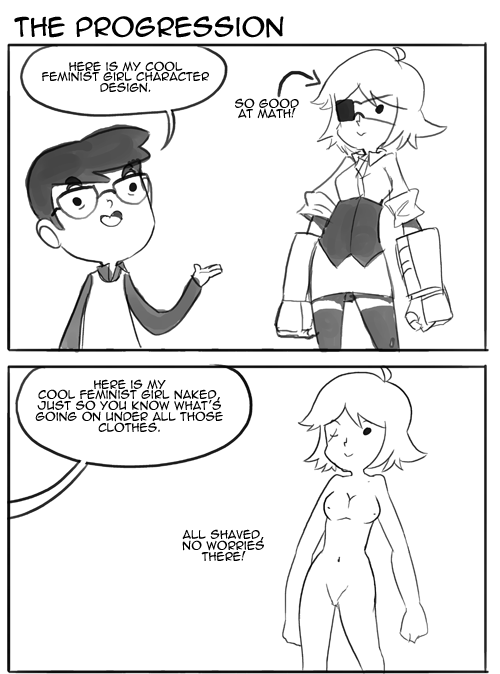
Web comic artist Mary Cagle, known on tumblr by the handle cube-watermelon,  recently posted the comic above, poking fun at the phenomenon of many male comic artists that self-identity as some form of progressive or feminist ally where they will draw cheesecake type pinups or costumes and scenarios that appeal to them specifically, but then try to dress them up (no pun intended) as not just pleasing to look at, but that the art is somehow "empowering" or transgression.

She concludes her post with the bon mot, "Sometimes I think it's okay to just admit you like looking at certain types of bodies naked, and that's okay."

While Cagle most likely wasn't surprised at getting some push-back from some people on tumblr, she was definitely surprised by one response: Aaron Diaz, the writer and artist of transhumanist science fiction web comic Desden Codak. He sent Cagle a note on tumblr:

Hey, how about not being a passive-aggressive shit next time, eh?
To which Cagle published the response:
I would think that you, who spend so much time pointing out the flaws and problematic areas in other people’s work, would be able to take one silly comic directed at your work and others like it. Normally I wouldn’t respond to this kind of thing publicly, but I’ll make an exception since you called me a shit.
Diaz has done many examples of comic and media criticism, notable among them being his redesigns of iconic DC Comics super heroes and concept art he made of Zelda as the lead character in a video game inspired, he said, by Anita Sarkeesian's Tropes Vs. Women in Video Games. And while Cagle parody comic wasn't specifically aimed at Diaz, it most certainly was inspired by a tumblr post (since deleted, see cached copy here) by him where he said "Inspired by some amputee photo shoots, I decided to try my hand at some cyborg-themed pinup sketches with Kim, a sort of celebration of the female form and taking agency over one’s body." Which is pretty ridiculous in the face of it, more so when you see the pin ups and his justification for drawing them (and that's leaving aide his kind of creepy "being disabled is totally an opportunity for the transhumanism movement). That fact that he deleted it shows that he recognizes that he messed up somewhere along the line, but instead of addressing it, he just vague-tweeted about it for a while.

In response to Diaz's actions, Magnolia Porter, a fellow web comic artist and friendly acquaintance of Diaz, published an open letter to Aaron Diaz:
There’s a place for everything, and an artist has the right to create whatever they want to create, for whatever ends they choose. What I have a problem with is that your comic is not presented as a science fiction comic with a dash of sexy thrills, but rather as a feminist narrative in support of powerful independent women. You've made it clear on many occasions that you don’t consider your work to be objectifying or sexist. I have a problem with cheesecake-style art being presented as something feminist, empowering, enlightened- something made “for women”, when it’s clearly made for men.You’re allowed to make art with male gaze. But please call a spade a spade... 
I don’t think I've seen a single page of Dresden Codak that doesn't feature a woman posed in a male-gazey way, with loving focus on her ass or cleavage, or wearing a sexual costume, or in some situation that puts her in a compromising position (like the most recent page in which Kimiko's clothing is burned off of her body, which has happened at least twice in the series’ run.) I have a very hard time believing that these details are accidental. 
...Aaron, you can do whatever you want with your own comic. However, if you really do care about female characters in media, or care to know why so many people seem to be angry with you about it, I would do one of two things. If you don’t want your comic to present its female characters in a borderline-erotic light, then stop doing that. If you don’t mind that, then by all means continue, but please just admit that you like drawing t&a and that it’s not particularly empowering, or feminist, or a celebration of personal agency. As a woman, I resent being told that men’s eye candy is actually meant to uplift me and that I should celebrate it.
Honestly, I don't have any sympathy for Aaron Diaz, nor do I have any sympathy for his position nor his reactions. He got called out for his messed up behavior and has fired back with sadly-all-too-typical defensiveness.

I've seen it happen so often, it's become distressingly familiar. A woman points out that a character or story or the way something is presented is sexist. Men insist that woman is seeing things that aren't there or otherwise reading too much into things because it doesn't come across as sexists to them. This is something I've done before, myself. As men, we are often taught that our perspectives are the default. We end up taking our perspectives and assuming that's how it is for everyone.

Commenter divined by radio at metafilter said it pretty well, I think:
So men who adamantly refuse to believe that their own gender privilege may have resulted in a variably-applied resistance to accepting a woman's objection or approach as valid -- to believe a woman when she speaks, to allow that what she is saying is true, even if they have not experienced precisely what she has experienced -- are displaying, at best, a touch of willful ignorance. They are privileging their own feelings and desires over women's truths, lives, stories, and experiences. And the end result doesn't tend to be very flattering.


Friday, August 22, 2014

If You Call This Justice, I Don't Want Your Support

Image courtesy of shutterstock.com
After my post on the unacceptable torrent of abuse that has been heaped upon Zoe Quinn by misogynist nerd man-babies so desperate to deny that the little clubhouse of video games is changing that they are perfectly happy to take a vituperative screed from her ex-boyfriend and run with it to harass, hack, speculate, insult and demean her by claiming that the private sexual life matters because she's a women making a game they don't like, , someone anonymous left a comment saying that I should link to "unbiased sources". The sources the comment linked was one tumblr post labeling her everything from a "shit-tier developer" to literally calling her a whore that faked every single bit of her abuse, harassment and public hacking at the center of an industry-wide conspiracy (that comment's gone, now, btw).

Prominent youtube "personality" joined the pile-on, with Youtuber JonTron linking approvingly to a pornographic slander comic, and then later approvingly linking to a fan comparing the outcry against his actions to black people being lynched.

Other games industry writers from Stephen Totilio and Patrick Klepek to Leigh Alexander and Jenn Frank took to her defense. One of her most prominent game developer defenders of Zoe Quinn was Phil Fish (who had recently returned publicly to twitter to comment on the human rights abuses in Ferguson). This week, both his twitter account and business website Polytron were hacked, and personal details were released-- everything from back accounts to home address history, along with a data dump of 1.5 GB of developer only assets and financial records for FEZ and his business. After he regained control of his accounts, he announced he was selling off the FEZ IP, the Polytron assets and leaving video game development for good.

Liz Ryerson has a cutting analysis of these angry, scared self-appointed gatekeepers:
Zoe has become the scapegoat for every bit of internalized misogyny and misdirected rage these people felt. she appears to them an amorphous assemblage of everything that is viewed as wrong with women - manipulativeness, sluttiness, being an 'attention-whore'. the idea of trusting the word of a frighteningly narcissistic ex who's out to ruin her reputation is fine with them, because it meshes with their worldview... 

...often it's a conservative, reactionary anger that comes out of disillusionment and fear, and gets constantly externalized onto marginalized people, especially women and queer people. they struggle to understand and adjust to a rapidly shifting cultural landscape, in and out of games, that's moving away from traditionally catering to them and their empathy-deficient values into something more culturally sensitive and aware. and so they find simple explanations for these complex phenomena that fit within their bigoted worldview - boogeymans of evil, manipulative and misleading women like Zoe Quinn or Anita Sarskeesian. they view themselves as anti-authority and anti-power, even as their actions are tremendously conservative and tremendously serving of the interests of power.

The outrage over alleged private infidelity that never even resulted in an actual review lays bare the lie that this is about hand-wringing over worries of "journalistic ethics" and shows instead that those joining in on the pile-on really just see women as a threat to the world of video games and other geeky hobbies, and are ready to rage and holler and attempt to intimidate any woman they decide is somehow a threat at the flimsiest provocation. If you really cared about favorable review currying for games, you'd maybe throw some of this vitriol at the industry practice of only releasing game information to friendly outlets, perhaps.

It shouldn't be up to women to fight these battles alone. As I mentioned in my post about what men need to do about the harassment of women online, we need to make it absolutely clear that this behavior is unacceptable and that anyone that feels otherwise is unwelcome.

So let me make this crystal clear: If you support the harassment of Zoe Quinn or her supporters, if you think you are doing the right thing by shaming her about her private relationships or sexual history, if you think that anyone harassed in the way she has been "had it coming" or that by doing any sort of gate-keeping to women in your hobby you are fighting the good fight-- I don't EVER want your support.

Don't visit my blog. Don't support my patreon. Don't donate to me. Don't read my work or play my games. Don't listen to my podcast. You are not welcome here on The Code, and I don't want you as a fan.

I call on major gaming sites to issue clear condemnations of this behavior in general and defense of Zoe Quinn in particular. When fans or site visitors heap abuse on women that criticize actions or inaction of those in the industry, it because these harassers and misogynists view this as okay thing to do. And if your site policy doesn't explicitly forbid these attitudes and actions from your audience, the toxic elements of your audience view this sort of pile on as implicitly okay. Look at the harassment of Courtney Stanton and Maddy Meyers by webcomic fans, the harassment of Samanta Allen by Giant Bomb fans, the pile-ons from 4chan and reddit and totalbiscuit and jontron fans and elsewhere of Zoe Quinn.

It is unacceptable and unforgivable. You are not noble truth seekers. You're just flinging shit.

Wednesday, August 20, 2014

Not OK: Hateful Man-Babies Target Zoe Quinn. Again.

Image via shutterstock
 Zoe Quinn, the indie lead developer behind the emotionally moving interaction fiction game Depression Quest recently released for free on Steam, as well as Narrative Designer for FRAMED, is being targeted by an unruly mob of misogynist anti-feminists (both overtly and under the guise of being concerned with journalistic integrity) again.

She was first targeted last year when her attempt to get Depression Quest approved via Steam's Greenlight program was cancelled after she was the target of a harassment campaign from a message board. The harassment bled from online into her offline world when her private phone number was published, leading to harassing and obscene phone calls. 

She resubmitted Depression Quest to the Steam Greenlight program a second time, and this time, despite the harassment from reddit, twitter, 4chan, and down-voting campaigns on Steam itself, Depression Quest was approved and released on Steam last week.

Now the same brigade of angry dudebro gamers are claiming Quinn is corrupt, or corrupting Kotaku, or setting back women developers? Quinn tweeted about her parents' phone number getting obscene phone calls. The sub-reddit r/Gaming has a post from its moderator calling out the egregious, harassing behavior of its members-- only to receive nearly 2,000 down-votes.Why? Thanks to a multi-part blog series by an angry ex-boyfriend that did nothing but air out relationship problems in public. Suddenly, men that would not bat an eye over sexual behavior were it done by a fellow dude are calling for an end to her career.

Quinn herself addressed the matter as much as it deserved in a blog entry on Monday:
I am not going to link to, or address anything having to do with the validity of the specific claims made by an angry ex-boyfriend with an ax to grind and a desire to use 4chan as his own personal army. This is not a “she-said” to his “he-said”. The idea that I am required to debunk a manifesto of my sexual past written by an openly malicious ex-boyfriend in order to continue participating in this industry is horrifying, and I won’t do it. It’s a personal matter that never should have been made public, and I don’t want to delve into personal shit, mine or anyone else’s, while saying that people’s love and sex lives are no one’s business. I’m not going to talk about it. I will never talk about it. It is not your goddamned business. 
What I *am* going to say is that the proliferation of nude pictures of me, death threats, vandalization, doxxing of my trans friends for having the audacity to converse with me publicly, harassment of friends and family and my friends’ family in addition to TOTALLY UNRELATED PEOPLE, sending my home address around, rape threats, memes about me being a whore, pressures to kill myself, slurs of every variety, fucking debates over what my genitals smell like, vultures trying to make money off of youtube videos about it, all of these things are inexcusable and will continue to happen to women until this culture changes. I’m certainly not the first. I wish I could be the last. 
Because I've had a small degree of success in a specific subculture, every aspect of my life is suddenly a matter of public concern. Suddenly it’s acceptable to share pictures of my breasts on social media to threaten and punish me. Suddenly I don’t have any right to privacy or basic dignity. Suddenly I don’t get to live out normal parts of life, like going through a bad and ugly breakup in private. I have forfeited this by being a blip in a small community, while those who delight in assailing me hide behind their keyboards and a culture that permits it, beyond reproach. 
My life and my body are not public property. No one’s life and body are public property.
And that's what it boils down to-- a bunch of sexist shook gamers acting like gatekeepers and hypocritically talking about ethics and integrity while trying to bring up a women's private life as a detriment to her career. Talking about fighting corruption while harassing her via reddit and twitter. Talking out of one side of their mouth about the truth while talking gossip and character assassination with the other.

This is unacceptable. It's unacceptable to happen to Zoe Quinn. It's unacceptable to happen to any women in the games industry. This happening to even one woman is one too many, and while Zoe Quinn isn't going anywhere, a number of bright, talented women writers in the gaming scene have been targeted, harassed and hounded-- Anita Sarkeesian, Samantha Allen, Courtney Stanton, Maddy Meyers, and Brianna Wu are the most recent that come to mind. Samantha Allen actually stopped writing about games because of the daily level of constant harassment. 

I covered a bit on the difference between the harassment men and women get in the games industry in "Mythbusting Ideas About Women In Games" that excerpted from Brianna Wu's article as well as linking to an example provided by Sarkeesian, but I want to quote from the end of my post "The Status Is Not Quo: Being A Geeky Woman Online & What Med Need To Do":

Women's hurt and fear for safety and the emotional toll for being harassed online have real, chilling impact on discourse.

This is unacceptable. And the burden of speaking out shouldn't continually fall to the women being harassed. So what can we do? Guys, we have to loudly speak out against this behavior. We have to support women in our creative and media spaces. We need to let other men know that this behavior is not okay, and we need to make it socially unacceptable. We need to listen to women's experiences-- really listen, and not just wait for our chance to say "not all men". We need to realize that online harassment isn't something that just happens-- it's a choice that is made, it is a crime that is done.

As Andy Kouri says in "Fake Geek Guys: A Message to Men About Sexual Harassment":

It is wholly and rightfully and crucially up to men in this society and especially in this subculture to speak out and watch out. To end the cycle of bullying, harassment and violence. To recognize the grotesque irony of degrading women over matters of heroic fictions whose lessons about fairness and decency we've supposedly been studying since we were just little boys, and to start putting those ideas into practice as grown-ass men.


It's not just a few bad apples, guys. It's a lot of bad apples. These are guys that think they represent gamers, that they say what other men are thinking. And we have to push back on this. If you care about safety, if you care about equality, you must push back on this. Staying silent in an attempt to be neutral isn't really being neutral. It just makes dissenting voices less common, and makes the misogynists think that they have your support.

Thursday, August 7, 2014

Tech's Gender Gap Is Real, Pervasive, Worse Than Men Realize


For all the idealism behind the idea that technology knows no borders, that data and the market-place of ideas offer equal access to meritous ideas, free from gender bias or that women have achieved parity with men in the technology field, the actual lived experience of scores of women in the tech industry, from app development to tech investments is rife with stories that tell otherwise. Last week, Wired published an eye-opening and unflinching look at the gender gap between men and women in the tech industry entitled "This Is What Tech’s Ugly Gender Problem Really Looks Like". An excerpt:
Shortly after Kathryn Tucker started RedRover, an app that showcases local events for kids, she pitched the idea to an angel investor at a New York tech event. But it didn’t go over well. When she finished her pitch, the investor said he didn’t invest in women. When she asked why, he told her. “I don’t like the way women think,” he said. “They haven’t mastered linear thinking.” To prove his point, he explained that his wife could never prioritize her to-do lists properly. And then, as if he was trying to compliment her, he told Tucker she was different. “You’re more male,” he said. Tucker didn’t need to hear any more. “I said, ‘Thanks very much,’ walked out, and never spoke to him again,” she recalled earlier this year, as part of a panel discussion on “fundraising while female” at the annual Internet Week conference in New York. 
It was one of many stories shared during a panel that painted the tech world as a place that—for all its efforts to push into the future with apps and gadgets and online services—is still very much stuck in the past when it comes to attitudes involving gender...  
But there’s another truth to remember: For every story you hear about investors behaving badly, there are far worse stories that many women wouldn’t dare to tell. “The most common thing I hear from other women is: ‘Oh the stories I’ll tell once I’m far enough along that I don’t have to worry about being shamed,’” says Kathryn Minshew, co-founder of the job search and career advice site The Muse. For women who have experienced this bias—and there are many—the simple act of talking about it is taboo... And yet, it’s only through these stories that we can begin to understand that the statistics aren’t the result of some fluke or mass oversight, but a very real problem that needs to be solved.
The entire article is worth a thorough read, and hopefully serves as a decent wake-up call. A word of advice, though: Don't read the comments on the article. They're particularly loathsome.

Tuesday, August 5, 2014

Hooked On A Feeling: Guardians of the Galaxy Hits Some Sour Notes


Guardians of the Galaxy is the first big-release movie in a few years I've actually managed to see on opening night (and don't worry, it was at a theater that knew the difference between Guardians of the Galaxy and Rise of the Guardians), and last weekend, hundreds of thousands of people saw GotG too. It pulled in over $94 million last weekend. I really enjoyed it-- it has a fun, spry tone throughout the entire movie and reminded me of one of my favorite movie series when I was a kid-- the Indiana Jones series. It was a movie that had a sweeping scope and lots of action sequences, but it didn't attempt to take itself overly seriously. One of the best examples of it skewering an action series trope that's been done to death, The Overly Dramatic Slow-Motion Group Walk... by showing one character stretching and yawning and another character adjusting his jumpsuit.

And like most Marvel movies of the past few years, it passes the Bechdel test, so it seems like a problem-free win, right? Not exactly. As Gavia Baker-Whitelaw points out in an article for The Daily Dot entitled "'Guardians of the Galaxy' passes the Bechdel Test—but it fails women":
...[W]e have Rocket Raccoon suggesting that Gamora seduce someone to get them all out of space jail. This doesn’t make a whole lot of sense because she already has a way more useful skillset—plus, everyone in the prison is terrified of her or wants her dead. Then toward the end, Drax just straight-up calls her a “whore.” This makes even less sense because Drax’s gimmick is that he takes everything very literally, indicating that he actually means every word he says. The coup de grace is when the final battle scene ends with Peter calling Ronan a “bitch.”
Drax out and out calling Gamora "that green whore" threw me for a loop, but before I could think about it too much, there were more confrontations and explosions. Later on, I found myself a little puzzled-- hadn't Nicole Perlman written the GotG script? Again, not exactly. As Baker-Whitelaw points out:
Guardians of the Galaxy is the first Marvel movie with a woman as one of the credited writers. Nicole Perlman drafted the original screenplay while on a two-year writer’s contract at Marvel Studios, before handing her work over to James Gunn for rewrites in 2012. After that she had little to no influence on the outcome of the film, and my theory is that among various other edits, Gunn’s additions included that handful of weird and jarring attempts at sexist humor.
I agree. I enjoyed the hell out of GotG, but the weird bits of misogynistic humor were like hearing a talented orchestra delivering a stirring performance... with a few noticeable notes played way out of tune every so often. It took me out of the perfomance unfolding before me for a few moments each time.

Now, fellow fans, please keep this in mind-- it's okay to like things with problematic elements. Critques on a movie aren't an attack on the movie, or an attack on you for enjoying it. To engage with media and stories, it's also important to know why they have problems. It's also important that you do not dismiss someone’s feelings, or get ticked off that someone pointing out a problem in media you like could ruin your enjoyment. Your wanting to enjoy a thing is not more important than someone discussing how it affects them.

Thursday, July 31, 2014

Watch The Entire "Women Who Kick Ass" SDCC Panel Here

Here are Natalie Dormer, Maisie Williams, Katey Sagal, Tatiana Maslany, Sarah Paulson and Nicole Beharie talking about the depiction of women in media, the challenges of women in pop culture and more.

Critical Failure: WotC Employed Toxic Harassers As Consultants On New D&D

Last week, I cast a spotlight on the newest edition of Dungeons & Dragons and praised the Player's Handbook for taking the bold step to have inclusive language on gender and orientation right in the handbook. I heralded it as a great step forward and said "Kudos to WotC."

I take it all back.

image

The blog Fail Forward details how beneath the positive press for its inclusive language, the latest edition of D&D also counts among it consultants two men that have a long history of engaging in harassment, homophobic and transphobic behavior: RPGPundit and Zak S.
Seeing their names there in black and white was just too much, and people began to speak out. Most did so in private, others posted publicly but without naming names. This, I became aware, was because anyone who criticized the pair found themselves subjected to harassment, abuse and real world stalking... This is where Zak excels. He has in the past posted lists of people who he feels have displeased him in some way, complete with their real names. Those people then lists find themselves subjected to sustained campaigns of harassment.
...
While this behavior is alarming, it the choice of victim that is the most telling. These attacks nearly always target women and LGTBQ individuals, mostly freelancers and independent designers. Zak and Pundit have taken pains to defend themselves against accusations of transphobia, but I know several trans people who their fans have attacked and harassed. Zak described one of them as ‘mentally ill’, both he and Pundit told others they would be better off committing suicide. Recently, in a post defending Zak and accusing his detractors of misogyny, his girlfriend attempted to out a trans designer.
The anonymous tumblr Problematic Tabletop started cataloging some of their more public behavior. Fresh waves of hate mail forced designers to delete and hide social media accounts to escape. At the same time Zak put his setting book on sale, using promotional quotes consisting of people calling out his behaviour. This was not unusual, Zak’s business model revolves around publicly being a jerk. He is, quite literally, a career bully. 
Eventually, Mike Mearls, the lead designer of the newest edition of D&D, asked for people to come to him privately with any stories of harassment on the part of Zak S. and the RPGPundit had engaged in. Days later, Mike Mearls said that he considered of the claims didn't matter, because he couldn't find any evidence of either man using explicit slurs, so the matter was closed as far as he was concerned.
 Meanwhile, Zak was publicly speaking on Mearls’ behalf, saying that WOTC had found the claims against him to be baseless. Those who sent Mearls information began to panic, had he just shared their complaints with their harasser? Mearls responded that he had told Zak the claims were baseless, but hadn’t shared any names or details with him. Nevertheless they were not pleased, nor did they feel safe. Why had Mearls consulted with Zak before replying to them? Why was it more important to re-assure Zak he was in the clear than respond to allegations of harassment? Mearls again replied, saying that he was not taking the accusations seriously because some of the people stating them were members of the Something Awful forums... Meanwhile, The RPG Site, operated by someone Mearls hired as a consultant, currently contains such topics as: “Bruce Baugh can go fuck himself with a rusty spoon”, “Why I dislike feminism” and a thread defending the use of the word ‘Jap’ in WW2 settings...  
In investigating this story I heard the same tales over and over again. The RPG community is small enough that almost every woman, person of colour or LGTBQ individual seems to have had a run in with Zak or Pundit. The only reason I hadn’t heard about this before is because they are too afraid to speak out. Discussions happen in private, or with the names left out, because both Zak and Pundit are infamous for googling their own names and attacking their critics. Zak even now tries to portray these allegations as prudish conservatives out to smear him due to his involvement in pornography. Yet for that to be true almost every marginalised voice in the RPG community would need to be part of a secret right wing conspiracy. At a certain point you have to accept that that is implausible.
WotC has not made a public statement on the matter. All communication has been through private emails and a now-deleted G+ discussion. It's been nearly a month since this brought to light. WotC has been content to soak up praise and admiration for using inclusive language, but wants to dodge responsibility for using two poisonous people as consultants for that same new edition of D&D.

You don't get to have it both ways. Inclusive language has to accompany inclusive behavior-- otherwise, you're doing nothing but paying lip service with empty words.

Shape up, WotC.

Friday, July 18, 2014

The Status Is Not Quo: Being A Geeky Woman Online & What Men Need To Do


It's a bitter irony that for the many self-identified male geeks, nerds, gamers (both of the video and tabletop kind), comic books fans, sci-fi enthusiasts &etc that talk about growing up feeling unwelcome or ostracized in wider society, many women wanting to contribute to, or participate in, those same communities end up feeling that same isolation, hostility and othering just for being a woman online. Whether it's having their "credentials" challenged as being nothing more than a "fake geek girl" or being made to question their own legitimacy at an even just because they are attending an event with their significant other.

Online platforms like Twitter and Youtube have enabled women to work to curate and create spaces on their own terms. Women have flocked to these services to create their own networks of support, activism, and discussion as well as reclaim online space to talk about shared interests, media fandom, geek culture, video games and more from a feminist perspective. However, as Samantha Allen points out, for all the resources and community the Internet has offered, it has made it...

"...much easier for men to manipulate, harass, abuse, stalk, and, yes, physically harm women.This past weekend, I was on a panel with some members of Nostalgia Chick, a set of veteran media critics who often include feminist perspectives in their videos. They told me that the Internet, in many ways, has become a less hospitable place for them to do their work over the years. 

And I believe it. Between 4Chan, Men’s Rights Activist groups, theReddit Red Pill community, pick-up artist (PUA) groups, and anti-PUA groups like the one that Elliot Rodger clung to so dearly, the Internet has allowed men to band together more efficiently than ever before to threaten and antagonize women. Every woman with an online presence has a story to share about unwanted contact, sexual harassment, and predatory behavior."

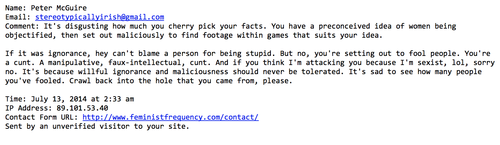
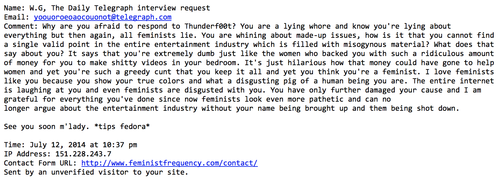
Anita Sarkeesian, the writer and producer of the Feminist Frequency web video series, started the "Tropes vs. Women In Video Games" series that looks at video game tropes and culture through a feminist lens, has been the target of years of harassment, and recently shared a small sampling of the harassing emails she gets on a regular basis:
I get so many emails like this I could publish a coffee table book full of them.
image
It’s especially amusing that this misogyny laced email is unironically signed “See you soon m’lady. *tips fedora*”
image
Sadly, this is a widespread problem for women creators on YouTube, and was addressed at this year's VidCon, the world's largest conference for online video content creators. As Rae Votta outlines in "What It's Really Like For Women On Youtube":

In March, abuses of power by men in the YouTube space over their younger, female fans came to light after several women spoke out on Tumblr and other platforms about their experiences, causing community-wide outrage and task forces like YouCoalition, which was formed to “combat sexual abuse, emotional manipulation and other forms of violence in the YouTube community,” according to the website. Saturday’s Women on YouTube panel broached this still-raw topic, emphasizing the opinion that, while the start of the conversation about abuse had a lot of flaws, the important thing is that the community doesn't treat the situation like it’s finished, and still gives the issue the attention that it deserves.

Rojas, who was one of the women who spoke out against inappropriate behavior, chimed in, “We've shown a lot of people that they won’t get away with it.”
“We are not a community that welcomes abusers,” emphasized Lex Croucher. “The most important thing is to encourage people affected by this to come forward and [to be] supportive of those who do come forward.”
Lots of people try to frame harassment and abuse online as "just the Internet", but the emotional toll and physical danger is important, and a very real threat, and carry very real consequences. Recently, Samanta Allen was harassed off Twitter after she was buried under an avalanche of harassing tweets when she talked about how she liked the staff of Giant Bomb but was disappointed that for all the site's talk of valuing diversity, the site's first public hires in years were another two white men. Women's hurt and fear for safety and the emotional toll for being harassed online have real, chilling impact on discourse.

This is unacceptable. And the burden of speaking out shouldn't continually fall to the women being harassed. So what can we do? Guys, we have to loudly speak out against this behavior. We have to support women in our creative and media spaces. We need to let other men know that this behavior is not okay, and we need to make it socially unacceptable. We need to listen to women's experiences-- really listen, and not just wait for our chance to say "not all men". We need to realize that online harassment isn't something that just happens-- it's a choice that is made, it is a crime that is done.

As Andy Kouri says in "Fake Geek Guys: A Message to Men About Sexual Harassment":
It is wholly and rightfully and crucially up to men in this society and especially in this subculture to speak out and watch out. To end the cycle of bullying, harassment and violence. To recognize the grotesque irony of degrading women over matters of heroic fictions whose lessons about fairness and decency we’ve supposedly been studying since we were just little boys, and to start putting those ideas into practice as grown-ass men. 

Readers, what say you? Sound off in the comments below.

Tuesday, January 11, 2011

Retro Repost: Penny Arcade, Game Culture & Rape

Note: This article was originally published as part of my time as an Associated Content Featured Contributor to the Video Games Section. Associated Content was later bought by Yahoo! and renamed Yahoo! Voices. Yahoo Voices shut down in July of 2014. This article is being republished here on The Code, backdated to its original date of publication to remain as a record of my writing.

Trigger warning: This article includes discussion of abuse, sexual assault, and rape, including rape as humor and rape as story elements in video games.


On August 11, 2010, the web comic Penny Arcade presented a comic strip titled "The Sixth Slave". According to the news post for that comic, it was based on a real quest in an MMORPG, and intended to lampoon the sort of punch-clock morality introduced by having to repeat the same instance of a quest over and over for new players. In the first panel, an armor-clad hero strides past a ragged slave, who calls out, "Hero! Please, take me with you! Release me from this Hell unending!". The second panel is a close-up of the slave's haggard face as he continues, saying, "Every morning, we are roused by savage blows. Every night, we are raped to sleep by the dickwolves!". In the final panel, the hero replies, "I only needed to save five slaves. Alright? Quest complete." As the slave protests with a "But..." the hero interjects, "Hey. Pal. Don't make this weird."
The reaction to the comic from fans, writers, and rape survivors touched off a firestorm of controversy, and apparently took the creators by surprise. Commenter Sydera in a discussion thread on the feminist blog Shakesville theorized that "...the reason this cartoon thought a rape joke would be funny is the pervasive use of 'rape' among WoW players to mean something other than rape."
Others pointed out that since rape isn't an explicit part of most video games and was only part of the set-up to the joke, something else equally over-the-top and horrible could have been substituted for being "raped to sleep by dickwolves" without losing the humor of the punchline. Others wondered if the joke would have been as funny if it were a child or a woman instead of a man making the pleas. But the most common criticism leveled at the comic was that using rape as the set-up to a punchline was part of larger problem of both male-centric gaming culture and society at large: jokes about rape inadvertently reinforce a social climate where real pain from rape survivors is minimized. Shaker Milli A, in a guest post on Shakesville, said that this is especially damaging"...because rape survivors exist among us, and after being victimized by rapists, they are re-victimized by a society that treats even real rape like a joke, forced to live in a culture that actually has a lot of rape jokes... because people don't take rape seriously."
The creators of Penny Arcade, Mike Krahulik and Jerry Holkins, seemed surprised and even angry at the criticism. Kahulik responded on Twitter, saying "I don't feel like we made a mistake... Some people seem to work really hard so that they can be mad. Life is too short." When it was pointed out that rape jokes have the potential for triggering severe traumatic responses in survivors, Krahulik replied with "[T]he idea that our cartoon could cause 'significant trauma' is bat s*** f***ing insane."
The pair released a follow-up comic two days after "The Sixth Slave" that featured the comic's two main characters, Tycho and Gabe, directly facing the viewer. In the first panel, Tycho says "Hello, this is Tycho Brahe, of Penny Arcade. We recently made a comic strip where an imaginary person was raped imaginarily by a mythological creature whose every limb was an erect phallus. Some found that idea disturbing." Gabe chimes in with "We want to state in clear language, without ambiguity or room for interpretation: We hate rapers, and all the rapes they do. Seriously, though. Rapists are really the worst." In the final panel, Tycho, Tycho says, "It's possible you read our cartoon, and became a rapist as a direct result. If you're raping someone right now, stop. Apologize. And leave. Go, and rape no more!" In the comic's related news post, Kahulik said "Did the [previous] comics about bestiality, suicide, murder, pedophilia, and torture not bother them? Or how about the fruit f***er? I mean, we have a character who is a literal rapist. What comic strip have they been reading all these years?"
Melissa McEwan responded by pointing out that "No, one rape joke does not 'cause' someone to go out and commit a rape. But a single rape joke does not exist in a void. It exists in a culture rife with jokes that treat as a punchline a heinous, terrifying crime that leaves most of its survivors forever changed in some material way." According to the Community Counseling Centers of Chicago, a third of rape survivors can develop post-traumatic stress disorder. McEwan further explained that "...rape jokes trigger (some) survivors of sexual violence... A survivor of sexual violence who experiences a trigger is experiencing the same thing as a soldier who experiences a trigger, potentially even including flashbacks... [and] post-traumatic stress disorder". This is why I have chosen to place a trigger warning at the beginning of the article.
A charitable interpretation of the official response from Penny Arcade is that Krahulik and Holkins were upset and defensive. There was hope that the many posts from gamers and bloggers along with emails containing critical responses from fans in the wake of the "Sixth Slave" comic could help the duo realize that the bigger problem wasn't that the inclusion of a rape joke was unnecessary and potentially offensive, but that the joke and their response were potentially triggering. In the months after the controversy, they had the time to educate themselves about post-traumatic stress disorder and trigger warnings. However, on October 8th, Krahulik posted the following introduction to his podcast about Dungeons and Dragons: "Trigger Warning for attempts to coerce laughter through foul language, Dungeons, Dice rolling, contempt for Hydra's bodily autonomy, [and] Dragons". Immediately following this post, Holkins posted an announcement for one of two new shirts on sale: a "Penny Arcade Dickwolves" shirt, done in the manner of a sports team logo. Shortly thereafter, Penny Arcade also added a Dickwolves pennant.
I personally feel that with a news post mocking trigger warning and PTSD victims, followed by the sale of a "Penny Arcade Dickwolves" T-shirt, Mike Krahulik and Jerry Holkins progressed from being ignorant, insensitive and unintentionally offensive to outright deliberately cruel, all while trying to exploit the controversy and pain caused in the wake of the "Sixth Slave" comic and their response for a profit. Penny Arcade is a website that draws millions of views every single day. They run two separate video game conventions. MTV Online has called Krahulik and Holkins "...the closest the medium [of video games] has to leaders of a gamers' movement." They created the Child's Play charity originally to combat the negative stereotypes about people that play video games and have raised nearly 9 million USD for children's hospitals over 8 years. They were listed as part of the 2010 Time Magazine 100 people that "most affect our world". Yet they have offered the defense that the comic and the resultant merchandising is not supposed to be influential or taken seriously. Either they can influence their audience, or they can't.
When they published "The Sixth Slave", I was willing to give the duo the benefit of the doubt. I wanted to believe that Krahulik and Holkins were only being clueless out of ignorance, not being malicious on purpose. Of course, intent doesn't mitigate impact. If you're doing a funny dance for a bunch of people and you accidentally step on someone's foot, it's still going to hurt, even if you didn't mean to step on anyone's feet. When Penny Arcade published the follow-up comic after making several angry and defense responses, I could no longer willfully make an assumption of good faith. Mocking trigger warnings, and by extension PTSD, along with selling a Dickwolves t-shirt and pennant has led me to conclude that they are being malicious on purpose for their own satisfaction, and to make a quick buck.
The problem with using rape as part of punchline is that is adds more to the cultural waters where rape is not taken seriously. As mentioned before, recounting of rape can has the potential to trigger awful traumatic reactions in survivors. And the number of survivors of sexual violence is very large indeed. According to RAINN, 1 in 6 women and 1 in 33 men will be sexually assaulted in their lifetime. Despite the high percentage of women who are survivors of sexual violence, many people making rape jokes tend to think of rape as an abstract thing that is horrible and wrong but hasn't happened to them, nor to anyone they know. So they feel free to make jokes about a shocking subject, thinking that since they don't mean any harm, they won't be harming anyone. This adds to the pervasive attitude that rape is just some nebulous thing that happens to "other people" and a dismissive attitude has no real impact. That attitude, in turn, in turn leads to victims being less likely to tell someone who makes these jokes that they have been sexually assaulted.
According to RAINN, a little over 60 percent of incidents of sexual assault go unreported. This is partially attributed to the fact that prevalent attitudes regarding assault and rape make survivors reluctant to speak out. A critically-acclaimed video gives an example of this shame and silencing effect-- in Mass Effect 2, when Commander Shepard asks what the prison is like, one of the male prisoners answers makes lots of fidgeting and furtive glances and obliquely references the fact that other prisoners have stolen his clothes, his belongings and even his pride, and that he's been so afraid he hasn't showered in months. It is played for laughs. There is an entire category on TV Tropes about the use of prison rape as comedy. In the "Sixth Slave" comic strip, the slave begging to be saved from the fate of being "raped to sleep by the dickwolves" is a man. As a survivor of sexual assault myself, I can personally attest that constant jokes about male on male rape, casual use of rape jokes and rape as slang for losing (or winning) a video game by a wide margin have made me less likely to share my experiences, increased the level of humiliation and shame I have felt, as well as contributing to me feeling like an outsider at times in a community I wanted to belong to.
Krahulik wondered why this particular comic seemed to spark so much outrage when they have been doing offensive comics for years. Leaving aside the notion that people are allowed to chose what they devote their own mental energy to, as well as the fact that Penny Arcade is not an episodic strip with much in the way of continuity... the strip has been online since 1998. The number of people reading comics online has grown by leaps and bounds in the past 13 years. I personally think that the backlash might not be a matter of fans suddenly being upset with them, but instead reflect the first time that Krahulik and Holkins really couldn't ignore what they were being told.
The Dickwolves t-shirt doesn't turn gamers into rapists, but it does dismiss and trivialize a very real trauma. It can contribute to an atmosphere that can make victims of sexual assault-- of which women are the most likely-- feel unwelcome and ostracized from the gaming community, especially in light of the fact that there are two Penny Arcade conventions. An outfit isn't just something one uses to cover one's nakedness. As anyone giving job interview advice would tell you, your choice of outfit sends a message to the people around you. Many gamers or geeks will wear t-shirts that express a geeky side or love of video games. The Penny Arcade Dickwolves t-shirt looks like a team jersey of the kind typically worn by fans or supporters of their favorite sports team. So what sort of message are you sending when you wear a "team Dickwolves" shirt or display the Dickwolves pennant? I looked high and low for a "Sixth Slave" sports team t-shirt. Penny Arcade doesn't sell those.
One person who is, however, is producer and blogger Kirby Bits. Bits has responded by designing a shirt for the "Dickwolves Survivors Guild". The shirts are priced at a dollar over cost, Bits said, with 100 percent of the proceeds being donated to RAINN. When asked about his reasons for making the shirt, Bits said that "...the thing that motivated us into action was that if you're going to make a t-shirt... [the Dickwolves design] is about the laziest, most uncreative way to do that. And on top of that, they are literally profiting off of rape culture, which makes me sick to my stomach when I think about it for too long."
Even if you don't agree with the fact that placing rape and the trauma of rape survivors as part of a joke makes life worse, it is a demonstrated effect that these joke can trigger physical and severe mental trauma. Do you want to be a part of that? How can we, as members of the video game community, claim to be a part of the good that charities like Penny Arcade's Child's Play will do, but choose to ignore, dismiss or marginalize women gamers and survivors of sexual assault? Every single response from Penny Arcade-- a website that has proven to be enormously influential in both the effects it has on the video games industry and the audience it commands-- has sent the message that if you have been raped, if feel uncomfortable about rape jokes, or if you don't think that joking about rape is funny, then the video gaming community isn't really the place for you.
The official response from Penny Arcade to fans who emailed them, engaged them on twitter and pointed out the consequences of Penny Arcade's rape humor were mocked, insulted and ultimately ignored. The fact that Krahulik and Holkins now proudly sell t-shirts and pennants mocking the reaction and claiming allegiance via the "Penny Arcade Dickwolves" is a bitter irony when you consider that they used to sell a t-shirt with a drawing of geek icon Wil Wheaton emblazoned with the statement "Wil Says: Don't Be A Dick".
Sources:
http://www.penny-arcade.com/comic/2010/8/11/
http://www.penny-arcade.com/2010/8/11/
http://www.penny-arcade.com/comic/2010/8/13/
http://www.penny-arcade.com/2010/8/13/
http://www.time.com/time/specials/packages/completelist/0,29569,1984685,00.html
http://www.penny-arcade.com/2003/11/24#1069746601
http://shakespearessister.blogspot.com/2010/08/rape-is-hilarious-part-53-in-ongoing.html
http://shakespearessister.blogspot.com/2010/08/survivors-are-so-sensitive.html
http://danbruno.net/blog/2010/08/apologies-apologia/
http://www.penny-arcade.com/2010/10/6/
http://www.rainn.org/get-information/statistics/sexual-assault-victims
http://www.rainn.org/statistics
http://www.c4chicago.org/taxonomy/term/35
http://geekfeminism.wikia.com/wiki/Timeline_of_incidents
http://kirbybits.wordpress.com/2010/10/19/here-is-a-shirt-dickwolves-survivors-guild
http://wilwheaton.typepad.com/wwdnbackup/2008/03/wil-says.html

Share This Post