Showing posts with label disability. Show all posts

Monday, April 30, 2018

Video Game Subtitles: The Good & The Bad

Nowadays, most video games, from the tiniest independent title to the AAA blockbusters have subtitles. Subtitles are important not just for the Deaf and hard of hearing-- players with audio processing disorders need them too, as well as player who need the voices or sound lowered for whatever reason. Max Deryagin, an expert consultant on subtitles whose work has appeared in hundreds of videos, is also an avid video game player. His thoughst on what video game with subtitles often fail to do correctly is a well-thought-out article with plenty of examples from last year about what not do to. Here's an example of an irritating problem I ran into way too often: crappy contrast between the subtitle text and the actual game environment...

if the game is highly dynamic, you don't have much time to focus on the subs, so it can be really hard to keep up with them when the contrast is low. Let me demonstrate that in the video clip below. Try to pay attention both to the image and the text. (The clips are muted to imitate not hearing the dialogue well, when you'd want to enable subtitles.)


Subtitles in Star Wars Battlefront II from Max Deryagin on Vimeo.


Ridiculous, isn't it? I can't even read the text in time, let alone enjoy the scenery or concentrate on the action.

Max's post includes a lot more common subtitling implementation mistakes from last year, so whether you're a game player or a game developer, it's essential reading.

As with previous posts I've made on accessibility, these issues don't just affect gamers with disabilities. Making games-- or whatever content you're distributing-- accessible makes them available to a wider audience, and if just a little thought and consideration goes into these measures at the beginning, they can be both super easy and super cheap to include from the get-go.

Tuesday, April 24, 2018

Leveling the Playing Field: Video Games & Accessibility

Description: Close up of a pair of hands holding a Playstation
4 controller. The controller is a deep blue, and a light on the front
of the controller glows brightly.
Accessibility in video games is more than just creating specialized controllers. It's an issue that doesn't even have to be particularly time-consuming or expensive, as long as you make sure to think of it at the beginning instead of bolting it on at the end. So why are ways to make video games accessible still so sparsely implemented? Why does change keep happening so incrementally, if at all? How can this be fixed? Why is the video game industry so slow to adopt techniques that have made entertainment media accessible in other domains? In "How Games Can Better Accommodate Disabled Players", Waypoint's Mike Diver interviews Ian Hamilton, an game development consultant and advocate for increasing video game accessibility for game players with disabilities. An excerpt:
"Awareness, though, can be hard to come by directly—the circumstances in which games are made are not the same as those in which games are played. Console games are not played on a 27-inch monitor, 18 inches from your face; but that's often the environment in which day-to-day UI decisions are made... There's no reason why the system can't be designed and implemented before the content it's going to display is finalized. That's something I'd dearly love to see addressed at an engine level, as there's really no need for developers to keep reinventing the wheel every time—especially when it's so often reinvented as a square. Again, as with a great deal in accessibility, this isn't rocket science to solve, at all. It's just about actually getting it done."

The discussion of subtitles in video games was of particular interest to me. I always play with subtitles on, as I have an auditory processing disorder and there are times that I just can't focus on the dialogue any other way. Hamilton also talks about controller remapping, colorblind mode and more. The entire article's a great read, so do read the whole thing.

Monday, July 31, 2017

Disfigured Villains In Films Harm Real People

Batman's nemesis Two-Face, the Harry Potter series' Lord Voldemort, and Wonder Woman's Dr. Poison-- all of them are villains, and they all have disfigured faces. It's a common trope in fiction to show the internal ugliness of a character's evil deeds and thoughts be reflected by giving the character facial disfigurement. Popular culture reflects the world around us, which society reflects back, creating a feedback loop that further reinforces harmful stereotypes and makes the lives of people with facial disfigurements worse, because audiences have internalized these messages. In an interview with Brendon Connelly, when asked why so many James Bond villains have disfigurements, James Bond producer Michael G. Wilson said it was meant to honor the narrative device that Bond novel author Ian Fleming employed, "the idea that physical deformity and personality deformity go hand in hand in some of these villains.”

Writing for Teen Vogue, Alaine Leary outlines how Wonder Woman's Dr. Poison portrayal feeds into that idea and reinforces an already painful stigma for people with facial disfigurements:
Dr. Poison falls into the easy trope that suggests disability — and in this case, specifically facial disfigurement — means that a character is evil. We never find out Dr. Poison’s backstory and whether her facial scarring caused her to become a villain or happened after she already was one, but the message is the same: We should be afraid of people whose faces and bodies are different from our own... When we pigeonhole disabled characters into basic roles that are easily defined, such as sympathetic and pitiable or villainous and evil, we’re reinforcing the idea that disabled people don’t live full, meaningful lives the same way non-disabled people do. We need more media that offers a diverse perspective on disability and facial disfigurement, and doesn’t just boil our vast experiences down to a plot point.
Ariel Henley, an author with Crouzon Syndrome, has also talked about how Dr. Poison affects her as a person with facial disfigurement, saying "As someone with a facial difference,... [t]he only evil most of us have experienced has been at the hands of a society that refuses to accept us."

Honestly, I agree. The idea of someone's outward appearance reflecting anything about that person's inner life and worth is junk, and the "Evil Makes You Ugly" trope is cliched, lazy, harmful nonsense that had worn out its welcome ages ago.

Friday, June 23, 2017

Harry Potter and the Tax On The Blind

Image description: tweet by Titanium Cranium (@FelicityTC)
including three screenshots of a Harry potter book in three different formats
on Amazon. Text: “Harry Potter on Amazon - Print: $6.39 Audio: $44.99
Braille: $100.00 #CripTax”
Tumblr user actuallyblind debunks the idea that charging 8 to 10 times more for audio and Braille version of books is just covering the cost of production:
But those defenders of higher prices are reversing the argument to justify fleecing disabled readers.
What do I mean by that? 
Braille is not magic. It is done by taking plain text and feeding it through fairly affordable translation software, creating a document that can easily be printed in braille. All that time and effort and special software? IS NOT FOR THE BRAILLE... 
Printing in braille is cheap; reverse engineering a finished text to print it in braille IS NOT. Same with those audio books. After a book is completed and, often, after it has already been published, the publisher arranges to have the book recorded by a professional voice actor/reader, which usually also involves a recording producer... However: that cost? IS RARELY FACTORED INTO THE BUDGET OF PRINTING A BOOK. 
[The claim that Braille and audio] formats are more expensive to produce so they have to be priced higher is only true if you completely throw out the premise that publishers have an obligation to account for disabled readers when they are actually budgeting for and publishing the book."
In my experience as a designer, I've noticed that the high cost of creating accessible features-- whether it's on a website or a building-- is not due to the features costing anything exorbitant. The actual high cost comes in when there is a lack of considering accessibility issues from the very start and you have to retro-fit those features in. Whenever this approach is a project's primary approach to accessibility, then accessibility seems expensive. The true is expense is a failure to plan.

Unfortunately, it's a lot easier to blame disabled people for wanting accessibility to the same resources as everyone else instead of blaming the designers or publishers or the people responsible for hiring and directing them.

If you're about to say something like "Oh, no one has to read entertainment books, I'm sure it's taken care of in schools, tumblr user inlustris weighs in:
My mom is a textbook braillest. She has the software, fixes the formatting, takes the textbook and makes it translatable into braille. Most of her work ends up becoming rush jobs, because schools always forget about their blind students and the materials that they need. They start semesters without the right textbooks, are provided the materials late, can’t take the tests at the same times, because schools and teachers usually lack the foresight to provide the materials in advance. 
What we need is for more designers, publishers and project design leads to learn about the principles of universal design.

Tuesday, June 13, 2017

Glitch In The Narrative: ROM 2064 Missteps With Disability

I loved almost everything about MidBoss' cyberpunk adventure game, Read Only Memories: 2064. The soundtrack was evocative and well put together, the look of the game nailed the classic cyberpunk aesthetic, the writing was by turns affecting and humorous, and nearly all the characters from the protagonist and side NPCs were vibrantly well written. ROM: 2064 is also a game that takes unflinching looks at issues of morality, disability, gender, and mental illness in society, which is why one character's end game story turns out to be so disappointing. I've set up a jump cut to ward off accidental spoilers, so be warned: the rest of this post features spoilers for the endgame of ROM: 2064.

Tuesday, May 23, 2017

Making the Web Accessible For The Visually Impaired

Description of how a screen reader works with webpages.
Courtesy of the National Federation of the Blind, the Amer-
ican Foundation of the Blind, and the Associated Press.
Children's author and key "We Need Diverse Books" boosted a recent discussion between a web developer and a blind web user: what are the main challenges for people with visual impairments when trying to navigate a website that hasn't been optimized for accessibility? user answers:

[A]ttempting to navigate the site will be really obnoxious. There are shortcuts to help navigate screens with the screen reader, and these are used pretty frequently. JAWS, for example, will use H to move from header to header, T from table to table, and so on. If that order isn’t intuitive, an end user can get in an unexpected place - and since there’s no visual context, it can be hard to get back on track. 
Mostly, it’s about being aware that the structure of your code has further reaching impact than just the visual aspects of the screen.

If you're a business, it also ends up costing you sales and loyal customers. By coding a website that is screen-reader accessible with features like properly marked-up semantic structure and labeled links and images, your website will be more easier to be indexed search engines. Web crawlers (also called "web spiders") such as the one Google uses get their information from websites the same way a user employing assistive technology would. By having an accessible site Google can more easily index your site and make it easier to find in search results. And according to WebAim, if a visually impaired customer finds a commercial website is easy to use with assistive technology, they are twice as likely to be a repeat customer.

A site's marketing copy is tailored to bring customers to your website, so it's just good business sense to make sure it’s accessible once they arrive. The American Foundation for the Blind and WebAIM have several tip sheets and tutorials that help make your website welcoming for people with low or no vision.

Ultimately, while making the web more accessible for the blind does immediately benefit visually impaired users right now, it also helps your bottom line AND your future use of the web. As I wrote last year:
"But Shawn, I don't have a disability, why should I care?" some might ask. Well, if empathy won't convince you, how about self interest? In the disability activism community some people use the term "temporarily able-bodied" (TAB for short) to refer to people that don't have a disability. Why? Well, odds are that as you age, you will experience declines in vision, movement, motor function or cognitive functions. You may be able-bodies NOW, but you won't always be.

Monday, May 1, 2017

Discord: Inaccessible To The Blind, Devs Won't Budge

Logo for the Discord chat app
Discord is a wildly popular chat application for both desktop computers and mobile phones. It has focused its branding message as an app that helps build communities, and has over 25 million users as of December of last year. Discord also remains completely inaccessible to blind users on any platform. Even Discord for the iPhone-- a platform that has been praised for having very accessible applications and ways to make apps accessible for the blind-- remains inaccessible.

The Discord developers seems keen on keeping its app that way, too. They answer accessibility requests as just a "quality of life" feature and thus not a reason to have to make the app accessible at all. One totally blind Mac user filed a bug report that showed Discord wouldn't work with the Voiceover program-- a screen reader that reads the text out loud. The official Discord response was that he should just use the Zoom program. Zoom is a program that lets you magnify portions of the screen. This is like telling a deaf person letting you know your closed captions on your video aren't working that all they need to do is turn the volume up.

After some push back over several months by visually impaired users, Discord developers said that if this request can get enough upvotes, they’ll consider adding in visually impaired accessibility features.

If you're a Discord user, all you need to do is login, upvote that link, and maybe even leave a comment. It's pretty crappy that a text and voice chat app is inaccessible to the visually impaired, especially an app that talks about building communities.

Monday, January 25, 2016

Make The Web Better In Under 5 Minutes

Description: Close of of a computer keyboard. Just above the
"alt" key is a blue rectangular key with rounded corners labeled
"Accessibility", with the International Symbol For Access next to it.
Folks, I'm gonna put on my web develop hat for a moment here. One of the biggest barriers to making the web accessible for everyone are lack of accessibility features. People with disabilities deserve to access the web as much as anyone else. Features that can make websites accessible for people with disabilities are often simple and involve minimal labor or cost. These features typically have either no impact on the web experience of non-disabled people at all, or else improve the experience for everyone using the web. Right now, the law requires businesses to make their websites accessible. But most businesses ignore this obligation, in part because the U.S. Department of Justice has delayed the release of regulations that spell out exactly what accessibility features websites must have.


"But Shawn, I don't have a disability, why should I care?" some might ask. Well, if empathy won't convince you, how about self interest? In the disability activism community some people use the term "temporarily able-bodied" (TAB for short) to refer to people that don't have a disability. Why? Well, odds are that as you age, you will experience declines in vision, movement, motor function or cognitive functions. You may be able-bodies NOW, but you won't always be. So consider web accessibility as a way to "future-proof" the web and its vast resources, if nothing else.

Monday, August 18, 2014

Guest Post: Coping With Disabilities Through Pony Panel Recap


"Our Little Inspirations" back cover artwork by Stoneth
The Code has been promoting and documenting a Brony dad with a visual disability's effort to bring a panel called "Coping With Disabilities Through Pony" to Bronycon 2014, with the aim of showing other fans how the can advocate for and empathize with people with disabilities in the fandom. The panel host and organizer, Matthew Palumbo, wrote in with a report on the panel, so I'm giving him a guest post slot to share the panel report with you all.
The day of the panel was amazing! We all met at 1:00 PM in front of the Hall of the Moon to prep our opening presentation along with Rachel Merryfield's demonstration of Braillemon. 
As we discussed how things would go, I was asked about my Snowdrop plushie by a young lady behind me. I let her see Snowdrop and she began to share how she found Snowdrop very inspirational in feeling understood despite her disability. She then asked me if I was attending the panel. Of course, I stated that I was the lead panelist and how the rest of the team was right in front of her. She was amazed. But what really touched her was how I pointed out how Meredith Sims, the voice and writer of Snowdrop, was right in front of her. The young lady couldn't believe it. So I asked Meredith to come over. The lady was ecstatic to share with Ms. Sims how her work with Silly Filly Studios positively impacted her life. Meredith was nearly speechless. 
Set up was far easier than expected, so the team took time to answer some questions before the panel started. The turnout was ever growing and eventually reached about 90% of the room's capacity. This was truly impressive. 
The introductory videos went over very well with the audience applauding after various segments were shown. I then discussed the meaning behind the videos before turning it over to my son, Ethan, who discussed briefly how a dad was a dad. Disabled or not a parent is there for you and loves you.  
Benjamin Platt spoke on how he became a fan and what it was like to have a brother with Autism and a sister with Down's. He pointed out  how they inspired him by showing how they coped with their respective conditions while also finding their own ways to take part in this great big world of ours. This overall showed that one cannot and should not judge a person by simply a first impression. Doing so makes you miss out on how different people have their own ways of being an active part of all our world has to offer. 
Rachel Merryfield's presentation was next. It was also perhaps the most impactful. The reason for this is that prior to the panel starting a fourteen year old member of the audience announced to us all how he had Autism and felt like he may not have a purpose since nobody seemed to want to listen or understand him. Rachel has Autism but did not intend to note it during her discussion of accessible software. The boy's bravery brought Rachel to not only share how she, too, was Autistic but also prove that individuals with special needs do have a purpose. She went on to discuss how there are people who do genuinely see you for more than your condition who do want to genuinely be your friends while working alongside you in those things you delight in doing. It was an extremely emotional moment that hit home with not only members of the audience but the whole team as well. 
Meredith Sims of Silly Filly Studios was last to speak. She discussed the development of Snowdrop while touching on why she chose to make Snowdrop blind. This being how she knew individuals with no sight were known for having a strong sense of touch. Knowing it took a delicate touch to make a snowflake, Meredith decided Snowdrop being blind would help deliver a more powerful message for the animation.
Ms. Sims also shared how the teacher was based after experiences she had witnessed in her own life while Snowdrop's non stereotypical presentation was inspired by meeting many individuals with special needs in her church's youth group. 
What hit home the most for Meredith was when she asked the audience how many had watched Snowdrop. Nearly everyone in attendance raised their hand! This seemed a most humbling moment for Meredith who, despite having read all the comments on the YouTube video, hadn't truly realized how deeply Snowdrop had positively influenced so many who had special needs. 
After the panel everyone was approached by members of the audience to discuss how delighted they were in how and what was presented. Even Matthew's son, Ethan, was talked to and asked to sign an autograph! 
We look forward to sharing more in the coming days. Thanks to everyone who helped make this panel and its Beyond the Panel aspects a true success!
When I asked Matthew about the "Beyond the Panel" mention, he said it referred to how he had collected 41 stories of inspiration from 5 countries around the world and made it available as an accessible Word document, a PDF, and a physical book. He will also be releasing an audiobook version this week as well and exploring a Braille version. Meredith Sims has also committed to releasing a version of Snowdrop with descriptive narration for the visually impaired.

You can visit the panel website at http://copingwithpony.weebly.com and contact Matt at hapotales@gmail.com.

Tuesday, August 12, 2014

Telltale Games' Devs Eager To Kill Disabled Character

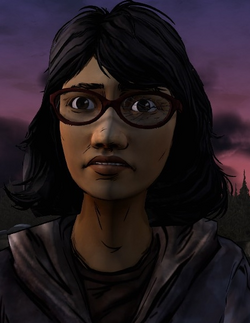
AmTR Sarah Evening
Note: This post has spoilers for Season 2 of The Walking Dead Game.

Telltale Games have had a successful run with spinning great episodic adventure games from licensed franchises while managing to stay true to the source material, from the goofy absurdity of Homestar Runner in the "Strong Bad's Cool Game For Awesome People" to the sci-fi adventures of the Back to the Future series. The praise has continued for its adaptation of a video game based on the best-selling comic book series and cable TV show, The Walking Dead.

The Walking Dead video game has also been given kudos in particular for its diverse cast. Women characters are well-represented and well written. There are a wide range of characters in a wide range of backgrounds, ethnicity and even body types.

The second season of Telltale Games' Walking Dead game introduced a new original character as part of that season's group of cabin survivors: Sarah, a Hispanic teenager girl presented as neuro-divergent and implied to have some sort of anxiety disorder, complete with disassociation and panic attacks. Her father Carlos is shown to be overbearing and over-protective.

While there were the usual complaints from gamer dudebros about women characters followed discussion of Sarah in the game, there was also a grimy patina of ableism. Players talked about Sarah being a liability or bringing the group down. Slurs used against people with disabilities were used to describe the character, and gamers took to Facebook and Telltale's official forums to talk about how they had the chance to kill Sarah, how they would be happy to get the chance.They uploaded videos to Youtube titled "I HATE SARAH" or videos about how the suggested she could die.

But this was all asshole gamer dudebros, right? Not like this gross language was being echoed by actual Telltale developers, right?

Sadly, it actually was, in a recent episode of the web series "Playing Dead" with the team behind The Walking Dead Game where they echoed all this gross language... and worse. Marissa has the details:
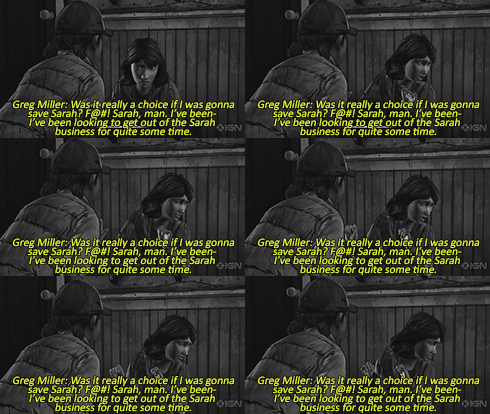
Greg Miller spent the entire segment on Sarah putting her down. 
 image
 image
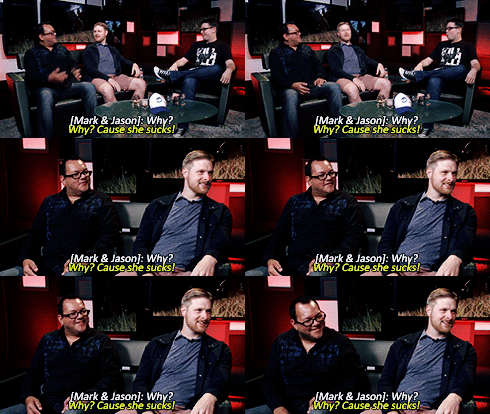
(“Was it really a choice if I was gonna save Sarah? Fuck Sarah, man. I’ve been looking to get out of the Sarah business for quite some time.” “Why?” “Cause she sucks!”)He talked about how glad he was to be able to leave her behind, and how happy he was to watch her get eaten. 
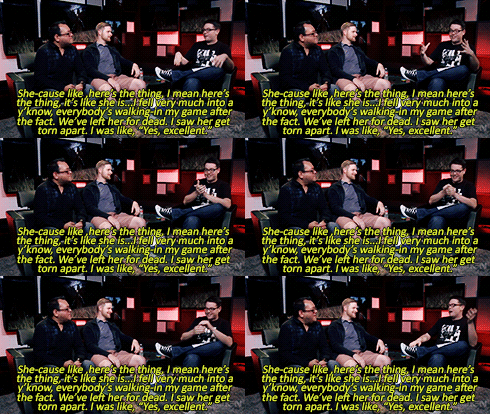
 image
(“I saw her get torn apart. I was like, ‘Yes. Excellent.’”)Now, this would be bad enough. But we know Greg Miller is an asshole to female characters. He has been since Season 1. Where this went wrong, was this part: image
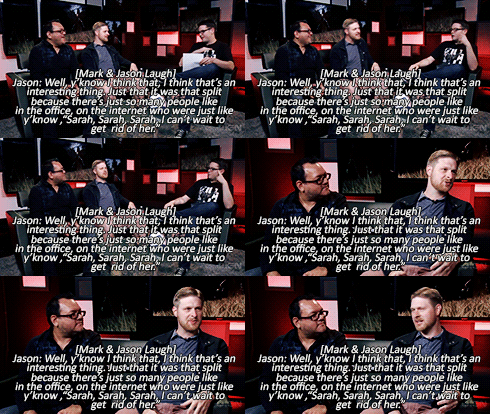
(“…there’s just so many people like in the office, on the internet who were just like y’know, ‘Sarah, Sarah, Sarah, I can’t wait to get rid of her.’”) 
The two Telltale employees publicly stated that people at Telltale were excited to kill Sarah. That they were waiting for a chance to do so. And that they listened to the ableist casual fandom who hated her and used that to go forward with her eventual pointless death.  
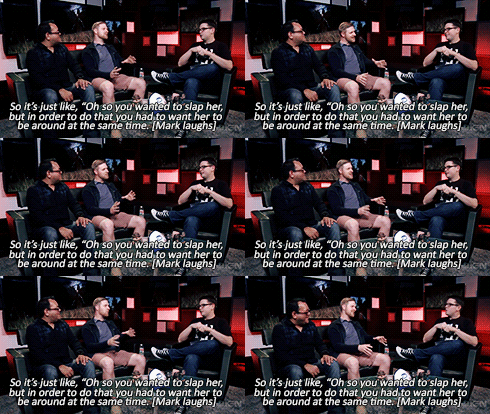
They then go on to make a joke about the fact that, in order to save Sarah, the player has to physically assault her while she’s in the middle of a shut-down. They joke that people who hated her wanted to slap her, but that would mean saving her, something they didn't want to do. 
image
(“So it’s just like, ‘Oh so you wanted to slap her, but in order to do that you had to want her to be around at the same time.’ [Mark laughs]The final nail in the coffin... came from this part of the interview: 
imageimageimage image
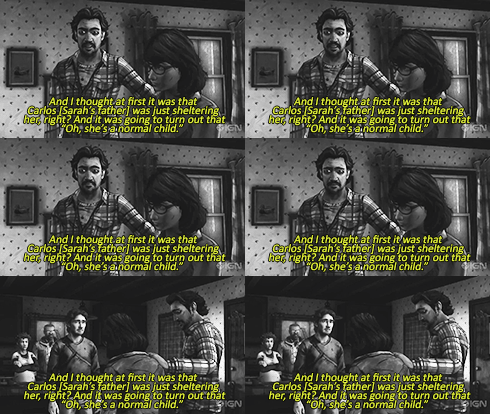
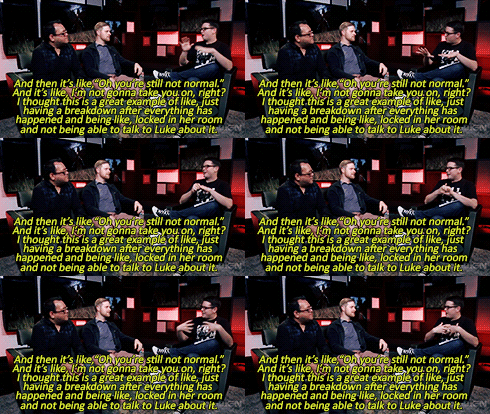
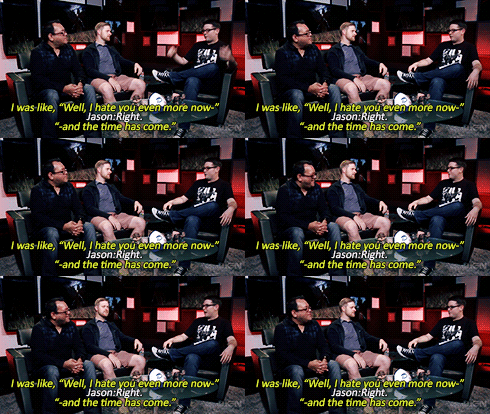
(“We meet her for the first time in Episode, I guess at the end of Episode 1, right?” ”Yeah.” “Where [Clementine] gets to talk to her. Something’s off about her.” “Something’s off. Yeah.” “This isn’t right.”"And I thought at first it was that Carlos [Sarah’s father] was just sheltering her, right? And it was going to turn out that ‘Oh, she’s a normal child.’”"And then it’s like, ‘Oh, you’re still not normal.’”"I was like, ‘Well, I hate you even more now.’ ‘Right.’ ‘And the time has come.’”)He tells the Telltale employees how he feels about Sarah “not being normal” and that he wants her to die for it - and they agree! 
This is unacceptable. It is disgusting and unprofessional for a studio to speak openly about how much they were looking forward to killing a disabled character, and to let shitpiles like Greg Miller speak in such an ableist way about her without saying a word in her defense - even agreeing with him.  
Disabled and neurodivergent players all over the internet are hurt by this. Several have tried to contact Telltale, to try to get some sort of apology or acknowledgment out of them, to no avail. So many players, myself included, are disappointed that this company - known for diversity and well-handled diverse characters - has botched the treatment of a disabled WoC so badly.
As Anna Anthropy said on twitter:
"yeah, i'm glad we could cater to your fantasies of wanting to watch a disabled girl of color die" ~two dudes who still have jobs somehow

Seriously, "not normal"? We need to make them aware that this is unacceptable. If you agree you can send an email to feedback@telltalegames.com or tweet them @telltalegames and let them know this is unprofessional, unacceptable, and hurts actual people with disabilities too.

Friday, August 1, 2014

Reminder: "Coping With Disabilities Through Pony" Panel Tomorrow

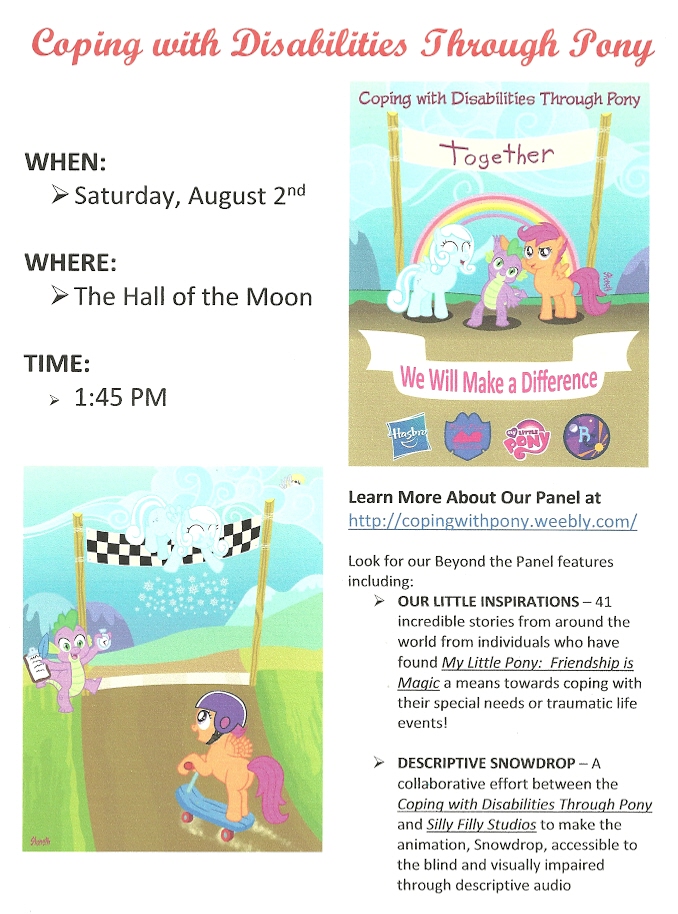
Matthew Palumbo, a dad with a degenerative visual disability, is spending the last Bronycon he expects to have usable vision left taking his seven year old son to meet all the voice actors his heart desires... and also help raise awareness and reformation in the MLP:FiM fandom by hosting the panel "Coping With Disabilities Through Pony" tomorrow. The panel will be tomorrow in Moon Hall, starting promptly at 1:45 PM. The panel will be headed by Matthew Palumbo and his 7 year old son Ethan, fan animator Meredith Sims of Silly Filly Studios, illustrator, fan artist and programmer of Braillemon Rachael Meredith, and writer & aspiring educator Benjamin Platt.
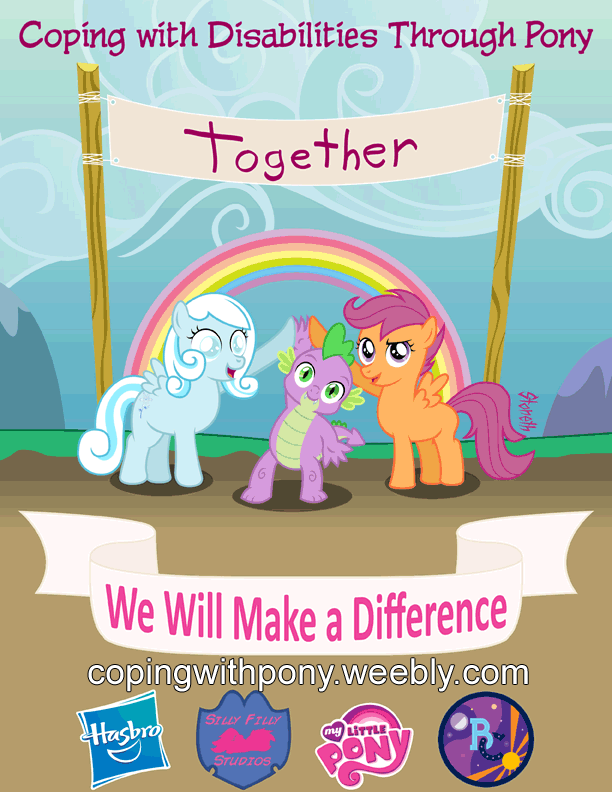
They will also detail two new "Beyond the Panel" initiatives: The collection of "Our Little Inspirations"-- 41 stories from fans around the world in e-document, free pdf and at -cost physical book form as well as a free downloadable audiobook-- and "Descriptive Snowdrop"-- an re-release of award-winning fan film Snowndrop that makes the story of a blind pony fully accessible to the blind and visually impaired with descriptive audio.

Don't miss it!

Friday, July 18, 2014

Panel Spotlight: Dad With Visual Disabilty Hosting Panel @ Bronycon


Picture
Matthew Palumbo was born with a degenerative eye condition. As the years have gone on, his vision has continued to deteriorate, robbing him of the use of one eye. This has left him unable to pursue many tasks that he previously enjoyed. He bonds with his seven-year-old son, Ethan, through watching My Little Pony: Friendship is Magic together, the bright colors of which are still traceable to his good eye.

Palumbo wants to spend the last BronyCon he may attend with good vision setting up a panel to educate and spread awareness of disabilities and how My Little Pony: Friendship is Magic and the fan community can and has helped.

To that end, he is running a panel titled "Coping With Disabilities Through Pony" this year at the largest Brony convention in the United States, BronyCon. They are currently holding a fundraiser so that the panel can be a success. The mission of the panel is “…to share how the cartoon My Little Pony: Friendship is Magic and its fans have helped to improve the lives of individuals with special needs.”

The panel will also feature such guests as Meredith Sims, writer of Silly Filly Studios’ acclaimed short fan film “Snowdrop” (as well as voice for the titular character), Rachel Merryfield, a software developer working on Braillemon (a fan-developed version of the original Pokémon Red and Blue video game, re-worked for visually impaired players), his son Ethan and more. Here's the official panel description from the Bronycon website:
MLP: FiM helps kids & grown-ups be better people. Did you know it also helps people with disabilities and special needs? Come find out how as we share inspirational stories from bronies & speak with: the writer and voice talent of fan film "Snowdrop"; ,a father and his supportive young son; a video game developer who aspires to make technology accessible to all; and an educator of tomorrow who has first hand experience with how powerful MLP has been in giving individuals with disabilities & special needs a way to cope & bond with the world in which we all live in. We'll explore how My Little Pony and its fans have used the show to bond with others and cope with all sorts of disabilities and special needs through the power of Ponies!
Location: Moon Hall
Track: Community
Start Time: 8/2/2014 1:45 pm
End Time: 8/2/2014 2:45 pm
You can also get more information on the panel, its panelists, and plans for a free e-book and audiobook at http://copingwithpony.weebly.com

Share This Post