Showing posts with label racism. Show all posts

Wednesday, July 12, 2017

Looking For Group: Gamers of Color Sticking Together

Image description: A tweet from twitter user sourcedumal that reads "when
there are 47 long flowing hair options in character creator but 3 natural hair
options: afros, cornrows, dreads. And they all look terrible."
Writing for Endgadget, Jessica Condit gave us "Gaming While Black: From Casual Racism to Cautious Optimism", and detailed how many gamers of color have either banded together or not engaged in voice chat just to be able to keep enjoying a hobby and form of entertainment important to them because social pressures and racial harassment follow them everywhere:
“The stories Allen could tell probably wouldn't surprise Dr. Kishonna Gray. Dr. Gray is an Assistant Professor at Eastern Kentucky University's School of Justice Studies, and the founder and director of EKU's Critical Gaming Lab, a hub for researching the immersive online environments within console gaming. She studies gaming and harassment from the player's point of view. "Most gamers of color have isolated themselves into private parties, private chats, or just don't engage verbally at all," Dr. Gray said. "And that's sad because they can't take full advantage of the gaming experience that they paid for. So what's happening is a virtual ghettoization of minority gamers. [...] Because a person's identity is automatically revealed when a person speaks, they are targeted. I call it linguistic profiling. As soon as someone hears how you sound, they engage in this practice. They hear how you sound and react based on that. So a lot of black gamers are called derogatory terms because of how they sound. They don't have to do anything but sound black."”
While thre are still some that would cling to the dismissive response of video games and online game not being a part of the real world, Dr. Gray disagrees:
"Gaming culture is a direct reflection of our society," she said. "The only reason racism and sexism run rampant in gaming is because racism and sexism run rampant in society. But in physical spaces, mostly, it's not overt. It's subtle. It's covert. So, yes, these issues manifest in a similar manner in gaming, but I contend that they present themselves worse. It's not subtle. It's in-your-face racism. A black person may not be called a [n word] to their face, but they can almost guarantee it will happen in virtuality."
Although the article was written in 2015, not much has changed. The entire article is a fascinating read, so go read the whole thing.

Monday, June 26, 2017

Marvel vs. Limits of Diverse Representation

I've written before on the numerous times Marvel comics has tried and failed to grasp just how diversity works. Seriously, just search the marvel tag. However,  the example that sticks out for writer Paige Allen isn't Marvel's continuing mishandling of Captain America. Nor is it Marvel's VP of Sales blaming attempts at diverse casts of superheroes for hurting sales. According to Allen, the most egregious example is the writing of Marvel's Invincible Iron Man. Penned by Brian Michael Bendis, Invincible  that introduced the world to a new Iron Man – a young black teen by the name of Riri Williams. Writing for Geeks of Color, Allen points out that "...some fans were skeptical of Bendis writing the experiences of a young black girl, especially since Marvel had no black women writers on its staff when the series was first announced."

Bendis has also written also wrote about another black teen assuming the mantle of of Marvel franchise powerhouse-- Miles Morales as Spider-Man. Bendis has also talked about the research he's done as an author and the perspective that raising two of his adopted African-American children have given him. Allen points that while Bendis is able to write about the challenges and loss Riri Williams faces as a black girl, his knowledge is reflected in a very narrow focus of the Black experience:
Unfortunately, this knowledge is the overall problem Bendis has in his depiction of Riri Williams. He knows about black pain and the various micro- and macro- aggressions that black people face every day, especially during these particularly fraught times of racial hostility... Basically, Bendis is like your white classmate that took one Africana class and now believes himself to be the purveyor of all knowledge on black life. However, because he acquired his knowledge as an outsider to the culture, the only way he really knows how to depict blackness is through identifiable aspects of The Struggle – all the negative social realities of being black that you see reported on TV, lambasted on Twitter, and through quickly cruising through activist circles in search of easily transferable knowledge about racism without any nuanced understanding of how black people deal with it.

This came to a head when scans from a page of Invincible Iron Man #8 appeared online recently, where it shows Williams in class trying to actively seek out marginalization as a motivator.

Allen reflected:
Never in my wildest nightmares would I imagine a black child seeking out racism to fight against in the pursuit of their dreams. Racism isn’t a Sailor Moon villain that waits for us to level up before trying to kick our ass; we are always aware of it and are always affected by it, but one of the best traits that black people have is our ability to bypass that negativity and live our lives despite it, not to specifically spite it.
This isn't the first time Bendis' writing for a black character has been criticized. The Nerdist pointed out that Bendis and other white writers writing characters of color often come off as tone-deaf and run the risk of alienating the very fans they want to recruit.

As I wrote in an earlier post, the real key is to actually hire diverse creators to write diverse casts. Otherwise we're just slapping a Band-Aid on the issue:
Looking at a diversity initiative as the beginning and end of what's needed to help improve the state of comics is short-sighted and wrong-headed. Instead of just having the same white men tell stories with some characters of color here and there, there should be structure in place for minority writers and artists and creators to tell the stories they want to a mainstream audience. Diversity as the final and only goal is a hollow act that does nothing but reinforce whiteness and the status quo as the default. That's not the world we live in, so why should worlds we get to make up have to be that way? Free your mind, and the audience will follow.

Wednesday, June 14, 2017

Black, Queer & In Love: "Bingo Love" Comic Coming Soon

Black queer romance is not a common sight in comics.  Tee Franklin, a black queer disabled comic book writer, has set to change that with her graphic novel "Bingo Love". "Bingo Love" centers on two teenage girls, Hazel and Mari, who meet when their grandmothers bring them along to a church bingo night. They become best friends in the 1960s, then fall in love, and then are forbidden to see each other by their families. Over the next couple of decades decades, the two friends reconnect and become closer as they get older.

In an interview with The Root, Franklin said that she felt this graphic novel was important because “...very rarely do we see queer people, women of color and elderly people in comics, so I knew I was taking a risk, but it’s been well worth it,People need to see that you can be LGBTQ and have a partner for life. We are all worthy of that happy ending, too.”

Some of her own life served as inspiration for the characters' struggles. Franklin explains that she was "...once married to a man and wasn’t fully out to my extended family until very recently. I definitely understand that there are black LGBTQ people out there like Hazel and Mari who feel that they have to hide their true selves from the world because of how society views them. I wanted to tell that story.”

Franklin is no stranger to boosting Black-creator comics, as she is the creator of the #BlackComicsMonth hashtag, but she was still overjoyed to see her work supported. "Bingo Love" was successfully crowd-funded via Kickstarter in March and is currently available for pre-order.

"Bingo Love" is written by Tee Franklin and drawn by Jenn St-Onge ("Jem and the Misfits", "Steven Universe", "Rick and Morty") and the art is gorgeous. Here's an a page:


To get the latest news and pre-order the graphic novel, you can visit the "Bingo Love" website.

Thursday, April 27, 2017

Localization Editor Withdraws Name Rather Than Give Up "KKK" Joke

Akiba's Beat Game Over Screen
On XSEED's official forum, localization editor Tom Lipschultz posted a list of changes made in the English version of game Akiba's Beat. In addition to things like changing names of characters to reflect puns in the original Japanese, there was one joke that Lipschultz was changed that he felt was a bridge too far-- changing a background sign that read "KKK Witches" in the original Japanese version :
The original was a parody of "NKK switches," a Japanese light switch manufacturer based out of Akihabara. I personally felt "KKK witches" was pretty funny for its shock value, but when I mentioned it to my coworkers, they... were not as amused. 
Yeah, I can't imagine why a white guy going "LOL it says KKK roflcopter" would be a bad look or anything. Instead of pausing for a moment of self-reflection as to why the name of a domestic terrorist group was funny to him, or why a background joke might be worth changing, Lipschultz decided to double down.
 ...[XSEED was] insistent upon the name being changed. And of course, I fought this as best as I could, since I saw the forceful change of this as an act of censorship...
Yes, according to Lipschultz, changing a joke to avoid name-dropping the Ku Klux Klan is exactly the same thing as actively suppressing art! He was the lone brave white guy sticking up for the original intent. Like, what if the original Japanese developer really wanted to make the minor background company sign joke as some sort of statement about the USA right-wing hate group responsible for lynching about 3,500 black men over the course of its existence, right? Lipschultz continues:
In the end, however, it was Acquire themselves who voluntarily changed it to "ACQ witches"... [XSEED emailed the original Japanese developers] to let them know that the KKK is a well-known abbreviation for a hate group in America, and asking them if the name "KKK witches" had any specific meaning in Akiba's Beat... Acquire simply changed the sign text and sent us a new build. 
Oh. So since the original developers of the game made the change, this must mean they were cool with it. If the intent was to make some sort of political statement, they would have kept it. Censorship implies there's some sort of involuntary act, and Lipschultz himself said the original developers made this decision themselves. So that's why Lipschultz... asked for his name to be removed from the credits? Yep, he confirms it himself.
It is due to this change, and specifically due to my initial misconception that we'd directly asked the devs to change it, that I asked to have my name removed from the credits of Akiba's Beat... I feel it's a good symbolic gesture on my part, showing my commitment to my principles on this matter... I'm perfectly fine with being the "ninja localizer" of XSEED, fighting the good anti-censorship fight from the shadows. 
Yes, this is the hill Lipschultz chose to die on. This also means that per XSEED company policy, he will no longer be credited on any future work he does for the company, and he took this stand being fully aware of this company policy.

It turns out that Lipschultz has many misconceptions, from what censorship is, to what it means to be funny to what it means for something to be "very Japan". Not content to dig a hole for himself on the forums of the company he works for, Lipschultz took to the comments section of a Kotaku article about his decision in what I'm sure he thought was a noble and well-reasoned attempt to defend himself. Here, let's watch him go and dig himself deeper:
[The KKK acronym] doesn’t make me chuckle on its own, but in the context of appearing on a sign in a busy part of Tokyo, where the business in question obviously had NO IDEA what it meant? That’s pretty funny, if you’ve ever been to Japan. “Engrish” exists as a concept for a reason, and a sign that says “KKK witches” is so out there, so WRONG, that it appearing on a sign is definitely worthy of at LEAST a chuckle, for the absurdity alone. 
I guess the idea is, I believe it would be funny to the game’s target audience, those being Japanophiles. Because it really is very “Japan.”
You see, a KKK reference is funny because... racism! Non-native speakers being ridiculed for not understanding a language is funny because, um... also racism? People that like Japanese pop culture think racism is funny too? I guess?

Honestly, I'm surprised Lipschultz still has a job considering he seems to have no grasp of optics, humor, or what localization is supposed to be. Posting on the Neogaf boards, Lipschultz once had this to say in his defense of anime boobs and fan-service:
Even if you consider content in a game to be perverted and classless... let the classless perverts have it! They deserve to enjoy their games just as much as the rest of us. And to say that it "taints" the game for the rest of us is no different than saying having someone of a different race, or sexual orientation, taints the neighborhood.
Yes, just like his withdrawing his name from the credits of Akiba's Beat and all future XSEED games he works on was his attempted to channel Evelyn Beatrice Hall (no, REALLY, he said so right here), standing up for sexualized female characters created by men, for men, is like speaking out against discrimination of marginalized people. That's totally not gross at all!

I think the best way to explain translation vs transliteration is by using a musical analogy. When a violin repeats what a piano just has played, it can't make the exact same sounds. It can only approximate the same chords.The violin can, however, recognizably make the same "music" as a piano, but only when it's faithful to the logic and limitations of the violin as it is to the logic and limitations of the piano.

Languages are like that, too. Each has their own "sound" and their own logic.The process of rendering ideas from language to language is really more like a transposition than a translation-- translation implies that there are word-for-word equivalents that exist from one language boundary to another. That's like saying piano sounds exactly like the violin!

And the idea of word-for-word equivalents of a story, of a language's underlying feeling strikes me as false to the nature of story telling.The best a translator can do is hope for is to come close as possible not to the text's literal meaning-- it's nearly impossible to drag a sentence's meaning across one language barrier to another completely 100 percent intact. What is more important in preserving, intent... even at the expense of making four strings do the same notes as 88 keys (i.e.English from Japanese). A translator should work to preserve a story's essence, the total feeling of the complexities.Literal translations, as outlined in today's earlier piece on Persona 5, are stilted, awkward and can seem more like transcribing than translation,

When the original game developer of Akiba's Beat was contacted about what the KKK initials of the "off brand" light switch maker sign meant for a US audience, they changed the joke because they intended to just make a silly company name reference, not name-drop a US domestic terrorist group.

Basically, what Lipschultz has done is mixed up the right of people to not be suppressed by the government or societal coercion with the tension that is part and parcel of the act of translation. Instead of pausing and reflecting on why a minor joke with unintentional racist overtones was something he saw as so essential he'd be willing to throw away credit for his work, Lipschultz decided that not keeping "KKK witches" was the molehill to die on.

Monday, October 10, 2016

Quick Shots: Fact-Checking RPS, Arcade Treasure & LoL Pro Pwns Self


Hey all. Feeling pretty awful today, so here's a few quick newsbits instead of something long.

1) J. Walker of "Rock, Paper, Shotgun" didn't just screw up, he lied by omission and follow some twisted logic on top of it for his Review In Progress of Mafia 3. Of  the game's title card, of which he calls "strange... paranoid... odd," he says:

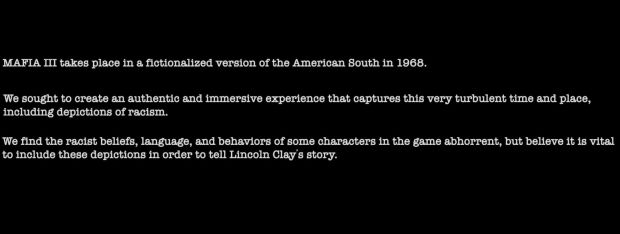
Description: Partial opening card from Mafia 3 that reads "“Mafia III takes place in a fictionalized version of the American South in 1968. We sought to create an authentic and immersive experience that captures this very turbulent time and place, including depictions of racism. We find the racist beliefs, language, and behaviors of some characters in the game abhorrent, but believe it is vital to include these depictions in order to tell Lincoln Clay’s story.”
“We find the racist beliefs, language, and behaviors of some of the characters in the game abhorrent, but believe it is vital to include these depictions in order to tell Lincoln Clay’s story.” Which is, well, a pretty odd way of putting it.“It’s vital to include these depictions in order to tell the story of this era of this nation’s history,” would have been equally unnecessary and paranoid, but at least made a lick of sense. Lincoln Clay isn’t real, the city is fictional, and his is not a story that was going untold until some people in a room invented it. 

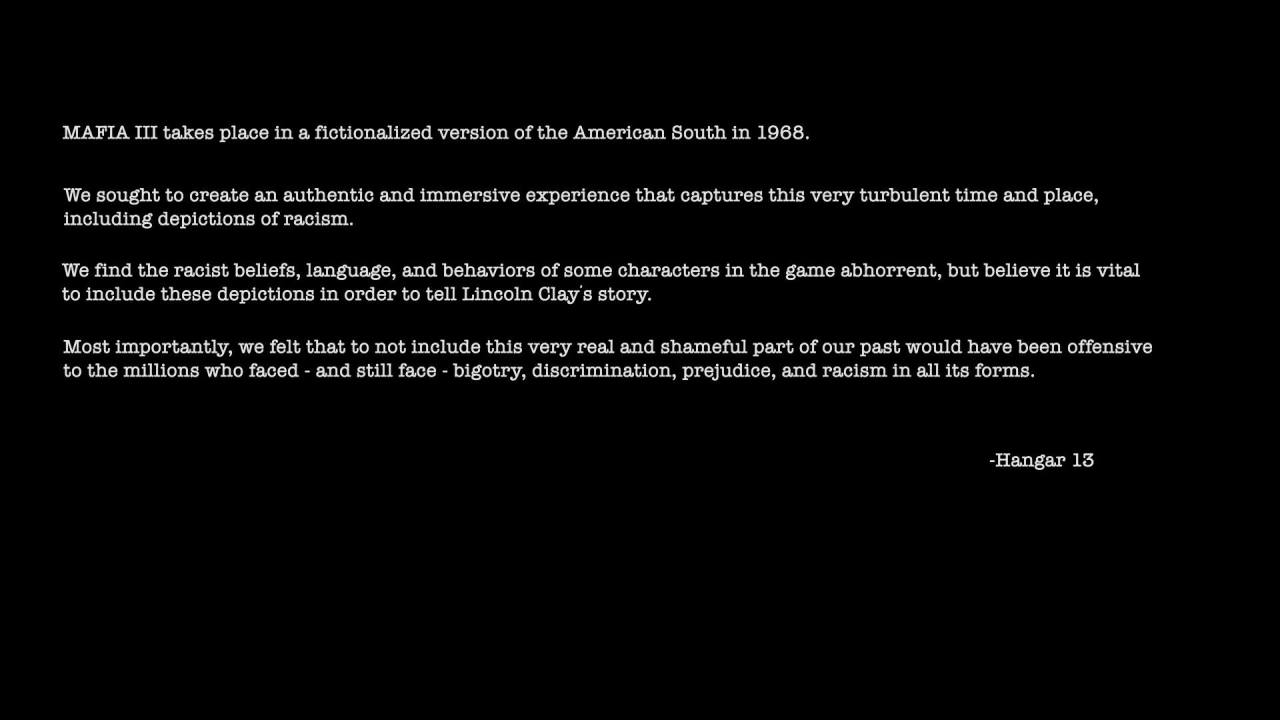
Aside from ignoring that fiction doesn't take place n a vacuum (and leaving out his bizzarre "I watched Luke Cage on Netflix" tangent), he also left off the full text. Below is a screenshot of the FULL opening card, including the final paragraph he left off, emphasis mine:

cypheroftyr:
“ “ “Mafia III takes place in a fictionalized version of the American South in 1968.
We sought to create an authentic and immersive experience that captures this very turbulent time and place, including depictions of racism.
We find the...
Description: The full opening card to Mafia 3 including the text that J. Walker cut off in his review, which reads: "“Most importantly, we felt that to not include this very real and shameful part of our history would have been offensive to the millions who faced - and still face - bigotry, discrimination, prejudice, and racism in all its forms.” Screenshot courtesy of Nikki Kendall.
C'mon, Walker, get it together.

2) Tim Nichols recently launched a treasure trove of a reference site. If you're trying to fix or restore an old arcade machine, or you're just interested in some classic arcade history, he has over 2,400 arcade cabinet manuals available for free download now online at arcadertfm.com.  Check out this cover for OutRun:


And finally, pro League of Legends gamer Road of team I May has been suspended and fined for harassment and racially charged remarks. Kotaku has the full details.

Friday, October 7, 2016

Tech Sector's Diversity Problem: White People Still Aren't Listening

Description: A bar graph shows a demographic breakdown of employees at tech companies. Apple is 80% men, Microsoft and Google are 83% men,  Facebook is 84% men and Twitter is 90% men. Continuing the demographic breakdown, Apple employees are 54% white, 21 percent are Asian, 6 percent are Hispanic, and 3 percent are black and 165 are other.

The above graph from a Mother Jones article about diversity in the technology industry in general and the Rev. Jesse Jackson's outreach work in Silicon Valley in particular last year showed that for all the publicized diversity initiatives, tech has a LONG way to go before achieving any sort of equality or parity. So, a little over a year later, what's changed?

Not much.

Twitter has historically been the worst of the high-profile tech companies, with an employee workforce that's 90% male, and majority white, with Black employees making up just 1 percent of the workforce.  Janet Van Huysse, who was the Vice President of Diversity for Twitter spoke in 2014 about working to improve diversity. In 2015,  with Twitter no further along aside from very vague plans to increase hiring “marginalized groups” in their US offices, Van Huysse resigned after Twitter's numbers didn't even budge after 2 diversity initiatives and the traditional university graduate application rush.

Van Huysse-- a white woman-- was replaced by Jeffrey Simonoff as Vice President of Diversity. Simonoff is a middle-aged white dude.

Whoops.

It gets worse.

Leslie Miley wrote about his departure from Twitter due in no small part to the racism that went on behind closed doors even as the company benefitted from use by citizens and activists in Ferguson and the Black Lives Matter movement . An excerpt :
Twitter’s issues with growth and engagement and the issues with internal diversity are somewhat related. The over-reliance on a limited number of schools and workplaces for talent has caused a type of group think to dominate. Any change would be approved by people who all think alike. There was very little diversity in thought and almost no diversity in action. To quote Mark S. Luckie “Without a variety of voices contributing ideas, the workplace becomes a homogenized environment where potential brilliance may never be achieved. Diversity should rightly be seen as a benefit to growth, not an obstruction to avoid.” For some at Twitter, diversity is an obstruction to avoid.
 Once Miley left, Twitter management was left without any directors or vice presidents of color in any of the product management or engineering divisions.

While Twitter may have the most egregious examples, as evidenced by the graph at this article's beginning, it's not the only big-name tech company to have a serious diversity problem. Instead of listening to people of color, though, many tech companies have been hiring teams like "Paradigm"-- a company that “uses social science to increase diversity”... run by three white women and a white man. After some bad PR, they hired one woman of color as a partner, and two women of color as consultants.

This glaring blind spot extends to some of the largest tech events, too-- even in places where ou'd least expect. The annual "Grace Hopper Celebration Of Women In Tech" didn't have any black women speaking or conducting talks. In fact, it was ZERO women of color and a few dozen white men spoke at least year's event! In fact, as this storify link points out:

500 speakers were req'd to buy tickets to conf they're speaking at for a conference heavily targeting students, & of 12,000 people who belong to a demographic that's systematically underpaid.
There are >900 confs for professionals in coding. I know of ~3 that charge speakers for tickets. GHX is one. Pay gap makes that esp uncool. Black women are paid 64% of white men. Hispanic&Latina women are paid 54% of white men. Charging to speak ENSURES under-representation.
...which is what prompted last year's NOTGHC counter-conference, organized by disaffected women engineers of color. Yeah, that's right, the whiny baby attitude of "oh, if you want diverse things, go make your own" has extended to engineering conferences, and once again when people of color DO make their own thing, they get the backlash of everything from being "not organized enough" to "being too exclusive"! GHC still charges speakers to pay, by the way.

Fellow white people, if you think that this lack of diversity only matters in boardrooms and doesn't affect people's real lives, think again. Last year at Dragon*Con, which is a sprawling nerd convention that lasts for days and temporarily takes over most of city downtown, automatic soap dispensers wouldn't detect black peoples' hands. The CEO of the soap dispenser's parent company had to admit that they never really thought to adjust the infrared sensors beyond a certain range. And if you just found out about this now, from me, a white dude? That's part of the problem!

The effects on health runs deeper than un-soaped hands. Erica Joy wrote about the effects tech culture's isolation and alienation of her as a black women impacted her health:
“The stress and isolation I mentioned have really taken their toll on me. Long term stress is known to cause health issues. Not long after I started working in New York, I developed heart problems (PVC’s). About 3 years ago I started to get acne, something I’ve never had in my life. I always thought it was hormonal but now recognize that it happens when I’m stressed. The isolation and resultant loneliness have exacerbated the stress, leaving me in constant fight or flight mode… I know this: I am not my job. I am not my industry or its stereotypes. I am a black woman who happens to work in the tech industry. I don’t need to change to fit within my industry. My industry needs to change to make everyone feel included and accepted.” 
She's right, of course. Cameron Glover said it best:
Without consequences and more nuanced understanding of different perspectives and cultures, we’re left with a tech culture something akin to a leech: the best parts of marginalized workers are taken, and we are left feeling like victims and stripped of our power.

Monday, August 1, 2016

Spec Fic's Systemic Racism & What To Do About It

Text: Out of 2,039 stories published in 2015, 38 were written by black authors.
Speculative fiction can be a gateway for aspiring authors, above and beyond getting a pay-day or seeing your work in the SF/F anthology of your choice. It can also be the first step to greater access to agents, a fanbase, novel deals and more. Over the past few years, there has been an increased push for publishing a diversity of voices, but in a recent study, Fireside Fiction outlines that out of all of the speculative fiction stories that were published last year, only 1.9 percent of those stories were written by black authors. To put those odds in perspective, they do some math to point out that:
...the probability of the 1.9% average occurring by random chance is 3.21x 10^-76, or
0.00000000000000000000000000000000000000000000000000000000000000000000000000000321%
For comparison’s sake, the odds of winning the New Jersey Pick Six lottery are 7.15x 10^-08, or 0.00000714%
Author Mikki Kendall wrote in a companion essay, "Opportunities Lost", that it's not a matter of talent or lack of stories, but a lack of initiative on the part of publishers:

Race matters at every step of the publishing process. Including who gets out of the slush pile and onto the page. The myth that Black people don’t read science fiction or fantasy has been thoroughly debunked. And despite any claims to the contrary, Black writers of speculative fiction have been producing amazing work since the genre’s inception. The real problem isn’t one of a lack of stories or a lack of talented writers, the problem is a lack of outlets willing to publish stories that don’t center white characters.
New York Times best-selling author Tobias S. Buckwell points out that this lopsided figure doesn't even reflect the current makeup of the United States in his essay "Boldly Going Nowhere":
I don’t remember the first time I was told there were plenty of diverse writers in the field, and had the same few names repeated to me over and over again... the same four names—“Hopkinson, Butler, Delany, Barnes”—as a list of writers of color when I would point out the whiteness of the science fiction field. With some 1,500–2,000 members of the Science Fiction and Fantasy Writers of America, in order for our field to just match the demographics of the USA that meant SFWA should have had at least 150–200 African-American writers because twelve percent of the US population was African-American. 
To match the U.S.A’s demographics, there should be about 200 members of SFWA who would choose African-American on a census bureau questionnaire. 90 who would choose Asian-American. 18 Native-American. 54 like me, who would choose two or more races on the census questionnaire.Basically, every time you go see a bunch of writers, in person or in print, about 30% of them should be something other than white. Just to reflect demographics.
Fireside Fiction is not above pointing out that they have failed at this goal as well, but editor Brian White posted an editorial that, among other things, showed he was willing to put his money where his mouth is:
  • We’re working with the developer of our submissions system to add in an optional, anonymous form for people to self-report their demographic information when they submit to Fireside. This way, we can take a much closer look at what is going on in our submissions pile.
  • We are going to change our submissions process. Once a year, we will still have one big submission period open to everyone. But several other times a year, we will have targeted submissions windows, each targeted toward a specific marginalized group. So black writers, writers of color generally, LGBTQA writers, women, writers with disabilities, etc. We’re still working out the details on this, but all the dates will be publicized well ahead of time, so that people who don’t have the leisure time to whip up a submission on short notice can get their work ready. 
  • We also want to hear from the black writing and publishing community about what else we could do better. You can email me directly at brian@firesidefiction.com or talk to us on Twitter.

Readers, what else do you think can be done to fix this problem in spec fic? Sound off in the comments below.

Monday, August 31, 2015

Super Powers, Super Mom: Raising Dion Now Online

Description: A young black boy faces the camera, giggling. He closes his
eyes, then disappears with a puff of black smoke. He reappears on the other
side of the room, suddenly reappearing in front of his mother, who drops the
bag of groceries she was holding in surprise.
Many young children dream of having super powers. Many people compare parents to super heroes. So what do you do when you have to raise a child who has all the normal evergy and curiosity and fears of any other... but also a bevy of barely-controlled super powers? These issues and more are being tackled in xxxx xxxxx 's new comic book series, Raising Dion.

Raising Dion offers a novel way to look at so many issues and ideas: super humans in society, superpowers and how they affect relationships, the challenges of parenting, and race in American society.

In particular, Dion's mother tells him not to use not use any of his super powers in public addresses how society implicitly judges his as a black child and explicitly how he is judged as a super human in a comic book world. It also echoes "The Talk" that parents of color have to have with thier kids about encounters with the police. As Raising Dion's artist Jason Piperberg says in an interview at Fusion.net:
“Traditionally in comics and really most stories, the protagonist is the one with the powers,” said Piperberg. “You see the world through the eyes of the character with all the abilities usually because they are immediately the most exciting and/or interesting person in the story.” 
... “I think a lot of people still don’t get that The Talk is a real thing that black families have to have,” said Piperberg. He admitted that initially the parallels weren’t all that clear to him either. “I think it’s really important to step out of my bubble of privilege to see what’s really going on. To discover and look at injustices that have been swept under the rug, or worse, accepted as the norm by society.”
The first issue of Raising Dion is available online to read for free.

Wednesday, August 5, 2015

NK Jemisin On Fantasy Worlds & Status Quo

Cover for the collection "The Inheritance
Trilogy" by N.K. Jemisin
There was a great interview in The Guardian last week with one of my favorite fantasy writers-- N. K. Jemisin. I first heard of her during the whole racefail 09 debacle. But she didn't just rest on her laurels. She's not just been continuing to write novels and novellas, but also working with other POC to confront racism and sexism in the industry head on.

In part of the interview she talks about how so much of epic fantasy and science fiction seems to end up reinforce a lot of industry and genre status quo in particular as well as the status quo for viewpoints and stories told in general. She puts forth the idea that not only is that contrary to the nature of fantasy, it is contrary to who she is as an author, and person, and why she seeks to challenge and change with her writing:
 “As a black woman, I have no particular interest in maintaining the status quo. Why would I? The status quo is harmful, the status quo is significantly racist and sexist and a whole bunch of other things that I think need to change. With epic fantasy there is a tendency for it to be quintessentially conservative, in that its job is to restore what is perceived to be out of whack... I hear all the excuses: things were just like that back then. There really were 90% men in medieval Europe and they were all white and somehow they magically got silk from East Asia and we don’t know how that happened... But that makes no sense to me. I don’t really understand why so many fantasy writers choose to focus on worlds that just seem strangely denuded. But to them I guess it doesn’t seem strange. And I guess that’s their privilege. It isn’t mine.” 
For some concrete examples, of Nemisin's work, the collection pictured aboce, is an amazing series of stories, with action and intrigue, alliances and betrayals set in a far-future fantasy Egypt-like kingdom. It was nominated for, and won a pile of awards, and rightly so!  If you'd like to get a good idea of what her writing style is like for free, you can read her story "Non-Zero Probability" here. It;s available in both text and audio versions.

Thursday, July 9, 2015

Strange Fruit: When Writing Black Experience For A White Audience Goes Wrong

Southern trees bear strange fruit,
Blood on the leaves and blood at the root,
Black bodies swinging in the southern breeze,
Strange fruit hanging from the poplar trees.

Pastoral scene of the gallant south,
The bulging eyes and the twisted mouth,
Scent of magnolias, sweet and fresh,
Then the sudden smell of burning flesh.

Here is fruit for the crows to pluck,
For the rain to gather, for the wind to suck,
For the sun to rot, for the trees to drop,
Here is a strange and bitter crop.


-"Strange Fruit", by Billie Holiday and Abel Meeropol


"Strange Fruit" is one of Billie Holiday's most haunting and iconic songs, a haunting and moving metaphor for lynching in particular and racism in general.  The Library of Congress put the song in the National Recording Registry. It's been declared as one of the most important songs of the 20th century. So if you're going to release a comic invoking a name with that weighty a legacy, about an issue as volatile as racism, you want to make sure that you do things right. But even having the best of intentions doesn't mean you can't royally screw things up as comic critic and culture analyst J.A. Micheline writes in "The White Privilege, White Audacity, and White Priorities of STRANGE FRUIT #1":

Writing about Strange Fruit #1 has been a long time coming... since it was announced on February 20th — Dwayne McDuffie’s birthday. For readers who are unaware, Dwayne McDuffie was one of the most prominent black comics writers and, arguably, one of the most prominent black activists working within the industry. He is one of the few faces that looks like mine whose work specifically aimed to promote other faces like mine in the comics — on the page and off it — and for that alone, he represents a lot. And his birthday was the day BOOM! Studios elected to announce that two white men would be writing and drawing a title about the racist South called Strange Fruit.
...No, seriously, stop a second and look at this constellation of events. This comic, announced on Dwayne McDuffie’s birthday, about racism in the South by two white men is being marketed as a “deeply personal passion project.” Do I need to go into why I have some questions about why a story about racism is deeply personal to white people? Do I need to explain why I think that marketing choice was tone-deaf and perhaps even toeing the line into disrespect? Do I need to air my concerns about what that indicates about who this book is being marketed to and why I suspect it is not people who look like me?
The entire article is a great read and review of the comic itself.

I want to add to it that there’s already a comic called “Strange Fruit,” about black history, written and illustrated by black men. http://www.amazon.com/Strange-Fruit-Volume-Uncelebrated-Narratives/dp/1938486293. 

Tumblr user spikedrewthis did a rundown of some of her favorite comics written and illustrated by marginalized people and you can check it out starting with this tweet:
https://twitter.com/Iron_Spike/status/618844573436133376 

And here’s a list of webcomics by black creators: http://pastebin.com/Mh7RV5YY .

Thursday, June 4, 2015

WisCon: Your Microaggresions Aren't Welcome Here

photo via BuzzFeed
WisCon, first started in 1977, a sci-fiction and fantasy convention that bills itself as the leading feminist science-fiction convention in the world. The convention as a whole, and it attendee and convention committee members in particular, have been paying special consideration in recent years towards creating a safer convention space more inclusive of people of color, marginalized identities, those with disabilities, even as the convention itself has some ups and downs.

Author, tech writer and blogger K. Tempest Bradford, (who's also been the organizer for the safer space for people of color at the convention and is also a committee member) recently posted about how microagressions are everywhere (inappropriate comments, touching of hair, questioning of disabilities, accommodation, etc) and how she wasn't sure what she could do:
Thee most obvious one for me is to be that person that calls folks out when I witness such situations and encourage others to do so as well. That’s only workable so long as there are people willing and around. You can’t be everywhere. And while that could eventually grow and grow into awareness for everyone, that could take time. And while that’s happening some people still won’t feel welcome at the con. 
What didn’t occur to me is that WisCon the organization could do something to address this behavior. As of this year, we are. The Safety chairs made it clear that con goers should, if they felt comfortable doing so, report such behavior (labeled microaggressions) to Safety, and that the on duty staff as well as appropriate department or con chairs would take steps to address the problem with the involved parties. That could mean having a discussion with someone about their inappropriate words/behavior and giving them guidelines around further contact with the person who filed the complaint (such as: do not approach them again), as happened this year. 
That’s not the only recourse. The idea is to make WisCon a safer space for everyone, not just some certain kinds of people. To make WisCon the type of con where you are not required to let things roll off your back and ignore or laugh off microaggressions and othering so you don’t disrupt everyone else’s good time
The outline of what WisCon is doing in particular ends with a powerful exhortation to fandom to make this something that becomes part of fandom and community at large:
As a community, can we make it clear that othering is not okay? That microagressions are not appropriate? Can we make it our problem to address as a community and not only a burden individuals have to deal with? Can we agree that allowing this crap to drive people away (and it does) is untenable?

Angry White Gamers vs Social Constructs: We Can Do Better

angry white male gamerRust is an indie survival horror game currently in alpha testing on Steam. In a thematic twist that's sort of a cross between Minecraft and Resident Evil, you start the game buck naked and have to craft everything you need to survive, from shelter to the clothes on your back, and try and survive as long as possible. It's a multiplayer game, so if the monsters don't get you, another player might!
 Last week, the developers of Rust issued an update to their game. It has some of the usual features one would expect: bug fixes and the like. It also added a new cosmetic feature: randomized skin tones.

As the developers explain on the official blog:
Everyone now has a pseudo unique skin tone and face. Just like in real life, you are who you are – you can’t change your skin colour or your face. It’s actually tied to your steamid... There’s a lot of skin colours in the world, and it’s really easy to appear racially insensitive when doing this. This is compounded by the fact that everyone is really used to seeing this guy as a white guy, so when you see him as a black guy it feels like he’s just “blacked up“. So we’re spending a lot of time trying to lessen that effect.
So what happened? Players lost their ever-lovin' minds! As Megan Condis writes:
The reactions to Rust’s unprecedented experiment were swift. Many gamers were aggrieved by the skin tone automatically assigned them. Others felt drafted into racial discourses that they preferred to ignore, and lamented the entrance of social justice activism into what they saw as a blissfully post-racial online world. But the backlash only underscored a disturbing reality: By insisting that race doesn’t or shouldn’t exist online, such attitudes ensure an online status quo in which people of color remain marginalized and invisible.
Yes, in addition to the sad but predictable racist reactions, there were also plenty of white gamers who insisted that they didn't have a problem per se with playing a black character, but thought that the randomized possibility of your in game avatar having black skin was forcing racial diversity or taking them out of the game experience by making them play someone that they couldn't identify with. This is a bit of a head-scratcher for me, because if that's how they felt about possibly getting a default character who's black... why wasn't there a similar outcry when the game's avatar was only a default white guy? What about a woman player who must play video games as a male hero? What about a gay or bi gamer playing though a game with romance options that can't romance characters of the same sex?

As Condis puts it, it's due to most white people just sort of unconsciously accepting "white" as "default" because that's also what society does:
The reactions reflect a failure on the part of some gamers to recognize that whiteness is a race at all. These players appear to think of whiteness as a neutral type of embodiment, the universal category of humanity against which all those who do “have” a race (anyone who is not white) are compared.
I agree. Default choices are choices. As a white guy, living in a culture that prioritizes white men, there are lots of things I don't actively have to think of or worry about because I see a lot of people who look like me as the default. I don't have to consider other ways of living in my day to day life-- what it's like to live as a black man, or a gay woman, for example. It's like the fish that lives in the ocean, surrounded by water, not realize what surrounds it. It's this sort of thing that leads to marginalized and minority groups not only being dismissed, but often just flat-out not even being thought of in the first place. As Tauriq Moosa writes in Polygon about the lack of people of color in current AAA title hit The Witcher 3:

Let’s look at a few uncomfortable facts. Almost every Witcher 3 review I came across was written by a white man — excellent writers and all of whom I respect. But games media itself is, like the tech world, a very white-male dominated area. This is why we got a hundred articles confronting the Witcher 3 devs about less pretty grass physics, but not a single article asking them about no people of color. As a person obsessed with graphics... downgrade questions concern me, too. But I’d hope more folk would be asking questions about entire races not existing in a game world and why. But the lack of persons of colour, and the lack of questions about our absence, comes from ignorance rather than animosity. It probably just wasn’t even considered. That is itself the major issue. It’s not just that people of color weren’t in the game, it’s that so few people in the gaming press noticed.
So how and why does representation-- making sure people of color can seem themselves in games matter so much? Why does leaving them out, even it's it's "just an oversight" become so harmful? As Moosa explains:
By creating digital representations of people who aren’t white, it indicates a culture and industry who view us as people. It counters the status quo that dehumanizes us by erasing us or casting us as a non-human. We want to be seen as people, too. There’s little more to it, for me. But seeing angry responses to this simple request speaks volumes about the kind of culture we’re creating by not diversifying races, genders and so on. Consider: In Witcher 3, all humans are white and every other being is non-human. That’s not exactly friendly or inclusive of people of color. A game can include diverse number of monsters, but not a diverse number of skin colours or races for humans? And then we see panic and anger when white gamers may be asked to play as people of color in Rust. The double standard is rarely addressed. Being white is apolitical, being a person of color, even simply by existing, is threatening to some players.
Many geeks and gamers want to uphold the idea of gaming as a welcoming and inclusive hobby. But when when can have a AAA title released with humans and dragons but not a single person of color, or when gamers act like they feel threatened for even having a character avatar whose skin might be a little brown... we're obviously a long ways away.

Fellow white folks: listen to gamers of color. Work to include them. We may not be able to change a bigot's mind, but we can certainly do what we can to make gamers of color amd other marginalized people considered, listened to and welcome so that just existing in this gamer space isn't considered some sort of radical act.

Friday, August 15, 2014

Battlefield, Ferguson, Police & The Media

Image courtesy of Electronic Arts & Visceral Games
Battlefield Hardline is the latest title announced in the Battlefield series by publisher Electronic Arts. The game purports to be about "the war on crime" against the backdrop of the "battle between cops and criminals". But in a country where the police have been growing more and more militarized-- both in attitude and in equipment-- are games like this part of the problem? How does a game like Battlefield Hardline contribute to how mainstream media and the general public see cops? How does entertainment like this contribute to how we see people classified as criminals? And in the wake of Furguson, where the everyday reality of police violence and intimidation against black people in America was thrown into stark relief for the rest of the nation, what do games like this have to say about anything?

USGamer.net's Mike Williams tackles all of this as a person of color in an excellent article on this very issue, "Life Imitates Art: Battlefield Hardline and How the Media Handles Police". As he puts it:
The protests in Ferguson are happening because that is the only recourse those citizens believe they have. They believe there is no justice. They believe that Mike Brown's murder will go unpunished... They believe that there is overwhelming societal and institutional favor with the officers who did the killing. The assumption is that they are correct, that lethal force was used because the victim had done something wrong. 
Which brings us to Battlefield: Hardline... [which] plays on the growing militarization of the military, showing scenes of all-out war between heavily-armed police and criminals. It's a war game in a different skin, something that should probably disturb us more than it does. In light of the imagery coming out of Ferguson, it's not out of the question that some players may be disturbed by what Hardline represents.
The idea of the police as power fantasy, of being brave enough to bend or break the law in the service of justice is a powerful and pervasive one, played across hundreds of movies, TV shows, and yes, in video games. As Williams points out, no one is a bad person for liking media that includes this, but it still affects how people view the truth:
Our entertainment normalizes certain things, things that frequently aren't true. It says that law enforcement is always correct, which isn't true because they only human. (In 2011, 9 out of 10 stops by law enforcement in New York didn't lead to any arrest.) Our entertainment reinforces beliefs founded in racial or sexual biases; that's why so many hammer on representation in games, comics, movies, and television. That's why it's important to watch how a game tells its story or what's being presented. That's why we should question our entertainment instead of just digesting it whole without any thought.
The entire article is a great read as Williams clearly and compelling lays out his case for why we should question games like Battlefield Hardline in specific, our entertainment in general, and where one's race and lived experience place your viewpoint. The comments section is also thought provoking, so I urge you to read the whole thing.

Thursday, August 14, 2014

GenCon & Gaming's Race Problem

Image courtesy GenCon LLC
GenCon 2014 officially starts today. It's a four day convention that draws over 40,000 attendees to a celebration of gaming, from tabletop games, miniatures, war gaming, board games, collectible card gaming and the like. This year will be its 47th year of operation, making GenCon the longest running convention of its kind (Friend of the blog, Drew of Drew's Robots will be there showing off his walker robot throughout the convention, btw).

However, for all of its long and storied history, there is little doubt that its demographic makeup hasn't changed as drastically as it could have. As A.A. George writes, in "Gaming’s Race Problem: GenCon and Beyond" for Tor.com:
As a lifelong gamer, I am excited to go to GenCon. 
As an ethnic minority, I am apprehensive about going to GenCon. 
For all that GenCon offers, it lacks in minority gamers. Last year was my first GenCon, and as I explored the convention, I saw almost no one who looked like me. By far, the most visible minorities at GenCon were the hired convention hall facilities staff who were setting up, serving, and cleaning up garbage for the predominantly white convention-goers... 
... GenCon is emblematic of this problem. Of the twenty-seven Guests of Honor (in various categories), only two are people of color. The judges of the prestigious ENnie Awards for role-playing, hosted at GenCon, have been almost exclusively white since its inception. The same is true for the nominees and winners of the Diana Jones Awards. There may be more efforts to include people of color in gaming artwork, but where are the real life people of color on the grand stage of gaming? 
Furthermore, GenCon is disturbingly tolerant of deeply offensive material. Shoshana Kessock wrote about her experiences with Nazi cosplay and paraphernalia at Gencon shortly after returning from GenCon 2013, and I had similar encounters... GenCon has weakly worded policies to prevent these horrific violations, but it has failed to enforce its own rules.
There are lots of well-meaning gamers that say that race isn't a factor in what they choose to play or who they choose to play with. I've even heard a number of gamers insights that they don't even see color, just a gamer. A.A. George responds:
I’ve been told time and again by gamers, “I don’t see race” as if they were doing me a kindness. This is not enlightenment or progressiveness. It is ignorance. If you do not see race, you do not see me. You do not see my identity, my ethnicity, my history, my people. What you are telling me, when you say “I do not see race,” is that you see everything as the normal default of society: white. In the absence of race and ethnicity, it is only the majority that remains. I am erased.
He does have suggestions, however, on what allies, advocates and those that want to make gaming an open, inclusive and more accepting and diverse:
  • Listen. The Gaming as Other series is a great place to start. There are a handful of panels at Cons on the topic and I’ll be sitting on two of them at GenCon: “Why is Inclusivity Such a Scary Word?” and “Gaming As Other.” 
  • Keep engaging, listening and supporting. We notice your support and it gives us the strength to keep going. 
  • Hire more people of color and give them agency, visibility, power, responsibility, and credit in a wide variety of meaningful and important areas in your organization. Do not simply hire a token minority. Do not use people of color as a form of marketing. 
  • Reach out to minority groups and invite them personally to conventions. Your neighbors, your co-workers, the people at your church, all of them. 
  • Offer and play games that are actively and intentionally more inclusive.
These are all excellent starting points. I'd also encourage you to read the entire post of George's, because he addresses how fantasy gaming both helped and hindered acceptance his own identity.

Wednesday, August 6, 2014

Walking Dead Star Still Struggles For Auditions, Blazing Own Trail


In a recent interview with The Wrap, Steven Yeun, better known as The Walking Dead's "Glenn", talked about how even though he has a role on one of the most popular shows on cable TV, he is struggling to find more auditions, and that it's part of a systematic (and sadly, still unsurprising) bias against Asian-American actors:
“People ask, ‘So, how are the roles now? You must be getting so many.’ And it’s like, I don’t know if you know, but I’m Asian still,” Yeun told The Wrap earlier in July, laughing. “It’s not a complaint, that’s just how it is now, and I have to forge my own path through it and see that through. I think that if I had not been Asian, I probably would have a whole plethora of roles, at least to audition for, but it’s just not what has been written.”
Looking to change the way Hollywood directors and casting companies choose their talents, Yeun announced that he will producing and write his own feature films in order to support, and increase the visibility of, Asian actors.

Hollywood has continuously taken roles that were originally written with Asian characters and then cast white actors in the roles instead-- The Last Airbender, Oldboy, even Dragonball Z! Even 21, which was based on the story of real life MIT Blackjack Team that was completely Asian-American, had most of the principal characters recast as white people. So taking matters into their own hands might be the only real way to make any real and lasting changes in the entertainment industry

Monday, June 7, 2010

Jake Gyllenhaal Stole Gamer's Video Game and Identity

... metaphorically.

Sara Haghdoosti is a 22-year-old Iranian-Australian feminist writer, active with GetUp! Australia, and has been a lifelong fan of the the Prince of Persia video game series, ever since the very first game for the PC.

So she was very excited when the Prince of Persia movie was first announced... and then very disappointed when the movie was first released.
Why does she feel the Prince of Persia movie took computer games the she loved as a child and ruined them in a movie based on those video games as an adult?

She explains:

"As a child I loved the computer games. They weren’t just fun, they gave me an easy way to talk to and relate to others over something that was special to me and my heritage. As an adult, I feel like the movie has totally wiped out that aspect of it. The movie has reduced my identity, my heritage and my cultural background to lighting and make up.

Why should we care about the casting of the latest Hollywood epic action film? Castings of movies like the ‘Prince of Persia’ are important because we know that media images have profound impacts on our identities. "


Nick Mahatmas also explains and points out that the physical and cultural identities are whitewashed or papered over in his review of the film. To wit:

"Are non-white characters being played by white people? Of course! Everyone already knows that Jake Gyllenhaal is the titular Prince Dastan, but he's not the only blue-eyed Persian in this flick. There's two older brothers, one a blue-eyed guy who looks sort of like a Mormon Jesus Christ, and another, angrier brother who is at least dark-complected, but he looks more like Zack de la Rocha than anything else. (Next up for Disney—Martin Mull IS Barack Obama in The Audacity of Hope: The Imax Experience.)... Persia is a pretty neat place, actually. Maybe one day someone will make a cool fantasy movie about it. "


M. Night Shamalyan-directed The Last Airbender, the live-action movie based on the Nickeloden cartoon Avatar: The Last Airbender, has encountered similar protests and charges of erasing and whitewashing all of the pan-Asian influences of the show-- changing the Chinese calligraphy to nonsense glyphs, and casting all of the principal lead characters, who were Asian in the show, white white actors instead. There has even been an activist group, Racebending that has been writing about and addressing the controversy for nearly two years.

What do you think we can do, as gamers and as activists and people who care, about the distressing tendency of whitewashing or under-representation? Will you vote with your wallet? Write letters? Speak out to your friends? Or if it doesn't affect you, do you say it's not a big deal? Why does or does it not matter to you?

Thursday, March 26, 2009

You left me outside and now you want in

Blogger yeloson talks about some of his personal frustrations regarding fandom and racial cluelessness. An excerpt:
A few years back, I went to GenCon, the largest tabletop roleplaying convention in the US. I arrived excited and eager to play, and a little sad my friends whom I had attended ComiCon weren't with me. I had just gotten out of the registration line and saw a person dressed up in blackface as a drow/dark elf. I flashed back just about 4 days before when a friend of mine had to leave ComiCon, completely shaking with hurt because someone thought it would be cool to get in blackface to dress up as Storm from the X-men.

The day before I flew back, I saw a newspaper headline, "Blacks are leaving Indianapolis, feel unwelcome". I wonder why?

I began to start looking hard at my hobby. Everything from artwork to social circles and the behaviors around it. I tried to start up conversations. Conversations with people who were intelligent, who I knew personally, who had no problem analyzing social behavior and how it affected play (after all, a roleplaying game is nothing but a group socially deciding imaginary stuff...).

But those conversations failed.

At first I thought I wasn't approaching it correctly, I tried different tacks, from talking about the raw representation of the artwork, to the historical issues of blackface, to, well... everything.

But see, my mistake wasn't that I was talking to intelligent, well read people - it was that I was continuing to mistake ignorance on the part of intelligent, well read people as unintentional. I was giving benefit of the doubt to the people who had the least excuse to be ignorant of both history and media. It wasn't not knowing, it was choosing not to know.

Instead of turning their minds to a legitimate question, "Hey, how did I NOT notice that all the bad guys are dark, or that the language used around orcs = the language used on native populations, or that even POC heroes are dehumanized with glowing eyes etc.?", instead the response was "You're crazy/reading too much into it/it's just a game/why do you care/you should find another hobby!"

That's right. "If you don't like it here, you can leave." And then they turn around and ask why there's so few POC in their hobby or their numbers are shrinking. (I went to GenCon SoCal that year, and all I saw were asian and hispanic kids playing Yu-Gi-Oh. I guess people of color aren't into geek stuff, right?)

But my story is not unique.
Read the whole post here.

Tuesday, March 24, 2009

A qucik summary of RaceFail '09

What is RaceFail '09? [info]daedala provided the shortest summary of RaceFail '09 here and it is as followed:
1. Elizabeth Bear writes a post about "how to write the Other"
2. Avalon's Willow critiques one of her books on racial tropes
3. Bear agrees unequivocally in writing
4. Commenters defend Bear in increasingly racist language.
5. Massive fail all over the internet.
6. Bear says that she was lying in 3. in order to model appropriate conversation.
But [info]daedala's summary barely scratches the surface. Here are other more detailed, but still brief summaries of events:

» A reader's digest of RaceFail '09 by [info]white_serpent, which [info]dmarley kindly provided some contexts here.
» A summary of RaceFail '09 by [info]withdiamonds.
» A Timeline (of the Great Cultural Appropriation Debate of Doom '09) (a summary of the beginning of RaceFail '09) by Willow.
» Because "tl;dr" shouldn't be an excuse (a summary of the middle and later part of RaceFail '09) by [info]rydra_wong.
» Endangering somebody is okay when you do it under your real name (a summary of later events of RaceFail '09) @ unfunnybusiness.
» Racefail09: Just This (a summary of the beginning and later part of RaceFail '09) by [info]mpoetess.

And here are a few longer overviews:

» A themed summary of RaceFail ‘09 in large friendly letters for those who think race discussions are hard by Ann Somerville.
» O HAI RACEFAILZ: Notes on Reading an Internet Conflict by [info]tablesaw.
» I have stayed quiet about something for too long, and I am ashamed by [info]popelizbet.

For a comprehensive overview though, [info]rydra_wong has provided an almost chronological link list here and you could follow the discussion at her gcadod 09 tag. And among the many, many people who have spoken up about RaceFail '09 are [info]asim, [info]bossymarmalade, [info]ciderpress, [info]coffeeandink, [info]deepad, [info]helsmeta, [info]inalasahl, [info]nojojojo, [info]oyceter, Seeking Avalon's Willow, [info]shewhohashope, [info]sparkymonster, [info]spiralsheep, [info]vito_excalibur, [info]vom_marlowe, [info]yeloson and [info]zvi_likes_tv.

The reason it’s called RaceFail ’09 is to distinguish this from past incidents, and also to acknowledge that not only it is ongoing, but that this could happen again.

Does that worry you, too?

To quote Nick:
If the Fail is happening anyway—if havoc is already being wrecked in the hearts of authors and fans of color, if people who shouldn’t be driven out are already being driven out (or at least too damn close to out)—then I kind of want it to impinge on the space of as many white fans and authors as is humanly possible. Yes, it IS too high a price for mere education, but if the price is being paid regardless, let’s goddamn GET something for it. The more clueless-but-well-meaning white folk (I firmly include myself in this category) see the hurt being caused and start reading, thinking, and trying to understand the things being said by the myriad brilliant fans/authors/theorists of color (and allies!) involved here, the more likely it is that something will have changed by the time the next high-profile racial screw-up rolls ‘round.

Share This Post