
The podcast is currently on hiatus, so now's the time to get caught up on episodes! You can listen via Rolling 12s on stitcher, on Google Play or via iOS.

The countless histories documenting Dungeons & Dragons’ 40-year ascent to the cultural mainstream tend to gloss over the women who made the fantasy role-playing game what it is today. The early D&D heroes we hear about are always big-gutted men with gray beards, who in their basements and at conventions in their name, cultivated the younger men who would carve the game’s legacy in their image. But that’s the lore of D&D, not its story. From the earliest days of D&D, women were shaping its look, its narrative, its affect and its fandom.
This may come as a surprise since, in those nascent years, most women around D&D were tolerant wives and mothers. That’s not because D&D didn’t appeal to women; it had simply inherited the deeply masculine culture of its predecessor—wargaming.It is a great read and talks with many key TSR employees from Dungeons and Dragons' past. Check it out!


[Many of the PAX East] show’s panels that touched on harassment and abuse did so in a way that was only marginally helpful.. The Diverse Gaming Coalition held a panel on stopping online bullying, and concluded that “fixing” people who want to cause harm “is our goal” but is “not realistic,” ending 20 minutes early after focusing primarily on hawking T-shirts and signing up new partners.
The It Gets Better Project’s panel immediately followed and was even more frustrating... When asked what should be done to fight this abuse, panelist Leslie Pirritano recommended that victims reach out to the Online SOS Network—but when it came to reducing instances of harassment, the It Gets Better panel could only spout platitudes; Huertas referenced Game of Thrones’ Tyrian Lannister, saying victims should “wear [their abuse] like armor.”
Most disappointingly, it doesn’t seem like community managers... seem that concerned with ending the problem. At a panel entitled “Community Management 101”... Devin Connors of game studio Psyonix said CMs can try to “remold their behavior” but should try not to engage. That sort of corporate non-answer, which prioritizes companies over lives, is especially distressing when you consider that Connors is in charge of maintaining the Rocket League community as Corsair Media’s Global Social Media and Community Manager.As Riedel points out, women play games just as much as men, but cis men hold the majority of jobs in gaming.
Take a look at the numbers: Even though Pew Research Center finds that women play games just as much as men, and "There are no differences by race or ethnicity in who plays video games," the International Game Developers Association reports that over 75% of those working in the games industry are straight, white cisgender men... gaming culture as a whole is still nightmarishly toxic for people who aren't cisgender men, and even for some who are.This circles back to my earlier posts on diversity in the tech sector. Those in positions of power need to prioritize marginalized voices, and that means hiring more women and people of color and LGBT+ people-- not just as token hires but with real responsibility, As for those not in hiring positions, but positions of societal power, we need to prioritize amplify marginalized voices instead of talking over them, and when they talk, we NEED to listen.
[W]e don’t expect dads to give up all their hobbies and redirect their energies into sewing bunting or father-baby yoga. Mums shouldn’t have to either... During the first three months of my son’s life, playing video games was one of the only things I could realistically do for myself. They are relatively cheap and you don’t have to spend two hours trying to leave the house.One suggestion McDonald gives is to make sure the games you pick can be started and put down easily:
It’s hard to find the time, though, and this is about the only area of parenting where a cursory Google didn’t throw up 50 articles giving me totally conflicting advice on what I should be doing. So I thought I’d fill that gap.
Say goodbye to online multiplayer games. Just accept that you are not going to be doing any four-hour Destiny raids at any point in the next year. Anything that requires you to turn up at a certain place, at a certain time, is out (FYI: this also applies to real life appointments).
Any game you play now will need a pause button, and must not overly tax your tired brain. I found games with gentle, predictable rhythms extremely comforting, so I spent a lot of time with the fantasy farming game Stardew Valley in the middle of the night. I also rediscovered the space ship sim Faster Than Light on my iPad, and enjoyed zoning out with Amplitude, a trippy music game that I’d already spent about 100 hours mastering and could therefore play on autopilot.
 |
| Photo of Zak Smith courtesy of White Wolf. |
Regarding the recent accusations made against our freelancers: White Wolf was aware of and investigated the previous accusations against Zak before contracting him to write and illustrate the game script. Fortunately, these accusations all pertained to alleged online behavior: each accusation is connected to an online discussion, and the digital records of these discussions can be located and reviewed. White Wolf’s investigation concluded that the accusations are false, and that Zak did not engage in the alleged behavior. We have full faith in Zak and Sarah and are excited to see their great work with the World of Darkness spread!It's notable because this paragraph confirms that White Wolf has not just gone creatively bankrupt but morally bankrupt, too. Aside from the fact that WW decided to hire a sentient trash pile that assumed the shape of a person, WW's decision is puzzling because Zak Smith has used his fanbase to harass people important to WW's past, like David Hill (Chronicles of Darkness, Changeling) and Avery Adler (Monsterhearts). David Hill writes of the harassment he received:
The phone call that I received came from a cheap prepaid phone purchased in the city he lives, but millions do. The phone call directly referenced him, and things he's specifically obsessed with. Around that time, I received an email rerouted through the United Arab Emirates which featured a photo of my child's school and a number of very specific threats... it referenced things he's said about me which were not true, and at the time, he lived some 20~ minutes from me.
I know every time he brings me up, because I tend to wake up to a stream of threats and very disturbing anonymous messages.
For the past seven or so years, he's screen-shotted and saved everything I say online, even things I've said in private groups, in spite of thorough blocks. I've had to aggressively block people suspected of being his sock puppets. At one time, a friend of mine being harassed by him actually had an associate who is a plagiarism expert identify a few of his sock puppet accounts who write exactly like him... He's been impersonating [an] RPG net mod for over a year... When called on it, he said it wasn't him and it didn't happen. When logs were shown, his story changed and now he's saying it isn't him, but someone that shares a computer with him, who has been impersonating this community figure for over a year to defend him and talk him up. And who writes with an almost laughably similar style to him.
My issue is that he stalks me. He saves everything I say online. His fans threaten me and my family. I have tried for the better part of a decade to get him to leave me the fuck alone, but he absolutely under no circumstances will not. This isn't some thing where I can sit down with a cup of tea and meet him half way... This is not some rational disagreement. He's a stalker. He's an abuser. I'm not going to kindly ask him to pretty please stop abusing me and everyone else he's abusing. Because I have before. It didn't work. It won't work.In 2015, I covered Zak Smith's use of a website he ran to snipe, misgender, insult and harass anyone Zak didn't like. But the documentation of Zak Smith's harassment doesn't end there. Here's a first-hand account from another one of his targets of one incident, and then a master post of what Zak did over the course of three and a half years. Here's a 3 part post from another woman in tabletop gaming Zak Smith has harassed detailed what she was put through: Part One, Part Two and Part three.
 |
| Description: Illustration of a knitting work in progress of a heart pattern using a knitting guide. Illustration courtesy Idea Studios. |
Knitting is an exercise of binary code: knit or purl. One or zero. Knitting patterns—and patterns for other yarn crafts—can be considered some of the first programming languages.
"Computers ultimately started off partially inspired by weaving and the Jacquard loom," electrical engineering professor Karen Shoop of Queen Mary University in London told Mind/Shift in 2013. "Arguably, some of the earliest programmers were the people making paper punch hole patterns for weaving patterns."While yarn and its aesthetics have been a part of video games over the years, present in titles like Yoshi's Woolly World or the more recent Unraveled, Carpenter explores designer April Grow's work on two games that center on yarncrafting as actual game mechanics: Pattern and Threadsteading.
Both games use craft in its literal sense—the act of making something—as well as as a storytelling theme, in a more abstract way. They bridge the perceived gap between technology and craft, a perception that Shoop discusses, too: "I loved the fact that there is a perception—usually wrong—that there's a world of computer (soulless, technical, 'geeky') and a completely different domain such as knitting (traditional, 'female', craft)—yet there is a clear overlap."
Pattern is knitting as binary made literal, using crochet as the craft of choice. Like knitting, crochet uses patterns. Grow's game intends to teach players to decipher a pattern's programming-like expressions; she wanted to highlight the math, systems, and equations she saw in crochet—the ones and the zeroes.The entire article is an interesting exploration of the way knitting as a mechanic bridges the gap between technology, craft, code and personal memories. Read the whole article here.
 |
| Rat Queens fan art. Illustration courtesy of nebezial at nebezial.deviantart.com |
 |
| Description: Stephen Colbert, dressed in a business suit & seated at a desk, raising a pitchfork. the caption reads "Unleash Nerd Fury!" |
However, though there was a lot of talk about official censorship there was never really any serious chance it would happen in America. Video games were declared free speech by the Supreme Court in 2005 in a 7 – 2 decision, and Nintendo had given up their dream of completely family-friendly entertainment by 1994. Mature content became a badge of honor to the gamer community. It was proof that the medium couldn’t be stopped by moralistic thugs determined to protect us from ourselves.So what happened?
Journalists like Leigh Alexander and Mattie Bryce as well as YouTubers like Anita Sarkeesian began looking at game content, both narrative and mechanical, and examining what that content said about us. It was not, as a lot of gamers like to claim, a call to censor or ban that content. It was just looking at it in a more thoughtful and nuanced way. With games now protected by all the power of the First Amendment, you would think that discussion over them could flourish more freely since they were in no danger of being taken away.
That’s not what happened, though. Organized retaliation against the concept of conversation and dialogue in the form of 4chan ops and GamerGate happened instead. Sarkeesian’s videos were constantly flagged on YouTube in an attempt to take them down and online campaigns to have various journalists discredited or fired became a new way of life for anyone who dared deconstructing games from a social justice perspective... Criticism of the status quo, no matter how mild, is felt like an attack on a person’s morality. Religious people in the ‘80s who were comfortable with traditional gender roles took the idea of someone else rejecting those roles as a judgment. Likewise, players who are perfectly happy with a white, male-centric, violent, heteronormative status quo in gaming feel judged for that happiness when marginalized people and their allies speak up about how it affects them.How bad has it gotten? A couple worked together for a year on a game called "That Dragon, Cancer" as a way to help process and explore their grief as well as the boundaries of games as an interactive medium. And hardcore gamers howled with outrage. Over a game a couple made born from their experiences of watching their infant son wrestle with cancer.
Unfortunately, Feminist Frequency gave the game a good review, and so of course the horde has descended on Steam to flood the forums with cries of “feels-marketing” and saying the Greens immoral for not donating profits to cancer research. Bear in mind, none of these people have actually played That Dragon, Cancer. They just hate it because a bunch of other people they normally pick on all got together and said it made them feel something.So readers, I ask you: what are moderate gamers to do? Sound off in the comments below.
 |
| Description: the caption "this is a gamer" is displayed over a cartoon drawing of a woman with tied-back long hair, wearing a Triforce T-shirt, jeans, and sneakers. Next to her is a woman with loose long hair wearing a tank top, mini-skirt and heels, captioned "This is also a gamer." Below it reads "How you dress does not define how much of a real gamer you are. A gamer plays video games. The concept is not that difficult, you bunch of territorial turbo-nerds." |
"...there are women and poc and queer people who are fans and collectors and have an incredible wealth of knowledge and shouldn’t be treated like second-class citizens in fandom.
But it’s not because of that knowledge.
It’s because no one deserves to be treated badly or like they aren’t good enough just because they don’t meet your standards.
It’s because there are no standards for being a fan. There are no real fans or fake fans.
And even if you’re "not really" a fan? If you really do just like the tee shirt design or thought a costume was cool and decided to wear it? There’s actually no rule against that. You are not less of a human being for not knowing a lot about a character you dressed up as. You are not less of a human being for not knowing the secret identity of the superhero on the keychain you bought because she kind of looked like you.

The fact of the matter is that point-and-click adventure games never died.
The chronology just doesn’t add up. To pose a few obvious examples:
- The Nancy Drew series, a point-and-click adventure franchise as old-school as they come, put out over a dozen titles during the early 00s.
- Funcom’s Dreamfall: The Longest Journey was enormously successful, both critically and commercially, during a period when the gaming press would have us believe the genre was almost wholly moribund.
- Likewise, the Dream Chronicles series managed three sequels during a period when point-and-click adventure games allegedly weren’t a thing...
When FPSes began to dominate the young male gaming audience in the mid 90s, point-and-click adventure games saw the writing on the wall, and shifted their target audience en masse to young girls. And it worked fantastically - but as far as the gaming press was concerned, that was high treason.
 |
| A large sticker echoing the parental advisory labels on records that reads "Fandom Advisory: Fake Geek Girl" |
that kind of blew my mind. “I actually prefer violent video games,” wrote one. “It’s a great way to blow off steam after a stressful day at work. Completely doing away with violence in video games would make them really boring.” That’s all well and good, I think … except that I never suggested completely doing away with violence in video games. In fact, I didn’t really decry violence in video games at all, except to mention that there’s a lot of it, and it isn’t the most efficient vehicle for storytelling, and that maybe we should think about making new games with new mechanics that aren’t violence. So where were [they] getting this ridiculous interpretation from?The source, as Sheva outlines, is rooted in a sort of reflexive idea that any changes that would make gaming more accessible to a broader audience would mean that gaming as a hobby might be taken away from a group or maybe it would take something away some how. Sheva contends that :
...there’s this weird thing about the gaming community that’s a part of most permutations of geek culture: it’s incredibly exclusionary. There’s a lot of weird gatekeeping and geek policing that goes on; there’s a ton of unspoken expectations and rules for this behavior about who can be a part of the community and who can’t. If you’re a woman—and especially if you’re a queer woman, a woman of color, or both—you probably experience a lot of this firsthand... This gatekeeping behavior is rooted in the idea of women as interlopers and invaders. People love to act as if gaming was a boys-only treehouse by design... when we start talking about opening the gate—expanding the criteria by which we classify “gamers” to include everyone in the community the gate never opened wide enough to accommodate—people get uncomfortable. There seems to be this mentality that if the gaming community changes (that is, if it changes to acknowledge how diverse it’s actually always been) it will cease to be a space of belonging for those who have always belonged in it.In this article, by the way, you should actually read the comments because there's a lot of great discourse going on, too.
 |
| Description: A red-haired woman warrior locked in combat with a lizard monster taller than she is. She holds a shield to defend against attacks, sword ready to strike. The armor she is wearing is a chain mail bikini, leaving much of her body exposed to attack. |
 |
| Description: Video game renders of characters in armor.On the left,a woman wears armor that covers armor covering her hands, feet, legs& shoulders while barely covering her crotch and breasts & exposed midriff. At right, a male character in armor leaving nothing exposed but his head. |

“The straight white male gamers so untroubled by BioShock Infinite, whose ideology and privilege are in fact perfectly reflected in it, are just not up to the task of reviewing on their own. Their subjectivities betray complicity. It’s a dead end, the good old boys speaking to their bros, and only by diversifying in every way possible can the review community thrive... This means more women, more people of color, more queer and transgender folks, more reviewers from diverse social, economic, and cultural backgrounds that don’t neatly fit the lifelong gamer mold. Not simply because we need reviewers to match the shifting demographics of those playing games, but because diversity is of clear and obvious value to any community and any discourse.”
 Rust is an indie survival horror game currently in alpha testing on Steam. In a thematic twist that's sort of a cross between Minecraft and Resident Evil, you start the game buck naked and have to craft everything you need to survive, from shelter to the clothes on your back, and try and survive as long as possible. It's a multiplayer game, so if the monsters don't get you, another player might!
Everyone now has a pseudo unique skin tone and face. Just like in real life, you are who you are – you can’t change your skin colour or your face. It’s actually tied to your steamid... There’s a lot of skin colours in the world, and it’s really easy to appear racially insensitive when doing this. This is compounded by the fact that everyone is really used to seeing this guy as a white guy, so when you see him as a black guy it feels like he’s just “blacked up“. So we’re spending a lot of time trying to lessen that effect.So what happened? Players lost their ever-lovin' minds! As Megan Condis writes:
The reactions to Rust’s unprecedented experiment were swift. Many gamers were aggrieved by the skin tone automatically assigned them. Others felt drafted into racial discourses that they preferred to ignore, and lamented the entrance of social justice activism into what they saw as a blissfully post-racial online world. But the backlash only underscored a disturbing reality: By insisting that race doesn’t or shouldn’t exist online, such attitudes ensure an online status quo in which people of color remain marginalized and invisible.Yes, in addition to the sad but predictable racist reactions, there were also plenty of white gamers who insisted that they didn't have a problem per se with playing a black character, but thought that the randomized possibility of your in game avatar having black skin was forcing racial diversity or taking them out of the game experience by making them play someone that they couldn't identify with. This is a bit of a head-scratcher for me, because if that's how they felt about possibly getting a default character who's black... why wasn't there a similar outcry when the game's avatar was only a default white guy? What about a woman player who must play video games as a male hero? What about a gay or bi gamer playing though a game with romance options that can't romance characters of the same sex?
The reactions reflect a failure on the part of some gamers to recognize that whiteness is a race at all. These players appear to think of whiteness as a neutral type of embodiment, the universal category of humanity against which all those who do “have” a race (anyone who is not white) are compared.I agree. Default choices are choices. As a white guy, living in a culture that prioritizes white men, there are lots of things I don't actively have to think of or worry about because I see a lot of people who look like me as the default. I don't have to consider other ways of living in my day to day life-- what it's like to live as a black man, or a gay woman, for example. It's like the fish that lives in the ocean, surrounded by water, not realize what surrounds it. It's this sort of thing that leads to marginalized and minority groups not only being dismissed, but often just flat-out not even being thought of in the first place. As Tauriq Moosa writes in Polygon about the lack of people of color in current AAA title hit The Witcher 3:
Let’s look at a few uncomfortable facts. Almost every Witcher 3 review I came across was written by a white man — excellent writers and all of whom I respect. But games media itself is, like the tech world, a very white-male dominated area. This is why we got a hundred articles confronting the Witcher 3 devs about less pretty grass physics, but not a single article asking them about no people of color. As a person obsessed with graphics... downgrade questions concern me, too. But I’d hope more folk would be asking questions about entire races not existing in a game world and why. But the lack of persons of colour, and the lack of questions about our absence, comes from ignorance rather than animosity. It probably just wasn’t even considered. That is itself the major issue. It’s not just that people of color weren’t in the game, it’s that so few people in the gaming press noticed.So how and why does representation-- making sure people of color can seem themselves in games matter so much? Why does leaving them out, even it's it's "just an oversight" become so harmful? As Moosa explains:
By creating digital representations of people who aren’t white, it indicates a culture and industry who view us as people. It counters the status quo that dehumanizes us by erasing us or casting us as a non-human. We want to be seen as people, too. There’s little more to it, for me. But seeing angry responses to this simple request speaks volumes about the kind of culture we’re creating by not diversifying races, genders and so on. Consider: In Witcher 3, all humans are white and every other being is non-human. That’s not exactly friendly or inclusive of people of color. A game can include diverse number of monsters, but not a diverse number of skin colours or races for humans? And then we see panic and anger when white gamers may be asked to play as people of color in Rust. The double standard is rarely addressed. Being white is apolitical, being a person of color, even simply by existing, is threatening to some players.Many geeks and gamers want to uphold the idea of gaming as a welcoming and inclusive hobby. But when when can have a AAA title released with humans and dragons but not a single person of color, or when gamers act like they feel threatened for even having a character avatar whose skin might be a little brown... we're obviously a long ways away.
 |
| Photo courtesy of Shuterstock |
"Every woman I know in games right now is really tired. Careful: That is 'every woman I know,' not 'every woman.' You must be very careful. It's the kind of fatigue that isn't so easily explained by our fist-shaking male colleagues who earnestly empathize across their social media platforms with how 'we get harassed a lot'. Some of us get harassed a lot and some of us don't... For the most part, I still have the same job that I have always had (not that I'm not proud of the growth I've had within it over the years). For my friends, the Twine revolutionaries and the vocal Tweeters and the other writers, a great act of deception has occurred: We've been in the New York Times and been invited to conferences and told that we are Important Voices, doing Important Work, we've been on the news at night and in magazines. We are awash in social capital. But none of it translates to real capital."She talks also about her frustration with the impermanent nature of gaming's history, how so little is curated and so much writing about it disappears, and how so many interviews and panels want to focus on the issues she faces as being a Woman In Gaming to the detriment of her work in gaming:
[Another problem is] our ongoing memory crisis -- this field maintains little permanent record of either projects or conversations, reinvents the wheel every five years -- means we are all afraid to stop lest we be swept away and forgotten. If I were ever to stop, then five years from now, someone quite like me will not have known of me. Women, especially marginalized women, who had so much more to lose than I ever had and who risked it all to make their contributions, to do their important work, fear this too, probably far more. So we endure the interviews about The Harassment. But The Harassment is not our biggest problem at all...I have been here long enough to know that this article about Being A Woman will be more widely read than nearly any heartfelt work of pure games criticism I could do. That knowing is a low and constant ache.The entire essay is a bracing and personal read. Please, read the whole thing.
 |
| Photo courtesy theverge.com |
 |
| Image courtesy of Janine Hawkins |
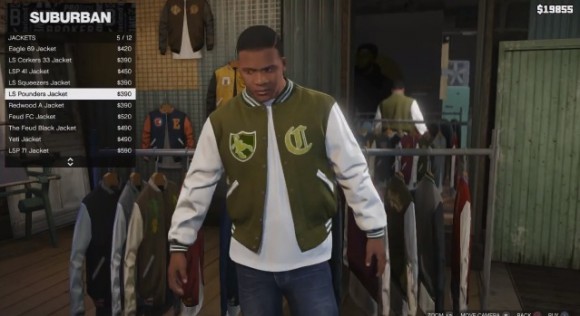
When you think of the intersection of fashion and gaming, it’s unlikely that Grand Theft Auto V is the first thing that surfaces in your mind. Instead, you might think about those “Girl Games,” almost invariably packaged in a shade of pink equal parts magnetic and repellant, interspersed between the “good” games on a store shelf. If you’re up to date on your mobile gaming, you may just think of Kim Kardashian: Hollywood and the polarized reception it received. Fashion is a common subject of many games targeted towards girls and women, and it’s also easily one of the most derided in gaming...
...My point isn’t that there are good fashion games—it’s that placing an importance on fashion-play doesn’t taint a game. If you don’t believe me, just look at Grand Theft Auto. The fashion system present in Grand Theft Auto is a significant part of the experience of existing in its open world, and has been developed and refined with each installment... Players now post videos on YouTube modeling their favorite outfits and the latest clothing DLC for GTA V and Grand Theft Auto Online, and these videos have nothing to do with what pieces provide the best stat bonuses or buffs.

