Monday, November 21, 2016

Social Anxiety Guide To Calling Gov't Representatives

In the wake of the recent United States elections, calling your state and local representatives as a means of taking direct action and affecting change have become even more vital than ever. For those that struggle with chronic mental illness or anxiety, taking this sort of action can be even more difficult than it would be for a neurotypical person.  The artist Cordellia of echothroughthefog recently made a comic about how they pushed against anxiety, made those calls, and how you can do that, too! A transcript of the comic and more resources follow.


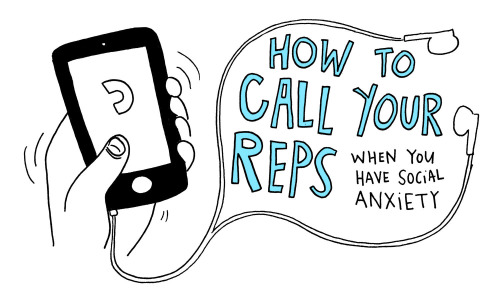
“How to call your reps when you have social anxiety”

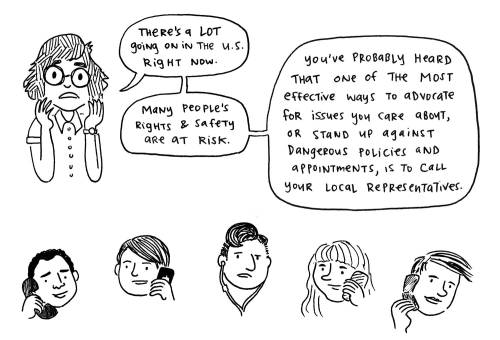
There’s a LOT going on in the U.S. right now. Many people’s rights and safety are at risk. You’ve probably heard that one of the most effective ways to advocate for issues you care about, or stand up against dangerous policies and appointments, is to call your local representatives.
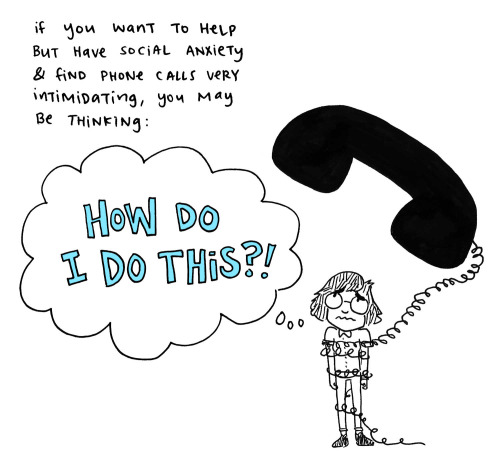
If you want to help but have social anxiety and find phone calls very intimidating, you may be thinking, “How do I do this?!” (An oversized telephone handset hovers ominously over the narrator with its cord spiraling around her body. She looks up at it with great concern.)
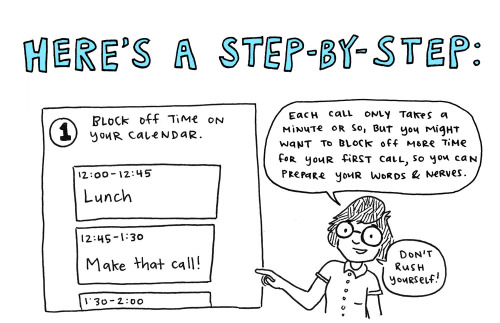
Here’s a step-by-step:
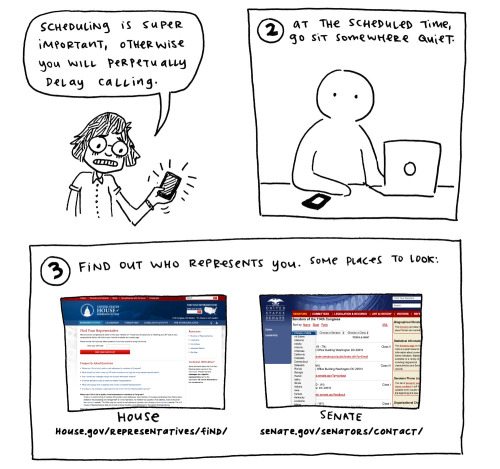
  1. Block off time on your calendar. Each call only takes a minute or so, but you might want to block off more time for your first call, so you can prepare your words & nerves. Don’t rush yourself! Scheduling is super important, otherwise you will perpetually delay calling.
  2. At the scheduled time, go sit somewhere quiet.
  3. Find out who represents you. Some places to look: House (http://www.house.gov/representatives/find/) and Senate (http://www.senate.gov/senators/contact/).
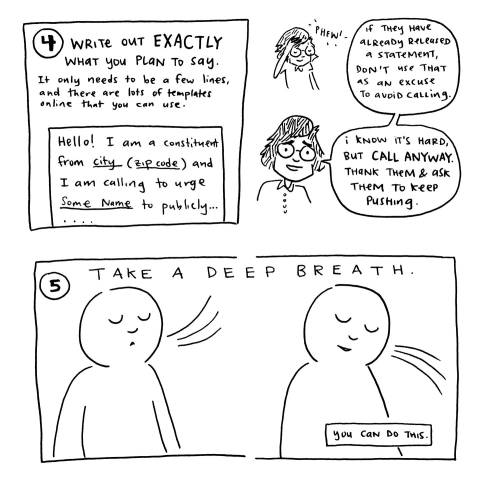
  4. Write out exactly what you plan to say. It only needs to be a few lines, and there are lots of templates online that you can use. e.g. “Hello! I am constituent from city (zip code) and I am calling to urge Some Name to publicly…” If they have already released a statement, don’t use that as an excuse to avoid calling. I know it’s hard, but call anyway. Thank them and ask them to keep pushing.
  5. Take a deep breath. You can do this.
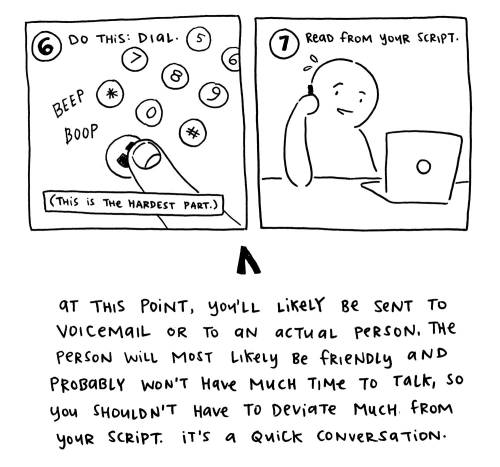
  6. Do this: dial. (This is the hardest part.)
  7. Read from your script. At this point, you’ll likely be sent to voicemail or to an actual person. The person will most likely be friendly and probably won’t have much time to talk, so you shouldn’t have to deviate much from your script. It’s a quick conversation.
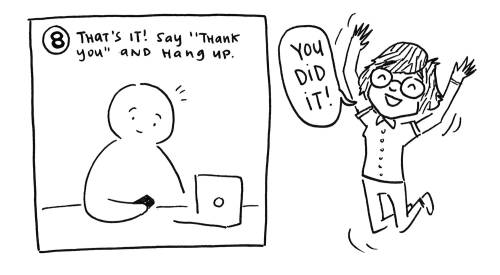
  8. That’s it! Say “Thank you” and hang up.
You did it! If you’re thinking “Hey, that wasn’t so bad…”, call more people! And follow up with them next week, or even tomorrow, to make sure they keep these issues top of mind.
It is okay if your voice shakes. It is okay if you feel awkward.They get a lot of calls, so they don’t have time to judge you by how well you delivered your message.
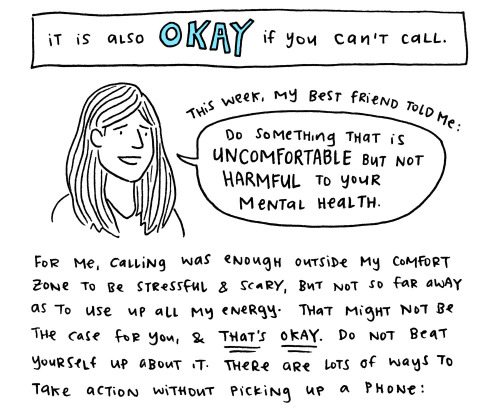
Is is also okay if you can’t call.
This week, my best friend told me, “Do something that is uncomfortable but not harmful to your mental health.” For me, calling was enough outside my comfort zone to be stressful & scary, but not so far away as to use up all my energy. That might not be the case for you, and that’s okay. Do not beat yourself up about it. There are lots of ways to take action without picking up a phone:

  • Write to government officials
  • Create art that challenges and art that inspires
  • Donate, if you’re financially able, to organizations that fight injustice
  • Listen to immigrants, people of color, women, trans and non-binary people, people of all faiths and orientations, and people with disabilities. Support their work. Amplify their voices.
  • Keep it up.
And here are some resources:
  • Emily Ellsworth explains why calling is the most effective way to reach your congressperson.
  • Sharon Wong posted a great series of tweets that helped me manage my phone anxiety and make some calls.
  • Kelsey is tweeting pretty much daily with advice and reminders about calling representatives. I found this tweet an especially great reminder that calls aren’t nearly as big a deal as anxiety makes them out to be.
Informational resources:
There are a lot of these, as well! These three are good places to start:

    Saturday, November 19, 2016

    Lost 17th Century Music Lives Again With Musician & Historian Team


    This is so cool!

    Musical Passages is a collaborative endeavor by Laurent Dubois, David Garner, and Mary Caton Lingold to document, explain, and recreate examples of Jamaican music as it was played in the 1600s. As they explain:
    Enslaved Africans and their descendants revolutionized global music, but historical records tell us far too little about their earliest practices. In this site we offer a careful interpretation of a single rare artifact, from Hans Sloane’s 1707 Voyage to the Islands of Madera, Barbados, Nieves, S. Christophers and Jamaica. Tucked away in this centuries-old book, are several pieces of music that make it possible to hear echoes of performances long past.

    The website functions as a minature interactive exhibit where you are invited to listen in on a musical gathering that took place in Jamaica in 1688. These three songs, 'Angola', 'Papa' and 'Koromanti', performed at a festival by enslaved African musicians and copied in musical notation by a Mr Baptiste, are the first transcription of African music in the Caribbean. Thanks to the preservation of this amazing work, the entire world can now listen to traces of music performed long ago and maybe even begin to imagine what it meant for the people who created it.

    Friday, November 18, 2016

    WLW Ask: Where Are Queer Butch Women In Video Games?

    In the media landscape of video games, there has been a noticeable rise in the amount of visible queer characters in everything from indie games to AAA big-budget titles. Queer men have a number of different types and portrayals, from Grand Theft Auto's Gay Tony and Dragon Age's Iron Bull, to Mortal Kombat's Kung Jin and Dremfall Chapter's Kian Alvane.

    But when it comes to queer women, Femme Hype's Aria argues that there is much less diversity of representation, and that that women who love women are the poorer for it. As Aria explains:

    As much as gamers should applaud the industry as a whole making those steady strides to create women who are not sexualized for men, one of the hard points of women that have yet to be presented in games at all is ardent female masculinity, especially within the context of butchness as a trait in women... we have very few characters in the gaming industry who would fit a description of “butch.”  
    Though their butch-ish coding may be recognizable to many players, these women are not in games that explore their characters’ stories or personalities, much less their sexualities, leaving any possible hope of butchness up to speculation and easily written off due to their environments and not their specific expression of their sexuality. Indeed, in may of the games in the FPS genre where some of these more “masculine” women exist, players can only speculate about the romantic and sexual modalities of these women—if their lives are explored at all—as the main men usually have their romantic lives explored.
    Some would argue (though it's an argument I've only seen put forward by men-- well-meaning or otherwise-- that explicitly coding a woman character as butch could be reinforcing stereotypes. As Aria points out, however, this argument is rather lacking:

    The absence of these types of women is not a testament to the gaming industry being uncharacteristically sensitive to queer stereotypes, it’s a testament to how female masculinity is rarely presented at all—and that, in fact, it must be overcompensated through clear heterosexuality. Not only does this prevent diverse representations of women, it upholds standards of women made for consumption by men. Having more butch bisexual or lesbian characters would subvert those standards and create a wider landscape of women for everyone to enjoy and admire.

    SO I turn this over to you, dear readers. DO you have any game recommendations, indie, AAA or in-between, that feature butch heroes?

    Leading Pinball Maker Still Crafts Cabinets By Hand

    Description: A row of pre-assembled pinball board for Stern Pinball's Ghostbusters cabinet await assembly. Photo courtesy of Brian Crecente & Polygon.
    Earlier this year, Stern Pinball celebrated its 30th anniversary of making pinball machines, and Brian Crecente of Polygon was given a rare, detailed behind the scenes look on all of the delicate assembly and intricate craft work that goes into making a pinball table. The most important ingredient for assembling a pinball machine, as it turns out-- is hand-crafted, human touch.

    Dankberg, Stern's director of marketing and licensing, comes by to walk me through the assembly process. [We] marvel at the process of turning reels of fine wires into the wiring harnesses that bring pinball machines to life.
    "We can't really automate this stuff," he said. "It has to be done by people.
    “Steve Ritchie is the king of flow,” Dankberg said. “He’s there with a ruler measuring angles, making sure everything fits. Some people like to build it out and see how it plays first.”
    The initial board designs are build on a white-wood, or an unpainted wood play field. We’ll cut a table, make some prototype parts,” Dankberg said. “Then they’ll test it. The white-wood stage could be really short or really iterative. If they hit a homer un at first, how great is that? But a lot of times they like to change things. It’s like a first draft.”

    The rest of the article features tons of behind the scenes assembly pictures and offers a fascinating look at how pinball machines are crafted by hand in 2016.

    Tuesday, November 15, 2016

    Patreon Stuff: Thanks, Sneak Peeks & Getting In On The Action

    See the picture to the left? That's going to a patron this month who is supporting my work at the "Surprise Mystery Care Package" level. I make a custom surprise care package every month and send it out.

    Speaking of patrons, here's this month's Thank Yous:

    • Cargo, who had nothing to link to, but is a great dude! Thanks, Cargo. 
    • Daphny Drucilla Delight David! Her Patreon is here and her blog is on the blogroll! 
    • Fluffy! Check out their stuff at beesbuzz.biz
    • Hillary Gross
    •  Gabriel Gentile

    The Code is helped by the patrons I just thanked. In addition to geek ephemera and the esoterically nerdy, I use this blog to focus on marginalized voices and perspectives and advocates for more inclusiveness in media fandoms and sub-cultures.

    I also create experimental electronic music and art prints & apparel under the name lowercase t and perform improvisational readings with the Overly Dramatic Readers.

    I also help people! 

    • I co-host several charity fundraisers with The Munchausen Society every year
    • Advocate for strong anti-harassment policies and safe spaces at conventions
    • Organize public relations, media outreach, recorded an audio book & designed the website for a disabled dad's panel on disability for Bronycon; it was so successful he was invited back 2 more times!
    • And More!

    I want to keep doing this work, and working with & helping people and also be compensated for my time and effort. My ultimate dream is to be able to offer a bi-monthly podcast along with a blog updated every day of the week. I know times are rough for a lot of people, so I've set this campaign to pay monthly-- no matter how much I do or produce, you'll only be charged the amount you chose once per month.

    I have rewards for every single support level I offer, too!


    $1 a month:
    TIP JAR 

    You'll get: 
    • My thanks & gratitude
    • Your name listed in a special "Thank You" post on The Code every month
    • Access to Patron-only posts and updates
    • One free Patron only exclusive download each month


    $3 a month
    CUP OF COFFEE


    You'll get:
    • Your name listed in a special Thank You post on The Code
    • Access to Patron-only updates
    • Free Patron only exclusive download every month
    • Monthly link/plug to whatever you want-- your website, aproject, your YouTube channel-- you name it!


    $5 a month
    LUNCH TIME


    You'll get:
    • All rewards for previous tiers (thank you post, Patron-only update access, free monthly Patron only download, free plug on The Code)
    • a free music download of a track of your choice from lowercase t every month!


    $10 a month
    SURPRISE MYSTERY CARE PACKAGE


    You'll get:
    • All rewards for previous tiers 
    • A special Mystery Surprise Care Package made just for you mailed to you EVERY MONTH. It'll be a CARE package stuffed to the brim with fun stuff like novelties, toys, magazines, surprises and a hand-made postcard from my pal at Blue Boi Studios.


    $20 a month
    PIZZA TIME


     You'll get:
    • All previous tier rewards (including the Monthly Mystery Surprise Package)
    • Every month you can request a post on The Code on a topic of your choosing or get a free music track made just for you based on a title you make up!

    Facebook Employees Meeting In Secret In Hopes of Busting FB B.S.

    Description: A hand making a thumbs-down gesture next to the word hoax as a
    parody of Facebook's thumbs-up next to the word Like icon. 
    Facebook is used by over 150 million Americans. According to a Pew Research Center for Journalism & Media report, two thirds of Facebook's users get their news via that platform. Unfortunately it's been plagued with a flood of flat out hoax news articles. While late last year, Facebook announced it was rolling out new tools for users to report hoax news sites and articles, it's been unclear how effective it's been in action-- and management isn't releasing any details.

    Earlier this year amid accusations of Facebook's Trending Topics team in charge of the way the Facebook News Feed worked having a bias towards liberal sites, the entire trending topics team was fired and replaced with an algorithm. The trending topics news feed was then immediately flooded with hoaxes, parody articles presented as fact and puff-piece press releases.

    In the wake of an increasingly loud debate across the country over fake news online in general, and on social media in particular, top management have dismissed the idea of having any culpability in leading to the recent election of Donal Trump-- CEO Mark Zuckerberg calling the notion a "crazy idea". Not surprisingly, a number of outlets disagree with him-- including his own employees. Buzz feed reports that they have learned of a group of Facebook employees that are meeting in secret to try and figure out ways to combat the flood of fake news plaguing the social media platform:

    “One employee said “more than dozens” of employees were involved, and that they had met twice in the last six days. At the moment, they are meeting in secret, to allow members of the group to speak freely and without fear of condemnation from senior management... Another Facebook employee said while the task force remained small, “hundreds” of Facebook employees had expressed dissatisfaction with the company’s stance on fake news in private online chats, and wanted to support efforts to challenge that position...
    'If someone is right-wing, and all their friends are right-wing, and that is the news they share on Facebook, then that is the bubble they have created for themselves and that is their right,' said the longtime Facebook engineer. 'But to highlight fake news articles in the [news] feed, to promote them so they get millions of shares by people who think they are real, that’s not something we should allow to happen. Facebook is getting played by people using us to spread their bullshit.'”
    Those sentiments have been echoed by former Facebook designer Booby Goodlatte, who said in a November 8th post:
    "News Feed optimizes for engagement. As we've learned in this election, bullshit is highly engaging. These outlets, and Donald Trump, have no concern for the truth, and really only care for engagement. A bias towards truth isn't an impossible goal. Wikipedia, for instance, still bends towards the truth despite a massive audience. But it's now clear that democracy suffers if our news environment incentivizes bullshit."

    Wednesday, October 12, 2016

    Soylent Bars: Literal Toxic Masculinity

    Description: Cartoon of a white man with eyeglasses wearing a green sweater,
    contemplating a glass of liquid.He declares, "Removing my taste buds has
    increased drinking efficiency by 4%!" Illustration by Brad Jonas.
    Soylent, the much touted "meal replacement" drink substance has gone from mixable pastes to coffee-flavored drinks to its latest offering: a Soylent bar. Soylent's consistency (in both the ingredient sense and in the promise of never having to worry about cooking, preparing or eating something different sense) has been presented by the company and it fans as a feature and key selling point.

    Something that's also been consistent has been Soylent being unsafe to eat . In 2013, a documentary by Vice showed rats scurrying around the factory where Soylent was made. Despite repeated claims of commitment to food safety, browsing the subreddit devoted to Soylent shows reports of every few batches released this year have come with an extra ingredient-- mold. And while the recently released breakfast bars haven't had mold, there have been enough consumers of the bar that have reported becoming violently ill, in one case leading to a trip to the ER.

    A community manager on the official Soylent forum responded to one users concerns about transparency thusly:

    I do tell you info. I generally tell you more info. But i'd rather have all the info before I speak. In this case we are testing bars. We've eaten bars sent to us ourselves. Myself included. All our evidence leans towards people having an ingridient[sic] intolerance.

    Okay, so the community manager actually trotted out the "I ate some and I'm perfectly fine defense" but they're just a person on a message board. Surely the actual company in charge of making Soylent wouldn't use the same--

    Description: A screenshot of Rosa Labs' statement to the press that reads: "After these reports, we have retrieved remaining bars from our consumers and have personally consumed many of the remaining bars without adverse effects. We have also sent them for further microbiological testing and all tests have come back negative. Based on this we remain very confident in the safety of the bars. A certain subpopulation of individuals may have an allergy, intolerance or sensitivity to ingredients such as soy and / or sucralose, or certain vitamin and mineral sources and should consult with their doctor before continuing to consume these products."
    Okay, so the actual makers of the Soylent bar did resort to the "we ate it and we're fine" defense too. And instead of contacting everyone who bought the tainted batches to initiate a recall, they're just telling people to send them in after they get sick. According to the FDA's online database, the current factory where Soylent is made hasn't been inspected since 2014. Then again, the tech-bro founder behind Soylent (which takes its name from the sci-fi movie "Soylent Green" where the titular food was made from human corpses) had this to say about shopping for groceries:
    I have not set [foot] in a grocery store. Nevermore will I bumble through endless confusing aisles like a pack-donkey searching for feed while the smell of rotting flesh fills my nostrils and fluorescent lights sear my eyeballs and sappy love songs torture my ears.
    Hey was also fined and charged by the city of Los Angeles earlier this year for his "experiment in sustainable living" that was really just an abandoned shipping container and port-a-potty covered in graffiti and trash.

    Remember how in Harry Potter they had magic jellybeans that could taste like any flavor, from cheesecake to human earwax? If a melange of misguided libertarian, bro-grammer culture, start-up philosophy, engineer's curse, and insecure masculinity would have a flavor, it would be Soylent.

    Monday, October 10, 2016

    Quick Shots: Fact-Checking RPS, Arcade Treasure & LoL Pro Pwns Self


    Hey all. Feeling pretty awful today, so here's a few quick newsbits instead of something long.

    1) J. Walker of "Rock, Paper, Shotgun" didn't just screw up, he lied by omission and follow some twisted logic on top of it for his Review In Progress of Mafia 3. Of  the game's title card, of which he calls "strange... paranoid... odd," he says:

    Description: Partial opening card from Mafia 3 that reads "Mafia III takes place in a fictionalized version of the American South in 1968. We sought to create an authentic and immersive experience that captures this very turbulent time and place, including depictions of racism. We find the racist beliefs, language, and behaviors of some characters in the game abhorrent, but believe it is vital to include these depictions in order to tell Lincoln Clay’s story.”
    “We find the racist beliefs, language, and behaviors of some of the characters in the game abhorrent, but believe it is vital to include these depictions in order to tell Lincoln Clay’s story.” Which is, well, a pretty odd way of putting it.“It’s vital to include these depictions in order to tell the story of this era of this nation’s history,” would have been equally unnecessary and paranoid, but at least made a lick of sense. Lincoln Clay isn’t real, the city is fictional, and his is not a story that was going untold until some people in a room invented it. 

    Aside from ignoring that fiction doesn't take place n a vacuum (and leaving out his bizzarre "I watched Luke Cage on Netflix" tangent), he also left off the full text. Below is a screenshot of the FULL opening card, including the final paragraph he left off, emphasis mine:

    cypheroftyr:
“ “ “Mafia III takes place in a fictionalized version of the American South in 1968.
We sought to create an authentic and immersive experience that captures this very turbulent time and place, including depictions of racism.
We find the...
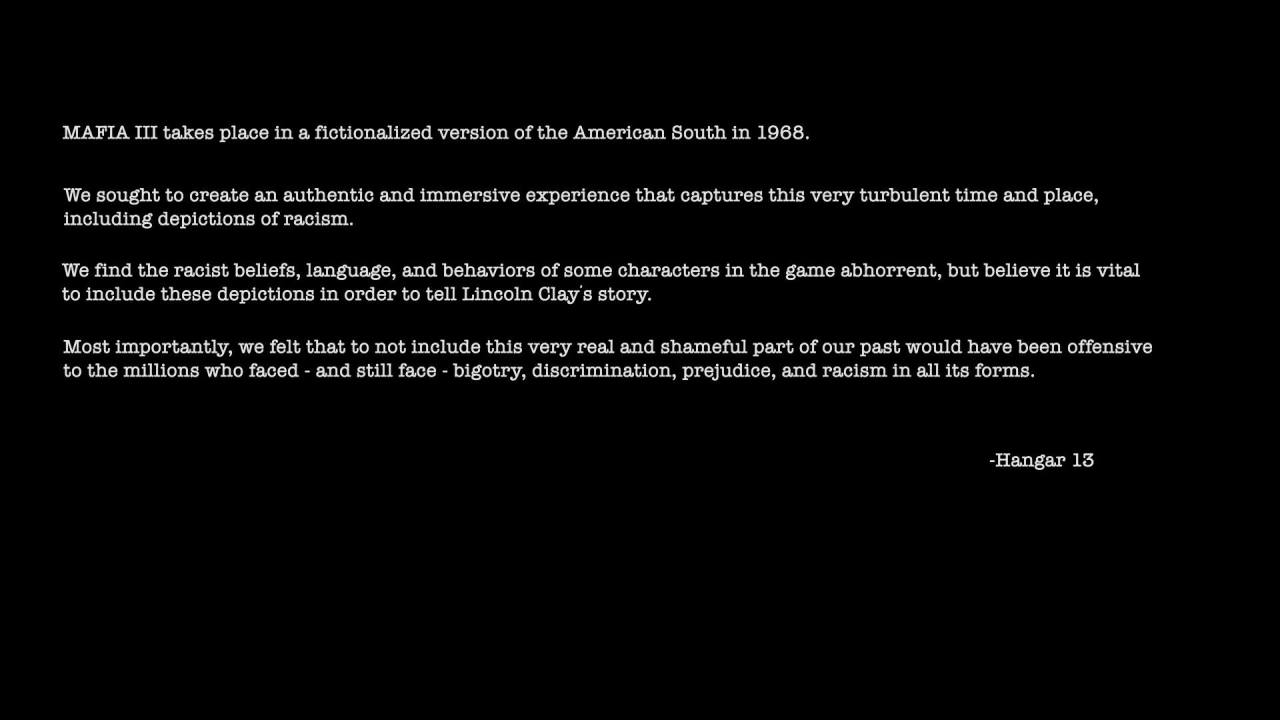
    Description: The full opening card to Mafia 3 including the text that J. Walker cut off in his review, which reads: "“Most importantly, we felt that to not include this very real and shameful part of our history would have been offensive to the millions who faced - and still face - bigotry, discrimination, prejudice, and racism in all its forms.” Screenshot courtesy of Nikki Kendall.
    C'mon, Walker, get it together.

    2) Tim Nichols recently launched a treasure trove of a reference site. If you're trying to fix or restore an old arcade machine, or you're just interested in some classic arcade history, he has over 2,400 arcade cabinet manuals available for free download now online at arcadertfm.com.  Check out this cover for OutRun:


    And finally, pro League of Legends gamer Road of team I May has been suspended and fined for harassment and racially charged remarks. Kotaku has the full details.

    Friday, October 7, 2016

    Tech Sector's Diversity Problem: White People Still Aren't Listening

    Description: A bar graph shows a demographic breakdown of employees at tech companies. Apple is 80% men, Microsoft and Google are 83% men,  Facebook is 84% men and Twitter is 90% men. Continuing the demographic breakdown, Apple employees are 54% white, 21 percent are Asian, 6 percent are Hispanic, and 3 percent are black and 165 are other.

    The above graph from a Mother Jones article about diversity in the technology industry in general and the Rev. Jesse Jackson's outreach work in Silicon Valley in particular last year showed that for all the publicized diversity initiatives, tech has a LONG way to go before achieving any sort of equality or parity. So, a little over a year later, what's changed?

    Not much.

    Twitter has historically been the worst of the high-profile tech companies, with an employee workforce that's 90% male, and majority white, with Black employees making up just 1 percent of the workforce.  Janet Van Huysse, who was the Vice President of Diversity for Twitter spoke in 2014 about working to improve diversity. In 2015,  with Twitter no further along aside from very vague plans to increase hiring “marginalized groups” in their US offices, Van Huysse resigned after Twitter's numbers didn't even budge after 2 diversity initiatives and the traditional university graduate application rush.

    Van Huysse-- a white woman-- was replaced by Jeffrey Simonoff as Vice President of Diversity. Simonoff is a middle-aged white dude.

    Whoops.

    It gets worse.

    Leslie Miley wrote about his departure from Twitter due in no small part to the racism that went on behind closed doors even as the company benefitted from use by citizens and activists in Ferguson and the Black Lives Matter movement . An excerpt :
    Twitter’s issues with growth and engagement and the issues with internal diversity are somewhat related. The over-reliance on a limited number of schools and workplaces for talent has caused a type of group think to dominate. Any change would be approved by people who all think alike. There was very little diversity in thought and almost no diversity in action. To quote Mark S. Luckie “Without a variety of voices contributing ideas, the workplace becomes a homogenized environment where potential brilliance may never be achieved. Diversity should rightly be seen as a benefit to growth, not an obstruction to avoid.” For some at Twitter, diversity is an obstruction to avoid.
     Once Miley left, Twitter management was left without any directors or vice presidents of color in any of the product management or engineering divisions.

    While Twitter may have the most egregious examples, as evidenced by the graph at this article's beginning, it's not the only big-name tech company to have a serious diversity problem. Instead of listening to people of color, though, many tech companies have been hiring teams like "Paradigm"-- a company that “uses social science to increase diversity”... run by three white women and a white man. After some bad PR, they hired one woman of color as a partner, and two women of color as consultants.

    This glaring blind spot extends to some of the largest tech events, too-- even in places where ou'd least expect. The annual "Grace Hopper Celebration Of Women In Tech" didn't have any black women speaking or conducting talks. In fact, it was ZERO women of color and a few dozen white men spoke at least year's event! In fact, as this storify link points out:

    500 speakers were req'd to buy tickets to conf they're speaking at for a conference heavily targeting students, & of 12,000 people who belong to a demographic that's systematically underpaid.
    There are >900 confs for professionals in coding. I know of ~3 that charge speakers for tickets. GHX is one. Pay gap makes that esp uncool. Black women are paid 64% of white men. Hispanic&Latina women are paid 54% of white men. Charging to speak ENSURES under-representation.
    ...which is what prompted last year's NOTGHC counter-conference, organized by disaffected women engineers of color. Yeah, that's right, the whiny baby attitude of "oh, if you want diverse things, go make your own" has extended to engineering conferences, and once again when people of color DO make their own thing, they get the backlash of everything from being "not organized enough" to "being too exclusive"! GHC still charges speakers to pay, by the way.

    Fellow white people, if you think that this lack of diversity only matters in boardrooms and doesn't affect people's real lives, think again. Last year at Dragon*Con, which is a sprawling nerd convention that lasts for days and temporarily takes over most of city downtown, automatic soap dispensers wouldn't detect black peoples' hands. The CEO of the soap dispenser's parent company had to admit that they never really thought to adjust the infrared sensors beyond a certain range. And if you just found out about this now, from me, a white dude? That's part of the problem!

    The effects on health runs deeper than un-soaped hands. Erica Joy wrote about the effects tech culture's isolation and alienation of her as a black women impacted her health:
    The stress and isolation I mentioned have really taken their toll on me. Long term stress is known to cause health issues. Not long after I started working in New York, I developed heart problems (PVC’s). About 3 years ago I started to get acne, something I’ve never had in my life. I always thought it was hormonal but now recognize that it happens when I’m stressed. The isolation and resultant loneliness have exacerbated the stress, leaving me in constant fight or flight mode… I know this: I am not my job. I am not my industry or its stereotypes. I am a black woman who happens to work in the tech industry. I don’t need to change to fit within my industry. My industry needs to change to make everyone feel included and accepted.” 
    She's right, of course. Cameron Glover said it best:
    Without consequences and more nuanced understanding of different perspectives and cultures, we’re left with a tech culture something akin to a leech: the best parts of marginalized workers are taken, and we are left feeling like victims and stripped of our power.

    Wednesday, October 5, 2016

    VOYA: Youth Advocates, Unless The Young Woman Is Bi

    Description: The character Beetlejuice wagging his index finger derisively at the
    camera, with the caption "Ah! Oo, oo, oo, ah, ah, ahh! Nobody says the 'B' word" beneath.

    Librarians across the country rely on Voices of Youth Advocates Magazine (VOYA) as a professional journal for young adult librarians. It's rutinely cited as a valuable publication in advancing advocacy of young adults, and the promotion of young adult literature and reading. Its reviews have a lot of influence in what Young Adult (YA) section librarians stock on library shelves and the magazine champions itself as "...one of the earliest and... strongest advocates for intellectual freedom and equal access to information for teens". Which is why a recent review of the YA novel "Run" by Kody Kepplinger is all the more troubling, and VOYA's response to the backlash against it very worrisome. Here's the review, (emphasis is my own doing):
    "Agnes is legally blind, and leads such a sheltered life that she cannot even take the bus home from school or attend parties. Bo Dickinson has a drug addicted mother, an absent father, and is rumored to be the town slut. Although opposites, they become good friends through their kindness and acceptance of each other. Bo’s cousin Colt is almost a brother to her; they have grown up together and are part of the family “you steer clear of because nothing good can come of getting mixed up with that bunch.” Agnes has a different problem; her parents hover over her and limit her activities so it is impossible for her to be a normal teenager, until she begins sneaking out to go places with Bo. When Bo hatches a plan to leave town to find her father, Agnes decides to go along, thinking she and Bo will live together. They steal a car from Agnes’s family and begin their road trip, along the way visiting Colt, with whom Agnes has a sexual encounter. When Agnes discovers that Bo intends to live with her father, they separate and she gets in touch with her parents, leaving Bo to a disappointing meeting with her father, and an eventual return to the foster care system. The story contains many references to Bo being bisexual and an abundance of bad language, so it is recommended for mature junior and senior high readers.–Rachel Axelrod"

    Yup. Not only is a character talking about her orientation eye-rolling mentioned in the same breath as cursing, it also means that it can't be recommended for anyone below junior or senior level in high school. Even though, like yours truly back in the long ago, there are bi youth that exist and know they're bi long before junior or senior year. As much as I'm angry at the biphobia in this review's attitude, I have it a little better than most. I'm a bi man. The form of biphobia that surrounds bi-women is even more pernicious and damaging.

    When the reviewer uses the word mature, it's a commonly understood meaning in YA book context that means "sexual content". And there's a common element where bi women are hyper-sexualized just by exisiting, We live in a society that acts that women that are bi, use the word "bisexual" to label themselves and are out about it are on the same level as sex acts. This attitude also floats around in a social climate where bi women face intra-group discrimination and increased percentages of harassment, violence and partner abuse. Plus, you don't see a similar warning like "this book contains many refences to being straight, so it's only appropriate for juniors and seniors" because straightness is see as the "default" or "normal".

    Well, maybe there's a sex scene with Bo, and that's what makes it mature, maybe? Nope. As the author herself pointed out on twitter:
    The irony? (And this might be a spoiler so beware:) There IS a sex scene in the book Between the STRAIGHT characters. Not Bo, the bi M[ain] C[harcter]. But Bo's sexuality - Bo who doesn't have a sex scene while her straight co-narrator does - is the one considered "mature." 

    The review doesn't think to warn about a sex scene, but does think to warn about a character talking about being bi! VOYA is super influential in the young adult literary field. Booksellers and librarians rely on these reviews because no one person can read all of the thousands of YA novels published every year. VOYA's own mission statement reads "Young adults have rights to free and equal access to information in print, nonprint, and electronic resources, without infringement of their intellectual freedom due to age or other restrictions." and this review's note runs counter to that. Author Tamina Wright points out that "These types of reviews, in addition to being insulting and harmful to actual queer teens, hurt queer books because they could be passed over. Queer books, by and large, don’t get the big advances or the huge marketing budgets so they depend on word-of-mouth, hand-selling, and libraries. Being in a library could quite literally make an author’s career."

    The topping on the sundae of crap that is this VOYA review? It was released during NATIONAL BI VISIBILITY WEEK.

    When Wright wrote an email to VOYA, pointing out that this attitude is harmful to bi youth in general, and herself in particular as both a bi woman and parent of a genderqueer child, a VOYA editor responded with the non-apology of "sorry if you were offended", claimed that nothing was inappropriate about the review, and then personally attacked Wright for "revealing your child's sexuality to me" (which the author didn't even do) and said that because it was Bi Visibility Week, all Wright wanted to do was "find and destroy your enemies in a public forum" (even though Wright sent a private email). FOR REAL. The screencaps of the emails are here.

    There was an outcry from queer youth and authors and librarians. SO VOYA did the logical thing... and printed Wright's email and the editor's response as a special "Letter To The Editor Column" on its website that has since been removed. Bi author Hannah Moskowitz, whose YA work VOYA has reviewed favorably in the past, wrote a scathing response to VOA's actions, which she shared on here twitter here.

    Literary agent Barry Goldblatt-- who is a big name YA lit agent-- publically announced he was pulling all agency ads from VOYA in response, and encouraging his contacts in the publishing industry to do the same.

    Author Peggy North dug through old VOYA back issues and found that the magazine only seemed to warn about f/f romances. NO similar warning for straight ones, and these reviews were all written by different staffers. Meanwhile VOYA doubled down on social media:


    cs_htfzuaaarjwh-jpg-large

    It gets better. And by better, I mean worse.

    VOYA finally apologizes. Sorta. In the most flouncy, pouty way possible. See, it's the "LGBTQ community" that has "taken offense" and "demanded" an apology! So, there's a ham-handed apology, but it's a start, right? Surely VOYA would start listening to authors and others and try to improve?

    Nope. They then deleted all mention of the controversy from their official twitter and FB accounts, and began blocking anyone that spoke to them about it. Including famous writers. Successive attempts at apologies from VOYA have started out better but quickly careen into defensiveness.

    Let me share a resource with you that shows YA stories with bi protagonists that don't have weird, unnecessary bi-phobic warnings.

    Tuesday, October 4, 2016

    Overwatch: FPS, PVP and WLW

    Description: In a style parody of the cereal box for "Cap'n Crunch Oops! All Berries",
    Tracer from Overwatch appears in place of the Cap'n, bearing the name "Oops! All
    Lesbians" with the tagline "All the time, forever" beneath it and the legend "Contains all
    women loving women".
    For most of its history, the first person shooter (FPS) genre has been dominated by male protagonists. Doom Guy, Master Chief... even Valve's team-based FPS Team Fortress 2 has nine class characters and all nine of them are men (yes, even Pyro, according to the series trading cards). Conversely, of the 22 character's in Blizzard's Overwatch, 9 of them are women. Unlike the cookie-cutter grizzled white guys or male-gazey fantasies of other games, each woman in the game has wildly different identities, roles, and even body types.

    So perhaps it's not much of a surprise that Blizzard's foray into the team based FPS field has garnered lots of attention and devotion from a large fanbase of women. Especially prominent has been the large, joyful and vocal fans pairing up the game's women in various couples, across fanart, fan music videos, animations and fan fictions. My personal favorite power couple name is PharMercy, a pairing of the two healers Phara and Mercy.

    However, all the of the women loving women content has been made by enthusiastic fans only. In an interview with Kotaku, director Jeff Kaplan had this to say:
    The only stated relationship actually that we’ve even ever mentioned in the backstory is between Amelie who is Widowmaker and her husband who was brainwashed and assassinated. That’s the only reference we’ve ever made to a romantic relationship. It’s not that our characters don’t have romantic relationships and don’t have sexual identities or whatever, but the stance that we’ve sort of taken on the team is that we’re not going to talk about that stuff just to pander to the topic that when it comes out for game play or story reasons, that’s the right time for it to come out.
    Tumblr user hattersarts, creator of the Sapphic Overwatch fanzine, had this to say about the idea that explicitly saying a character in Overwatch is gay is pandering:
    “There is the problem where people say ‘Well, we don’t want to make it about them being gay.’ Well no, we want that, if I’m honest. I want to know they’re gay! I want that, I want you to shove that down people’s throats. Until we get to a point where the world doesn’t care, I want it. We need to care.”
    Blizzard's coyness on the issue might be more than just well-intentioned fence-sitting. In a discussion of recent talks from DC Comics writers about Wonder Woman's sexuality on Metafilter, user rokusan had this to say:
     I've been involved in (the periphery of) Hollywood projects working from source material featuring characters who are either straight or of unspecified orientation, who are then deliberately cryptoqueered in the adaptation. They're not made gay, explicitly, but there are deliberate attempts to both raise and muddy the question just enough ... It ends up possible to see the character(s) both ways, or multiple ways...

    But it's not a social agenda effort, clever or offensive or otherwise. It seldom comes from the creatives at all. Rather, it's a calculated marketing trick from on high... The logic is that by toeing such a line, they can attract a wider audience, each of whom uses some kind of identity consumerism to see the thing they wish to see in the character(s). Double the sales, the thinking goes.
    What do you think, readers? As long as fans keep up the shipping, does it matter what Blizzard says? Or are unambiguous acknowledgment of gay or lesbian characters in Overwatch just as important for fans looking for representation and the series lore?


    Monday, October 3, 2016

    Bringing Roguelikes Into The Future: Improv FMV?


    Wayfarer, a 3/4 perspective 3-d roguelike in development
    The rouguelike genre gets its name from the game Rogue, a computer game released in 1980. What set it apart from dozens of swords and sorcery games for computers at the time was the way it guaranteed that no two players would play the same game the same way twice. It used a technique called procedural generation to randomize each dungeon level. This core element of Rogue has influenced games for decades since, from Nethack to Dwarf Fortress and even platform adventures like Spelunky and top-down adventure games like Don't Starve. Often, fans of roguelike games become developers themselves.

    The largest celebration and gathering celebrating the roguelike happened just last month, and I found a great write-up from speaker and attendee Josh Ge. In it, he also talks about his experience participating in what very well could be the future of the roguelike-- a game experience called "Bad News".

    In an overview of the history of the roguelike, Gamasutra writer J. Bridgman talks about how one game will be blending procedural generation, improvisation action, FMV and the American Old West with Bad News, and it sounds really interesting:
    “Bad News is set in a small American town in 1979 that has undergone a century of procedural world generation in the vein of Dwarf Fortress, complete with hundreds of residents who have formed subjective (and potentially false) opinions of the others in the town,” adds Ryan. “The player takes the role of a mortician’s assistant after the discovery of an unidentified body. Set with the task of finding the next of kin to inform them of the death, “the player explores the town and converses with its residents to discover the identities of both the deceased and next of kin, as well as the current location of the latter. Whenever the player encounters a town resident, an improvisational actor performs the non-player character live, adhering to the character’s generated personality, life history, and knowledge. This actor is Ben Samuel, whose earlier professional work includes Hulu’s original series Battleground.”
    What do you think, readers? Is this sort of thing part of the roguelike's journey into the future, or is this a digression down a dead-end path?

    This Could Be Yours If You're A Supporter!


    See the above picture? That's going to a patron this month who is supporting my work at the "Surprise Mystery Care Package" level. I make a custom surprise care package every month and send it out.

    The Code is helped by the patrons I just thanked. In addition to geek ephemera and escotericaI use this blog to focuse on marginalized voices and perspectives and advocates for more inclusiveness in media fandoms and sub-cultures.

    I also create experimental electronic music and art prints & apparel under the name lowercase t and perform improvisational readings with the Overly Dramatic Readers.

    I also help people! 
    • I co-host several charity fundraisers with The Munchausen Society every year
    • Advocate for strong anti-harassment policies and safe spaces at conventions
    • Organize public relations, media outreach, recorded an audio book & designed the website for a disabled dad's panel on disability for Bronycon; it was so successful he was invited back 2 more times!
    • Write personal essays on being a male survivor of abuse
    • Make business cards for everyone from artists to computer engineers 
    • Ghost-written over 200 articles for Textbroker clients

    I want to keep doing this work, and working with & helping people and also be compensated for my time and effort. My ultimate dream is to be able to offer a bi-monthly podcast along with a blog updated every day of the week. I know times are rough for a lot of people, so I've set this campaign to pay monthly-- 
    no matter how much I do or produce, you'll only be charged the amount you chose once per month.

    I have rewards for every single support level I offer, too!


    $1 a month:
    TIP JAR 


    You'll get: 

    • My thanks & gratitude
    • Your name listed in a special "Thank You" post on The Code every month
    • Access to Patron-only posts and updates
    • One free Patron only exclusive download each month


    $3 a month
    CUP OF COFFEE


    You'll get:

    • Your name listed in a special Thank You post on The Code
    • Access to Patron-only updates
    • Free Patron only exclusive download every month
    • Monthly link/plug to whatever you want-- your website, a project, your YouTube channel-- you name it!


    $5 a month
    LUNCH TIME


    You'll get:
    • All rewards for previous tiers (thank you post, Patron-only update access, free monthly Patron only download, free plug on The Code)
    • a free music download of a track of your choice from lowercase t every month!


    $10 a month
    SURPRISE MYSTERY CARE PACKAGE


    You'll get:
    • All rewards for previous tiers 
    • A special Mystery Surprise Care Package made just for you mailed to you EVERY MONTH. It'll be a CARE package stuffed to the brim with fun stuff like novelties, toys, magazines, surprises and a hand-made postcard from my pal at Blue Boi Studios.


    $20 a month
    PIZZA TIME


     You'll get:
    • All previous tier rewards (including the Monthly Mystery Surprise Package)
    • Every month you canrequest a post on The Codeon a topic of your choosing or get a free music track made just for you based on a title you make up!

    Patreon Thank Yous

    Description: A fountain pen writes the words "Thank You" in flowing script
    It's time for my monthly Patron Thank You Post!


    • Cargo, who had nothing to link to, but is a great dude! Thanks, Cargo. 
    • Daphny Drucilla Delight David! Her Patreon is here and her blog is on the blogroll! 
    • Fluffy! Check out their stuff at beesbuzz.biz
    • Hillary Gross
    • And a warm welcome to newcomer Gabriel Gentile!

    Tuesday, August 2, 2016

    Science YouTubers' Tribute To Hamilton

    No, no, not not the politician Hamilton-- the scientist Hamilton. They do use a pretty awesome homemade acapella cover of the first song from the play Hamilton to do it, though. It's arranged well and diversely cast, too, Check it out!


    So what did William Rowan Hamilton discover? He discovered quaternions, which are an extension of complex numbers: rather than just one number (i) that equals -1 when squared, these use thee (i,j,k). Also in that formula, multiplication is no longer commutative (the order in which things are multiplied matters, so a times b is not the same as b times a). They can be used to represent rotations.

    Monday, August 1, 2016

    Spec Fic's Systemic Racism & What To Do About It

    Text: Out of 2,039 stories published in 2015, 38 were written by black authors.
    Speculative fiction can be a gateway for aspiring authors, above and beyond getting a pay-day or seeing your work in the SF/F anthology of your choice. It can also be the first step to greater access to agents, a fanbase, novel deals and more. Over the past few years, there has been an increased push for publishing a diversity of voices, but in a recent study, Fireside Fiction outlines that out of all of the speculative fiction stories that were published last year, only 1.9 percent of those stories were written by black authors. To put those odds in perspective, they do some math to point out that:
    ...the probability of the 1.9% average occurring by random chance is 3.21x 10^-76, or
    0.00000000000000000000000000000000000000000000000000000000000000000000000000000321%
    For comparison’s sake, the odds of winning the New Jersey Pick Six lottery are 7.15x 10^-08, or 0.00000714%
    Author Mikki Kendall wrote in a companion essay, "Opportunities Lost", that it's not a matter of talent or lack of stories, but a lack of initiative on the part of publishers:

    Race matters at every step of the publishing process. Including who gets out of the slush pile and onto the page. The myth that Black people don’t read science fiction or fantasy has been thoroughly debunked. And despite any claims to the contrary, Black writers of speculative fiction have been producing amazing work since the genre’s inception. The real problem isn’t one of a lack of stories or a lack of talented writers, the problem is a lack of outlets willing to publish stories that don’t center white characters.
    New York Times best-selling author Tobias S. Buckwell points out that this lopsided figure doesn't even reflect the current makeup of the United States in his essay "Boldly Going Nowhere":
    I don’t remember the first time I was told there were plenty of diverse writers in the field, and had the same few names repeated to me over and over again... the same four names—“Hopkinson, Butler, Delany, Barnes”—as a list of writers of color when I would point out the whiteness of the science fiction field. With some 1,500–2,000 members of the Science Fiction and Fantasy Writers of America, in order for our field to just match the demographics of the USA that meant SFWA should have had at least 150–200 African-American writers because twelve percent of the US population was African-American. 
    To match the U.S.A’s demographics, there should be about 200 members of SFWA who would choose African-American on a census bureau questionnaire. 90 who would choose Asian-American. 18 Native-American. 54 like me, who would choose two or more races on the census questionnaire.Basically, every time you go see a bunch of writers, in person or in print, about 30% of them should be something other than white. Just to reflect demographics.
    Fireside Fiction is not above pointing out that they have failed at this goal as well, but editor Brian White posted an editorial that, among other things, showed he was willing to put his money where his mouth is:
    • We’re working with the developer of our submissions system to add in an optional, anonymous form for people to self-report their demographic information when they submit to Fireside. This way, we can take a much closer look at what is going on in our submissions pile.
    • We are going to change our submissions process. Once a year, we will still have one big submission period open to everyone. But several other times a year, we will have targeted submissions windows, each targeted toward a specific marginalized group. So black writers, writers of color generally, LGBTQA writers, women, writers with disabilities, etc. We’re still working out the details on this, but all the dates will be publicized well ahead of time, so that people who don’t have the leisure time to whip up a submission on short notice can get their work ready. 
    • We also want to hear from the black writing and publishing community about what else we could do better. You can email me directly at brian@firesidefiction.com or talk to us on Twitter.

    Readers, what else do you think can be done to fix this problem in spec fic? Sound off in the comments below.

    Share This Post