Showing posts with label race. Show all posts

Monday, August 7, 2017

Reaction Gifs: The New Digital Blackface?

Teen Vogue has been offering up a continuous supply of well-written, well researched essays, from a diverse range of writers. At least once a week, I'll read something on Teen Vogue that will give me pause and have me re-evaluate something I normally take for granted. This one surprised me: reaction gifs. As Lauren Michelle Jackson posits in her Teen Vogue op-ed, that could very well be the case:

 There’s no prescriptive or proscriptive step-by-step rulebook to follow, nobody’s coming to take GIFs away. But no digital behavior exists in a deracialized vacuum. We all need to be cognizant of what we share, how we share, and to what extent that sharing dramatizes preexisting racial formulas inherited from “real life.” The Internet isn’t a fantasy — it’s real life. After all, our culture frequently associates black people with excessive behaviors, regardless of the behavior at hand. Black women will often be accused of yelling when we haven’t so much as raised our voice. Officer Darren Wilson perceived a teenage Michael Brown as a hulking “demon”and a young black girl who remained still was flipped and dragged across a classroom by deputy Ben Fields. It’s an implication that points toward a strange way of thinking: When we do nothing, we’re doing something, and when we do anything, our behavior is considered “extreme.” This includes displays of emotion stereotyped as excessive: so happy, so sassy, so ghetto, so loud. In television and film, our dial is on 10 all the time — rarely are black characters afforded subtle traits or feelings. Scholar Sianne Ngai uses the word “animatedness” to describe our cultural propensity see black people as walking hyperbole.

The entire op ed is very well-written. Agree or disagree, you're likely to come away with a lot of food for thought, so be sure to read the whole article.

Wednesday, June 14, 2017

Black, Queer & In Love: "Bingo Love" Comic Coming Soon

Black queer romance is not a common sight in comics.  Tee Franklin, a black queer disabled comic book writer, has set to change that with her graphic novel "Bingo Love". "Bingo Love" centers on two teenage girls, Hazel and Mari, who meet when their grandmothers bring them along to a church bingo night. They become best friends in the 1960s, then fall in love, and then are forbidden to see each other by their families. Over the next couple of decades decades, the two friends reconnect and become closer as they get older.

In an interview with The Root, Franklin said that she felt this graphic novel was important because “...very rarely do we see queer people, women of color and elderly people in comics, so I knew I was taking a risk, but it’s been well worth it,People need to see that you can be LGBTQ and have a partner for life. We are all worthy of that happy ending, too.”

Some of her own life served as inspiration for the characters' struggles. Franklin explains that she was "...once married to a man and wasn’t fully out to my extended family until very recently. I definitely understand that there are black LGBTQ people out there like Hazel and Mari who feel that they have to hide their true selves from the world because of how society views them. I wanted to tell that story.”

Franklin is no stranger to boosting Black-creator comics, as she is the creator of the #BlackComicsMonth hashtag, but she was still overjoyed to see her work supported. "Bingo Love" was successfully crowd-funded via Kickstarter in March and is currently available for pre-order.

"Bingo Love" is written by Tee Franklin and drawn by Jenn St-Onge ("Jem and the Misfits", "Steven Universe", "Rick and Morty") and the art is gorgeous. Here's an a page:


To get the latest news and pre-order the graphic novel, you can visit the "Bingo Love" website.

Tuesday, May 30, 2017

Hollywood Still Way Behind LGBT & Racial Representation

Description: Screenshot from GLAAD study that reads: Transgender
representation was merely one character in "Zoolander 2". The
character, played by Bennedict Cumberbatch, was used as the punchline
to a joke.
Two years ago, GLAAD released a video titled "Hollywood Must Do Better" that  was basically a supercut of the most egregious anti-LGBT moments from major Hollywood films from the past few years. It was a companion piece to studies the group releases every year that rate major Hollywood films on a "social responsibility index" that looks at the representation of racial minorities as well as LGBT characters. "Moonlight" won an Oscar this year, so that must mean things are pretty great now, right?

Wrong. As this year's study shows, Hollywood is still way behind when it comes represention people that aren't white, straight, or male. in a study of 125 major film releases from major film studios, only 23 films included LGBT-identifying characters. That's just 18 percent.

Of those 22 films, 19 had a gay male character. Lesbian characters went from 23% in 2015 to 35% in 2016. 3 films had a bi character. Transgender representation in major Hollywood films last here clocked in at exactly one: a character played by a cis male actor as the butt of a transphobic joke.

Racial diversity in onscreen characters declined as well. From the LGBT characters of the last year, 48 of them were white (69%), nine were Black/African American (13%), four were Asian/Pacific Islander (6%) and one character was Latinx. Eight LGBT characters were identified as non-human.

The study also outlines a great thumbnail guide in looking at LGBT characters in films called the Vito Russo Test. A  film passes the Vito Russo test if:


  • The film contains a character that is identifiably lesbian, gay, bisexual, and/or transgender.
  • That character must not be solely or predominantly defined by their sexual orientation or gender identity (i.e. they are comprised of the same sort of unique character traits commonly used to differentiate straight/non-transgender characters from one another).
  • The LGBT character must be tied into the plot in such a way that their removal would have a significant effect, meaning they are not there to simply provide colorful commentary, paint urban authenticity, or (perhaps most commonly) set up a punchline. The character must matter.
Similar to the Bechdel Test, it's a fairly low bar to clear. Sadly, even the above reasonable standards aren't met by most films. As the study says:

Only 8 of the 22 (36%) inclusive major studio films passed the Vito Russo Test this year, the lowest percent­age in this study’s history, compared to 11 of 20 (55%) inclusive films released in 2014, 7 of 17 (41%) in 2013, and 6 out of 14 (43%) inclusive films released in 2012. This is a significant drop from the previous year when just over half of the inclusive films passed. There is clearly much room for industry improvement. More films need to include substantial LGBT characters that pass this simple test.


Thursday, May 18, 2017

Why Are There No Black Family Emojis?

First created by Shigetaka Kurita in 1999, emojis have come a long way. From little unicode-based pictures and ideograms used by a savvy few to what looks to be a thoroughly forgettable animated movie and novelty pillows shaped like cartoon poop, emoji are used millions of times a day. Once broad-based support was added for emojis in 2015, the use of emojis have almost become a language in and of themselves.

Since there are a lot people emojis, there has been a lot of controversy over representation and what is seen as the default. For example, "Family" emojis at first didn't depict same-sex couples, and after outcry and discussion, these options were added to the Unicode standard. It makes sense, after all. If there's a way to show a person, you'd like that person to look like you, right?

So why aren't there options to make black family emojis? Jeremy Burge, writing for emojipedia says:
[O]ther emojis all have a choice of skin tones. Why not the families? The answer is that black family emojis are already possible. Unicode supports the sequences required to make emoji families with any combination of people or skin tones.
In 2016, Microsoft used these ZWJ sequences to create white families, black families, and all kinds of variations in between in an update to Windows 10.
When Unicode 8.0 was rolled out in 2015, in addition to adding in stuff like a taco emoji🌮 , the standards group also added in a way to give the human emojis human skin tones in the following ranges: 🏻 🏼 🏽 🏾 🏿.

However, there is currently no way to apply these to the family emoji-- either as a whole or for individual family members. Instead, the family emojis are displayed according to one standard- that the skin tones be rendered in pure yellow. Superficially it might make sense-- after all the smiley face is the same yellow. However, that sort of falls apart after even some cursory consideration, because whiteness is usually taken as the default, even with the "cartoonish" yellow. Look no further than the Simpsons! And as emojipedia pointed out on twitter:
Over 35 percent of Americans identify as a race other than white and while they can text a single emoji that closely resembles their skin color, they can't use it for couple or family.I don't know about you but "it's so hard" isn't an acceptable answer for not including black families, and it seems more like an excuse that reeks of 💩.

Friday, October 7, 2016

Tech Sector's Diversity Problem: White People Still Aren't Listening

Description: A bar graph shows a demographic breakdown of employees at tech companies. Apple is 80% men, Microsoft and Google are 83% men,  Facebook is 84% men and Twitter is 90% men. Continuing the demographic breakdown, Apple employees are 54% white, 21 percent are Asian, 6 percent are Hispanic, and 3 percent are black and 165 are other.

The above graph from a Mother Jones article about diversity in the technology industry in general and the Rev. Jesse Jackson's outreach work in Silicon Valley in particular last year showed that for all the publicized diversity initiatives, tech has a LONG way to go before achieving any sort of equality or parity. So, a little over a year later, what's changed?

Not much.

Twitter has historically been the worst of the high-profile tech companies, with an employee workforce that's 90% male, and majority white, with Black employees making up just 1 percent of the workforce.  Janet Van Huysse, who was the Vice President of Diversity for Twitter spoke in 2014 about working to improve diversity. In 2015,  with Twitter no further along aside from very vague plans to increase hiring “marginalized groups” in their US offices, Van Huysse resigned after Twitter's numbers didn't even budge after 2 diversity initiatives and the traditional university graduate application rush.

Van Huysse-- a white woman-- was replaced by Jeffrey Simonoff as Vice President of Diversity. Simonoff is a middle-aged white dude.

Whoops.

It gets worse.

Leslie Miley wrote about his departure from Twitter due in no small part to the racism that went on behind closed doors even as the company benefitted from use by citizens and activists in Ferguson and the Black Lives Matter movement . An excerpt :
Twitter’s issues with growth and engagement and the issues with internal diversity are somewhat related. The over-reliance on a limited number of schools and workplaces for talent has caused a type of group think to dominate. Any change would be approved by people who all think alike. There was very little diversity in thought and almost no diversity in action. To quote Mark S. Luckie “Without a variety of voices contributing ideas, the workplace becomes a homogenized environment where potential brilliance may never be achieved. Diversity should rightly be seen as a benefit to growth, not an obstruction to avoid.” For some at Twitter, diversity is an obstruction to avoid.
 Once Miley left, Twitter management was left without any directors or vice presidents of color in any of the product management or engineering divisions.

While Twitter may have the most egregious examples, as evidenced by the graph at this article's beginning, it's not the only big-name tech company to have a serious diversity problem. Instead of listening to people of color, though, many tech companies have been hiring teams like "Paradigm"-- a company that “uses social science to increase diversity”... run by three white women and a white man. After some bad PR, they hired one woman of color as a partner, and two women of color as consultants.

This glaring blind spot extends to some of the largest tech events, too-- even in places where ou'd least expect. The annual "Grace Hopper Celebration Of Women In Tech" didn't have any black women speaking or conducting talks. In fact, it was ZERO women of color and a few dozen white men spoke at least year's event! In fact, as this storify link points out:

500 speakers were req'd to buy tickets to conf they're speaking at for a conference heavily targeting students, & of 12,000 people who belong to a demographic that's systematically underpaid.
There are >900 confs for professionals in coding. I know of ~3 that charge speakers for tickets. GHX is one. Pay gap makes that esp uncool. Black women are paid 64% of white men. Hispanic&Latina women are paid 54% of white men. Charging to speak ENSURES under-representation.
...which is what prompted last year's NOTGHC counter-conference, organized by disaffected women engineers of color. Yeah, that's right, the whiny baby attitude of "oh, if you want diverse things, go make your own" has extended to engineering conferences, and once again when people of color DO make their own thing, they get the backlash of everything from being "not organized enough" to "being too exclusive"! GHC still charges speakers to pay, by the way.

Fellow white people, if you think that this lack of diversity only matters in boardrooms and doesn't affect people's real lives, think again. Last year at Dragon*Con, which is a sprawling nerd convention that lasts for days and temporarily takes over most of city downtown, automatic soap dispensers wouldn't detect black peoples' hands. The CEO of the soap dispenser's parent company had to admit that they never really thought to adjust the infrared sensors beyond a certain range. And if you just found out about this now, from me, a white dude? That's part of the problem!

The effects on health runs deeper than un-soaped hands. Erica Joy wrote about the effects tech culture's isolation and alienation of her as a black women impacted her health:
“The stress and isolation I mentioned have really taken their toll on me. Long term stress is known to cause health issues. Not long after I started working in New York, I developed heart problems (PVC’s). About 3 years ago I started to get acne, something I’ve never had in my life. I always thought it was hormonal but now recognize that it happens when I’m stressed. The isolation and resultant loneliness have exacerbated the stress, leaving me in constant fight or flight mode… I know this: I am not my job. I am not my industry or its stereotypes. I am a black woman who happens to work in the tech industry. I don’t need to change to fit within my industry. My industry needs to change to make everyone feel included and accepted.” 
She's right, of course. Cameron Glover said it best:
Without consequences and more nuanced understanding of different perspectives and cultures, we’re left with a tech culture something akin to a leech: the best parts of marginalized workers are taken, and we are left feeling like victims and stripped of our power.

Monday, August 31, 2015

Super Powers, Super Mom: Raising Dion Now Online

Description: A young black boy faces the camera, giggling. He closes his
eyes, then disappears with a puff of black smoke. He reappears on the other
side of the room, suddenly reappearing in front of his mother, who drops the
bag of groceries she was holding in surprise.
Many young children dream of having super powers. Many people compare parents to super heroes. So what do you do when you have to raise a child who has all the normal evergy and curiosity and fears of any other... but also a bevy of barely-controlled super powers? These issues and more are being tackled in xxxx xxxxx 's new comic book series, Raising Dion.

Raising Dion offers a novel way to look at so many issues and ideas: super humans in society, superpowers and how they affect relationships, the challenges of parenting, and race in American society.

In particular, Dion's mother tells him not to use not use any of his super powers in public addresses how society implicitly judges his as a black child and explicitly how he is judged as a super human in a comic book world. It also echoes "The Talk" that parents of color have to have with thier kids about encounters with the police. As Raising Dion's artist Jason Piperberg says in an interview at Fusion.net:
“Traditionally in comics and really most stories, the protagonist is the one with the powers,” said Piperberg. “You see the world through the eyes of the character with all the abilities usually because they are immediately the most exciting and/or interesting person in the story.” 
... “I think a lot of people still don’t get that The Talk is a real thing that black families have to have,” said Piperberg. He admitted that initially the parallels weren’t all that clear to him either. “I think it’s really important to step out of my bubble of privilege to see what’s really going on. To discover and look at injustices that have been swept under the rug, or worse, accepted as the norm by society.”
The first issue of Raising Dion is available online to read for free.

Wednesday, August 5, 2015

Why "I Don't See An Author's Race" Is BS

DescriptionL A young white man and a young black woman are facing one another, with the white man covering the black woman's eyes and the black woman covering the white man's eyes, preventing them from seeing each other.

Tumblr user theawesomersace (whom you might also know as part of The Awesome Sauce on BookRiot) discovered something interesting recently after two similar tweets were responded to in very different ways. The first tweet simply asked their followers to name their favorite science fiction or fantasy author of color. Later in the afternoon, they asked twitter to name their favorite white science fiction and fantasy authors, and the responses she got this time were altogether different and unexpected:
Some people thought I was being sarcastic. Others said that is was a terrible way to label an author. "I hope I’m never labeled that way"... “I don’t see color," "I just read good books," "I don’t know what color my favorite authors are," "What does an author’s race have to do with anything?...  people either didn’t like me labeling white authors as white or they thought race was unimportant when discussing authors or they didn’t like having to admit that they had a favorite white author.
I remember a bunch of similar responses a few years ago, when during the usual pre-game banter in my gaming group, I mentioned I noticed I hadn't been reading any authors of color without even realizing it, so I went looking for some and found some really great fantasy and sci-fi! Before I could even begin to talk about books themselves, others in my group (all white) had pretty much the same reaction. I see it all too often in discussing race in creative works, and I used to believe it too: "Oh, I just read stuff. I don't notice race. I'm colorblind."

They put forth the idea that this ideal that isn't really ideal is present in society at large which is why it "... so heavily influences our current publishing climate, is the belief that by default an author is white unless otherwise specified [and] why authors of color are shunted off to imprints and shelves marked "Certain Marginalized Group" Literature and why discussions of “quality” and “taste” center around a white, masculine narrative.  This is the key to why representation within publishing is so dismal: there are (white) authors and then there are all of the other special categories. And when we’ve checked a box in one of those other special categories, we’re done.

To be colorblind at this moment means that you aren’t willing to take any of that background into account when choosing something to read... White is not the default. And we all need to work better to make sure that is reflected in the media we consume. "

So, readers, what are your thoughts? What are you doing in your nedia and reading habits to change things, even if just for yourselves?

Wednesday, July 22, 2015

New Video Series About Race In Gaming Needs Our Help


MYNG's Samantha Blackmon and Alisha Karabinus have announced "Invisibility Blues" which will be an online video series that aims to cast a critical eye on how video games deal with the issues of race and minority representation in video games. They plan to produce a five part series presented in a web documentary format and feature their own analysis as well as input from other gamers. The are looking to crowdfund the series via Kickstarter because "We love what we do, and we want to bring the discussion to a wider audience. We hope you’ll stand with us, by sharing, supporting, and talking about the project as we work."

Check out their progress at the hub page here and think about kicking in a few bucks to help out. They have 16 days left and are 3/4 of the way there.

Thursday, June 4, 2015

Angry White Gamers vs Social Constructs: We Can Do Better

angry white male gamerRust is an indie survival horror game currently in alpha testing on Steam. In a thematic twist that's sort of a cross between Minecraft and Resident Evil, you start the game buck naked and have to craft everything you need to survive, from shelter to the clothes on your back, and try and survive as long as possible. It's a multiplayer game, so if the monsters don't get you, another player might!
 Last week, the developers of Rust issued an update to their game. It has some of the usual features one would expect: bug fixes and the like. It also added a new cosmetic feature: randomized skin tones.

As the developers explain on the official blog:
Everyone now has a pseudo unique skin tone and face. Just like in real life, you are who you are – you can’t change your skin colour or your face. It’s actually tied to your steamid... There’s a lot of skin colours in the world, and it’s really easy to appear racially insensitive when doing this. This is compounded by the fact that everyone is really used to seeing this guy as a white guy, so when you see him as a black guy it feels like he’s just “blacked up“. So we’re spending a lot of time trying to lessen that effect.
So what happened? Players lost their ever-lovin' minds! As Megan Condis writes:
The reactions to Rust’s unprecedented experiment were swift. Many gamers were aggrieved by the skin tone automatically assigned them. Others felt drafted into racial discourses that they preferred to ignore, and lamented the entrance of social justice activism into what they saw as a blissfully post-racial online world. But the backlash only underscored a disturbing reality: By insisting that race doesn’t or shouldn’t exist online, such attitudes ensure an online status quo in which people of color remain marginalized and invisible.
Yes, in addition to the sad but predictable racist reactions, there were also plenty of white gamers who insisted that they didn't have a problem per se with playing a black character, but thought that the randomized possibility of your in game avatar having black skin was forcing racial diversity or taking them out of the game experience by making them play someone that they couldn't identify with. This is a bit of a head-scratcher for me, because if that's how they felt about possibly getting a default character who's black... why wasn't there a similar outcry when the game's avatar was only a default white guy? What about a woman player who must play video games as a male hero? What about a gay or bi gamer playing though a game with romance options that can't romance characters of the same sex?

As Condis puts it, it's due to most white people just sort of unconsciously accepting "white" as "default" because that's also what society does:
The reactions reflect a failure on the part of some gamers to recognize that whiteness is a race at all. These players appear to think of whiteness as a neutral type of embodiment, the universal category of humanity against which all those who do “have” a race (anyone who is not white) are compared.
I agree. Default choices are choices. As a white guy, living in a culture that prioritizes white men, there are lots of things I don't actively have to think of or worry about because I see a lot of people who look like me as the default. I don't have to consider other ways of living in my day to day life-- what it's like to live as a black man, or a gay woman, for example. It's like the fish that lives in the ocean, surrounded by water, not realize what surrounds it. It's this sort of thing that leads to marginalized and minority groups not only being dismissed, but often just flat-out not even being thought of in the first place. As Tauriq Moosa writes in Polygon about the lack of people of color in current AAA title hit The Witcher 3:

Let’s look at a few uncomfortable facts. Almost every Witcher 3 review I came across was written by a white man — excellent writers and all of whom I respect. But games media itself is, like the tech world, a very white-male dominated area. This is why we got a hundred articles confronting the Witcher 3 devs about less pretty grass physics, but not a single article asking them about no people of color. As a person obsessed with graphics... downgrade questions concern me, too. But I’d hope more folk would be asking questions about entire races not existing in a game world and why. But the lack of persons of colour, and the lack of questions about our absence, comes from ignorance rather than animosity. It probably just wasn’t even considered. That is itself the major issue. It’s not just that people of color weren’t in the game, it’s that so few people in the gaming press noticed.
So how and why does representation-- making sure people of color can seem themselves in games matter so much? Why does leaving them out, even it's it's "just an oversight" become so harmful? As Moosa explains:
By creating digital representations of people who aren’t white, it indicates a culture and industry who view us as people. It counters the status quo that dehumanizes us by erasing us or casting us as a non-human. We want to be seen as people, too. There’s little more to it, for me. But seeing angry responses to this simple request speaks volumes about the kind of culture we’re creating by not diversifying races, genders and so on. Consider: In Witcher 3, all humans are white and every other being is non-human. That’s not exactly friendly or inclusive of people of color. A game can include diverse number of monsters, but not a diverse number of skin colours or races for humans? And then we see panic and anger when white gamers may be asked to play as people of color in Rust. The double standard is rarely addressed. Being white is apolitical, being a person of color, even simply by existing, is threatening to some players.
Many geeks and gamers want to uphold the idea of gaming as a welcoming and inclusive hobby. But when when can have a AAA title released with humans and dragons but not a single person of color, or when gamers act like they feel threatened for even having a character avatar whose skin might be a little brown... we're obviously a long ways away.

Fellow white folks: listen to gamers of color. Work to include them. We may not be able to change a bigot's mind, but we can certainly do what we can to make gamers of color amd other marginalized people considered, listened to and welcome so that just existing in this gamer space isn't considered some sort of radical act.

Friday, August 15, 2014

Battlefield, Ferguson, Police & The Media

Image courtesy of Electronic Arts & Visceral Games
Battlefield Hardline is the latest title announced in the Battlefield series by publisher Electronic Arts. The game purports to be about "the war on crime" against the backdrop of the "battle between cops and criminals". But in a country where the police have been growing more and more militarized-- both in attitude and in equipment-- are games like this part of the problem? How does a game like Battlefield Hardline contribute to how mainstream media and the general public see cops? How does entertainment like this contribute to how we see people classified as criminals? And in the wake of Furguson, where the everyday reality of police violence and intimidation against black people in America was thrown into stark relief for the rest of the nation, what do games like this have to say about anything?

USGamer.net's Mike Williams tackles all of this as a person of color in an excellent article on this very issue, "Life Imitates Art: Battlefield Hardline and How the Media Handles Police". As he puts it:
The protests in Ferguson are happening because that is the only recourse those citizens believe they have. They believe there is no justice. They believe that Mike Brown's murder will go unpunished... They believe that there is overwhelming societal and institutional favor with the officers who did the killing. The assumption is that they are correct, that lethal force was used because the victim had done something wrong. 
Which brings us to Battlefield: Hardline... [which] plays on the growing militarization of the military, showing scenes of all-out war between heavily-armed police and criminals. It's a war game in a different skin, something that should probably disturb us more than it does. In light of the imagery coming out of Ferguson, it's not out of the question that some players may be disturbed by what Hardline represents.
The idea of the police as power fantasy, of being brave enough to bend or break the law in the service of justice is a powerful and pervasive one, played across hundreds of movies, TV shows, and yes, in video games. As Williams points out, no one is a bad person for liking media that includes this, but it still affects how people view the truth:
Our entertainment normalizes certain things, things that frequently aren't true. It says that law enforcement is always correct, which isn't true because they only human. (In 2011, 9 out of 10 stops by law enforcement in New York didn't lead to any arrest.) Our entertainment reinforces beliefs founded in racial or sexual biases; that's why so many hammer on representation in games, comics, movies, and television. That's why it's important to watch how a game tells its story or what's being presented. That's why we should question our entertainment instead of just digesting it whole without any thought.
The entire article is a great read as Williams clearly and compelling lays out his case for why we should question games like Battlefield Hardline in specific, our entertainment in general, and where one's race and lived experience place your viewpoint. The comments section is also thought provoking, so I urge you to read the whole thing.

Thursday, August 14, 2014

GenCon & Gaming's Race Problem

Image courtesy GenCon LLC
GenCon 2014 officially starts today. It's a four day convention that draws over 40,000 attendees to a celebration of gaming, from tabletop games, miniatures, war gaming, board games, collectible card gaming and the like. This year will be its 47th year of operation, making GenCon the longest running convention of its kind (Friend of the blog, Drew of Drew's Robots will be there showing off his walker robot throughout the convention, btw).

However, for all of its long and storied history, there is little doubt that its demographic makeup hasn't changed as drastically as it could have. As A.A. George writes, in "Gaming’s Race Problem: GenCon and Beyond" for Tor.com:
As a lifelong gamer, I am excited to go to GenCon. 
As an ethnic minority, I am apprehensive about going to GenCon. 
For all that GenCon offers, it lacks in minority gamers. Last year was my first GenCon, and as I explored the convention, I saw almost no one who looked like me. By far, the most visible minorities at GenCon were the hired convention hall facilities staff who were setting up, serving, and cleaning up garbage for the predominantly white convention-goers... 
... GenCon is emblematic of this problem. Of the twenty-seven Guests of Honor (in various categories), only two are people of color. The judges of the prestigious ENnie Awards for role-playing, hosted at GenCon, have been almost exclusively white since its inception. The same is true for the nominees and winners of the Diana Jones Awards. There may be more efforts to include people of color in gaming artwork, but where are the real life people of color on the grand stage of gaming? 
Furthermore, GenCon is disturbingly tolerant of deeply offensive material. Shoshana Kessock wrote about her experiences with Nazi cosplay and paraphernalia at Gencon shortly after returning from GenCon 2013, and I had similar encounters... GenCon has weakly worded policies to prevent these horrific violations, but it has failed to enforce its own rules.
There are lots of well-meaning gamers that say that race isn't a factor in what they choose to play or who they choose to play with. I've even heard a number of gamers insights that they don't even see color, just a gamer. A.A. George responds:
I’ve been told time and again by gamers, “I don’t see race” as if they were doing me a kindness. This is not enlightenment or progressiveness. It is ignorance. If you do not see race, you do not see me. You do not see my identity, my ethnicity, my history, my people. What you are telling me, when you say “I do not see race,” is that you see everything as the normal default of society: white. In the absence of race and ethnicity, it is only the majority that remains. I am erased.
He does have suggestions, however, on what allies, advocates and those that want to make gaming an open, inclusive and more accepting and diverse:
  • Listen. The Gaming as Other series is a great place to start. There are a handful of panels at Cons on the topic and I’ll be sitting on two of them at GenCon: “Why is Inclusivity Such a Scary Word?” and “Gaming As Other.” 
  • Keep engaging, listening and supporting. We notice your support and it gives us the strength to keep going. 
  • Hire more people of color and give them agency, visibility, power, responsibility, and credit in a wide variety of meaningful and important areas in your organization. Do not simply hire a token minority. Do not use people of color as a form of marketing. 
  • Reach out to minority groups and invite them personally to conventions. Your neighbors, your co-workers, the people at your church, all of them. 
  • Offer and play games that are actively and intentionally more inclusive.
These are all excellent starting points. I'd also encourage you to read the entire post of George's, because he addresses how fantasy gaming both helped and hindered acceptance his own identity.

Friday, August 8, 2014

Where Are The Women Video Characters?


Over 90 percent of kids play video games regularly, according to the most recent study from the NPD group. And according to the ESRB, over 65 percent of US households own at least one video game console.

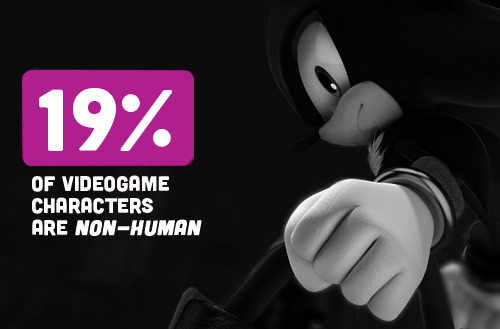
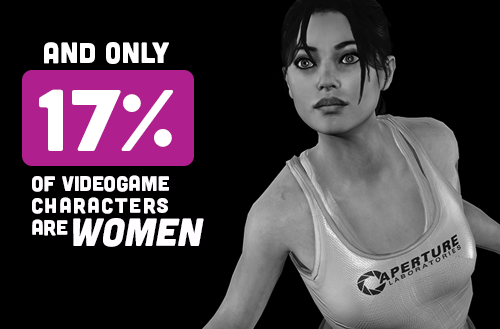
A study by Children Now and Dr. David Leonard of Washington State University this year that the images above reference showed that 17 percent of video games characters were female, 19 percent of characters were women and 64 percent of characters in video games were male. Even more distressing, the study found that found what little black women characters there were had a distressingly narrowed role: 90 percent of black female characters were either props, bystanders or victims. So with there being more non-human characters in video games than women characters in video games... how does that affect boys' views of women and what they can do? How does that affect girls' view of themselves? How many of the women characters are just motivation for the hero to start a quest, or a damsel in distress, or otherwise a periphery in a game?

As I've said often, representation matters. Two years ago, a study conducted by Commuunication Research showed that watching TV shows increased the self esteem of  white boys, but noticeably undercut the confidence and self esteem of girls no matter what the race.

One outlet that will be dedicated to tackling this issues is an upcoming podcast called The Smash Survey. The about page describes The Smash Survey as "... an upcoming podcast project that will critically explore the representation of race, gender, and queer identity in media and pop culture in a fun and engaging format. Through interviews, games, critiques, and panels TTS will try and answer the three primary questions of representation and media portrayals: Why are they the way they are, why are they wrong and what can we do to fix them?" You can follow the tumblr of the same name here.

What say you, readers?

Monday, August 4, 2014

Mattie Brice on Identity, Representation and Game Design

passing
Image via mattiebrice.com

Mattie Brice (who first came ot my attention when writing about the excellent "Depression Quest" by Zoe Quinn) has a great personal essay up about what she's been studying and considering about game design and identity entitled "Passing Through: Another Take On Identity In Activism & Design". An excerpt:
This past year, I've sat down with a lot of creators about representation in games. One of the first questions out of their mouth is “How do you depict minorities well in games?” Maybe it’s because this is usually over dinner, knife and fork in hand, that I want to reply with “Human?” Thinking of my grandmother who doesn't have a clearly identifiable race by American standards trying to explain herself to an official. ‘Human’ is loaded though; dominant identities are conflated with universal traits of humanity while minoritized people must be loud about their diverging qualities. Usually, I would fall back on trying to tap what is really human, and in turn, interrogate and separate what we assume is default about humanity and is really dominant culture... 
I've started to think of my grandmother’s story a little differently lately. I feel like there’s a more active, personal dynamic with identity than what we currently conceive. Contemporary activism has a strong slant towards self-identification, particularly within established minoritized groups. This makes sense; a person is who they say they are, and that needs to be respected. What does that say about my grandmother, who didn't have an answer for her race until she lived in America? Would she be outside today’s activism if she didn't explicitly label herself?
It's a thoughtful and engaging read, and I wholeheartedly encourage you to read the entire essay.


Share This Post