Showing posts with label character stories. Show all posts

Monday, June 26, 2017

Marvel vs. Limits of Diverse Representation

I've written before on the numerous times Marvel comics has tried and failed to grasp just how diversity works. Seriously, just search the marvel tag. However,  the example that sticks out for writer Paige Allen isn't Marvel's continuing mishandling of Captain America. Nor is it Marvel's VP of Sales blaming attempts at diverse casts of superheroes for hurting sales. According to Allen, the most egregious example is the writing of Marvel's Invincible Iron Man. Penned by Brian Michael Bendis, Invincible  that introduced the world to a new Iron Man – a young black teen by the name of Riri Williams. Writing for Geeks of Color, Allen points out that "...some fans were skeptical of Bendis writing the experiences of a young black girl, especially since Marvel had no black women writers on its staff when the series was first announced."

Bendis has also written also wrote about another black teen assuming the mantle of of Marvel franchise powerhouse-- Miles Morales as Spider-Man. Bendis has also talked about the research he's done as an author and the perspective that raising two of his adopted African-American children have given him. Allen points that while Bendis is able to write about the challenges and loss Riri Williams faces as a black girl, his knowledge is reflected in a very narrow focus of the Black experience:
Unfortunately, this knowledge is the overall problem Bendis has in his depiction of Riri Williams. He knows about black pain and the various micro- and macro- aggressions that black people face every day, especially during these particularly fraught times of racial hostility... Basically, Bendis is like your white classmate that took one Africana class and now believes himself to be the purveyor of all knowledge on black life. However, because he acquired his knowledge as an outsider to the culture, the only way he really knows how to depict blackness is through identifiable aspects of The Struggle – all the negative social realities of being black that you see reported on TV, lambasted on Twitter, and through quickly cruising through activist circles in search of easily transferable knowledge about racism without any nuanced understanding of how black people deal with it.

This came to a head when scans from a page of Invincible Iron Man #8 appeared online recently, where it shows Williams in class trying to actively seek out marginalization as a motivator.

Allen reflected:
Never in my wildest nightmares would I imagine a black child seeking out racism to fight against in the pursuit of their dreams. Racism isn’t a Sailor Moon villain that waits for us to level up before trying to kick our ass; we are always aware of it and are always affected by it, but one of the best traits that black people have is our ability to bypass that negativity and live our lives despite it, not to specifically spite it.
This isn't the first time Bendis' writing for a black character has been criticized. The Nerdist pointed out that Bendis and other white writers writing characters of color often come off as tone-deaf and run the risk of alienating the very fans they want to recruit.

As I wrote in an earlier post, the real key is to actually hire diverse creators to write diverse casts. Otherwise we're just slapping a Band-Aid on the issue:
Looking at a diversity initiative as the beginning and end of what's needed to help improve the state of comics is short-sighted and wrong-headed. Instead of just having the same white men tell stories with some characters of color here and there, there should be structure in place for minority writers and artists and creators to tell the stories they want to a mainstream audience. Diversity as the final and only goal is a hollow act that does nothing but reinforce whiteness and the status quo as the default. That's not the world we live in, so why should worlds we get to make up have to be that way? Free your mind, and the audience will follow.

Tuesday, May 30, 2017

Hollywood Still Way Behind LGBT & Racial Representation

Description: Screenshot from GLAAD study that reads: Transgender
representation was merely one character in "Zoolander 2". The
character, played by Bennedict Cumberbatch, was used as the punchline
to a joke.
Two years ago, GLAAD released a video titled "Hollywood Must Do Better" that  was basically a supercut of the most egregious anti-LGBT moments from major Hollywood films from the past few years. It was a companion piece to studies the group releases every year that rate major Hollywood films on a "social responsibility index" that looks at the representation of racial minorities as well as LGBT characters. "Moonlight" won an Oscar this year, so that must mean things are pretty great now, right?

Wrong. As this year's study shows, Hollywood is still way behind when it comes represention people that aren't white, straight, or male. in a study of 125 major film releases from major film studios, only 23 films included LGBT-identifying characters. That's just 18 percent.

Of those 22 films, 19 had a gay male character. Lesbian characters went from 23% in 2015 to 35% in 2016. 3 films had a bi character. Transgender representation in major Hollywood films last here clocked in at exactly one: a character played by a cis male actor as the butt of a transphobic joke.

Racial diversity in onscreen characters declined as well. From the LGBT characters of the last year, 48 of them were white (69%), nine were Black/African American (13%), four were Asian/Pacific Islander (6%) and one character was Latinx. Eight LGBT characters were identified as non-human.

The study also outlines a great thumbnail guide in looking at LGBT characters in films called the Vito Russo Test. A  film passes the Vito Russo test if:


  • The film contains a character that is identifiably lesbian, gay, bisexual, and/or transgender.
  • That character must not be solely or predominantly defined by their sexual orientation or gender identity (i.e. they are comprised of the same sort of unique character traits commonly used to differentiate straight/non-transgender characters from one another).
  • The LGBT character must be tied into the plot in such a way that their removal would have a significant effect, meaning they are not there to simply provide colorful commentary, paint urban authenticity, or (perhaps most commonly) set up a punchline. The character must matter.
Similar to the Bechdel Test, it's a fairly low bar to clear. Sadly, even the above reasonable standards aren't met by most films. As the study says:

Only 8 of the 22 (36%) inclusive major studio films passed the Vito Russo Test this year, the lowest percent­age in this study’s history, compared to 11 of 20 (55%) inclusive films released in 2014, 7 of 17 (41%) in 2013, and 6 out of 14 (43%) inclusive films released in 2012. This is a significant drop from the previous year when just over half of the inclusive films passed. There is clearly much room for industry improvement. More films need to include substantial LGBT characters that pass this simple test.


Thursday, January 21, 2016

Where's Rey? Dark Side of Marketing Forces Heroine Out

Left: Screenshot of Rey from Star Wars the Force Awakens. Right, a letter from 8 year old Annie Rose that reads "Dear Hasbro, How could you leave out Rey!? She belongs in Star Wars Monopoly and all the other Star Wars games! Without her, THERE IS NO FORCE AWAKENS! It awakens in her. And without her, the bad guys would have won! Besides, boys and gorls need to see women ca be as strong as men. Boys or girls, who cares? We are equal, all of us!" letter courtesy of Carrie M Goldman.
Star Wars: The Force Awakes looks to shatter box office records. It's brought in an estimated 1.5 billion dollars in box office sales so far. Rey is the heroine of the story, which is why it's been downright weird to see her missing from so much of the official merchandise Hasbro has been releasing. For example, on Hasbro's Star Wars Monopoly set, there were two characters from the main Star Wars series as game peices: Luke Skywalker and Darth Vader. There were two characters from The Force Awakens: Kylo Ren and Finn. So, representing the classic and modern Star Wars? All men.

The “Battle Action Millennium Falcon” playset tie-in to The Force Awakens has Finn, Chewbacca, and BB-8-- but not Rey even though in the film she is the actual ship's pilot! And while Hasbro released a statement apologizing for leaving her out of the board game release and promising to include her in future releases, most official merchandise for Rey is still exceedingly difficult to find, and what does exist is rather thin on the ground. This has lead to the hashtag #wheresrey as fans and parents have taken to social media to talk about this representation.

According to an insider source with Lucasfilm marketing, Rey's lack of visibility in merchandise was not just some sort of accidental oversight. In an article on pop-culture blog Sweatpants and Coffee, this marketing insider said this was done deliberately:
In January 2015, a number of toy and merchandise vendors descended on Lucasfilm’s Letterman Center in San Francisco. In a series of confidential meetings, the vendors presented their product ideas to tie in with the highly-anticipated new Star Wars film. Representatives presented, pitched, discussed, and agreed upon prototype products. The seeds of the controversies Lucasfilm is facing regarding the marketing and merchandising of The Force Awakens were sown in those meetings, according to the industry insider.
The insider, who was at those meetings, described how initial versions of many of the products presented to Lucasfilm featured Rey prominently. At first, discussions were positive, but as the meetings wore on, one or more individuals raised concerns about the presence of female characters in the Star Wars products. Eventually, the product vendors were specifically directed to exclude the Rey character from all Star Wars-related merchandise, said the insider.
“We know what sells,” the industry insider was told. “No boy wants to be given a product with a female character on it.”
It sounds like a bit of a self-fulfilling, doesn't it? Marketing decision-makers say female characters don't sell, so they exclude them from merchandise. They then use this as evidence that female characters don't sell, and use it to justify excluding them from merchandise in the future. Not only did marketing execs seem to be caught completely by surprise, but according to the article, they seem stymied by the fact that real life wasn't adhering to the narrative they'd created:
“I’ve spoken with Disney people, and they were completely blindsided by the reaction to the new Star Wars characters,” Marcotte went on to say. “They put a huge investment into marketing and merchandizing the Kylo Ren character. They presumed he would be the big breakout role from the film. They were completely surprised when it was Rey everyone identified with and wanted to see more of. Now they’re stuck with vast amounts of Kylo Ren product that is not moving, and a tidal wave of complaints about a lack of Rey items.”
How about your thoughts, readers? Is this sort of aggressively gendered marketing something that's going to fall by the wayside, or will marketers dig in their heels even more?

Wednesday, August 5, 2015

NK Jemisin On Fantasy Worlds & Status Quo

Cover for the collection "The Inheritance
Trilogy" by N.K. Jemisin
There was a great interview in The Guardian last week with one of my favorite fantasy writers-- N. K. Jemisin. I first heard of her during the whole racefail 09 debacle. But she didn't just rest on her laurels. She's not just been continuing to write novels and novellas, but also working with other POC to confront racism and sexism in the industry head on.

In part of the interview she talks about how so much of epic fantasy and science fiction seems to end up reinforce a lot of industry and genre status quo in particular as well as the status quo for viewpoints and stories told in general. She puts forth the idea that not only is that contrary to the nature of fantasy, it is contrary to who she is as an author, and person, and why she seeks to challenge and change with her writing:
 “As a black woman, I have no particular interest in maintaining the status quo. Why would I? The status quo is harmful, the status quo is significantly racist and sexist and a whole bunch of other things that I think need to change. With epic fantasy there is a tendency for it to be quintessentially conservative, in that its job is to restore what is perceived to be out of whack... I hear all the excuses: things were just like that back then. There really were 90% men in medieval Europe and they were all white and somehow they magically got silk from East Asia and we don’t know how that happened... But that makes no sense to me. I don’t really understand why so many fantasy writers choose to focus on worlds that just seem strangely denuded. But to them I guess it doesn’t seem strange. And I guess that’s their privilege. It isn’t mine.” 
For some concrete examples, of Nemisin's work, the collection pictured aboce, is an amazing series of stories, with action and intrigue, alliances and betrayals set in a far-future fantasy Egypt-like kingdom. It was nominated for, and won a pile of awards, and rightly so!  If you'd like to get a good idea of what her writing style is like for free, you can read her story "Non-Zero Probability" here. It;s available in both text and audio versions.

Thursday, July 30, 2015

This Cute Hedgehog May Change Movies & Virtual Reality

Description: A cartoon illustration of Henry, a hedgehog, looking
at the  viewer, smiling and waving hello.
 Henry is the star of a self-titled animated short. It's about a hedgehog who likes to hug that feels lonely on his birthday. He makes a wish for friends to celebrate with... which is when a little birthday magic  grants his wish... in the form of baloon animal friends, which is a little difficult for a hedghog to hug. The short is an original story created by former Pixar animator Ramiro Lopez Dau, who is also the director of the animated short. He is joined by fellow former Pixar artist Bernhard Haux and a former Dreamworks production designer Kendal Cronkhite who halped the director and animation crew develop the signature  look and feel of the project. Sounds like a cute, promising animated film, right? Henry isn't just a short-- it's an animation experience because it's also an interactive virtual reality. Take a look at the sneak peek below:


Sure, the team could have gone with something more action packed or gritty or science fictionish or, well, game-like, since this short will ship for free with the rollout of the virtual reality Occulus Rift system to consumers. In a WIRED featured article entitled "The Most Important Movie of 2015 Is a VR Cartoon About a Hedgehog" (seriously), the team explains that they wanted to give the experience an emotional connection, too:
It wasn’t just that Story Studio needed Unreal to do something it wasn’t made for. They also wanted to do things that had never been done in movies, period: they want Henry to look you in the eye, no matter where you are in his virtual world. At its core, Henry is a simple story... There are emotional ups and downs, and when Henry experiences a certain feeling, he looks at the viewer to share his sadness or excitement. This is an incredibly rare thing. It’s also unnerving; the first time I tried an early demo, I immediately felt like a voyeur, as if I was spying on this poor hedgehog during his sad solo birthday. But in VR, the whole point is that you’re meant to feel as though you’re physically there ... it’s weird if Henry doesn’t [notice]. “It’s just like ‘Why don’t you look at me? I’m right here!'” Unseld laughs. But when he does it carries an emotional connection, an empathy, that even those abused action figures in Toy Story 3 didn’t quite muster. 
You can read the whole article here and read more about Henry here.

Monday, June 1, 2015

Super Hair-io: How Hair Defines Video Game Characters

Photo illustration via The AV Club
There's a lot that goes into character design, from artist's concept sketches to emulation of hardware limitations.  The Onion's sister site, The A.V. Club, has an occasional feature that analyzes various ideas behind representations of the body in video games. The latest entry in this series takes a look at an essential aspect of character design that you might not have even noticed before: hair!
Without hair, Mario’s nose and ear completely disappear, congealing his entire face into a beat-up wad of Silly Putty. His appearance becomes harsh and unappealing. Perhaps some minor indications of his mouth would have been added, but the beautiful thing about that mustache was that he didn’t need a mouth; we just knew it was there. Without the sideburns and mustache, this is just a chubby guy—no charm, no flare. Add the mustache, and you can practically hear his cartoonish Italian accent ordering a pizza pie. Mario’s hair didn’t just soften him, it made him affable.
The article also examines how hair affects the character design of the Final Fantasy series, Mega Man and Bayonetta. Give it a read!

Friday, August 8, 2014

Where Are The Women Video Characters?


Over 90 percent of kids play video games regularly, according to the most recent study from the NPD group. And according to the ESRB, over 65 percent of US households own at least one video game console.

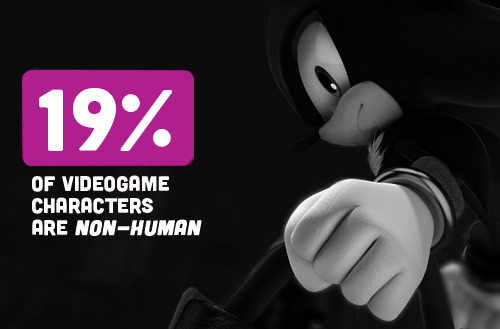
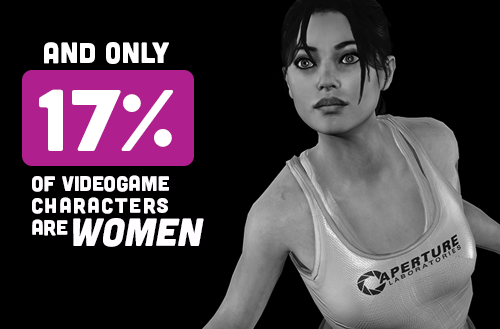
A study by Children Now and Dr. David Leonard of Washington State University this year that the images above reference showed that 17 percent of video games characters were female, 19 percent of characters were women and 64 percent of characters in video games were male. Even more distressing, the study found that found what little black women characters there were had a distressingly narrowed role: 90 percent of black female characters were either props, bystanders or victims. So with there being more non-human characters in video games than women characters in video games... how does that affect boys' views of women and what they can do? How does that affect girls' view of themselves? How many of the women characters are just motivation for the hero to start a quest, or a damsel in distress, or otherwise a periphery in a game?

As I've said often, representation matters. Two years ago, a study conducted by Commuunication Research showed that watching TV shows increased the self esteem of  white boys, but noticeably undercut the confidence and self esteem of girls no matter what the race.

One outlet that will be dedicated to tackling this issues is an upcoming podcast called The Smash Survey. The about page describes The Smash Survey as "... an upcoming podcast project that will critically explore the representation of race, gender, and queer identity in media and pop culture in a fun and engaging format. Through interviews, games, critiques, and panels TTS will try and answer the three primary questions of representation and media portrayals: Why are they the way they are, why are they wrong and what can we do to fix them?" You can follow the tumblr of the same name here.

What say you, readers?

Monday, August 4, 2014

Mattie Brice on Identity, Representation and Game Design

passing
Image via mattiebrice.com

Mattie Brice (who first came ot my attention when writing about the excellent "Depression Quest" by Zoe Quinn) has a great personal essay up about what she's been studying and considering about game design and identity entitled "Passing Through: Another Take On Identity In Activism & Design". An excerpt:
This past year, I've sat down with a lot of creators about representation in games. One of the first questions out of their mouth is “How do you depict minorities well in games?” Maybe it’s because this is usually over dinner, knife and fork in hand, that I want to reply with “Human?” Thinking of my grandmother who doesn't have a clearly identifiable race by American standards trying to explain herself to an official. ‘Human’ is loaded though; dominant identities are conflated with universal traits of humanity while minoritized people must be loud about their diverging qualities. Usually, I would fall back on trying to tap what is really human, and in turn, interrogate and separate what we assume is default about humanity and is really dominant culture... 
I've started to think of my grandmother’s story a little differently lately. I feel like there’s a more active, personal dynamic with identity than what we currently conceive. Contemporary activism has a strong slant towards self-identification, particularly within established minoritized groups. This makes sense; a person is who they say they are, and that needs to be respected. What does that say about my grandmother, who didn't have an answer for her race until she lived in America? Would she be outside today’s activism if she didn't explicitly label herself?
It's a thoughtful and engaging read, and I wholeheartedly encourage you to read the entire essay.


Wednesday, July 23, 2014

Not Just A Character Quiz... But a Character Adventure

Image via sharksden.deviantart.com
You might be forgiven for thinking this is like those uncounted number of buzzfeed personality tests passed around Facebook, tumblr, or the like, but The Fantasy RPG Character Class is a little more involved.

For starters, it offers about one hundred different possible character class results. How does this test manage that, you might ask? Well in addition to the standard fantasy-flavored personality questions, you can also go on an optional 4 part adventure that has some twists and turns, depending on your previously chosen answers.

You can take the test here! Feel free to share what you got in the comments.

Tuesday, July 22, 2014

Dungeons & Dragons Has Influenced A Generation of Writers & How It Helps Kids Today

Artwork courtesy of James Howe.
From a recent New York Times article:
For a new generation of writers, especially those raised in the 1970s and ’80s, all that time spent in basements has paid off. Dungeons and Dragons helped jump-start their creative lives. 
When he was an immigrant boy growing up in New Jersey, the writer Junot Díaz said he felt marginalized. But that feeling was dispelled somewhat in 1981 when he was in sixth grade. He and his buddies, adventuring pals with roots in distant realms — Egypt, Ireland, Cuba and the Dominican Republic — became “totally sucked in,” he said, by a “completely radical concept: role-playing,” in the form of Dungeons & Dragons.
When you think about it, it's not really too surprising. Speaking personally, while D&D offered an escape from an abusive home life, coming up with character back-stories that fit within an adventuring party was my first taste of collaborative storytelling. There are a lot of skills you can learning playing D&D-  collaborative problem solving, team building, working in groups, spatial awareness, multiplication, plus all of the creative things involved with running or taking part in a campaign, like character and world building.

And the current generation of D&D players are finding ways to use D&D to not just instill a love of the game in kids, but also teach children development skills. One author has even come up with a version for pre-preschoolers!

Laura Petelle has released a free game called Monster Dice Fight, a proto-D&D game for preschoolers that also teaches Early Learning Standards skills. As she describes it:
My husband was eager for our sons to get big enough to play D&D with him, and I suggested they were big enough now -- if we adjusted the game. I had recently been in early learning standard presentations, so that was on my mind as well... Parents can adjust the game in a variety of ways to help their children with specific developmental tasks, and can at the same time create appropriate challenges within the game for children of different ages.
If the kids are a little older and you want to introduce them to D&D, collaborative storytelling and some of the game mechanics, artist Jason Howe has you covered with "D&D For 8 Year Olds". As he explains it:
For my son's 8th birthday party he convinced me to run Dungeons and Dragons for four 2nd graders... I decided to take actual characters made in the DND Insider and simplify them us that the boys could have fun without much of a learning curve. Here are the six characters I made from scratch for the game. I am happy to report it was a huge success, each boy had a fantastic time... and so did I. I would happily do it again.
Howe didn't leave girls out, either, and created a number of boy and girl character sheets in full color, all ready to print out and personalize, which you can check out here.

Thursday, December 2, 2010

Retro Repost: 6 Best Video Game Characters of the Decade

Note: This article was originally published as part of my time as an Associated Content Featured Contributor to the Video Games Section. Associated Content was later bought by Yahoo! and renamed Yahoo! Voices. Yahoo Voices shut down in July of 2014. This article is being republished here on The Code, backdated to its original date of publication to remain as a record of my writing.

For all the progress video games have made in the past two decades as a both a vehicle of entertainment and as a vehicle of creative expression, the dearth of strong, independent female characters has been a shame. 

 Traditionally, female characters have been little more than eye-candy or adolescent fantasies for the assumed male demographic of games. The past ten years have shown an increase in the number of women as protagonists and supporting characters, developed as complex and intriguing characters in their own right. Here are six of the most well-developed women in video games that the past ten years have brought us.

6. Bonnie McFarlane 
Game: Red Dead Redemption

Equals turns caring and uncompromising, Bonnie McFarlane is an intriguing figure in the world of Red Dead Redemption. While she does help Marston, the main character, back to health, she also insists that he pay back doctor fees as he heals. This leads to her teaching Marston (and the player) the basics of how the game works. While Bonnie and Marston do become close and develop a relationship, is it that of mentor and friend. She doesn't fall into the role or damsel in distress, nor does she become the swooning love interest to the main character. She is firm but fair in helping Marston get back on his feet, and remains a witty, active presence throughout the entire game. She's worked hard as the daughter of a rancher, and both her demeanor and actions throughout the game make Bonnie a strong presence in Marston's quest for justice and redemption.

5. Lightning 
Game: Final Fantasy XIII
Lightning is the lead character of Final Fantasy XIII. Unlike the gravity-defying physique of Lara Croft or the campy dominatrix fashion of Bayonetta, Lightning favors a dark turtleneck 
 covered with a leather coat. In both action and dress, Lightning is designed to look powerful not to titillate. According to Motomu Toriyama, the director of Final Fantasy XIII, "In the past Final Fantasy titles, female characters in the leading role have traditionally been very... girl-you-want-to-protect... For Final Fantasy XIII, Lightning is not only beautiful, but she's very strong. She has this independence. In battle, she's very graceful in her movements, but she's very powerful and she's very speedy." Lightning also uses her training as a soldier to keep her cool in emergencies, and when the world seems to be falling down around her comrades, she is often the one who keeps a level head, calmly doing what needs to done.

4. Elena Fischer 
Game: Uncharted (Series)

Elena Fischer is a brave and fiercely independent reporter who has crossed paths with the Uncharted series' hero Nathan Drake several times. She dresses practically for the wilderness and jungle settings of the games. She is intelligent, amusing, witty, and not afraid to place her own life in danger if it will mean doing the right thing. She is so committed to doing the right thing that she will not hesitate to call out Nathan whenever he places his own selfish desires above his own morals. As the relationship between her and Nathan develops and deepens over the course of the series, nothing seems forced. She is every bit Nathan's equal and not afraid to take risks of her own.

3. The Boss 
Game: Metal Gear Solid 3


Solid Snake might be considered the embodiment of the Metal Gear series, but The Boss is the series' heart and soul, the foundation on which the entire series is built. In the Metal Gear universe, The Boss founded the US Special Forces, led Allied forces on D-Day, and gave birth on the battlefield after being shot, and develops the Close Quarters Combat System. And this is all before Metal Gear Solid 3 even starts! Once Metal Gear Solid 3 begins, she has been the combat mentor and comrade of the lead character, Naked Snake, for years. The Boss is in her mid-forties, and is still muscular with combat reflexes still sharp; she manages to single-handedly disarm, counter attack and defeat Naked Snake in a confrontation.

But the Boss isn't just strong because she can kick butt-- she is a patriot so devoted to her cause that she is willing to sacrifice her reputation by seemingly betraying her country even though she was really going deep undercover. To help a cold-war era US not be lead into a diplomatic incident or nuclear war, she was willing to become a scapegoat. When Snake and The Boss meet for a climactic final battle, although Snake emerges the winner, the true victor is The Boss because of the self sacrifice she makes for the greater good. Naked Snake is awarded the codename of "Big Boss" as the military way of declaring him to have surpassed The Boss, but Snake (and the player) know the truth that the rest of the world never will: The Boss is the game's real hero.

2. Alyx Vance 
Game: Half-Life 2

Alyx Vance is a supporting character in the Half Life 2 episodes that doesn't fall prey to the love interest or "she's powerful because she can blow things up" cliches. While she is a supporting character to Gordon freeman, Alyx is independent, strong, and powerful without it being the core of her characterization. She also has a wry sense of humor, rarely passing up the chance to crack jokes about the situations she and Gordon face along the way, whether it's a witty one liner or even imitating a zombie to break the tension. While she is at home toting a pistol or shotgun, Alyx is also a skilled hacker. She uses those talents to disable security systems, open up locked doors and even reprogram mines and turrets to attack the Combine, turning the invader's weapons against them.

Alyx is Half-Life 2's emotional center. She is nuanced and well-written, putting a human face to what would otherwise be seen as yet another grim and gritty post-apocalyptic science fiction game. She grows as a character and a person, eventually becoming a key figure in the resistance against the Combine.

1. Jade 
Game: Beyond Good & Evil


Jade is an unconventional heroine in an under-appreciated Playstation 2 game. While many video game protagonists search for power, wealth, dominance or some nebulously-defined sense of justice, Jade's motivation is more nuanced. She wants to expose the truth about a corrupt government and protect a children's orphanage. While she is agile and capable in hand to hand combat, beating faceless enemies down won't help her accomplish her goals, so she uses her greatest weapon: photojournalism.


In Beyond Good and Evil, Jade stealthily infiltrates factories, stockyards and even military bases, snapping pictures of the atrocities and crimes committed. She risks her life time and again to document the truth and spread the word to the public at large. Jade shows strength by supporting those she cares about, refusing to back down even when it means her life is threatened, all for her quest to reveal the truth. A nuanced, complex characterization by both the writing team and her voice actor, Jodi Forrest elevate the game Beyond Good and Evil from an average stealth game into a sleeper hit. Demand for the game's re-relase has been so high, in fact the a high definition re-release is slated for the Playstation Network and Xbox Live Arcade next year.


Monday, June 7, 2010

Signal boost: Your Money Where Your Mouth Is Edition

From Nick Mahatmas' blog:

"I noticed that the Readercon programming schedule is up and that there is to be a panel on racial diversity and cover art. Further [info]james_nicoll has collected a couple of links about the malaise in science fiction—either there is no science, or the science is just a magical Singularity of nanotech and bad manners and rudeness toward sexbots or something.

To all of which I can only respond:


The Next Continent


I mean, the people who complain about whitewashed covers are going to be interested in books with accurate covers, are they not? The readers hmmphing about the lack of realistic hard science are surely going to be interested in a novel about a private mission to the moon, neh? So I can Bookscan my title here every week and see the regional buying patterns change based on the publicly announced pent-up demand for both near-term hard SF and stuff that's reflective of the ethnic diversity of the planet in some way, yah?

Because I'm gonna start tracking you all. "

Saturday, May 24, 2008

Scenes From a D&D Barbarian Campaign

So, my character, Par Vaartal The Dark, is a barbarian originally from the frozen north. The current campaign has the group of barbarian PCs plucked from around the world and dumped in a strange, almost tropical forest and plains. So, in addition to initial communication difficulties, there is also the geographical unfamiliarities.

Michelle's character, Dru, is a fierce warrior as well. The group was just jumped by a horde of Kobolds, and through a hard-fought battle, use of the death's door rule (where if you're healed quickly enough after your hit points drop below zero, you don't die), and our groups SOLE shaman healer, Par Vaartal is taken from near death to a whopping 3 hit points.

Dru wants to help. She is not a healer. She knows just enough to realize that the healer can't make another healing check unless there is a fresh wound to be healed. Dru approaches Par, and says "Do you trust me?"

Par nos, "Yes, of course!"

... only to be poked by Dru a second later with her dagger; after all, if she can make a tiny wound, then the healer can heal that, and perhaps gain Par a few more HP...

... and ends up doing maximum damage with her dagger: 4 points. PLUS her strength bonus.

So, of course, Par was a little leery of her when ever he saw her dagger.

In another irony, the healer used the last of her healing herbs.... and brought Par Vaartal back up to positive hit points.

TWO hit points total. So it was a net loss. ;)

But also one of the funniest moments in any campaign.

Share This Post